Labels

Showing posts with label creativity. Show all posts

Thursday, September 4, 2025

CSM: Cooking videos got these Gazans a global following. Now, there’s nothing to eat.... “This famine is entirely man-made [BY ISRAELI BLOCKADE]"

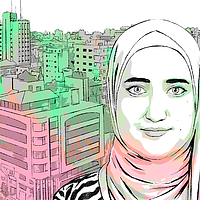
Renad Attallah by a clay oven in Gaza where she cooked when there was food- her Instagram account has more than 1.6 million followers.

For more than a year, Renad Attallah’s Instagram cooking tutorials offered an unusual window into life in the Gaza Strip.

On @renadfromgaza, the giggly 11-year-old explained to her 1.6 million followers how to cook hamburgers with canned meat from an aid parcel. In another video, she quipped at the drones buzzing overhead as she explained how to make a banana roll “the Gazan way.”

“It looks like the drone above us likes cream – that’s why it’s out!” she joked. As basic ingredients became increasingly scarce in Gaza, Renad improvised, mashing cooked pasta to make bread.

Why We Wrote This

Their Instagram accounts became globally popular for showing the creative ways Palestinians in Gaza cooked and ate in a time of war. But as hunger spread, the story they were sharing began to change.

But Renad’s popularity isn’t due only to her made-for-social-media cuteness. With foreign media excluded from Gaza, and local journalists regularly killed in the line of duty, social media has become one of the few windows still cracked open onto life in the besieged territory. Through the eyes of Renad and other content creators, the conflict’s devastating effects on civilians play out in real time.

“It’s not about views. It’s not about comments,” Renad says. “It’s about the truth of our lives.”

“The Gazan way”

And the truth now is that Palestinians in Gaza are starving. In late August, United Nations agencies warned that close to 100% of people in Gaza are facing a hunger crisis, and 1 in 3 will experience famine – meaning “catastrophic conditions characterized by starvation, destitution and death” – by the end of September.

“This famine is entirely man-made,” the U.N.-backed report said.... READ MORE https://www.csmonitor.com/World/Middle-East/2025/0902/renadingaza-hamadashoo-instagram-gaza-famine-hunger

 AS ALWAYS PLEASE GO TO THE LINK TO READ GOOD ARTICLES (or quotes) IN FULL: HELP SHAPE ALGORITHMS (and conversations) THAT EMPOWER DECENCY, DIGNITY, JUSTICE & PEACE... and hopefully Palestine, or at least fair and just laws and policies]

Monday, February 24, 2025

Mo Amer - “Mo," Honoring Palestine & Absurdities of the U.S. Immigration...

Feb 3, 2025: Mo Amer, a writer, stand-up comedian, and co-creator and star of “Mo,” sits down with Jon Stewart to discuss the second season of his Peabody Award-winning Netflix series, inspired by his own refugee experience. They discuss how the series explores the complexities of statelessness and asylum, the absurdities of the immigration process, and how he leaned on Jon for support while figuring out whether to talk about Oct. 7 on his show. #DailyShow #JonStewart #MoAmer

Thursday, November 17, 2022

A couple (زوج), mud on wood, 1989 by Sliman Mansour #FreePalestine

A couple (زوج), mud on wood, 1989 by Sliman Mansour

A couple (زوج), mud on wood, 1989 by Sliman Mansour
.
"During the first Intifada (1987 – 1993), Palestinians boycotted Israeli goods as a form of resistance. Artists in their turn boycotted Israeli art supplies. Four Palestinian artists Vera Tamari, Nabil Anani, Tayseer Barakat and myself formed a group and called it the “New Visions” group. Artists turned towards their environment and used materials such as wood, leather, mud, henna, natural dies and found objects. This new approach helped to develop Palestinian art and formed a link between Palestinian art produced for several decades after Alnakbah and the contemporary art produced by young Palestinian artists." Sliman Mansour  

Saturday, October 12, 2013

"So let us put the narrative of injustice away and find the joy, if it’s the last thing we ever do. " Tala Abu Rahmeh, Palestinian poet and writer

Wadi Qelt, Jericho. Photo by Ramzi Hazboun.
 [AS ALWAYS PLEASE GO TO THE LINK TO READ GOOD ARTICLES IN FULL: HELP SHAPE ALGORITHMS (and conversations) THAT EMPOWER DECENCY, DIGNITY, JUSTICE & PEACE... and hopefully Palestine]
http://www.thisweekinpalestine.com/details.php?id=4116&ed=223&edid=223

Contemporary Palestinian Literature In Search of Joy
By Tala Abu Rahmeh
 
“…there is no rain
anywhere, soft
enough for you.” Michael S. Harper


I used to have this recurring dream that I was wearing a red dress and walking down the steps to a jazz parlour in Harlem. It would take me a second to see through the smoke but then I would see him, John Coltrane, holding the saxophone and taunting gods with Naima. He would sway and I would wake up to the realisation that he’s been dead a while, and I no longer knew what my story was.

I always thought I knew what I would write about. My life has been cluttered with images of bombs and the small details of debris. I knew how to construct the perfect phrase about the exact sound of a shell escaping the tank and landing in the middle of my heart. The geography of my first book had the thick lines of the Apartheid Wall and the graves of all my grandparents, dead on the way and in exile.

Then, as destiny willed it, my mother died from cancer. As I tried to hold myself through grief it hit me, what if Palestine is no longer my story? What if this loud whimper matters more than all the other big bangs? I was slowly losing footing into my poems that suddenly became all about morphine and infested limbs.

Through my exploratory journey into modern Palestinian literature, I found myself to be an ever-found alien. The Pessoptimist by Emile Habibi defined my loneliness, Men in the Sun by Ghassan Kanafani unravelled a multi-faceted anger, and Madih Adh-Dhill Al-‘Ali by Mahmoud Darwish dusted the pieces of all that was broken in me and forced me to look at them, one by one. Nevertheless, I was still an alien. My pain over the loss of my mother had never transformed into a metaphor for a lost country. As much as I tried to reshape it, it still nudged me awake in one simple statement, “Your mother is dead.”

What is it about this country that made us feel guilty for being our particular selves? Why is it that in the past 60 years we have only accepted literature that held together the collective narrative, but never our own? Our modern history is built on singular stories of lost children and destroyed villages, so why do we matter less today? In the past 15 years, authors have tried to drag their details into the bigger picture, but even those novels were mostly written in English, with the Westerner being the target audience. Even this article is written in English (obviously).

Is it the Palestinian literary scene or the reader that needs an overhaul? I’m thinking both. You might wonder who I am to think that I can gather years of Palestinian literature and relay a statement, and you might be right to ask if it weren’t for the simple fact that I have not read one Palestinian book written during the past period that ignited the fire of my soul. Well, maybe I’m expecting too many particularities, but why is it that it’s easier for me to relate to a writer in Kansas that it is to one in the West Bank?

The stark reality is that we are hungry for personal stories, but not when they are written as part of our wider notion of representation. When the story is printed for the public to read, we always need it to look, feel, and sound a certain way, even if that obliterates it. Palestinian writers are always daunted by the potential of straying from their national identity, whatever that may mean. Every time I read a new Palestinian book, I feel the struggle to try to prove a commitment to the “cause” in the veins of the pages.

The individual, especially in the complex layers of literature, does not erase the collective, nor does it threaten the struggle for freedom. Moreover, it is not a selfish concept, simply because our entire existence is an individual endeavour. At the end of each day we are alone, and if that story is not worth telling, nothing is.

Maybe my contemporary argument is that we have lost our capacity for joy. The first time I had this epiphany was when I looked at a portrait taken of all the major jazz and blues artists in Harlem in 1958. During that time, Harlem was barely pulling through under the weight of oppression and brutality, and yet, those beautiful men and women stood around and took a picture that contained one thing more than any other, pure joy. Maybe it was because it was a good day, or maybe because each one of them played their instruments with such individuality that it helped them wade through that water.

Joy in Palestine is a modernist idea that we do not buy. Dancing at weddings or right through a checkpoint might make us happy, but happiness is fleeting, whereas joy is there to stay. Joy is not communal, but incredibly specific. It is the feeling of wonderment over what we are able to create with pens, hands, vocal chords, fingers, and minds. It is the quiet corner in our spirit that, when found, can never be lost or taken away. So let us put the narrative of injustice away and find the joy, if it’s the last thing we ever do.  


Tala Abu Rahmeh is a Ramallah-based young writer and professor of literature and creative writing. She holds an MFA in poetry from American University in Washington, DC. She is a regular contributor to Mashallah News Magazine, and her poems have been published in a number of magazines and books. She is also the cofounder of the blog The Big Olive: the Tales of Two Professors in Palestine, http://thebigolive.tumblr.com/. Tala can be reached at tala.ar@gmail.com.


***


 Palestinian poet and writer
Originally from Yaffa, she was born in Amman in 1984.  
After moving to Ramallah, living through the second intifada,
 and graduating from Birzeit University, Tala moved to Washington
DC to study for a Masters of Fine Arts at American University.

Tala's work has earned recognition from Palestine to the US and she
has received the Eliav-Sirtawi Middle East Journalism Award and the 
Expressions of Nakba Competition 2008 Best Written Work Award. 
She will also be featured in the upcoming anthology 25 under 25, which is edited by 
Naomi Shihab Nye, and published by HarperCollins.

She has been a featured performer at the American Poetry Museum, Black Church Maraca, the Peace 

Mural, Katzen Arts Center at American University, and readings ranging from Mahmoud Darwish 
commemorations to Gaza events.

She is currently working on her first book poetry

Monday, February 25, 2013

In the West Bank village whose struggle to regain land taken by Israel was portrayed in an Oscar-nominated documentary, activists huddled around a campfire before dawn Monday to watch the ceremony.

Palestinians worm themselves as they watch the Oscar ceremony in the West Bank village of Bilin near Ramallah, Monday, Feb. 25, 2013. Bilin's struggle to regain land taken by Israel was portrayed in an Oscar-nominated documentary "5 Broken Cameras". The village has been the scene of weekly protests against the barrier, which were documented in the film. Palestinians charge that the barrier, which cuts into the West Bank, is a land grab. Israel says it's needed to keep Palestinian attackers out. (AP Photo/Majdi Mohammed)
[AS ALWAYS PLEASE GO TO THE LINK TO READ GOOD ARTICLES IN FULL: HELP SHAPE ALGORITHMS (and conversations) THAT EMPOWER DECENCY, DIGNITY, JUSTICE & PEACE... and hopefully Palestine]

http://hosted.ap.org/dynamic/stories/M/ML_PALESTINIANS_OSCAR?SITE=AP&SECTION=HOME&TEMPLATE=DEFAULT&CTIME=2013-02-25-07-55-10
West Bank villagers view Oscars at night, outdoors

BILIN, West Bank (AP) -- This wasn't your typical Oscar viewing party.

In the West Bank village whose struggle to regain land taken by Israel was portrayed in an Oscar-nominated documentary, activists huddled around a campfire before dawn Monday to watch the ceremony.

For added symbolism, they pinned the screen to a tent just meters (yards) away from Israel's West Bank separation barrier, which cut off the village of Bilin from much of its land....READ MORE

Saturday, January 19, 2013

Palestinian passengers will be more tempted to read books after a new reading campaign is launched next week. A group of young writers are gathering books to put in mini-vans linking major cities in the West Bank, routes that can waste hours.

 http://www.themedialine.org/news/news_detail.asp?NewsID=36916
Library on the Move Written by Diana Atallah
Published Monday, January 14, 2013


Get In the Taxi, Pick Up a Book
Ramallah - Palestinian passengers will be more tempted to read books after a new reading campaign is launched next week. A group of young writers are gathering books to put in mini-vans linking major cities in the West Bank, routes that can waste hours.
Wiam Karyouti, a sales employee and a young writer, first thought of the campaign when a passenger next to him asked him if he had another book for him to read. “I usually read in the taxi and carry books with me. I handed him a novel and he gave it back to me at the end of the ride saying he would go buy it,” Karyouti told The Media Line.
The incident triggered Karyouti to think of ways to encourage reading and use the spare taxi time only to find that taxi drivers welcomed the initiative of putting books in their orange-painted service cars, which take up to seven passengers.
Karyouti and his colleagues at a young writers club called “Bastet Ibda" (Creativity Peddlers) volunteered to make their idea come true and advertised for the campaign through their Facebook pages.
Since their announcement on December 26, they have received 600 books donated by NGOs, publishing houses, intellectuals and individuals who came to the collecting points in different West Bank cities.
After the collecting ends this week, seven or eight will be available in a cloth bag near each driver in 311 taxis for passengers to read. “The topics range from religion, science history and arts, to novels and children books, because we think that parents might travel with their kids,” Karyouti added.
“We still need another 600 books, but we won’t distribute all of them at once. We plan to periodically renew new books in taxis," Karyouti explained. 
Intellectuals and young writers agree that reading is not very popular among Palestinians and think the education system and lack of government support has a role in pushing people away from reading. 
“I see the same groups of people in book readings,” says Karyouti, who hopes that when he publishes his first poetry book, he will rely on friends to encourage their connections to read it.
Abd El Salam Khaddash, the Reading Campaigns Manager at Tamer Community Education Institute, told The Media Line the Palestinian curriculum doesn’t make students thirsty for knowledge and learning.
Khaddash added that the curriculum depends on memorizing books by heart, and doesn’t encourage creative thinking.
Tamer championed reading campaigns for the past 20 years focusing on a different topic each year. Last year, their “Father: read for me” campaign events included distributing children books in the dentists’ waiting rooms.
Although Ramallah’s public library, not far from the city center, has more than 40,000 books in different topics and languages, it only served around 7,000 visitors of the city’s 30,000 inhabitants during 2012. Around 300,000 people live within the borders of the governorate of Ramallah and Al Bireh and neighboring villages.
“A few visitors come for the sake of reading, but we have housewives, workers and retired people who come to read for fun. Students visit because they are required to study and read for their research papers,” library supervisor Ruba Husseini told The Media Line.
In 2012, around 1,000 books were loaned to the library’s subscribers who pay a yearly fee that doesn’t exceed $10. Using the library is free of charge unless photocopying is needed.
Khaddash thinks that reading has become less of a priority these days. “I was a student in the eighties and people were eager to know what would happen next with their lives, especially politically,” he said.
Tamer works with 75 libraries in the West Bank and the Gaza Strip and around 50 public schools libraries to encourage reading. “We think that the librarians can play a part in encouraging learning and education but their salaries are too low and some work as volunteers,” Khaddash said.
He added that there is a problem with both libraries. Some community libraries are the first facilities to be affected when the local municipalities face financial difficulties. Also, the absence of specific reading classes in many schools or using this class for exams studying makes school libraries less useful to students.
Hala Kaileh, the manager of a libraries enhancement project in the Ramallah Municipality, told The Media Line that the municipality is working to develop reading in the Palestinian society. The municipality set up a new children's library to help make reading a habit for children. “Content of books is important but the library looking good is important to attract visitors, and we’re working on developing the children's library and including a film room as well,” Kaileh said.
Karyouti is not worried if people decide to borrow or keep the books they read in the taxis for themselves. “If I win a reader, I wouldn’t mind losing a book,” he cheerfully told The Media Line.
Khaddash told The Media Line he is optimistic. “I interview hundreds of people for jobs, and I care less for their university marks. Now parents care more for their children to be educated rather than being at the top of their class,” he said.
Khaddash added that it’s not important that readers increase by a thousand, but rather to broaden the idea into the importance of education and reading in life.

Monday, September 17, 2012

CITIZENSHIP: The 21st-century competencies - captured as the 4Cs of communication, collaboration, critical thinking, and creativity - are critical for success in college and career.

"Besides basic skills in reading and math, young people today need to acquire 21st-century skills and competencies that include:

*  Knowledge of economic and political processes.

*  Skill in understanding what is presented in the media.

*  The ability to work well with others, especially diverse groups.

*  Creativity and innovation to solve problems in new ways.

The 21st-century competencies - captured as the 4Cs of communication, collaboration, critical thinking, and creativity - are critical for success in college and career. They are also essential for effective citizens and a vibrant democracy. The knowledge and skills needed to engage in civic and political life - whether that be in one's school, hometown or local clubs, or state, national, global and/or virtual landscapes - are the same skills needed to solve hands-on, real-world problems in college and in the workplace. The skills one needs to engage in civic discourse are the same needed to work with diverse colleagues, address challenges and creatively solve problems. "


Op-ed: What citizenship means for the 21st century