The now-famous poem “If I must die” by Refaat Al-Areer was written to his daughter Shaymaa, who Refaat foresaw as his continued presence on this earth, even after his departure from it. Today, Israel murdered Shaymaa, her husband, and their newborn child, in a deliberate assassination.
Shaymaa was an artist in her own right, whose calligraphy work was known to many in Gaza. She now joins Refaat as a martyr, along with her child who was not yet born at the time Israel murdered his grandfather Refaat. Shaymaa had maintained a WhatsApp group in loving memory of her father that included former students and readers of his works, and had shared in the group the pain of confronting the fact that her child would never know his grandfather.
As family and loved ones of Shaymaa and Refaat mourn yet another deep and shocking loss, we contend that Refaat and Shaymaa’s spirit live on in their people and in their nation. If they must die, then we must live. May their names and their memories be recalled at the hour of Palestine’s liberation.
"... Friday’s
protest drew Jewish and non-Jewish students who indicated they share a
common view about the human rights violations against Palestinians
happening in Gaza.
“I
can absolutely empathize with the fact that anyone living in a war zone
is afraid but [Israelis] have bomb shelters to go to,” said a Jewish
student from Harrisburg who identified herself only as Hannah. “There’s a
massive difference there in just like the quality of life and safety.”
[AS
ALWAYS PLEASE GO TO THE LINK TO
READ GOOD ARTICLES (or quotes or watch videos) IN FULL: HELP
SHAPE ALGORITHMS (and
conversations) THAT EMPOWER
DECENCY, DIGNITY, JUSTICE &
PEACE... and hopefully
Palestine]
Dickinson College students gather to protest the war in Gaza
Concerned college students are raising U.S. awareness about the very
real plight and suffering of Palestinian men, women, and children.
In response, billionaire businessmen on broadcast TV news here in America boast that they won't hire
college students who protest for Palestine. Arrests are made, students are suspended... But even that is not stopping or
silencing the passion for Palestine that has awakened in many
young people today.
Arresting students and banning Tiktok will not stifle the truth about Israeli crimes against humanity.
Foolishly our mainstream media, religious leaders, and
politicians protect Jews-preferred Israel, empowering blatant
bigotry and genocide: FYI only reading echo chamber pro-Israel
distractions and fabrications serves Israeli interests- not America.
American money should not be funding Israel in any way, shape or form. But we should be fully funding UNWRA which was created in 1949 to help feed and educate the Palestine refugees https://www.unrwa.org/who-we-are
UNWRA is a worthy institution worth investing in. War and more weapons for Israel is not. Please stop misusing American tax payers' hard earned money to fund
rampant Israeli injustice, religious craziness, home demolitions, and escalating war in the Middle
East.
Use our money to help feed starving people, help nourish
hungry minds, help fair and just laws & policies flourish here and
there.... for everyone's sake.
Building a pier in Gaza for American aid for Palestinians is
an expensive distraction, and not a good use of funds. UNWRA is already
in place- already built thanks in a large part to American efforts
after WWII. Use the right tool for the job to get the job done.
FYI the Israel/Palestine conflict did not start on Oct 7th 2023. To
be
fair and honest you must go back to 1917 when the British Empire
and Occupation promoted the Balfour Declaration to create a "national home for the Jewish people" in
Palestine. At the time Palestine was part of the Ottoman
Empire and there was a small Arab Jewish population living
there, living in peace along with Muslims and Christians.
Fast forward to 1948 when following
the horrors of the Nazi Holocaust, modern man made Israel was
created. Israel was not created peacefully or by consensus with
the Arab residents who had lived there for eons. Israel was
created by invading Zionist terrorists who murdered many indigenous
Arabs- fragmenting families, and pushing millions of
Palestinians into forced exile.
The
UN Mediator for Palestine, Count Folke Bernadotte, believed that
the Palestinians displaced had a right to return to their homes
and wrote several UN reports to that effect.
"It
would be an offence against the principles of elemental justice
if these innocent victims of the conflict were denied the right
to return to their homes while Jewish immigrants flow into
Palestine, and, indeed, at least offer the threat of permanent
replacement of the Arab refugees who have been rooted in the
land for centuries."
Bernadotte
was assassinated on Friday 17 September 1948 by members of the
group Lehi, a Zionist terrorist
organization, commonly known in the West as the Stern Gang
Lujayn describes an increasingly common tactic of the Israeli military in her narrative: bulldozing buildings
with people still inside. In addition, Lujayn’s story serves as a
warning to the world about the dangers of Israel’s threatened invasion
of Rafah. If she were displaced again, she and her family would have
nowhere to go.
Lujayn is a brilliant student. She had been planning to go to university to study mathematics. But there are no more universities
left in Gaza, and Lujayn has no permanent home. All she can do right
now is survive and tell her story. For Lujayn as for many Palestinians,
storytelling is a form of resistance.
“The Bulldozer Kept Coming”: A Girl Stares Down Death in Gaza
The extraordinary story of a 14-year-old, her mother, and what happened when the Israeli military came to destroy their house.
This picture taken during a media tour organized by the Israeli military
on February 8, 2024, shows Israeli soldiers standing near a bulldozer
inside Gaza City. (Jack Guez / AFP via Getty Images)
This story was originally written in Arabic by a 14-year-old Palestinian
girl in Gaza named Lujayn. Along with one of Lujayn’s relatives, I have
translated it into English. She initially wrote this story for her
mother and then decided to share it with the world. It recounts her
family’s forced displacement from the house where they were sheltering
in Khan Younis. This was the fourth time Lujayn had been displaced since
Israel’s assault on Gaza began.... READ MORE https://www.thenation.com/article/world/the-bulldozer-kept-coming-a-girl-stares-down-death-in-gaza/?utm_source=pocket-newtab-en-us
[AS
ALWAYS PLEASE GO TO THE LINK TO
READ GOOD ARTICLES (or quotes or watch videos) IN FULL: HELP
SHAPE ALGORITHMS (and
conversations) THAT EMPOWER
DECENCY, DIGNITY, JUSTICE &
PEACE... and hopefully
Palestine]
Students protest in support of Palestinians near a closed entrance of Columbia University, in New York City, April 23, 2024. Caitlin Ochs/Reuters
There was a political theorist who famously said there are decades
when nothing happens, and weeks when decades happen. As someone who
writes about history a good bit, I think we should take those decades
when “nothing happens” to remember flashpoints.
When I saw
students at Columbia University engaging in a pro-Palestinian protest
last week, I thought about South Carolina State University, about Kent
State, about Jackson State, and about Southern University. When more
than 100 students were arrested
in New York City after said protest, my concerns went to the natural
escalation that occurs when the people clash with the police, when
people push back against war.
I understand that pushback, because I
never met my uncle, my dad’s older brother. A few days after his 20th
birthday, he was killed in Vietnam. The presidential election year of
1968 was a harrowing one that hit close to home for my dad, who would
later decide to attend South Carolina State. Only three months before my
uncle died, a student protest ended in tragedy during the events that
are now known as the Orangeburg Massacre. Students from SC State and
Claflin University sought to desegregate
a local bowling alley, which led to an eventual clash with police. It
was the first instance of police killing protesters at an American
university....
[AS
ALWAYS PLEASE GO TO THE LINK TO
READ GOOD ARTICLES (or quotes or watch videos) IN FULL: HELP
SHAPE ALGORITHMS (and
conversations) THAT EMPOWER
DECENCY, DIGNITY, JUSTICE &
PEACE... and hopefully
Palestine]
The Al-Aqsa Mosque complex, located in occupied East Jerusalem, is the
holiest Muslim site in Palestine [Nick Brundle Photography/Getty-file
photo]
Extremist Israelis stormed occupied East Jerusalem's Al-Aqsa Mosque complex on Wednesday, under the protection of Israeli police.
The official Palestinian news agency Wafa reported that they numbered in the hundreds, and carried out rituals at site, the third holiest in Islam.
It comes after around 172 Israeli extremists raided the site and performed rituals on Monday, according to Wafa.
Under a longstanding status-quo agreement, prayer at Al-Aqsa is reserved for Muslims.
While Al-Aqsa is a highly revered holy
site for Muslims, Jews consider the complex the most sacred site in
their religion, believing it to be the location of their two ancient
temples.
Many Israeli extremists seek to either
divide Al-Aqsa between Jews and Muslims in terms of time and space
available, or to replace the mosque with a new temple.
Al-Aqsa is located in the Old City, part of occupied East Jerusalem.
Israeli authorities and settlers seek to
strip East Jerusalem of its Palestinian Muslim and Christian character
and turn it into a Jewish-Israeli area.
Palestinians view the city's eastern
sector, which Israel illegally annexed in 1980 after capturing it in
1967, as the capital of their future independent state.
Almost the entire international community rejects Israel's annexation and sovereignty claims over Jerusalem.
Across East Jerusalem and the rest of the occupied West Bank, there are more than 700,000 Israeli illegal settlers.
The construction and expansion of settlements are aimed at taking over Palestinian territory.
Settlements breach international law and
are considered a key barrier to a workable two-state solution as they
carve up Palestinian land.
Al-Aqsa is the holiest Muslim site in Palestine, followed by the Ibrahimi Mosque in the West Bank city of Hebron.
The Ibrahimi Mosque has been split into
two parts – one side remains for Muslims while the other was transformed
into Jewish space.
The site was the location of a massacre in
1994, when Israel-American extremist Baruch Goldstein opened fire on
Muslim worshippers, killing 29 people.
A further 125 people [Palestinians] were also wounded in the attack.
[AS
ALWAYS PLEASE GO TO THE LINK TO
READ GOOD ARTICLES (or quotes or watch videos) IN FULL: HELP
SHAPE ALGORITHMS (and
conversations) THAT EMPOWER
DECENCY, DIGNITY, JUSTICE &
PEACE... and hopefully
Palestine]
‘Too many of our people are worshipping a false idol once again.’ Photograph: Thalia Juarez/The Guardian
I’ve been thinking about Moses, and his rage when he came down from the mount to find the Israelites worshipping a golden calf.
The
ecofeminist in me was always uneasy about this story: what kind of God
is jealous of animals? What kind of God wants to hoard all the
sacredness of the Earth for himself?
But there is a less literal way of understanding
this story. It is about false idols. About the human tendency to worship
the profane and shiny, to look to the small and material rather than
the large and transcendent.
What I want to say
to you tonight at this revolutionary and historic Seder in the Streets
is that too many of our people are worshipping a false idol once again.
They are enraptured by it. Drunk on it. Profaned by it.
[AS
ALWAYS PLEASE GO TO THE LINK TO
READ GOOD ARTICLES (or quotes or watch videos) IN FULL: HELP
SHAPE ALGORITHMS (and
conversations) THAT EMPOWER
DECENCY, DIGNITY, JUSTICE &
PEACE... and hopefully
Palestine]
Israel has dropped almost 75,000 bombs and shells on Gaza in 200 days, twenty times more than the US aimed at Iraq in six years of war.
It’s not war. It’s genocide.
Disturbing reports continue to emerge about mass graves in Gaza in which Palestinian victims were reportedly found stripped naked with their hands tied, prompting renewed concerns about possible war crimes amid ongoing Israeli airstrikes, the UN human rights office, OHCHR, said on Tuesday.
The development follows the recovery of hundreds of bodies “buried deep in the ground and covered with waste”
over the weekend at Nasser Hospital in Khan Younis, central Gaza, and
at Al-Shifa Hospital in Gaza City in the north. A total of 283 bodies
were recovered at Nasser Hospital, of which 42 were identified.
“Among the deceased were allegedly older people, women and wounded,
while others were found tied with their hands…tied and stripped of
their clothes,” said Ravina Shamdasani, spokesperson for the UN High
Commissioner for Human Rights.
Al-Shifa discovery
Citing the local health authorities in Gaza, Ms. Shamdasani added that more bodies had been found at Al-Shifa Hospital.
The
large health complex was the enclave’s main tertiary facility before
war erupted on 7 October. It was the focus of an Israeli military
incursion to root out Hamas militants allegedly operating inside which
ended at the beginning of this month. After two weeks of intense
clashes, UN humanitarians assessed the site and confirmed on 5 April that Al-Shifa was “an empty shell”, with most equipment reduced to ashes.
“Reports suggest that there were 30 Palestinian bodies buried in two graves
in the courtyard of Al-Shifa Hospital in Gaza City; one in front of the
emergency building and the others in front of the dialysis building,”
Ms. Shamdasani told journalists in Geneva.
The bodies of 12 Palestinians have now been identified from these locations at Al-Shifa, the OHCHR spokesperson continued, but identification has not yet been possible for the remaining individuals.
“There
are reports that the hands of some of these bodies were also tied,” Ms.
Shamdasani said, adding that there could be “many more” victims,
“despite the claim by the Israeli Defense Forces to have killed 200
Palestinians during the Al-Shifa medical complex operation”.
200 days of horror
Some
200 days since intense Israeli bombardment began in response to
Hamas-led terror attacks in southern Israel, UN human rights chief
Volker Türk expressed his horror at the destruction of Nasser and
Al-Shifa hospitals and the reported discovery of mass graves.
“The intentional killing of civilians, detainees and others who are hors de combat is a war crime,” Mr. Türk said in a call for independent investigations into the deaths.
Mounting toll
As
of 22 April, more than 34,000 Palestinians have been killed in Gaza,
including 14,685 children and 9,670 women, the High Commissioner’s
office said, citing the enclave’s health authorities. Another 77,084
have been injured, and over 7,000 others are assumed to be under the
rubble.
“Every 10 minutes a child is killed or wounded.
They are protected under the laws of war, and yet they are ones who are
disproportionately paying the ultimate price in this war,” said the
High Commissioner.
Türk warning
The UN rights chief also reiterated his warning against a full-scale Israeli incursion of Rafah, where an estimated 1.2 million Gazans “have been forcibly cornered”.
“The
world’s leaders stand united on the imperative of protecting the
civilian population trapped in Rafah,” the High Commissioner said in a
statement, which also condemned Israeli strikes against Rafah in recent
days that mainly killed women and children.
This included an
attack on an apartment building in the Tal Al Sultan area on 19 April
which killed nine Palestinians “including six children and two women”,
along with a strike on As Shabora Camp in Rafah a day later that
reportedly left four dead, including a girl and a pregnant woman.
“The
latest images of a premature child taken from the womb of her dying
mother, of the adjacent two houses where 15 children and five women were
killed, this is beyond warfare,” said Mr. Türk.
The
High Commissioner decried the “unspeakable suffering” caused by months
of warfare and appealed once again for “the resulting misery and
destruction, starvation and disease and the risk of wider conflict” to
end.
Mr. Türk also reiterated his call for an immediate
ceasefire, the release of all remaining hostages taken from Israel and
those held in arbitrary detention and the unfettered flow of
humanitarian aid.
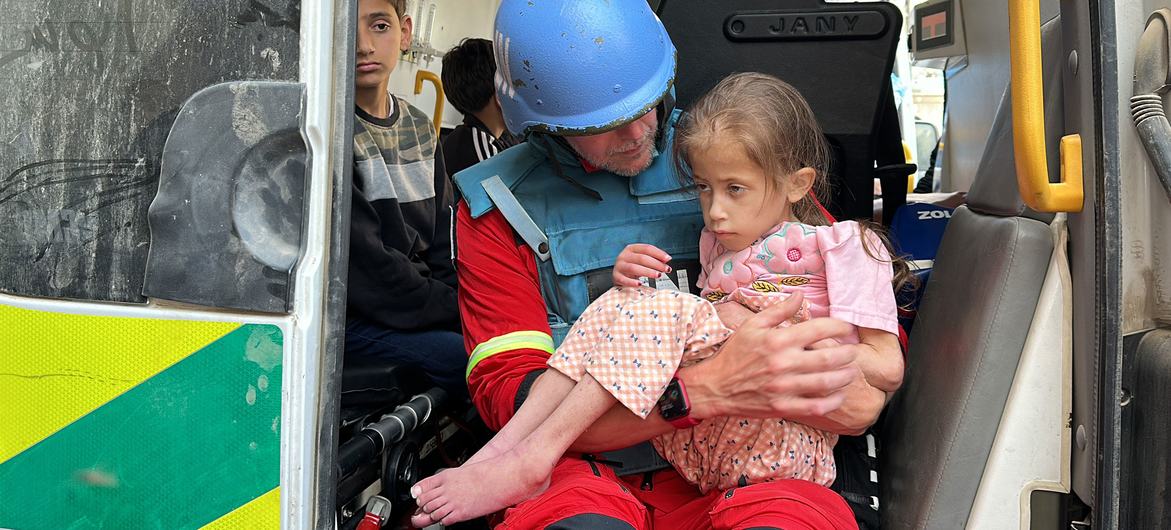
A
young girl is transferred from the Kamal Adwan hospital, in the far
north of Gaza to a hospital in the south of the enclave. (file)
Massive settler attacks in West Bank
Turning to the West Bank, the UN rights chief said that grave human rights violations had continued there “unabated”.
This was despite international condemnation of “massive settler attacks” between 12 and 14 April “that had been facilitated by the Israeli Security Forces (ISF)”.
Settler violence has been organized “with the support, protection, and participation of the ISF”,
Mr. Türk insisted, before describing a 50-hour long operation into Nur
Shams refugee camp and Tulkarem city starting on 18 April.
“The
ISF deployed ground troops, bulldozers and drones and sealed the camp.
Fourteen Palestinians were killed, three of them children,” the UN
rights chief said, noting that 10 ISF members had been injured.
In
a statement, Mr. Türk also highlighted reports that several
Palestinians had been unlawfully killed in the Nur Shams operation “and
that the ISF used unarmed Palestinians to shield their forces from attack and killed others in apparent extrajudicial executions”.
Dozens
were reportedly detained and ill-treated while the ISF “inflicted
unprecedented and apparently wanton destruction on the camp and its
infrastructure”, the High Commissioner said.
[AS
ALWAYS PLEASE GO TO THE LINK TO
READ GOOD ARTICLES (or quotes or watch videos) IN FULL: HELP
SHAPE ALGORITHMS (and
conversations) THAT EMPOWER
DECENCY, DIGNITY, JUSTICE &
PEACE... and hopefully
Palestine]
“Reprehensible and dangerous.” “Terrorist sympathizers.” “It’s not 1938 Berlin. It’s 2024, Columbia University, NYC.”
The White House, Congressional Republicans, and cable news talking heads
would have you believe that the Columbia University campus has devolved
into a hotbed of antisemitic violence – but the reality on the ground
is very different. As a Jewish student at Columbia, it depresses me that
I have to correct the record and explain what the real risk to our
safety looks like. I still can't quite believe how the events on campus
over the past few days have been so cynically and hysterically
misrepresented by the media and by our elected representatives.
Last
week, the Columbia University Apartheid Divest (CUAD) coalition,
representing more than 100 student organizations, including Jewish
groups,organized the Gaza Solidarity
Encampment, a peaceful campus protest in solidarity with Palestine. CUAD
was reactivated after the university suspended
Students for Justice in Palestine and Jewish Voice for Peace in the
fall. On Wednesday morning, hundreds of students camped out on
Columbia’s South Lawn. They vowed to stay put until the university
divests from companies that profit from their ties to Israel. Protesters
prayed, chanted, ate pizza, and condemned the university’s complicity
in Israel’s attacks on Gaza. Though counter-protesters waved Israeli
flags near the encampment, the campus remained largely calm from my
vantage point.
Columbia responded by imposing a miniature police state. Just
over a day after the encampment was formed, university President
Minouche Shafik asked and authorized the New York Police Department to
clear the lawn and load 108 students – including a number of Jewish
students – onto Department of Corrections buses to be held at NYPD
headquarters at 1 Police Plaza. One Jewish student told me that she and
her fellow protesters were restrained in zip-tie handcuffs for eight
hours and held in cells where they shared a toilet without privacy. The
NYPD chief of patrol John Chell later told
the Columbia Spectator that “the students that were arrested were
peaceful, offered no resistance whatsoever, and were saying what they
wanted to say in a peaceful manner.”
Since then,
dozens of undergraduates have been locked out of their dorms without
notice. Barnard College, an affiliate of Columbia, notably gave students
just 15 minutes
to retrieve their belongings after returning from lockup and finding
themselves evicted. Suspended students cannot return to campus and are
struggling to access food or medical care. Students who keep Shabbat,
and do not use electronics on the Sabbath, were forced
to rely on technology in order to secure food and emergency housing.
This crackdown was the most violence inflicted on our student body in
decades. I implore you, as our Jewish Voice for Peace chapter does, to consider whether arresting Jewish students keeps us and Columbia safe.
[AS
ALWAYS PLEASE GO TO THE LINK TO
READ GOOD ARTICLES (or quotes or watch videos) IN FULL: HELP
SHAPE ALGORITHMS (and
conversations) THAT EMPOWER
DECENCY, DIGNITY, JUSTICE &
PEACE... and hopefully
Palestine]
If you want to learn about the truth about our lives, at least for the past 30 years, not only for the past 200 days as many want others to understand, read these poems. They were published in April 2022.
This is the only book that survived the mass killing and destruction with me.
Noor, a young school-aged girl, is curious to learn about what happened to her Palestinian grandmother (Teta) during the infamous 1948 Nakba (The
Catastrophe) that befell the Palestinian people, and why her family was
forced to leave their home in al-Quds (Jerusalem). Why were they pushed
out of their homeland? Where did they go? And how did they become
refugees?
Wafa Shami was born and raised in Ramallah, Palestine.
She moved to the
U.S. to pursue higher education and graduated with a Master’s degree in
International Studies.
Since moving to the U.S. Wafa has maintained her
engagement in Middle Eastern issues as a volunteer.
After her son was
born she was inspired to write children’s storybooks based on her
childhood memories
Her stories, Easter in Ramallah, and Olive Harvest in
Palestine were published in the last few years.
Besides being busy
raising her son, Wafa who lives in California has a passion for cooking
and writes a food blog, in which she shares her family’s recipes.
Visit
her blog at www.palestineinadish.com and follow her on social media
@palestineinadish for delicious recipes.


%20%20United%20nations.jpg)

..webp)


