Labels

Saturday, May 18, 2013

AP PHOTOS: Palestinians in Egypt village exhibit consequences of 65 years of mass displacement

In this Friday, May 17, 2013 photo, Palestinian refugee Sulaiman al-Namodi, 92, sits outside of his house in Gezirat al-Fadel village, Sharqiya, about 150 kilometers (93 miles) east of Cairo, Egypt. As...   (Associated Press)
"...While many know nothing more of life beyond Gezirat al-Fadel, they say they have not lost their connection to Bir el-Sabae. They say they dream of returning to their land in hopes of living a more dignified life and leaving behind this almost forgotten corner of Egypt, a nation already burdened by a population boom and widespread poverty."

 http://www.newser.com/article/da6brsvg1/ap-photos-palestinians-in-egypt-village-exhibit-consequences-of-65-years-of-mass-displacement.html

AP PHOTOS: Palestinians in Egypt exiled, forgotten

In 1948, Suleiman Mamoudi fled by foot with his parents and other families from their village of Bir el-Sabae in Palestine. The 28-year-old and his family walked west for several hundred miles, crossing the Sinai Peninsula before settling in an area around 90 miles (145 kilometers) north of Cairo.

They had not planned to stay long in Egypt's Sharqiya province, until they found themselves unable to return home after the Jewish takeover of their city, renamed Beersheba.

Mamoudi, now 93 years old, is among some 3,000 Palestinians living in the impoverished village of Gezirat al-Fadel. He spends his days sitting on a cushion on the ground outside his sparsely furnished two-bedroom, mud brick home. The dirt roads make it difficult for him to walk with his cane.

He lives with his 13 children and 28 grandchildren. Like his neighbors, they sleep on mats spread in the corridors of the house.

His neighbor, Khadra Mohammed, 52, lives in a 540 sq. foot (50 sq. meter) mud brick house with 19 of her family members...READ MORE

 [AS ALWAYS PLEASE GO TO THE LINK TO READ GOOD ARTICLES IN FULL: HELP SHAPE ALGORITHMS (and conversations) THAT EMPOWER DECENCY, DIGNITY, JUSTICE & PEACE... and hopefully Palestine]

Time Magazine Pictures of the Week: May 10 – May 17... Palestinian refugee children play in front of their family house in Jabaliya Refugee camp, in the Gaza Strip.

Ali Ali—EPA
May 14, 2013. Palestinian refugee children play in front of their family house in Jabaliya Refugee camp, in the Gaza Strip.


"In 1949, the international community accepted Israel's UN membership upon two conditions: That they respect resolutions 181 (two states) and 194 (refugee rights). Neither has been honored. In fact, 65 years later, Israel has not even acknowledged what it did in 1948." Saeb Erekat

Wednesday marks the 65th anniversary of the Palestinian Nakba.
http://www.maannews.net/eng/ViewDetails.aspx?ID=595459
 65 years of impunity

Every May 15, a nation marks her historic catastrophe. In 1948, the Palestinian people were condemned to exile, and their homeland, Palestine, disappeared from the maps. Some 418 villages were destroyed and 70 percent of our people became refugees.

For 65 years, our people have lived through the vicissitudes and humiliation of being treated as strangers, both in exile and in their own land. Today, we are still struggling to return Palestine to the map and attain justice based on international law for Palestinians everywhere.

This solemn commemoration, which pains the heart of every Palestinian, should be a cause for shame on an international level. After decades of unfulfilled resolutions calling for the achievement of the inalienable rights of the Palestinian people, Israel continues to act with impunity.

Twenty-five years after Palestine's historic and painful compromise of recognizing the State of Israel on 78 percent of our historic homeland, Israel has not only failed to recognize the State of Palestine, but continues to expand its colonies throughout our occupied country.

Moreover, Israel benefits from its illegal and oppressive enterprise while maintaining good relations with countries throughout the world.

In 1949, the international community accepted Israel's UN membership upon two conditions: That they respect resolutions 181 (two states) and 194 (refugee rights). Neither has been honored. In fact, 65 years later, Israel has not even acknowledged what it did in 1948.

Even more despicably, the State of Israel has legislated to forbid Palestinian citizens of Israel from commemorating their Nakba. But denying the Nakba does not negate its existence. Refusing to assume responsibility for the refugee question does not mean that refugees will disappear. On the contrary, it simply makes it harder to achieve reconciliation and a just and lasting peace.

Today's Nakba is alive in 11 million Palestinians around the world. One example is the Palestinian refugees in Iraq and Syria, suffering the consequences of sectarian violence in conflicts of which they are not a part. This situation shows, once again, that international responsibility for the safety and welfare of the Palestinian people cannot be effective without the Palestinian return to their homeland.

We have made painful compromises to achieve peace. With us we have brought the Arab Peace Initiative, which confirms the Arabs will to normalize relations with Israel in exchange for some small measure of historical justice, meaning the end of the occupation that began in 1967 and a just solution to the issue of Palestinian refugees based on resolution 194.

Unfortunately, what we are faced with is an occupying power that does not want peace; an extremist government made for and by settlers. A government that each time it has had the opportunity to choose between peace and settlements has chosen the latter; a government whose ministers call for the elimination of the Palestinian state and for the construction of settlements for 1 million settlers in occupied territory.

This is why US Secretary of State John Kerry’s latest initiative should be supported. Sixty-five years after the Nakba, the sole message of the international community must be that enough is enough. It is a shame that 65 years later, we are still listening to statements without actions.

It is time to put things right, to do whatever is needed to allow Palestine to return to the map as a free and sovereign state living side by side with Israel and, most importantly, to fulfill the rights of Palestinians everywhere.

To achieve this, the international community must leave old, failed recipes aside. To call for a resumption of negotiations without terms of reference or without forcing Israel to honor its previous obligations are simply calls for another 20 years of empty dialogue which will allow Israel to continue its policy of colonization with a better cover. This will destroy any remaining prospects for peace.

After well over half a century, this is the first anniversary of the Nakba whereby Palestine is a recognized state in the United Nations. Though we are under occupation, we have taken a concrete and positive step in the right direction. We will continue following the same path toward exercising our legitimate and inalienable rights.

We must end 65 years of impunity. The international community cannot continue marking commemorations without taking any real action. Israel must become aware that the price for denying the rights of the Palestinian people is higher than the price of making peace. In Israel’s mind, this equation is the other way around.

Saeb Erekat is the chief negotiator of the Palestine Liberation Organization.


Arab and Islamic countries and organizations pledged hundreds of millions of dollars to support Jerusalem during conferences and summits, but that only a small portion of the pledged money was sent.

http://www.maannews.net/eng/ViewDetails.aspx?ID=596597
Abbas urges Muslims, Christians to visit Palestine

CAIRO (Ma'an) -- President Mahmoud Abbas on Friday urged Muslim and Christian Arabs to visit Palestine to show support for the Palestinian people.

"We welcome any Arab Muslim and Christian visiting Jerusalem and Bethlehem," Abbas said in a meeting with Egyptian journalists and intellectuals at the end of his 3-day visit to Cairo.

"Coming to this country does not mean normalization between the visitors' countries and Israel, but rather a visit to imprisoned people not to those who imprison them."

Abbas criticized the Islamic world's indifference to the Al-Aqsa Mosque and blamed some Islamic intellectuals for "issuing Fatwa suggesting that visiting al-Aqsa Mosque and offering support is prohibited according to the Islamic regulations.

"Prophet Muhammad, though, mentioned al-Aqsa Mosque as one of the few mosques Muslims should set out to," the president said.

Influential Muslim cleric Yousef al-Qaradawi recently said that visiting the mosque while it remains under Israeli occupation would be a breach of religious regulations.

Al-Qaradawi visited the Hamas-run Gaza Strip earlier in May, a step that was strongly denounced by Palestinian Authority officials who said such visits had political implications and maintained disunity between the Palestinians.

Abbas said that Arab and Islamic countries and organizations had pledged hundreds of millions of dollars to support Jerusalem during conferences and summits, but that only a small portion of the pledged money was sent.

During the Arab League summit in Libya the conveners agreed to allocate $500 million to Jerusalem, but in reality only $37 million was delivered, Abbas said.

At another Arab League summit in Doha, Arab countries agreed to allocate $1 billion to Jerusalem, but that was "just a number," the president said.

Friday, May 17, 2013

Repercussions... a poem


     Repercussions

Thucydides noticed
“Ignorance is bold..."

ALL CAPS SCREAMING
social media bellows
WAR IS TERRORISM
WITH A BIGGER BUDGET

forwarded over and over
by naive wives, mothers
little sisters
college students
and myopic Islamists near and far.

No budgets are needed
enlisting pawns- puppets- tools
bridges to beyond reason
bolstering bomb builders
and bullies world wide fueling
bigotry and bad attitudes

creating Hell for random strangers
and religious tyranny for Palestine.


Tuesday, May 14, 2013

Why Ending the Occupation and Peace with Israel is Still the Palestinian National Goal...

End the conflict in the Middle East through a negotiated agreement that provides for two states - Israel and Palestine - living side by side in peace and security.


Hussein Ibish lecture at Tufts University-February 10, 2010

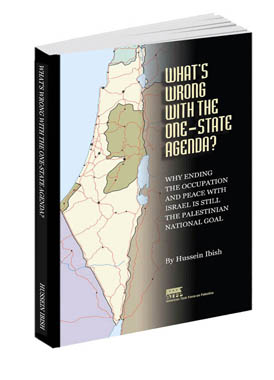
What’s Wrong with the One-State Agenda?

Why Ending the Occupation and Peace with Israel is Still the Palestinian National Goal

by ATFP Senior Fellow Hussein Ibish

Whats Wrong with the One State SolutionIn this new book, Dr. Ibish examines the arguments generally put forward by Palestinian and other Arab American proponents of abandoning the goal of ending the occupation and establishing a Palestinian state and instead seeking to promote a single, democratic state in all of Israel and the occupied Palestinian territories. The book also looks at differences between the deployment of the one-state idea by some Palestinian figures in the occupied territories as a diplomatic "threat" intended to spur greater Israeli seriousness about a negotiated agreement and the diasporic discourse that drives most one-state rhetoric. Finally, Dr. Ibish explains in some detail why ending the occupation and peace with Israel, while difficult to achieve and thus far elusive, are the only plausible and practicable Palestinian national strategy.

The book also includes a preface by ATFP President Ziad J. Asali.

The 138-page book can be read or downloaded in the following formats:
HTML |  EBook | PDF

Hard copies can be ordered from ATFP for $10 per copy, inclusive of shipping, by clicking here

***
ATFP is strictly opposed to all acts of violence against civilians no matter the cause and no matter who the victims or perpetrators may be.  The Task Force advocates the development of a Palestinian state that is democratic, pluralistic, non-militarized and neutral in armed conflicts.

Thursday, May 9, 2013

“Were you really shot in a fight over water?” He winces out his answer: “It wasn’t about politics. It wasn’t about the Muslim Brotherhood. It was about water.”

"The great American environmentalist Dana Meadows, when asked if it was too late to do anything about climate change, used to say, “We have exactly enough time — starting now.” The Arab world has exactly enough time — starting now. If people do not stop fighting with each other over dead ideologies and sectarian differences and focus instead on overcoming their deficits of knowledge, freedom and women’s empowerment — as the U.N. Arab Human Development Report urged — there is no hope. As Qaid suggested, in Yemen those old ideologies are luxuries now. It is just about water." Postcard From Yemen By Thomas L. Friedman May 7, 2013

Former Palestinian fighter now battles for a middle path: Palestinian Mohammed Dajani, from a prominent Jerusalem family, has become a vocal advocate for pragmatism and peace.

Palestinian Mohammed Dajani's staircase in the Jerusalem neighborhood of Beit Hanina is a literal paper trail of his family and career, from an Ottoman sultan's decree that gave his relatives custodianship of David's tomb to the photos just behind him of then-Senator Barack Obama visiting his Al Quds University classroom.
 Christa Case Bryant/TCSM
  Wasatia: Quranic term for “moderation” or “balance,” aims to give a voice to what Dajani considers a majority of Palestinians who want to work for statehood through nonviolent means but get drowned out by increasing radicalization on both sides.

 [AS ALWAYS PLEASE GO TO THE LINK TO READ GOOD ARTICLES IN FULL: HELP SHAPE ALGORITHMS (and conversations) THAT EMPOWER DECENCY, DIGNITY, JUSTICE & PEACE... and hopefully Palestine]

http://www.csmonitor.com/World/Middle-East/Olive-Press/2013/0508/Former-Palestinian-fighter-now-battles-for-a-middle-path?nav=107-csm_subcategory-leadStory

By Staff writer / May 8, 2013 East Jerusalem

By his own admission, Mohammed Dajani was “extremely radical” as a young man working for the Palestinian militant group Fatah in Lebanon.

His family was forced to leave their stately Jerusalem home during the 1948 Arab-Israeli war. Following the example set by his grandfather, who ripped up the refugee card given to his wife, Mr. Dajani has refused to label himself a refugee: “We are citizens and human beings and we have to earn our way,” he says.

But as a young man he saw no other solution than taking back all of historic Palestine from the Israelis.

“I believed that it was us or them and that the only solution was to liberate our land,” he says. “And if we did not have the power to do that, we should do what Samson did and bring down the temple on everyone’s head,” he says, referring to the biblical story of a Hebrew prisoner who killed 3,000 people, including himself, when he removed the central pillars of a Philistine temple.

After that, however, he went to the US to get a PhD; getting some distance from the conflict changed his outlook dramatically and he began working for peace.

Those efforts crystallized into a new initiative after he witnessed a standoff at an Israeli checkpoint near his home. Palestinians who wanted to pray in Jerusalem amassed at the checkpoint, but Israeli guards initially refused to let them pass.  Eventually they worked out a deal – the Palestinians were allowed to pass...READ MORE

Sunday, May 5, 2013

Palestine now recognised by greater power than US or Israel – Google


3 May 2013:
Internet giant follows UN in recognising statehood, changing home page tagline from 'Palestinian territories' to 'Palestine'

Saturday, May 4, 2013

My letter to the NYTimes RE One Step Forward, The Arab League offers an improved proposal for peace in the Middle East, a welcome announcement.

 Whereas recognition of the inherent dignity and of the equal and inalienable rights of all members of the human family is the foundation of freedom, justice and peace in the world...
In 1950, on the second anniversary of the adoption of the Universal Declaration of Human Rights, students at the UN International Nursery School in New York viewed a poster of the historic document.   After adopting it on December 10, 1948, the UN General Assembly had called upon all Member States to publicize the text of the Declaration and "to cause it to be disseminated, displayed, read and expounded principally in schools and other educational institutions, without distinction based on the political status of countries or territories."  (UN Photo)
 RE One Step Forward
http://www.nytimes.com/2013/05/03/opinion/one-step-forward-for-the-israelis-and-palestinians.html?ref=global

Dear Editor,

In 1948, Martin Luther Kings was fifteen years away from articulating "I have a dream" making America a more real democracy.

In 1948, after the horrors of the Nazi Holocaust, the idea of creating a country called Israel specifically as a Jewish homeland probably seemed reasonable.  That was then, this is now... Now after the longest running refugee crisis in the world today only grows more catastrophic for the native non-Jewish population of the land that Israel currently rules with an iron fist, and now as Islamists clamor to gain power, I think we must conscientiously refuse to underwrite religious tyranny of any type: Taxpayers here and there should not be funding religious 'scholars', settlements and further conflict.

Fair and just laws and respect for universal basic human rights are the tools to keep Jewish people (as well as Muslims and Christians and everyone else) safe, secure, gainfully employed, able active citizens contributing to the common good. Two fully sovereign secular states, one Israel and one Palestine living side by side in peace is the best way forward- for everyone's sake.

Sincerely,
Anne Selden Annab

NOTES
Fayyad Steps Down, Not Out

The Economist: Squeeze them out... As Jewish settlements expand, the Palestinians are being driven away

'Quiet man' Kerry's strategy for Middle East peace

Vatican urged to act after nuns, landowners lose Israel wall challenge After a seven-year legal battle, a group of Palestinian landowners and Catholic nuns this week lost an appeal against Israel building its separation barrier on their land.

Youth voice hope for change in static Palestinian politics

This Week in Palestine: Palestinian Institutions A Story of Perseverance ... Salam Fayyad "This was not about roads, buildings, or infrastructure, despite their importance. This plan was about statehood, citizen participation, and enfranchisement. It was based on the vision of establishing a functional framework where government is accountable and citizens participate in the widest and most effective way possible in decision-making and governance."

Israeli forces uproot 700 olive trees near Jenin

CNN online Dean Obeidallah: I'm Muslim, and I hate terrorism

Hussein Ibish: Fate of Christians will define the Arab future


"I come from there and I have memories... "


".... it being clearly understood that nothing
          shall be done which may prejudice the civil and religious
          rights of existing non-Jewish communities in Palestine..."

"Legislature should "make no law respecting an establishment of religion, or prohibiting the free exercise thereof..." Thomas Jefferson

The Office of International Religious Freedom ( http://www.state.gov/j/drl/irf/)   Given the U.S. commitment to religious freedom, and to the international covenants that guarantee it as the inalienable right of every human being, the United States seeks to:
Promote freedom of religion and conscience throughout the world as a fundamental human right and as a source of stability for all countries

Palestinian Refugees(1948-NOW) refused their right to return... and their right to live in peace free from religious bigotry and injustice.

The Golden Rule... Do unto others as you would have them do unto you

"Where, after all, do universal human rights begin? In small places, close to home - so close and so small that they cannot be seen on any maps of the world. Yet they are the world of the individual person; the neighborhood he lives in; the school or college he attends; the factory, farm, or office where he works. Such are the places where every man, woman, and child seeks equal justice, equal opportunity, equal dignity without discrimination. Unless these rights have meaning there, they have little meaning anywhere. Without concerted citizen action to uphold them close to home, we shall look in vain for progress in the larger world." Eleanor Roosevelt

Refugees and the Right of Return
Palestinian refugees must be given the option to exercise their right of return (as well as receive compensation for their losses arising from their dispossession and displacement) though refugees may prefer other options such as: (i) resettlement in third countries, (ii) resettlement in a newly independent Palestine (even though they originate from that part of Palestine which became Israel) or (iii) normalization of their legal status in the host country where they currently reside.  What is important is that individual refugees decide for themselves which option they prefer – a decision must not be imposed upon them.

UN Resolution 194 from 1948  : The refugees wishing to return to their homes and live at peace with their neighbours should be permitted to do so at the earliest practicable date, and that compensation should be paid for the property of those choosing not to return and for loss of or damage to property which, under principles of international law or in equity, should be made good by the Governments or authorities responsible.

Friday, May 3, 2013

The Economist: Squeeze them out... As Jewish settlements expand, the Palestinians are being driven away

A barrage of reports by the UN, the European Union and assorted charities has repeatedly warned that the Palestinians in Area C are under threat. Some 350,000 Jewish settlers now inhabit over 200 settlements and outposts in the same area, usually on the high ground, twice as many people as the Palestinians in the land below.