Labels

Showing posts with label Saeb Erekat. Show all posts

Wednesday, July 2, 2014

Palestine's Saeb Erekat: Mideast peace impossible without international action

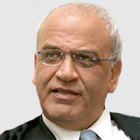
(MaanImages/file)
 [AS ALWAYS PLEASE GO TO THE LINK TO READ GOOD ARTICLES IN FULL: HELP SHAPE ALGORITHMS (and conversations) THAT EMPOWER DECENCY, DIGNITY, JUSTICE & PEACE... and hopefully Palestine]  

Analysis: Mideast peace impossible without international action
By Saeb Erekat

Saeb Erekat is chief Palestinian negotiator for the PLO.

The predicted "death" of the two-state solution, which has been repeated consistently for many years now, has led to a sense of complacency and a lack of urgency regarding the current situation. In the government of Israel, this does not provoke major concern, because the present coalition's political platform is focused on consolidating colonization rather than achieving peace. This is a government that believes it can indefinitely maintain a system whereby one group of people is privileged and another oppressed.

Among the Israeli public, it is not a central concern due to the fact that Israel is not paying any price for its systematic violations of human rights and international law, allowing its people to turn a blind eye to the millions persecuted in their name. But something is clear: We are at the point of no return. Whether we achieve a two-state solution based on the 1967 borders, or enter into a long struggle for civil rights in order to defeat Israeli apartheid throughout historic Palestine, it will fall to the international community to decide.

Palestine recognized Israeli sovereignty over 78 percent of our homeland back in 1988. This painful and historic compromise was not a tactical move, but a strategic choice. We have worked tirelessly to implement, on the ground, the vision of two sovereign, democratic states living side by side in peace and security. We have made every effort to reach a just and lasting peace, from the adoption of non-violent methods to resist the Israeli occupation to diplomatic steps, within the international arena, seeking to achieve overdue Palestinian rights.

Acceding to multilateral treaties also helps Palestine to shape itself as a peace-loving state that respects human rights and a responsible actor on the international stage. And yet, all such Palestinian moves have been answered with aggressive responses from Israel, resulting in an absurd situation whereby acts such as sitting at the negotiating table or signing treaties on women's and children's rights, are met with further settlement announcements, increased violence against Palestinians, and economic sanctions on an already captive economy.

Although some sectors within Israel understand the urgency of the situation, the lack of decisive international action has undermined those who want a negotiated two-state solution and has empowered the extremists leading the Israeli government coalition. As long as no action is taken on the economic, political, and diplomatic levels, Prime Minister Netanyahu, Foreign Minister Lieberman, Housing Minister Ariel, and Economy Minister Bennett will continue along the same path, which is one of apartheid and colonization rather than one of justice, peace, and reconciliation.

The European Union took an important step by publishing guidelines prohibiting European funding to settlements. This is a step in the right direction, but there is much more to be done in order to tackle the Israeli settlement enterprise, the main obstacle to peace. If the international community believes in the two-state solution, simple actions such as recognizing the State of Palestine; supporting Palestine's access to international treaties; ensuring that international companies have no contracts with, investments in, or trade with, Israeli entities that have direct or indirect links to settlements; or in the case of Europe, asking Israeli settlers to apply for visas, will go a long way toward achieving this.

The reality of the "end of the two-state solution" has been reflected in the EU Heads of Mission Report on East Jerusalem and reports on human rights and freedom of worship from the U.S. State Department. It can be read in every document produced by UN organizations and can be seen all over the occupied State of Palestine. The reality is no secret. What is required, however, is more active steps from all third party states, steps which will bring their operative policy in line with their declared policy, and most importantly, with international law.

It is time for the international community to empower those within Israel who want peace rather than colonization. It is time to stop treating Israel as a state above the law. It is time for Israel to revoke dozens of laws and hundreds of policies that discriminate against Palestinian Christians and Muslims. It is time to end the immorality of prolonging the exile and occupation of an entire nation due to the incapacity of the international community to hold Israel accountable for decades of forced displacement, occupation, and colonization.

Over the years I have come to know many Israelis. My belief in the prospects of peace was boosted, most of the time, after those personal encounters. I feel that many Israelis resent the notion of forever being occupiers. However, their government continues to avoid the only logical conclusion.

Time does not stand still. Israelis are approaching the point where they must make a fateful choice: Are they ready to opt for the two-state solution, or abandon it forever? I am one of those who believe a two-state solution is still possible, but I am not naïve. Without international action, the prospects for a just and lasting peace will remain elusive.

Thursday, May 15, 2014

"Palestine has recognized Israel's right to exist since 1988. We are not asking for Hebrew not to be an official language or Jewish holidays not to be official holidays. The character of Israel is not for us to define." Saeb Erekat

 [AS ALWAYS PLEASE GO TO THE LINK TO READ GOOD ARTICLES IN FULL: HELP SHAPE ALGORITHMS (and conversations) THAT EMPOWER DECENCY, DIGNITY, JUSTICE & PEACE... and hopefully Palestine]


"We will not be complicit in the notion that any ethnic-religious group should have dominance over any other. We will not accept the denial of basic human rights to which all are entitled." Saeb Erakat

'Israel can't erase the Nakba from history'

Saeb Erekat is chief Palestinian negotiator for the PLO.
 
Today is the anniversary of what we Palestinians refer to as the Nakba, our catastrophe – although a single word cannot begin to explain it, and a single day cannot begin to commemorate it.

More than ever before, Israel needs come to terms with the horrors it has caused since 1948, by ending its subjugation of millions rather than intensifying its denial and trying to legitimize its persecution. Peace can only come through justice and reconciliation.

This day, in 1948, marks the forced exile of over 750,000 Palestinians from their homes and lands. Some were subjected to brutal massacres, many fled for fear of their lives. A few managed to stay in what would become Israel. All suffered. Sixty-six years later, all continue to suffer.

The Nakba is a story of fear and intimidation, of denial and persecution, a cruel, unending reality.

Today in occupied East Jerusalem, Palestinian families are evicted from their homes due to claims that their property belonged to Jews before 1948, while being forbidden from returning to their pre-1948 homes in West Jerusalem.

In Gaza – one of the most densely populated areas in the world – 1.2 million refugees overlook the open areas of what is now southern Israel. In my own home town, Jericho, there are two refugee camps where thousands continue to live in miserable conditions. In 2014, Palestinian children died of starvation at the Yarmouk refugee camp in Syria.
 
 
Israel, which claims to be a democracy for all its citizens, continues to ban the villagers of Iqrit and Kufr Birem, two Christian villages in the Galilee, from returning to their lands, despite a ruling from the Israeli High Court of Justice on the matter.

This is not the only example of persecution within Israel. Prime Minister Benjamin Netanyahu's promotion of the "nationality bill," determining Israel as the Jewish nation-state, is one more in a long line of discriminatory laws against a fifth of Israel’s own population, the original inhabitants of the land.

A list of laws which make it not only acceptable, but legally admissible, to discriminate against Israel's own citizens for belonging to a different ethnic-religious group.

Meanwhile, in the land which Israel has illegally occupied since 1967, settlers and soldiers use similar methods of intimidation and fear to force Palestinians from their homes.

The reality in the West Bank is no less than apartheid, and, in Gaza, out and out siege. Both within occupied Palestine and further afield, those who have been waiting 66 years, with their keys in hand, continue to wait.

Palestine has recognized Israel's right to exist since 1988. We are not asking for Hebrew not to be an official language or Jewish holidays not to be official holidays. The character of Israel is not for us to define.
 
 
But we will not allow any Palestinian to be portrayed as the immigrant or intruder in his or her own land. We were here in 1948: We were here for centuries before that – Muslims, Christians and Jews – all Palestinians. The concept of an exclusively Jewish state naturally entails the denial of the Nakba. It tells us: "This is our land. You were on it illegally, temporarily, by mistake." It is a way of asking us to deny the existence of our people and the horrors that befell them in 1948. No people should be asked to do that.

We will not be complicit in the notion that any ethnic-religious group should have dominance over any other. We will not accept the denial of basic human rights to which all are entitled.

Rather than accepting historical responsibility, rather than acknowledging a painful truth about the birth of Israel and addressing it, as a step toward peace, the Israeli government attempts to wipe the event from history.

In Israel, it is forbidden by law to even commemorate the Nakba. If you can erase the narrative, it is much easier to erase the people. This Israeli government, in particular, is taking extraordinary measures to achieve this. Is it any wonder that we have not managed to reach an agreement at this time?

Today, we remember those who have lost their lives, at the hands of their oppressors, in their quest for freedom and dignity. Despite this, we are ready to live side by side in peace with our Israeli neighbors. We hope Israelis, if not their current government, will move in that direction.

At this point we do not know what the future will look like in terms of a solution, or when it will come. What we know for certain is that we will remain.


Saturday, May 18, 2013

"In 1949, the international community accepted Israel's UN membership upon two conditions: That they respect resolutions 181 (two states) and 194 (refugee rights). Neither has been honored. In fact, 65 years later, Israel has not even acknowledged what it did in 1948." Saeb Erekat

Wednesday marks the 65th anniversary of the Palestinian Nakba.
http://www.maannews.net/eng/ViewDetails.aspx?ID=595459
 65 years of impunity

Every May 15, a nation marks her historic catastrophe. In 1948, the Palestinian people were condemned to exile, and their homeland, Palestine, disappeared from the maps. Some 418 villages were destroyed and 70 percent of our people became refugees.

For 65 years, our people have lived through the vicissitudes and humiliation of being treated as strangers, both in exile and in their own land. Today, we are still struggling to return Palestine to the map and attain justice based on international law for Palestinians everywhere.

This solemn commemoration, which pains the heart of every Palestinian, should be a cause for shame on an international level. After decades of unfulfilled resolutions calling for the achievement of the inalienable rights of the Palestinian people, Israel continues to act with impunity.

Twenty-five years after Palestine's historic and painful compromise of recognizing the State of Israel on 78 percent of our historic homeland, Israel has not only failed to recognize the State of Palestine, but continues to expand its colonies throughout our occupied country.

Moreover, Israel benefits from its illegal and oppressive enterprise while maintaining good relations with countries throughout the world.

In 1949, the international community accepted Israel's UN membership upon two conditions: That they respect resolutions 181 (two states) and 194 (refugee rights). Neither has been honored. In fact, 65 years later, Israel has not even acknowledged what it did in 1948.

Even more despicably, the State of Israel has legislated to forbid Palestinian citizens of Israel from commemorating their Nakba. But denying the Nakba does not negate its existence. Refusing to assume responsibility for the refugee question does not mean that refugees will disappear. On the contrary, it simply makes it harder to achieve reconciliation and a just and lasting peace.

Today's Nakba is alive in 11 million Palestinians around the world. One example is the Palestinian refugees in Iraq and Syria, suffering the consequences of sectarian violence in conflicts of which they are not a part. This situation shows, once again, that international responsibility for the safety and welfare of the Palestinian people cannot be effective without the Palestinian return to their homeland.

We have made painful compromises to achieve peace. With us we have brought the Arab Peace Initiative, which confirms the Arabs will to normalize relations with Israel in exchange for some small measure of historical justice, meaning the end of the occupation that began in 1967 and a just solution to the issue of Palestinian refugees based on resolution 194.

Unfortunately, what we are faced with is an occupying power that does not want peace; an extremist government made for and by settlers. A government that each time it has had the opportunity to choose between peace and settlements has chosen the latter; a government whose ministers call for the elimination of the Palestinian state and for the construction of settlements for 1 million settlers in occupied territory.

This is why US Secretary of State John Kerry’s latest initiative should be supported. Sixty-five years after the Nakba, the sole message of the international community must be that enough is enough. It is a shame that 65 years later, we are still listening to statements without actions.

It is time to put things right, to do whatever is needed to allow Palestine to return to the map as a free and sovereign state living side by side with Israel and, most importantly, to fulfill the rights of Palestinians everywhere.

To achieve this, the international community must leave old, failed recipes aside. To call for a resumption of negotiations without terms of reference or without forcing Israel to honor its previous obligations are simply calls for another 20 years of empty dialogue which will allow Israel to continue its policy of colonization with a better cover. This will destroy any remaining prospects for peace.

After well over half a century, this is the first anniversary of the Nakba whereby Palestine is a recognized state in the United Nations. Though we are under occupation, we have taken a concrete and positive step in the right direction. We will continue following the same path toward exercising our legitimate and inalienable rights.

We must end 65 years of impunity. The international community cannot continue marking commemorations without taking any real action. Israel must become aware that the price for denying the rights of the Palestinian people is higher than the price of making peace. In Israel’s mind, this equation is the other way around.

Saeb Erekat is the chief negotiator of the Palestine Liberation Organization.


Wednesday, February 6, 2013

Foriegn Policy: An interview with Palestinian negotiator-in-chief Saeb Erekat

"The institution-building efforts led by the Palestinian government have been completely undermined by the lack of freedom. This situation cannot continue. Oslo succeeded in bringing back 250,000 Palestinians from the diaspora and building the capacity for our state. The international community failed though, by granting Israel an unprecedented culture of impunity that allowed them to use negotiations as a means to continue rather than stop colonization." Saeb Erekat

 http://www.foreignpolicy.com/articles/2013/02/05/The_Peace_Processor_Palestine_Saeb_Erekat

BY AARON DAVID MILLER | FEBRUARY 5, 2013

Other than Mahmoud Abbas, Saeb Erekat could be the most recognizable Palestinian on the planet. The chief Palestinian negotiator is certainly among the most passionate in promoting the cause. And nobody on the Palestinian side knows the substance of the issues or the negotiating history better.

I first met Erekat in the late 1980s, while working on the Palestinian issue for then Secretary of State George Shultz. Back then, the U.S.-educated diplomat was already showing the brashness and outspokenness that would make him one of the most memorable -- if exasperating -- of the Palestinians with whom we dealt.

He annoyed then Secretary of State James Baker by wearing his kaffiyeh around his shoulders at the opening of the Madrid Peace Conference in October 1991. And over the years, he continued to annoy the Israelis too with his fiery performances on CNN -- though to this day, key Israeli negotiators, such as Isaac Molho, continue to praise his pragmatism at the bargaining table.

It was Erekat's academic bent, analytical chops, and capacity to ...READ MORE

Saturday, January 12, 2013

"We know the [Israeli] army follow us on Twitter and Facebook, so we made out we were holding a protest somewhere else."

The tent village in the area known as E1, near Jerusalem. Photograph: Baz Ratner/Reuters

Monday, July 30, 2012

My letter to the Washington Post RE Romney

Claire Schwartz photo: 2011 Barbed Wire in Jerusalem outside the Jerusalem/Bethlehem Checkpoint.

RE Beyond Romney’s Olympic troubles By E.J. Dionne Jr http://www.washingtonpost.com/blogs/post-partisan/post/beyond-romneys-olympic-troubles/2012/07/27/gJQAa2DHEX_blog.html. .... (& today's wire story "Romney praises Israel’s success, but his failure to mention occupation outrages Palestinians" )
http://www.washingtonpost.com/politics/romney-raising-campaign-cash-in-israel-before-heading-to-poland-final-leg-of-trip/2012/07/30/gJQAjdveJX_story.html

Dear Editor,

Romney just raised more than a million dollars in Israel by pandering to wealthy Zionist ideologues who actively scorn respect for international law and universal basic human rights... Would Romney be so eager to pander to Zionist ideologues & propagandists if his own home and freedom to travel and his ability to earn a living were at stake?

Would Romney continue to have so little sympathy and compassion for the Palestinian refugees refused their right to return if he was suddenly refused reentry into the United States- and his home and his wealth was usurped by non-Mormons convinced that Mormons are a 'demographic threat'. 

Would Romney be so motivated to idolize a foreign country- a foreign country dedicated to building racist laws and walls if he actually believed in America and our ideals of real democracy with full and equal rights for all.

Saeb Erekat, a senior aide to Palestinian President Mahmoud Abbas is right that Romney "lacks information, knowledge, vision and understanding of this region and its people". 

Sincerely,
Anne Selden Annab

NOTES
Demographics should be a research tool, not a national policy shaping institutionalized bigotry and injustice.

Violent attacks by settlers on Palestinians and their property, mosques and farmland had increased by 150% over the past year.

Palestinian officials point out that US Republican presidential candidate Mitt Romney is undermining peace... "What this man [Mitt Romney] is doing here is just promoting extremism, violence and hatred"

"If you have to modify it, it isn't really a democracy."

'Separate and Unequal' is Unacceptable to Palestinians

World Bank says Palestinian economy unsustainable, noting that Israeli restrictions remain the biggest impediment to investing, creating high uncertainty and risk

Do you support as a solution to this conflict the emergence of a fully sovereign state of Palestine on the territory occupied in 1967, including East Jerusalem? Yes or no?


********
The Office of International Religious Freedom ( http://www.state.gov/j/drl/irf/ )  Given the U.S. commitment to religious freedom, and to the international covenants that guarantee it as the inalienable right of every human being, the United States seeks to:
Promote freedom of religion and conscience throughout the world as a fundamental human right and as a source of stability for all countries

Refugees and the Right of Return: "Palestinian refugees must be given the option to exercise their right of return (as well as receive compensation for their losses arising from their dispossession and displacement) though refugees may prefer other options such as: (i) resettlement in third countries, (ii) resettlement in a newly independent Palestine (even though they originate from that part of Palestine which became Israel) or (iii) normalization of their legal status in the host country where they currently reside. What is important is that individual refugees decide for themselves which option they prefer - a decision must not be imposed upon them."


"It is in Israel's vital interest to come to a complete resolution of the conflict between it and the Palestinian people sooner rather than later, relieving the weight of this tragic conflict from both of our peoples' shoulders. We owe it to ourselves. We owe it to the world." Maen Rashid Areikat: The Time for a Palestinian State Is Now


"Where, after all, do universal human rights begin? In small places, close to home - so close and so small that they cannot be seen on any maps of the world. Yet they are the world of the individual person; the neighborhood he lives in; the school or college he attends; the factory, farm, or office where he works. Such are the places where every man, woman, and child seeks equal justice, equal opportunity, equal dignity without discrimination. Unless these rights have meaning there, they have little meaning anywhere. Without concerted citizen action to uphold them close to home, we shall look in vain for progress in the larger world."Eleanor Roosevelt

Monday, July 9, 2012

The returning issue of Palestine's refugees... When negotiations resume once again, the world must not abandon the refugees of Palestine, nor attempt to coerce their representatives to do so either.


: "Before his murder in 1948, Lord Folke Bernadotte, the first UN mediator to the Arab-Israeli conflict, stated: "It would be an offence against the principles of elemental justice if these innocent [Palestinian] victims of the conflict were denied the right to return to their homes, while Jewish immigrants flow into Palestine." Lord Bernadotte paid for his candour with his life as Jewish militants assassinated him under the direction of Yitzhak Shamir, the man who would later become prime minister of Israel.

Less than three months after his death, as the war of 1948 ground to a close, and nearly three-quarters of the entire indigenous Palestinian population had been displaced by Israeli forces, the UN passed general assembly resolution 194, calling for the return of Palestinian refugees to their homes and to be awarded compensation for their losses...
 
... When negotiations resume once again, the world must not abandon the refugees of Palestine, nor attempt to coerce their representatives to do so either.
 
Israel's recognition of Palestinian refugee rights and its agreement to provide reparation and meaningful refugee choice in the exercise of these rights will not change the reality in the Middle East overnight, nor will it lead to an existential crisis for Israel. What it will certainly do is mark the beginning of a new reality that will no longer be rooted in repression, denial of rights, and discrimination. In other words, it will lead to a lasting peace – the kind of peace envisaged by Lord Bernadotte and hoped for by Palestinians and Israelis alike." 
 
                                       The returning issue of Palestine's refugees
 

Wednesday, September 7, 2011

Palestinian negotiator Saeb Erekat on statehood moves at U.N.

"Peace between conflicting parties is not about Saeb Erekat waking up one morning and feeling his conscience aching for Israelis or Israelis waking up and feeling their conscience aching for my suffering. It's about the matrix of interests maturing. Once any conflicting party believes that making peace is cheaper than continuing war, he'll do it. Our matrix of interest has matured to deliver the requirement for peace, but Israel hasn't opened the door. They think maintaining the status quo is best for them. We are trying to show them that the status quo is not sustainable." Saeb Erekat

Palestinian negotiator Saeb Erekat on statehood moves at U.N.

Friday, December 10, 2010

It's 62 years since the UN passed a resolution on the rights of Palestinian refugees – rights Israel must recognise for peace

The returning issue of Palestine's refugees

It's 62 years since the UN passed a resolution on the rights of Palestinian refugees – rights Israel must recognise for peace

Before his murder in 1948, Lord Folke Bernadotte, the first UN mediator to the Arab-Israeli conflict, stated: "It would be an offence against the principles of elemental justice if these innocent [Palestinian] victims of the conflict were denied the right to return to their homes, while Jewish immigrants flow into Palestine." Lord Bernadotte paid for his candour with his life as Jewish militants assassinated him under the direction of Yitzhak Shamir, the man who would later become prime minister of Israel.

Less than three months after his death, as the war of 1948 ground to a close, and nearly three-quarters of the entire indigenous Palestinian population had been displaced by Israeli forces, the UN passed general assembly resolution 194, calling for the return of Palestinian refugees to their homes and to be awarded compensation for their losses.

On Saturday, 62 years will have passed without this historic resolution being implemented despite being upheld by the UN with nearly universal consensus ever since. In fact, Israel's own admission as a member to the United Nations was contingent on its adherence to the principles of UNGA 194, something it proceeded to disregard once membership was granted.

Contrary to what Israeli political figures would like the world to believe, the issue of Palestinian refugees is not an academic matter, the solution of which is somehow rendered moot by the passage of time and by the creation of Israeli "facts on the ground." Palestinian displacement continues to this day through the revocation of residency cards, land confiscation, home demolitions and evictions. At the same time, Israel has barred Palestinians displaced between 1947 and 1949, and again in 1967, from returning to their homes or receiving restitution for their lost property, making Palestinian refugees the oldest and largest refugee community in the world today....READ MORE

Friday, October 29, 2010

Regarding the Palestinian Refugees Right of Return

Erekat: “Statements Of UNRWA's Director, Disappointing”

Friday October 29, 2010 11:12 by Saed Bannoura - IMEMC & Agencies

Head of the Negotiations Department at the Palestinian Liberation Organization (PLO), Dr. Saeb Erekat, stated that the statements of UNRWA New York director, Andrew Whitley, regarding the Palestinian Right of Return are disappointing.
Palestinian Refugees on their way to Lebanon, October, 1948 - Palestine Remembered

Whitley said that the Palestinians “should not live under the illusion of achieving the Right of Return”, and added that Arab countries must start procedures for settling them in the Arab world.

Dr. Erekat sent a letter to Whitley expressing the Palestinian rejection to these statements especially since they deny an internationally guaranteed right.

The UNRWA said that the statements of Whitley do not represent its official stance.

Meanwhile, Dr. Erekat said that the Palestinians did not, and will not, abandon their right, and added that in 1948 Israel forced more than 700,000 Palestinians out of their homes and lands.

He added that the refugees, now more than 4.5 million, will not give up their right to return to their homeland, and will remain steadfast especially since their right was approved by the international community and several U.N. resolutions, including resolution number 194.

“Mr. Whitley should have defended the legitimate right of the refugees, instead of accepting the harm inflicted on them”, Erekat added. “Those rights are guaranteed under the international law; they should be achieved, not abandoned or denied”.