Labels

Showing posts with label Geneva Conventions. Show all posts

Thursday, September 24, 2026

Humanity in war: A global initiative for humanitarian law - As of mid-August 2026, 118 states have officially joined the Global IHL Initiative, launched by Brazil, China, France, Jordan, Kazakhstan and South Africa, together with the ICRC.

https://www.upholdhumanityinwar.org/en
 

Born from the ashes of World War II, the Geneva Conventions are a powerful promise that even in war, humanity must prevail. Created to put limits on the way wars are conducted and to protect those not taking part in the fighting – like civilians, prisoners and wounded soldiers – they have since been complemented with a series of treaties and customary law. This legal framework, known as international humanitarian law - or the laws of war - sets clear rules to follow amid the chaos of conflict.

There are now around 130 active armed conflicts worldwide.

They are not abstract legal concepts. They are the line between life and death, between dignity and despair, for millions caught in the crossfire. Yet despite a global consensus supporting the Geneva Conventions, adherence to even the most basic humanitarian norms remains shockingly insufficient in today’s war zones. Current conflicts reveal, in appalling and devastating ways, the immense challenges facing international humanitarian law in providing real and effective protection.

The suffering witnessed in war zones across the world is not inevitable. With strong political will, we can close the gap between the law and the reality on the ground.
How does international humanitarian law (IHL) protect in war?
Global IHL Initiative
  1. Civilians must be protected.

    It is illegal to target civilians and civilian objects, such as homes, schools and hospitals. Civilians must also be protected against the effects of military operations. 

  2. The sick and wounded must be cared for regardless of whose side they're on.

    Wounded, sick and shipwrecked civilians, soldiers and fighters, as well as medical staff, are all protected under IHL.

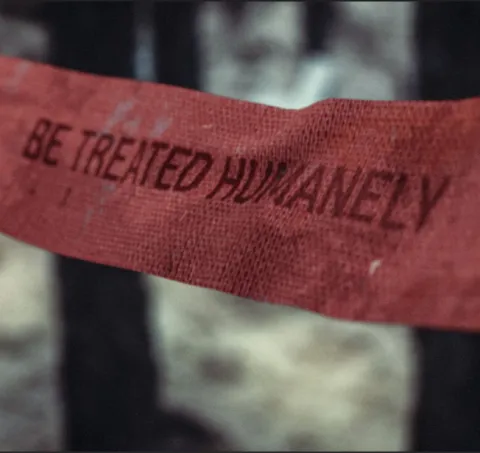
  3. Detainees must be treated humanely and with dignity.

    IHL protects those deprived of their liberty from ill treatment, acts of violence and intimidation.

  4. The dead must be treated with dignity.

    Warrying parties must take all possible measures to search for, collect and evacuate the dead. 

  5. Parties to a conflict must facilitate humanitarian access.

    People must be able to receive humanitarian aid, like food, water and medicine.

  6. IHL places limits on the fighting

    IHL treaties and customary law regulate weapon use and ban some, such as biological and chemical weapons, landmines, and cluster munitions. 

  7. War crimes must be punished.

    States have the responsibility to investigate, prosecute and punish serious violations of IHL.

Why this matters

To uphold and reaffirm the promise that, even in war, humanity must prevail.

The Global IHL Initiative exists to restore respect for the rules of war and ensure that the Geneva Conventions remain a living lifeline for the vulnerable. In an age of rising conflict and fading restraint, we stand for the sanctity of life, for accountability and for a future where the laws of war are not forgotten relics but the foundation of our shared humanity. 

Despite the universal ratification of the Geneva Conventions, violations of fundamental humanitarian norms are widespread. Ongoing conflicts around the globe, whether in urban centres, rural villages or at sea, are causing devastating human suffering, destruction and displacement. Attacks on civilian infrastructure, hospitals and humanitarian workers are all too frequent. The human, social, economic and environmental costs of these violations are unsustainable.

 https://www.upholdhumanityinwar.org/en

[AS ALWAYS PLEASE GO TO THE LINK TO READ GOOD ARTICLES (or quotes) IN FULL: HELP SHAPE ALGORITHMS (and conversations) THAT EMPOWER DECENCY, DIGNITY, JUSTICE & PEACE... and hopefully Palestine, or at least fair and just laws and policies here, there- and everywhere]


World leaders united in defence of international humanitarian law to uphold humanity in war

Alarmed by widespread violations of international humanitarian law (IHL) in conflicts around the world and the resulting unconscionable human suffering, we, the leaders of Brazil, China, France, Jordan, Kazakhstan and South Africa, together with the International Committee of the Red Cross (ICRC), urge States and the international community to act. 

 https://www.icrc.org/en/statement/world-leaders-united-defence-international-humanitarian-law

Tuesday, September 22, 2026

Towards A More Just World... learn more

Square profile picture
Int'l Criminal Court

⚖️ Even in the most challenging times, the #ICC remains steadfast in its mission: to bring justice to the victims of the most serious crimes of concern to the international community. Learn more about the #ICCProcess ➡️icc-cpi.pulse.ly/d6u8taynjm
 

How the Court works

The crimes

The Court's founding treaty, called the Rome Statute, grants the ICC jurisdiction over four main crimes.

First, the crime of genocide is characterised by the specific intent to destroy in whole or in part a national, ethnic, racial or religious group by killing its members or by other means: causing serious bodily or mental harm to members of the group; deliberately inflicting on the group conditions of life calculated to bring about its physical destruction in whole or in part; imposing measures intended to prevent births within the group; or forcibly transferring children of the group to another group.

Second, the ICC can prosecute crimes against humanity, which are serious violations committed as part of a large-scale attack against any civilian population. The 15 forms of crimes against humanity listed in the Rome Statute include offences such as murder, rape, imprisonment, enforced disappearances, enslavement – particularly of women and children, sexual slavery, torture, apartheid and deportation.

Third, war crimes which are grave breaches of the Geneva conventions in the context of armed conflict and include, for instance, the use of child soldiers; the killing or torture of persons such as civilians or prisoners of war; intentionally directing attacks against hospitals, historic monuments, or buildings dedicated to religion, education, art, science or charitable purposes.

Finally, the fourth crime falling within the ICC's jurisdiction is the crime of aggression. It is the use of armed force by a State against the sovereignty, integrity or independence of another State. The definition of this crime was adopted through amending the Rome Statute at the first Review Conference of the Statute in Kampala, Uganda, in 2010.

On 15 December 2017, the Assembly of States Parties adopted by consensus a resolution on the activation of the jurisdiction of the Court over the crime of aggression as of 17 July 2018.

See The Rome Statute and Elements of Crimes

https://www.icc-cpi.int/about/how-the-court-works
 
 [AS ALWAYS PLEASE GO TO THE LINK TO READ GOOD ARTICLES (or quotes) IN FULL: HELP SHAPE ALGORITHMS (and conversations) THAT EMPOWER DECENCY, DIGNITY, JUSTICE & PEACE... and hopefully Palestine, or at least fair and just laws and policies here, there- and everywhere] 

Ten key facts about the legal process

Further to the Key Features listed above, here are some of the basics you may want to know:

  • The ICC does not prosecute those under the age of 18 when a crime was committed.
  • Before the Prosecutor can investigate, he must conduct a preliminary examination considering such matters as sufficient evidence, jurisdiction, gravity, complementarity, and the interests of justice.
  • When investigating, the Prosecutor must collect and disclose both incriminating and exonerating evidence.
  • The defendant is considered innocent until proven guilty. The burden of proof lies with the Prosecutor.
  • During all stages of proceedings (Pre-Trial, Trial and Appeals), the defendant has the right to information in a language he or she fully understands, thus the ICC proceedings are conducted in multiple languages, with teams of interpreters and translators at work.
  • Pre-Trial judges issue warrants of arrest and ensure there is enough evidence before a case can go to trial.
  • Before a case is committed to trial (during the Pre-Trial phase), the defendant is referred to as a suspect. Once the case is committed to trial, since at that point the charges have been confirmed, the defendant is referred to as the accused.
  • Trial judges hear the evidence from the Prosecutor, Defence, and the Victims’ lawyers, render a verdict, and if a person is found guilty, the sentence and decision on reparations.
  • Appeals judges render decisions on appeals from the Prosecutor or Defence.
  • If a case is closed without a verdict of guilt, it can be reopened if the Prosecutor presents new evidence.

Thursday, August 13, 2026

A global initiative for humanitarian law: The Global IHL Initiative exists to restore respect for the rules of war and ensure that the Geneva Conventions remain a living lifeline for the vulnerable. In an age of rising conflict and fading restraint, we stand for the sanctity of life, for accountability and for a future where the laws of war are not forgotten relics but the foundation of our shared humanity.


https://youtu.be/xliM7atAwD0?si=ORBSx1V0J9qcHBUP 

Born from the ashes of World War II, the Geneva Conventions are a powerful promise that even in war, humanity must prevail. Created to put limits on the way wars are conducted and to protect those not taking part in the fighting – like civilians, prisoners and wounded soldiers – they have since been complemented with a series of treaties and customary law. This legal framework, known as international humanitarian law - or the laws of war - sets clear rules to follow amid the chaos of conflict.

There are now around 130 active armed conflicts worldwide.

They are not abstract legal concepts. They are the line between life and death, between dignity and despair, for millions caught in the crossfire. Yet despite a global consensus supporting the Geneva Conventions, adherence to even the most basic humanitarian norms remains shockingly insufficient in today’s war zones. Current conflicts reveal, in appalling and devastating ways, the immense challenges facing international humanitarian law in providing real and effective protection.

The suffering witnessed in war zones across the world is not inevitable. With strong political will, we can close the gap between the law and the reality on the ground.

 https://www.upholdhumanityinwar.org/en

How does international humanitarian law (IHL) protect in war?
Global IHL Initiative
  1. Civilians must be protected.

    It is illegal to target civilians and civilian objects, such as homes, schools and hospitals. Civilians must also be protected against the effects of military operations. 

  2. The sick and wounded must be cared for regardless of whose side they're on.

    Wounded, sick and shipwrecked civilians, soldiers and fighters, as well as medical staff, are all protected under IHL.

  3. Detainees must be treated humanely and with dignity.

    IHL protects those deprived of their liberty from ill treatment, acts of violence and intimidation.

  4. The dead must be treated with dignity.

    Warrying parties must take all possible measures to search for, collect and evacuate the dead. 

  5. Parties to a conflict must facilitate humanitarian access.

    People must be able to receive humanitarian aid, like food, water and medicine.

  6. IHL places limits on the fighting

    IHL treaties and customary law regulate weapon use and ban some, such as biological and chemical weapons, landmines, and cluster munitions. 

  7. War crimes must be punished.

    States have the responsibility to investigate, prosecute and punish serious violations of IHL.

Why this matters

To uphold and reaffirm the promise that, even in war, humanity must prevail.

The Global IHL Initiative exists to restore respect for the rules of war and ensure that the Geneva Conventions remain a living lifeline for the vulnerable. In an age of rising conflict and fading restraint, we stand for the sanctity of life, for accountability and for a future where the laws of war are not forgotten relics but the foundation of our shared humanity. 

Despite the universal ratification of the Geneva Conventions, violations of fundamental humanitarian norms are widespread. Ongoing conflicts around the globe, whether in urban centres, rural villages or at sea, are causing devastating human suffering, destruction and displacement. Attacks on civilian infrastructure, hospitals and humanitarian workers are all too frequent. The human, social, economic and environmental costs of these violations are unsustainable.

  https://www.upholdhumanityinwar.org/en

Wednesday, August 5, 2026

How Biden Enabled Israel’s Aggression Toward Gaza—and Iran: Top officials from the previous Administration now express regret over their failure to rein in Netanyahu.

Jake Sullivan, Biden’s former national-security adviser, told me, “I will say straightforwardly—we should have put more pressure on Israel to take a different approach.”Photograph by Saher Alghorra / NYT / Redux
A Reporter at Large

How Biden Enabled Israel’s Aggression Toward Gaza—and Iran

Top officials from the previous Administration now express regret over their failure to rein in Netanyahu.

On March 5, 2024, five months into the war in Gaza, Mirjana Spoljaric, the president of the International Committee of the Red Cross, sent a confidential letter to President Joe Biden. Under the Geneva Conventions, the Red Cross holds a unique responsibility to counsel states about avoiding war crimes. In the letter, which I obtained from a former United States official, Spoljaric reminded Biden that the organization had condemned the “horrific” October 7th massacre of Israelis by Hamas, and remained “relentless” in pressing the group to release the hostages it had taken. But she was now appealing to Biden “with profound alarm” because Israel, which had been pummelling Gaza with heavy munitions since October, was ignoring the Red Cross as never before. “The way the hostilities are being conducted by Israel is incompatible” with the laws of armed conflict, she wrote, “particularly the obligations to protect civilians and distinguish between military targets and civilians or civilian infrastructure, to ensure dignified treatment of detainees and the dead, to protect medical installations and personnel, and to provide and enable access of humanitarian aid.”

Allowing the Red Cross to visit detainees during a war or an occupation is one of the brightest lines established by the Geneva Conventions. Yet, after October 7th, Israel, for perhaps the first time in its history, fully blocked the organization’s access to Palestinian detainees from Gaza and the West Bank, putting it in the company of pariah states such as North Korea and Eritrea; even the warring factions in Yemen allowed Red Cross visits. Spoljaric noted that humanitarian groups and journalists had reported a “massive surge” in the number of Palestinians in Israeli prisons. At least a thousand had been released back into Gaza, and many of them gave accounts of torture, even though the Israeli military had concluded that they were not Hamas fighters. The Times reported that one released detainee, a law student named Fadi Bakr, described being beaten so severely that his genitals turned blue and blood still appeared in his urine weeks later. He said that Israeli guards had played music so loudly that one of his ears bled. (An Israeli military spokesman told the Times that the captors followed “Israeli and international law” and played music at a “low volume,” to prevent detainees from coördinating.) But the Red Cross couldn’t address such allegations: Spoljaric said that Israel had suspended all “legal-operational dialogue.”

To try to influence Hamas to release hostages, Spoljaric had appealed to Qatar and other patrons of the group; she now implored Biden to “bring about an immediate change” in Israel’s conduct. An appendix to the letter cited U.S. laws and Administration policies that prohibited the transferring of weapons likely to be used in war crimes, and Spoljaric urged Biden to withhold weapons “that should not be used in densely populated areas, in light of their devastating humanitarian impacts.” She warned Biden that failing to “uphold minimum standards of humanity” would be a “moral defeat” that “future generations are unlikely to forgive us for failing to avert.”

Two years after Spoljaric’s letter, President Donald J. Trump ordered the U.S. military to join Israel in attacking Iran. Some former senior officials in the Biden Administration told me that, in certain ways, the war in Iran was an extension of the Gaza conflict... READ MORE https://www.newyorker.com/magazine/2026/07/27/how-biden-emboldened-israels-aggression-toward-gaza-and-iran

[AS ALWAYS PLEASE GO TO THE LINK TO READ GOOD ARTICLES (or quotes or watch videos) IN FULL: HELP SHAPE ALGORITHMS (and conversations) THAT EMPOWER DECENCY, DIGNITY, JUSTICE & PEACE... and hopefully Palestine]

Thursday, July 16, 2026

Why does the US want to ‘dismantle’ the international criminal court? Marco Rubio has offered nonsensical rationale in attacking the court. The Trump administration’s real goal is impunity

‘What worries Trump officials most is the prospect that territorial jurisdiction could be used to prosecute them.’ Photograph: Graeme Sloan/Pool/Graeme Sloan - Pool/CNP/Shutterstock

 in The Guardian

Opinion   International criminal court 

Thu 16 Jul 2026 05.00 EDT

With the pointless war of choice in Iran going poorly, the Trump administration has declared a virtual war on the international criminal court (ICC). Secretary of state, Marco Rubio, vowed on Monday to “dismantle” the court as a supposed threat to US sovereignty. His rationale is laced with sophistry. The administration’s real goal is to secure impunity for war crimes, even those committed on the territory of ICC member states.

In a Wall Street Journal op-ed and a video posted on X, Rubio conjures up a dystopia in which local American officials such as police officers or border patrol agents “could be dragged before an international court, tried by judges from random countries across the globe, found guilty under international laws we neither consent to nor control, and then imprisoned thousands of miles from America”.

This is utter fiction. The ICC has no jurisdiction over crimes committed in the United States. Unless Donald Trump were to start deploying police officers or border patrol agents abroad, the ICC would have no capacity to charge or prosecute them.

Nor can the US government claim not to have consented to the laws applied by the court. They are drawn from treaties such as the genocide convention and the Geneva conventions and protocols that the US government has either ratified or incorporated into its military manuals. Is it really un-American to outlaw genocide? ... READ MORE  https://www.theguardian.com/commentisfree/2026/jul/16/international-criminal-court-marco-rubio

   [AS ALWAYS PLEASE GO TO THE LINK TO READ GOOD ARTICLES (or quotes or watch videos) IN FULL: HELP SHAPE ALGORITHMS (and conversations) THAT EMPOWER DECENCY, DIGNITY, JUSTICE & PEACE... and hopefully Palestine]