Labels

Showing posts with label Ziad Asali. Show all posts

Sunday, October 5, 2014

My letter to the Guardian RE Netanyahu says US criticism of settlements is 'against American values'

Champion of Human Rights
America's Eleanor Roosevelt (1884–1962)

RE Netanyahu says US criticism of settlements is 'against American values'
http://www.theguardian.com/world/2014/oct/05/netanyahu-says-us-criticism-settlements-against-american-values

Dear Editor,

“The idea that we’d have this ethnic purification as a condition for peace, I think it’s anti-peace.” Yes indeed Netanyahu has a point about peace and American values, but he fails to apply the same exact logic to Israel's brutal mistreatment of the native non-Jewish Palestinians who have been refused their inalienable right to return to original homes and lands since Israel first started pushing them into forced exile more than sixty years ago.

Hussein Ibish points out in his most recent op-ed, US has a responsibility to rein in Israeli settlements http://www.thenational.ae/opinion/comment/us-has-a-responsibility-to-rein-in-israeli-settlements, that "Hamas at least can claim to have established agency, initiative and momentum. Israel’s latest settlement activity seems almost calculated to play into their hands. It certainly delivers another brutal blow to Mr Abbas and all those who seek a negotiated agreement. It undermines the credibility of potential negotiations, and of the negotiators themselves."

Israel is playing a very VERY dangerous game of exasperating despair as well as religious extremism on all sides.

As Ziad Asali points out in his most recent op-ed Confronting ISIL: The Day and Decade "After"  "There is a vicious circle of mutual self-reinforcement between state and society failure on the one hand and the rise of extremist non-state actors on the other."

A fully secular two state solution to once and for all end the Israel-Palestine conflict ASAP is the best way forward. No more dithering, no more distractions, no more red herrings, no more shell games: Religion should be a personal private matter, not a state funded dictate determining who gets freedom, jobs, subsidized housing, security, justice, peace, and praise.

Sincerely,
Anne Selden Annab
American homemaker & poet

NOTES
Tala Haikal: "It may not be possible to immediately free all the kidnapped girls and women due to the scope of the conflict with ISIS and the geographical dispersal of the captives in various locations. Some of these women and girls can be freed only once ISIS is destroyed."

UN report spotlights 'staggering' Islamic State atrocities in Iraq... "The group, which is fighting in Iraq and Syria, has carried out a wide range of atrocities, including mass executions, abductions, rape and other forms of sexual and physical violence against women and children"

"There is a vicious circle of mutual self-reinforcement between state and society failure on the one hand and the rise of extremist non-state actors on the other." Ziad Asali: Confronting ISIL: The Day and Decade "After"

USA Today... Sweden PM says nation will recognize Palestinian state: "It doesn't change a thing on the ground," Ibish said. "It changes the number of countries that have recognized the Palestinian state. It changes the Western commitment to a two-state solution, (and) it does put more pressure on Israel to make concessions."

Vatican seeks Mideast Christians' right of return

Salam Fayyad: How To Fix the Israeli-Palestinian Peace Process

Excellent letter in the Guardian by Chris Doyle: Trouble and shock in the West Bank

STAY CONNECTED... Given the U.S. commitment to religious freedom, and to the international covenants that guarantee it as the inalienable right of every human being, the United States seeks to: Promote freedom of religion and conscience throughout the world as a fundamental human right and as a source of stability for all countries

US sharply criticizes new Israeli housing project

Non-violent resistance is Palestine’s most powerful weapon

Tala Haikal: Empathy Is Essential to Humanity

Normalizing Intelligent Conversations, Diplomatic Support, and Hope for Palestine... ATFP Panel Briefing: Israeli-Palestinian War in a New Regional Landscape.

ATFP... American Task Force on Palestine

ATFP Calls for De-Escalation between Israel and the Palestinians

Ziad Asali

International Year of Solidarity with the Palestinian People 2014

UNRWA photo and film archive for Palestine refugees

About UNWRA: ’The Long Journey of Palestine Refugee Women’ candidly portrays the lives and experiences of Palestine refugee women, this collection is a testament not only to their own strength and dignity, but also to the richness and resilience of their community.

Walking Palestine & The Abraham Path... a creative space for stories that highlight the unique culture, heritage and hospitality of the region

It's time for Palestinians and Israelis to share a just peace... It's time for freedom from occupation... It's time for equal rights.... It's time for the healing of wounded souls..... World Week for Peace in Palestine Israel: "Let my people go!"... 21 - 27 September 2014 An initiative of the Palestine Israel Ecumenical Forum (PIEF) of the World Council of Churches

Palestinian Refugees (1948-NOW) refused their right to return... and their right to live in peace free from religious bigotry and injustice.

1948

Time and time again I have watched the cycle of incitement and spin sabotage support for Palestine

Clarifying why Arab and Muslim Americans should be smart rather than stupid

Live by the Golden Rule

An Anne Frank Moment ... a poem by Anne Selden Annab

"Where, after all, do universal human rights begin?

America/Israel/Palestine 1776

America/Israel/Palestine 1948: All human beings are born free and equal in dignity and rights.They are endowed with reason and conscience and should act towards one another in a spirit of brotherhood.

The Golden Rule... Do unto others as you would have them do unto you

Monday, September 29, 2014

My letter to the LA Times RE Jonathan Zimmerman's Practice of beheading not limited to Islamic State

Washington DC
RE: Jonathan Zimmerman's Practice of beheading not limited to Islamic State
http://www.latimes.com/opinion/op-ed/la-oe-zimmerman-beheading-history-20140929-story.html

Dear Editor,

Zimmerman's "A brief history of decapitation" is not so much an actual history starting with the first known beheadings, which would immediately show how universal primitive ways once were. Nope, he'd rather help arm ISIL propagandists with blame America soundbites.

I think Zimmerman is titillated and entertained by violent you-tube videos, but I am not. I am horrified and disgusted by ISIL and their various apologists.  ISIL criminals are murdering people, raping women and girls, intentionally destroying cultural treasures, and stealing everything they can profit from in order to fund their war on anyone who refuses to worship their way. 

There has never ever been anything as dangerous and demented as ISIL. Hitler only had immediate neighbors to conquer and subjugate. ISIL has modern technology to recruit world wide, convincing vulnerable young men and women to join their ranks.

Ziad Asali of the American Task Force on Palestine wisely points out in his recent Huffington Post op-ed Confronting ISIL: The Day and Decade After that it "is state failure, with its disastrous social and political consequences -- as exemplified today in not only Syria and Iraq, but Libya and potentially some other Arab countries as well -- that lies at the heart of the explosion of violent extremism."

America is not a failed state. We Americans have freedom and justice and job opportunities, to name only a few of the benefits we enjoy.  We  have libraries and museums and national parks and schools and the ability to become elected leaders, or part of the fourth estate, or poets or scientists or whatever we want to work towards. Our founding fathers were most certainly not perfect, but they did set into motion a more real democracy where peace and progress can flourish, benefiting countless people and all our children.

Sincerely,
Anne Selden Annab

Wednesday, July 30, 2014

If a problem ever seems too big, too insurmountable, remember Nelson Mandela's words: "It always seems impossible until it's done."


"The only way to honor our tragic histories is to create a future for our children free of man-made tragedy. This means making peace fully, completely and without reservation, between Israel and Palestine." American Task Force on Palestine's born in Jerusalem Dr. Ziad Asali: To honor a tragic history, we must work for peace


Emanating from the conviction of the Arab countries that a military solution to the conflict will not achieve peace or provide security for the parties, the council:

1. Requests Israel to reconsider its policies and declare that a just peace is its strategic option as well.
2. Further calls upon Israel to affirm:
I- Full Israeli withdrawal from all the territories occupied since 1967, including the Syrian Golan Heights, to the June 4, 1967 lines as well as the remaining occupied Lebanese territories in the south of Lebanon.
II- Achievement of a just solution to the Palestinian refugee problem to be agreed upon in accordance with U.N. General Assembly Resolution 194.
III- The acceptance of the establishment of a sovereign independent Palestinian state on the Palestinian territories occupied since June 4, 1967 in the West Bank and Gaza Strip, with East Jerusalem as its capital.
3. Consequently, the Arab countries affirm the following:
I- Consider the Arab-Israeli conflict ended, and enter into a peace agreement with Israel, and provide security for all the states of the region.
II- Establish normal relations with Israel in the context of this comprehensive peace.


Tuesday, July 29, 2014

The Solution to Middle East Chaos ... American Task Force on Palestine: Categorically and unequivocally condemning all violence against civilians, no matter the cause and who the victims or perpetrators may be

The Solution to Middle East Chaos
July 28, 2014
Gaza, Syria, and Iraq are pained by that same disease of extremism and conflict. Civilians, more specifically children and women, are bearing the brunt of the injustices. In today's Middle East, we have sacrificed a generation to the flames of rage.


Israel’s rhetoric exposes some disturbing moral grey areas
July 28, 2014 

In the ongoing Gaza campaign, Israel and its supporters have once again fallen back on the shopworn idea that civilian casualties are justifiable because its primary intention is not to specifically target non-combatants.


VIDEO: The Conflict in Gaza: Recalculating the Political-Military Equation 
Published on Jul 24, 2014
Experts discuss Israeli and Hamas objectives and capabilities in the Gaza conflict, likely winners and losers, potential for a ceasefire agreement, and implications for future conflicts in the Middle East. Read more and download slide presentations


 VIDEO: MSNBC Last Word (7-18-14)... Nearly 300 Palestinians have died in the conflict between Hamas and Israel as both sides trade rockets and the blame. But who supports Hamas? Ziad Asali discusses.


 ATFP Calls for De-Escalation between Israel and the Palestinians

July 8, 2014, 
Washington, DC -- The American Task Force on Palestine (ATFP)
today called on Israel and the Palestinians to de-escalate as quickly as
 possible from an increasingly explosive situation and a moment of grave
 peril. Major airstrikes on Gaza have killed numerous Palestinians,
reportedly including several children, today while another heavy barrage
 of rocket fire from Gaza was launched towards southern Israel, and at
least one rocket being reportedly shot down over Tel Aviv. Today's
violence comes in the context of tit-for-tat killings of, and attacks
on, Israeli and Palestinian teenagers in Jerusalem, widespread tensions
in the West Bank, and even growing unrest among Palestinian citizens of
Israel. 

ATFP called on all sides to demonstrate leadership and to take immediate and
 concrete actions to de-escalate the growing conflict and refrain from
inflammatory rhetoric. ATFP urged all parties to consider the negative
consequences of similar conflagrations in the past, and recall that they
 did not benefit either side, militarily or politically, but caused the
deaths of countless innocent civilians, enormous destruction of
property, and widespread and lasting misery. ATFP urged President Barack
 Obama and the rest of the international community to use their good
offices to ensure that all prospects for resolving the crisis are fully
explored.

ATFP categorically and unequivocally condemns all violence against civilians, no matter the cause and who the victims or perpetrators may be
ATFP's mission is to articulate and educate about the United States
national interest in helping to create a Palestinian state living alongside Israel in peace, security and dignity. ATFP is committed to strengthening Palestinian-American relations at every level. The Task Force supports Palestinian institution-building, good governance, anti-corruption measures, economic development, and improved living standards. ATFP holds that these same values are relevant to the broader Arab world, and that the question of Palestine is inextricably linked to regional realities and developments.

Sunday, July 27, 2014

Palestinians in Gaza

Retweeted by Ziad Asali
USAToday: A Palestinian family seeks shelter in Khan Younis. More photos from Gaza: (Oliver Weiken, epa)


USA Today Photo Story

Monday, July 21, 2014

MSNBC Video: Who supports Hamas? Nearly 300 Palestinians have died in the conflict between Hamas and Israel as both sides trade rockets and the blame. But who supports Hamas? Ziad Asali discusses.

The Last Word 07/18/14 

 [AS ALWAYS PLEASE GO TO THE LINK TO LISTEN IN FULL: HELP SHAPE ALGORITHMS (and conversations) THAT EMPOWER DECENCY, DIGNITY, JUSTICE & PEACE... and hopefully Palestine]


 American Task Force on Palestine's mission is to articulate and educate about the United States
national interest in helping to create a Palestinian state living alongside Israel in peace, security and dignity. ATFP is committed to strengthening Palestinian-American relations at every level.

The Task Force supports Palestinian institution-building, good governance, anti-corruption measures, economic development, and improved living standards. ATFP holds that these same values are relevant to the broader Arab world, and that the question of Palestine is inextricably linked to regional realities and developments.

ATFP provides an independent voice for Palestinian-Americans and their supporters and advances human rights and peace. It categorically and unequivocally condemns all violence against civilians, no matter the cause and who the victims or perpetrators may be.

Thursday, July 3, 2014

BBC Video of American Task Force on Palestine's President Dr. Ziad Asali on the Violence in Palestine & Israel


Published on Jul 2, 2014
ATFP President Dr. Zaid Asali spoke today on BBC America TV about the upsurge in violence in Palestine and Israel. A Palestinian boy in East Jerusalem was kidnapped and murdered in an apparent act of vengeance two days after the bodies of three kidnapped and murdered Israeli teenagers were discovered in the occupied West Bank.

 ***

ATFP provides an independent voice for Palestinian-Americans and their supporters and advances human rights and peace. It categorically and unequivocally condemns all violence against civilians, no matter the cause and who the victims or perpetrators may be.

ATFP builds effective and durable working relationships with government departments and agencies, think tanks and NGOs, and the media. It has developed lines of communication with the US and other relevant governments in order to pursue its policy advocacy goals.  AFTP’s Board of Directors is made up of noted Palestinian Americans who agree with these principles.

American Task Force on Palestine
 - Introduction
The founding mission of the American Task Force on Palestine (ATFP) was, and remains, to impact decision-making in Washington on the importance of a two-state solution to the American national interest. Having just completed its first decade of work advocating for peace and Palestine, and embarking on its second decade, ATFP is issuing the following detailed set of explanations of exactly what it is, what it does and why. They are also intended to highlight and explicate ATFP's accomplishments during its first decade, which have far exceeded its expectations at its founding 10 years ago.

Wednesday, April 2, 2014

ATFP Peace Building ... civic muscle

ATFP Ending the Israel-Palestine Conflict

Youth Factor: The Missing Element in the Middle East Peace Process
April 1, 2014

Ironically, the major problem facing us now is not the novelty, but the staleness, of the idea of peace between Israel and Palestine. We need to treat peace as an idea that is still fresh, or at least that can be refreshed.

Surrounded by fanatics
April 1, 2014

Words matter. Sensible people know that. But fanatics know it too. Those who strive for peace between Israel and the Palestinians are keenly aware of their encirclement by radical propaganda. This has been true for decades, but the intensity of mania on the fringes isn't abating.

*** 
 
World Press Round Up

A tiny fringe group of radical Israeli settlers, mostly teenagers and young men, have been carrying out acts of vandalism in recent years to protest what they perceive as the Israeli government's pro-Palestinian policies and in retaliation for Palestinian attacks.
People walk past Hebrew graffiti that reads, "America equals Nazi Germany," at the Deir Rafat convent, central Israel, Tuesday, April 1, 2014. Israeli police say vandals have scrawled hate graffiti on a Catholic monastery in central Israel and slashed the tires of nearby cars. (AP Photo/Sebastian Scheiner)
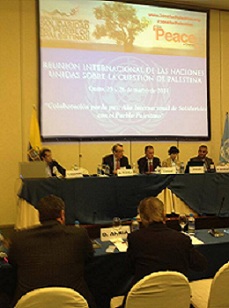
ATFP Pres. Ziad Asali’s Statement at the UN Conference on the Question of Palestine in Ecuador March 26, 2014 "...encouraging in word and deed the parties to do what they need to in order to make serious progress towards a peace agreement."

ATFP Gala 2013

 American Task Force on Palestine... A Decade of Achievement: Answers to Frequently Asked Questions About ATFP

 ATFP is a vehicle and asset for those Palestinian and Arab Americans who wish to make use of it. And it can serve as an exemplar for those who want to emulate or elaborate on its approach through organizations or initiatives of their own. Others who chose a different path should make use of the openness of the American political system to advance their own agendas. The single greatest asset belonging to the Palestinian- and Arab-American communities is our citizenship in by far the most powerful country in the world, which is also a free society that imposes no structural, legal or practical barriers to our own participation as fully engaged Americans. Anyone can assert their rights to full, equal American citizenship and help to define and implement our core, indispensable national interests, which include Middle East peace based on the creation of a Palestinian state.

ATFP on facebook

Commissars of Arab-American political correctness want the community powerless 

 
IBISH: ‘Tough love’ can keep Israel and the Palestinians honest

Israel is used to indulgence from the West, but it’s beginning to experience unexpected and uncomfortable forms of pressure. The Palestinians are used to being pressured by the West regarding Israel, but not on internal governance. It’s high time for a period of “tough love” for both, and this seems to have begun. It’s in everyone’s interests.

Israel has been trying to get into the US visa waiver programme, meaning that citizens of Israel wouldn’t need a visa to enter the United States. But US law requires that American citizens must receive the same treatment. And it’s been clear for decades that Israel discriminates against Palestinian and other Arab Americans.

This was acknowledged by the state department last week when spokeswoman Jen Psaki noted: “The department of homeland security and state remain concerned with the unequal treatment that Palestinian Americans and other Americans of Middle Eastern origin experience at Israel’s border and checkpoints, and reciprocity is the most basic condition of the visa waiver programme.”

In other words, the Obama administration is not going to make Israel an exception in allowing it to discriminate against American citizens on the basis of their ethnicity, religion or national origin.

There has been a recent spike in the number of rejections of Israeli visa applications. In the House of Representatives, a bill that effectively exempted Israel from the reciprocity clause languished. Instead, in January, the committee on foreign affairs adopted the “US-Israel Strategic Partnership Act of 2013”, which requires Israel to “satisfy” and “continue to satisfy” section 217 of the Immigration and Nationality Act for inclusion in the visa waiver programme. This requires “reciprocal privileges” for Americans.

The position of the state department and department of homeland security on Israel’s well-documented discrimination against Palestinians and other Arab Americans means it clearly wouldn’t qualify under the House bill.

Legislation pending in the Senate incoherently contains language that would both require Israel to comply with Section 217 and simultaneously be allotted a special dispensation to discriminate against Americans. Given the position of the House and the administration, it now seems almost certain that Israel’s efforts to get the United States to wink at its undeniable record and practice of discriminating against Palestinian and Arab Americans just isn’t going to happen.

The apparent collapse of efforts to include Israel in the US visa waiver programme is only the latest instance of what might be termed “tough love” coming from its western allies. This particular instance is pursuant to American anti-discrimination legislation and the rights of all Americans.

But many recent comments from both Barack Obama and John Kerry, the US secretary of state, have been much more blunt about the dangers facing Israel in the event of a collapse of peace talks with the Palestinians, and the limitations of what the US might be able, or implicitly interested, in doing to prevent the “international fallout.”

Among the key examples of this is an even “tougher” form of “love” coming from the European Union and individual European states, who are beginning to put substance into their long-standing policies objecting to Israel’s illegal settlement project.

They have already insisted that multilateral and public sector projects don’t include funding or support for any settlements. And Germany, Israel’s closest friend in Europe, is pushing to extend those restrictions to bilateral and private sector projects in any territories “not under Israel’s jurisdiction before June 1967”. If that happens, most other European countries will quickly follow suit.

For their own purposes, both the Boycott, Divestment and Sanctions movement (BDS) that seeks to target Israel as a whole rather than the occupation and settlements, and the Israeli government are trying to conflate the emerging European policy with BDS.

Benjamin Netanyahu spent a good deal of his recent speech at the American pro-Israel  organisation  AIPAC doing just that, with the overt purpose of making Europe’s actions seem anti-Israel, if not anti-Semitic. But in truth, the two are totally unconnected and pursuant to different goals.

Whatever BDS activists may imagine, European statesmen don’t read their blogs or Twitter feeds, and are not inspired by their rhetoric. The Europeans are pursuing the logic of their own policies and – since the United States does not appear to object to any of this – also potentially giving the Americans at least additional rhetorical leverage with Israel.

Europe’s policies aren’t anti- Israel. They are pro-peace and pursuant to international law. This is friends doing what friends should do: helping each other see what’s in their best interests and refusing to cooperate with self-destructive behaviour.

The Palestinians, too, require some “tough love.” The “love” they need is much greater aid and technical support from the West and the Arab world.

The “tough” part would be for the donor community to demand, as they can and should, that Palestinian advancements in recent years in good governance, transparency and security professionalism – many of which have frayed over the past 12 months – be at least restored to their former standards. The Palestinian people clearly want effective and accountable governance, and the donor community has unique leverage to help them ensure they get it.

The Palestinians and Israelis need their friends to help them achieve peace. But, like everyone, they also need their friends to help keep them honest. That’s what real friends do.

Hussein Ibish is a senior fellow at the American Task Force on Palestine, a columnist for Now Media and blogs at www.ibishblog.com. On Twitter: @ibishblog.


ATFP's fundamental mission is to advocate that a conflict-ending solution that allows two states, Israel and Palestine, to live side-by-side in peace, security and dignity is in the American national interest. ATFP emphasizes its role as an American organization serving American interests first and foremost. ATFP sees those interests as directly and indispensably served by the creation of a Palestinian state in the territories occupied in 1967. It believes such an arrangement is the only potential conflict-ending solution and supports negotiations to achieve it. ATFP also seeks to bring Americans and Palestinians closer together at every level, and to mainstream Palestine, Palestinians, Palestinian Americans in the American policy and broader national conversations.

ATFP also stands for the continuous improvement of the Palestinian quality of life despite the political and diplomatic variables. ATFP strongly supports Palestinian economic development, institutional-building and reforms aimed at good governance, accountability, transparency and the rule of law. ATFP supports the creation of a state of Palestine that is democratic, pluralistic, tolerant and peaceful. ATFP believes that resolving the Palestinian issue is inextricably linked with developments in the Arab world and the broader Middle East. It also holds that American interests and values are complementary rather than contradictory in the Middle East, and especially with regard to Palestine.

Ziad Asali

@ZiadAsali

President and founder of American Task Force on Palestine. ____RTs are interesting!
Washington D.C. · americantaskforce.org

Wednesday, March 26, 2014

Advancing Peace between Israelis and Palestinians: Obstacles and Opportunities Statement of ATFP Pres. Ziad Asali at the UN Conference on the Question of Palestine in Ecuador "...encouraging in word and deed the parties to do what they need to in order to make serious progress towards a peace agreement."


UNITED NATIONS INTERNATIONAL MEETING ON THE QUESTION OF PALESTINE
March 25, 2014 Quito, Ecuador
Statement of ATFP Pres. Ziad Asali

Introduction:

Over recent decades, particularly in the context of United Nations Security Council Resolution 242 and all subsequent resolutions following the 1967 war, an overwhelming international consensus has emerged in favor of peace in the Middle East based on two states -- Israel and Palestine -- living side by side in peace, security and dignity. The Palestinian state will be highest form and vehicle for realizing the inalienable rights of the Palestinian people through the exercise of self-determination. 

Since it was established in Madrid in 2002, this international consensus has been most directly expressed through the Middle East Quartet -- the United States, the European Union, the UN Secretariat, and Russia -- which has effectively given the imprimatur of the entire international community to the project of seeking this outcome. Moreover, a solid majority of both Israelis and Palestinians have expressed a preference for this outcome in virtually every poll and survey over more than two decades. Despite the enormous frustrations resulting from a lack of peace, these majorities remain committed to this goal. The Arab League has unanimously expressed the Arab consensus in favor of this as well, through the Arab Peace Initiative. With the exception of a few outliers internationally and in any given society, the whole world essentially agrees on both a two-state solution and its fundamental outlines: a Palestinian state alongside Israel based on the 1967 borders with mutually agreed land swaps and its capital in East Jerusalem, a fair and just resolution of the refugee issue, and full regional acceptance, recognition and integration of Israel in the Middle Eastern family of nations, and guarantees for its security.

There is an obvious reason for this consensus: it is the only potential conflict-ending solution. Other outcomes are achievable, most notably a continuation of the conflict in its present or modified forms. All other formulas are either fanciful and unachievable or would simply extend the conflict, albeit potentially in a somewhat altered context. Both of the parties, their neighbors and the entire world have a large stake in resolving this most long-lasting and politically damaging of conflicts. It is in the interest of no responsible party and no sensible people to wish to continue the Israeli-Palestinian conflict any longer. And this has been true for decades now. The problem before us today is, why have we been unable to achieve a conflict-ending two-state peace agreement, and what can be done to advance that crucial goal?

Obstacles to Advancing Peace:

The fundamental problem confronting all efforts to develop a two-state solution and realize the international consensus on a two-state peace agreement boils down to a fundamental disconnect between stated policy versus practical politics at several registers. Practical politics interferes with the stated policy aim of achieving a two-state solution. Everyone says they are for it, yet everyone is held back -- at least to some extent -- by political considerations and restraints.

The first, and perhaps most far-reaching of these, is a fundamental lack of trust that political leaders on both sides confront. For both Israelis and Palestinians, there is a lack of trust between the two sides, both at the political leadership and popular registers. Israelis and Palestinians do not believe each other, and while strong majorities of both say they want a two-state solution, they also say they believe the other side does not. They believe, in other words, that they are telling the truth but the other side is lying and has actual goals that are fundamentally incompatible with a two-state agreement. Second, there is a gap between the leaderships and their own publics. Both Israeli and Palestinian leaders have not done enough to prepare their peoples for the necessary and inevitable concessions that must be made to secure a viable peace agreement. Often the general publics on both sides don't trust their political leaderships to secure their interests, and leaders find themselves harassed on peace issues from both their left and right wing flanks. Finally, on both sides, political leaders lack strong personal and political incentives to make bold steps towards peace, even if that is clearly in the national interest of both Israel and the Palestinians. They face opposition within their own political establishments, which, on both sides, include significant and empowered actors that are either not committed to a two-state solution, or who find a personal or political benefit in opposing the necessary steps to advance one. There are powerful forces in both the Israeli and Palestinian political establishments opposed a two-state solution, in some cases under the present circumstances, and in some cases altogether. This is particularly damaging, and presents the most direct obstacle to leaders for the necessary compromises to move the process forward.
The agreed-upon final status issues themselves present another serious set of obstacles to advancing peace, because – despite significant progress in bridging the gaps over the past quarter century – the distance between the parties on these specific issues remain real and substantive. As the peace process has ground on, there have been several highly sanguineous and traumatizing eruptions of violence during the past two decades. Expanded settlement construction, ongoing occupation, violence, incitement, and regional and international meddling have exacerbated these problems. All these factors have led to a hardening of positions. In the past, both negotiators and the publics they represent appeared to be more flexible, and have more wiggle room, on the final status issues.

Amid growing cynicism about the prospects for the realization of a genuine and lasting two-state solution, self-serving narratives about the history of the peace process on both sides have intensified their grip on the public imagination, making compromise more politically difficult both to propose and to implement. Everyone agrees there are difficult choices to be made, but the political conditions render making them far more difficult than it should be.

The Middle East and North Africa region is currently undergoing a period of protracted instability and change, the outcome of which cannot be predicted or controlled (although it can be strongly influenced by sound policies). Under circumstances of uncertainty, societies typically fall back on familiar narratives, traditional positions that do not easily lend themselves to compromise, and an attachment to traditional assumptions that are familiar even though they may also be unsustainable and dangerous. Regional dynamics have also proven to be an impediment given the relentless interference in Israeli-Palestinian dynamics, and internal Palestinian politics, by various regional actors, some of whom are not committed to a two-state solution. Most notably Iran has used the Palestinian issue as a tool for its own foreign policy, and used proxies in the occupied Palestinian territories, Lebanon and Syria to undermine the prospects for a peace agreement. These forces use Palestine as a proxy for their own, independent, and sometimes entirely unrelated, purposes, and as a means to distract from other realities.

Another major impediment to peace arising from the present condition of instability in much of the region is the present inability of Egypt -- which is an indispensable partner in achieving a sustainable Israeli-Palestinian peace agreement, and even significant progress towards such an agreement -- to play such a role because it is undergoing a period of difficult transition of its own. Over the past three years, it has become increasingly clear that it is more difficult than ever to attempt to resolve the Israeli-Palestinian conflict in isolation from its regional context. Instead, it must be part of a broader transformation throughout the Middle East. And, in particular, crucial peace partners such as Egypt, Jordan and the Gulf states must be in a position to play their necessary roles.

Regional turmoil, in Syria and many other Arab states, also means that the Israeli-Palestinian issue has receded as an immediate priority for much of the international community, including many in the American political establishment, and even in the Arab world. Simply put, Palestine is no longer the overriding issue on the international and regional agenda that it was for so long, although its long-term strategic significance remains undiminished. The relative de-prioritizing of Palestine in the minds of many is a mistake, but also an unsurprising outcome of the broader turmoil facing much of the rest of the region. In Israel, this turmoil is often misinterpreted as arguing for a strategic imperative that emphasizes security based on a "fortress" mentality, emphasizing walls, missile-defense systems and a risk-averse approach to regional changes. But it could, and should, prove a catalyst for greater cooperation, or at least understanding, between Israel and many of the Arab states that share some of its core concerns about the strategic future of the Middle Eastern region. However, lack of progress towards a two-state solution is greatly hampering prospects of turning these potential convergences into open cooperation.

Opportunities for advancing peace:

Despite this relatively gloomy assessment, there are real reasons to hope and assume that a two-state solution remains not only a plausible outcome, but the most likely one because it is in the interests of all parties over the long run. The most obvious new opportunity for progress is the dynamic personal engagement of the American Secretary of State John Kerry. Through skill and determination he has accomplished more than most thought possible a mere 12 months ago.

If, for the reasons outlined above, the present circumstances are not conducive to a major breakthrough on final status issues in the immediate term, in their own core interests all parties need to "buy time" to sustain the viability of a two-state solution. Should no major breakthrough emerge in coming weeks for both political and strategic reasons, the parties, the region and the international community all have a major incentive to keep the prospects for peace alive. They should work together to achieve such progress or measures as can be realized in order to ensure that Israelis and Palestinians, other Middle Easterners, and people and leaders around the world do not give up on the prospect for a two-state, conflict-ending peace agreement.

The prospect for a real engagement by significant regional players in the Israeli-Palestinian dynamic in a positive, rather than a counterproductive, manner is foreseeable. Jordan has made its willingness to play a significant and helpful, and indispensable, role clear. Many of the Gulf states, too, appear interested in playing a constructive role if possible. And it is likely that Egypt, once it has reestablished domestic security and secured its new political system, will once again emerge as a central player in the pursuit of a conflict-ending agreement. However, a series of horizons can be identified to all of the regional obstacles and opportunities outlined above. They must be taken advantage of when they present themselves, or cultivated and encouraged to emerge. Otherwise, they may become yet another footnote in the endless catalog of missed opportunities in the Israeli-Palestinian annals.

One of the more encouraging recent developments that presents a new opportunity for advancing the peace agenda is the emerging policy of the European Union and key EU member states individually of declining to subsidize or be involved in Israel's settlement project. The recent negotiations over the "Horizon 2020" EU-Israel joint research project, in which Europe insisted that no funding would be extended to areas not under Israel's jurisdiction before 1967, was an excellent model of how the international community can emphasize to Israel that while it emphasizes Israel's legitimacy, it does not accept the legitimacy of its settlement project and will not cooperate with it. Efforts by Germany and other European states to extend this multilateral approach to existing and future bilateral agreements, and to include private sector initiatives as well as purely public sector ones, are also highly encouraging. This European approach is based firmly in international law, pursuant to a two-state agreement, and a responsible intervention to try to de-incentivize Israel from further provocative settlement construction and other unlawful activity in the occupied Palestinian territories.

Similarly, some official American rhetoric increasingly constitutes a kind of "tough love" for Israel by emphasizing the potential consequences of a failure to compromise with the Palestinians on peace and to maintain the occupation and the status quo. Recent comments by US President Barack Obama that, should peace talks fail, the United States might not be able to contain the international consequences for Israel are a prime example of such rhetorical toughening. Palestinians, too, have been hearing from both Europe and the United States about the urgent need for them to not only compromise with Israel, but also to reform their own governance and public-sector structures. Some of these warnings have been tied to aid and other assistance programs to the Palestinian Authority, just as the EU is making its investments in Israel contingent on its funding not being expended in the occupied territories. All of this is heartening because it constitutes friends and allies doing what they always should: encouraging in word and deed the parties to do what they need to in order to make serious progress towards a peace agreement, or at least maintain its viability and prevent any significant re-eruption of violence on the ground. On the whole, Western friends of both Israel and the Palestinians are becoming less knee-jerk and more critical in their responses to the conduct of the parties. A further such measure might be holding senior officials on all sides accountable for statements that gratuitously and brazenly undermine the two-state solution, and credibility and viability of efforts to achieve it.

What can be done now?

If it's true that a major substantive breakthrough on the core final status issues is unlikely in coming weeks, then what can be done immediately to maintain the viability of peace and improve the situation on the ground? Short of the urgent goal of ending the occupation, certainly Palestinians are in dire need of greater economic assistance, development and reform. The PA is under-funded and its ongoing fiscal crisis exacerbates the difficulties in maintaining stability and empowering leaders to compromise. It is a source of tension that can be fairly easily dealt with, given the political will in the West and among the Arab states to provide the necessary financial aid. Palestinians, too, must do their part in heeding the advice of all of the multilateral and international economic and financial institutions by trying to shift from a top-heavy, public sector-based economy to one that focuses more on private sector initiatives. Palestinians will need significant external assistance, and at least non-interference, if not cooperation, from Israel, in order to create more small and medium-sized private sector businesses. These can form the basis for a sustainable domestic economy into the future, and in a Palestinian state to come. In this regard there have been several encouraging Israel-Palestinian private sector initiatives that are worthy of support.

Similarly, Palestinian institution-building, which was initiated at the end of the last decade, and has been fraying somewhat of late for both political and financial reasons, needs to be reinvigorated. This will require significant efforts on the part of all parties. The Palestinians must have the will to reengage institution-building in a focused and determined manner. Israel must not use the occupation to thwart or stymie the creation of the institutions for a future Palestinian state. And the international community, particularly the West and the Arab world, must provide the political, technical, institutional, educational and financial backing for such projects. Not only will they help to provide the basis for Palestinian statehood, such efforts will foster and engender hope in the future within Palestinian society and promote stability and enhance the prospects for peace.

Palestinian political and institutional reform should be strongly encouraged. Notwithstanding the significant practical and political difficulties involved, municipal and national elections should be held. Palestinian political space would benefit from a wider public debate and engagement with civil society. The primary initiative for this must come from the Palestinians themselves, but, again, they will require international assistance and Israeli non-interference in order to achieve this important goal. The Palestinian people, Israel and the international community all should have a strong interest in helping Palestine engage in a thoroughgoing process of institutional development.

Finally, the international community should continue to develop and intensify efforts to de-incentivize Israel from any further illegal activities in the occupied Palestinian territories, particularly additional settlement construction, home demolitions, the expansion of the separation barrier, land seizures, population displacement, and many other practices that are prohibited under the Fourth Geneva Convention and other key bedrocks of international law. As the occupying power, Israel has rights and responsibilities, but also clear restrictions which it cannot be allowed to violate without consequences. As long as Palestinians perceive the occupation as intensifying and further entrenching with every year of the peace process dragging on without a clear path to Palestinian independence, all other obstacles will be exacerbated. Nothing is more damaging to the prospects for achieving a conflict-ending, two-state peace agreement, or more detrimental to stability.

Because of some of Israel's occupation policies, especially settlement expansion, the Israeli-Palestinian relationship is not a static one, but rather is a dynamic that is in almost continuous deterioration. This must stop. If final-status issue breakthroughs are to be achieved in the future, encouraging Palestinians to focus on institution-building and reform and discouraging Israel from unlawful and damaging occupation policies is crucial. The international community has a major opportunity and responsibility to take significant measures to improve conditions on the ground, and between the parties, through such incentives and disincentives which can stabilize the situation in the immediate term. Ultimately this also can lay the groundwork for progress on a final-status, conflict-ending Israeli-Palestinian peace agreement.