Labels

Showing posts with label Tourism. Show all posts

Wednesday, May 27, 2026

"The chaotic, unique, beautiful Lebanon I knew has been reduced to rubble. When will it end? Suspected war crimes happen almost daily as Israel continues its bombardment, which Unicef estimates is killing nearly 14 children a day. We cannot write this off as just another war in a war-torn region"

‘Lebanese people may have more experience of war, but they do not get used to having their houses bombed.’
Photograph: Mohammed Zaatari/AP


Wed 27 May 2026

There are various reasons why, at 43, I still don’t know how to drive a car. Clumsiness is one. I can’t even walk straight half the time, so I don’t think it’s a good idea that I take control of a 2-tonne vehicle.

Another reason is that my first driving lesson was in Beirut and the experience scarred me for life. The car was falling apart, Lebanese drivers ignore traffic rules and the lesson was in Arabic, which I barely speak. After I had veered on to a busy road the wrong way, my teacher made me get out of the car and yelled at me. I didn’t understand exactly what he was yelling, but it wasn’t good.

Despite that unfortunate incident, Lebanon – chaotic, beautiful, unique Lebanon – has a special place in my heart. When I was 18, my parents moved to Beirut for several years and I visited regularly. We’d go to the ancient ruins in Baalbek; drop by wineries in the Bekaa valley; eat man’oushe in the mountains. We’d do organised hikes, on which there would always be a glamorous woman in heels, full makeup and a designer nose (the Lebanese take grooming and cosmetic surgery very seriously).

Things were never completely calm. Coming home from a swim one summer, my mum narrowly escaped a car bomb intended for a politician. In 2006, my parents were stranded overseas for months because Lebanon and Israel were at war. In 2008, there were a couple of days of clashes that meant my mum and sister couldn’t leave the house.

Still, this was a relatively good time; there was investment, tourism, hope. In January 2009, the New York Times named Beirut its No 1 place to visit that year. With luxury hotels and restaurants opening, the Times said “the capital of Lebanon is poised to reclaim its title as the Paris of the Middle East”.

You may have heard that stupid phrase before: whenever a writer wants to convey to a western audience that Beirut is not some backwater, but a real place full of real people, they reach for it. It’s cringe and orientalist, but it’s also an effective shorthand. And maybe I should have adopted it myself, because what I’m trying to say here, with my walks down memory lane, is that Beirut is not fundamentally different from Paris. People who live in Lebanon, or the Middle East more broadly, are not born with thicker skin. They do not grieve their children less than Europeans do. They may have more experience of war, but they do not get used to having their houses bombed.

Many people seem to think otherwise... READ MORE  https://www.theguardian.com/world/commentisfree/2026/may/27/chaotic-unique-beautiful-lebanon-reduced-rubble-israel-bombardment

 [AS ALWAYS PLEASE GO TO THE LINK TO READ GOOD ARTICLES (or quotes or watch videos) IN FULL: HELP SHAPE ALGORITHMS (and conversations) THAT EMPOWER DECENCY, DIGNITY, JUSTICE & PEACE... and hopefully Palestine] 

Wednesday, April 2, 2014

"Read and remember, take a minute to recall the smell of your grandmother’s za’atar and the taste of balady labaneh, and imagine what would happen if we were to lose it all…" This Week in Palestine


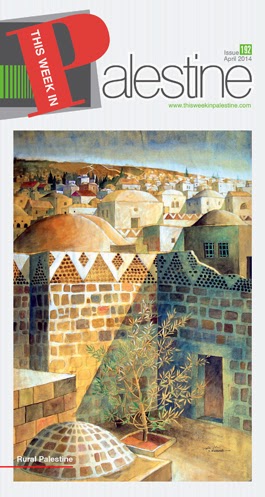
Theme: Rural Palestine
Cover photo: Suleiman Mansour


Ya yalla hal rabee’, nohroth hal sahel, wallah bilzare’ wallah, bnihmy ardina al hurra… The lyrics from a folkloric song, recomposed and distributed for Sareyyet Ramallah’s lastest dabkeh production, embody the essence of Palestine’s “rurality.” “Come, my people, let us farm the plain; with farming we protect our free land.” The idea that farming is a form of resistance is and should remain at the centre of Palestinian nonviolent resistance. Palestinians identify themselves with the land. We are first and foremost a rural agricultural society. Our modern urban centres have sprouted from villages and farming communities. We as a people are not urban, but rather descendants of farming families who are deeply tied to their land. And our Nakba is not simply the story of becoming refugees but rather the loss of our farming villages. Our producing farmers have become landless refugees.

It is not a coincidence that we chose Rural Palestine for April’s theme just as khobbaizeh, loof, akkoub, loze akhdar, and karaz akhdar (mallow, black lily, gundelia, green almonds, and green cherries) are in season - rural Palestinian delicacies that have many of us travel hours back to our home villages to taste a small dish. If this issue is supposed to accomplish anything at all, it should serve as a reminder that we are a hop, skip, and a jump away from rural Palestine no matter where we live. It should also put front and centre the true danger that we face as a nation today: an endangered farming craft, not only because of land confiscation but also through the seeping of Israeli produce into our markets and the savage industrialisation of rural fertile farming areas; the latter being more dangerous than Israeli occupation itself. If we lose our rural identity, we lose Palestine, plain and simple.

Read and remember, take a minute to recall the smell of your grandmother’s za’atar and the taste of balady labaneh, and imagine what would happen if we were to lose it all…

You will notice as you leaf through this issue that our print edition has a new look.  Again this is no coincidence that we chose to unveil our new look as winter dissipates and spring blossoms.  We are very excited about the new print edition, and hope that you will see it as the natural bloom and evolution of our previous look.  We look forward to hearing your feedback.

Riyam Kafri-AbuLaban
Content Editor

 
[AS ALWAYS PLEASE GO TO THE LINK TO READ GOOD ARTICLES IN FULL: HELP SHAPE ALGORITHMS (and conversations) THAT EMPOWER DECENCY, DIGNITY, JUSTICE & PEACE... and hopefully Palestine]
April 2014


One of the unforgettable memories that seems to accompany my few morning moments most days since I was a child is the smell of taboun bread stuffed with spinach saturating the air as it mixed with the first dawn light outside my grandparents’ house. I would watch my grandmother’s hands blend into the darkness of the taboun oven as she fiddled with the bread back and forth before laying it to rest on the stone bed in the bottom of the oven. My grandmother did this sacredly every day as part of the breakfast preparation ceremony.

I guess I developed a connection to the countryside of Palestine guided by my grandmother’s passion for the fields, the fig trees, the apricots, and the sage or mint herbs that we picked to prepare tea. We would wait for the rest of the family to get up to prepare breakfast under the grape pergola. My grandmother made everything herself: the jam, the labaneh balls dipped in oil, the olives, the pickles, and the zeit and zaatar. Her kindness taught me to care for the little things around me; the sound of the birds, the small vegetable garden, the chickens running around in the coop, and the olive terraces leading down into the valley through a set of intertwined narrow paths where shade is abundant during hot summer days. My grandmother’s generosity was an enlightenment and a stone-engraved lesson in rural hospitality and graciousness.

What does rural Palestine offer beyond this affability? A diverse landscape, a commanding series of olive-tree-covered mountains, and a historically immersed serene Palestinian village are some of the first thoughts that might come to mind. In my involvement with organisations such as the Rozana Association for Rural Tourism Development working from Birzeit, NEPTO (the Network of Experiential Palestinian Tourism Organizations), Masar Ibrahim, and others, I have been active in promoting community-based rural tourism throughout the West Bank. All our work is based on a simple platform idea that aims to identify the resources and capacities that exist in rural areas and that are able to add value to and benefit the local community. Needless to say, resources in the rural areas are abundant and include elements of architecture, handcrafts, environment, nature, food, culture, and heritage. Consolidated together these elements not only form attractive packages for visitors and guests, they also contribute to the building efforts of a differentiated Palestinian identity. I used to think that people who are as connected to the land as my grandparents could convert everything they touch into gold, given that they were able to create many things seemingly from nothing. The lands in rural Palestine can provide for the well being of our people. They are our food basket and our heritage. Our villages are immersed in history and they tell the story of an ancient people whose roots reach beyond time and civilisation. 
 
The question remains: How do we move forward beyond this potential? All organisations that are involved in community-based tourism supported by a strategic cooperation within the Ministry of Tourism and Antiquities have been converging towards a holistic vision that reflects the shape of the Palestinian rural-tourism product. The vision is based on a network of thematic trails and paths and a number of centres for local culture, all of which are linked together and developed in harmony and synchronisation, building and sharing synergies, resources, and capacities. One of the main pillars is a long trail that runs through the West Bank from Rummaneh in the north to Hebron and its vicinity in the south. This trail is locally called Masar Ibrahim and is essentially a cultural trail that zigzags between villages, fostering the Palestinian culture of hospitality, friendship, and kindness. National Geographic recently ranked this trail as the number one new trail in the world. It forms a spine as it crosses the entire West Bank. Masar Ibrahim intersects with the Nativity Trail in several areas as it connects between Bethlehem and Nazareth. Both trails also link with a network of Sufi trails, led by the Rozana Association. The Sufi trails model is based on a network of hub villages that operate as centres from which a number of trails originate. These are also cultural trails that attempt to promote local resources, history, heritage, landscape, environment, and an opportunity to meet and benefit the local rural communities...READ MORE

[AS ALWAYS PLEASE GO TO THE LINK TO READ GOOD ARTICLES IN FULL: HELP SHAPE ALGORITHMS (and conversations) THAT EMPOWER DECENCY, DIGNITY, JUSTICE & PEACE... and hopefully Palestine]
 

 [AS ALWAYS PLEASE GO TO THE LINK TO READ GOOD ARTICLES IN FULL: HELP SHAPE ALGORITHMS (and conversations) THAT EMPOWER DECENCY, DIGNITY, JUSTICE & PEACE... and hopefully Palestine]

Saturday, March 29, 2014

National Geographic rates the Abraham Path the #1 New Walking Trail in the World!

Get closer to your destination and lace up your boots for a trekking trip — relying on a map and negotiating tracks under your own steam is as rewarding as it is healthy. Whether you’re keen to pace the Wales Coast Path, walk in the shadow of Caribbean volcanoes, or tackle the Himalayan peaks, here’s our guide to the world’s best new walking routes
 
Published March 06, 2014
By Ben Lerwill
 
01 Abraham Path, Middle East

“I started walking these hills when I was seven, collecting wild honey with my father,” says Habib, my guide. We’re in the northern West Bank. From east to west, he points out the outcrops of Jordan, the banks of the Dead Sea, an Israeli settlement, two Palestinian villages, pale hills, Ramallah city and, in the distant haze, Jerusalem. It’s a lot to take in. “I still love to walk. It’s in my head, in my heart. If I have a problem, a big thing to think about, I come here and walk,” Habib adds.

In the Middle East there are a lot of big things to think about. It’s one of the reasons the Abraham Path — a long-distance hiking trail that, once complete, will stitch a route across almost the entire region; through Turkey, Syria, Jordan, Palestine and Israel — is such a singular project. It currently comprises over 280 miles of trails, with more added each year.

The route is based on the ‘cultural memory’ of Abraham — a key figure in Islam, Judaism and Christianity — and loosely traces the on-foot journey he made some 4,000 years ago. The overarching idea is for the path to build a connection between Middle East communities and visitors from across the world.

In the village of Al Mughayir, there’s a disturbance going on. My group is walking a three-day, 32-mile section of the path through the West Bank, winding along stony hillside tracks from the northern city of Nablus down to the outskirts of Jericho. It’s our second day, and after a morning spent passing through wheat fields and olive groves we reach the village as the day’s heat takes hold.

But we haven’t banked on coinciding with school break time. Spying the walkers, children begin charging at the playground fence: 10, 20 — suddenly more than 100. Their faces are urgent, their voices a frenzy. Through it all, it’s possible to pick out individual shouts. “How are you? Hello!”
“Welcome to Palestine!” “What’s your name?”

The landscape has a hardiness that conceals gifts: mistletoe, wagtails, dragonflies and pink cyclamen. And the walking is often dramatic, particularly in the canyons of Wadi Auja, where the only sounds are birdsong and footfall on loose rock.

We sleep in welcoming homestays. I learn that lamb-filled flatbreads and pomegranate juice make good hiking fuel, and the valleys glow gold at first light. There are surprises too, not least in the Christian town of Taybeh — pre-trip, I hadn’t envisaged myself ordering locally brewed beer from a nun.

It’s a spirit-lifting hike — and Habib provides an all-seeing eye throughout. Here the smoke from a Bedouin camp, there an Israeli military base. Here a porcupine print, there a sacred mountain. And this sense of immersion is what makes the Abraham Path project so extraordinary — it gives travellers the chance to shape their own perspective. abrahampath.org

Best for: Those looking for more than a scenic trek.
Difficulty rating: 6/10.

How to do it: In the West Bank, the Siraj Center runs tours along the Abraham Path from $650 (£398) for four days, including transfers from Jerusalem. EasyJet flies to Tel Aviv from Luton and Manchester; British Airways from Heathrow; El Al from Heathrow and Luton; Jet2 from Manchester. The airport is 27 miles from Jerusalem, with regular public transport. sirajcenter.org   easyjet.com   ba.com   elal.co.il   jet2.com

***

 We welcome YOU to experience Palestine through our walks!
Walking trails in Palestine are as old as the stones of Jerusalem. Caravan routes were used to cross Palestine through three different areas: the Jordan Valley (rift valley), the Central or Patriarch’s Route, and Via Maris. Caravans were used to trade and exchange goods with the people who lived in Palestine through all ages and civilizations. The people of Palestine have always offered great hospitality to first-time visitors, not knowing where they come from or how long they will stay. Hospitality and offering the best of what they have is still the main characteristic of the people of the land. Building on the great hospitality and kindness of the Palestinian people, and on the same routes that people have been using for thousands of years, new hiking and walking routes have been emerging in Palestine.

Thursday, December 19, 2013

"We Palestinians are a society, with a culture and language. We have our cause and the right to our land. Freedom of movement, speech, and press are the basics. If you’re in solidarity and you believe that, put your investment in the right place." Manar Harb

This Week in Palestine archived cover
What Are Fifteen Years?
By Manar Harb


I started my editorial career at This Week in Palestine (TWIP), and I am very proud of this fact. TWIP is a national magazine, made for the people, by the people! It may have started as a publication for tourists, but throughout the fifteen years of its existence, TWIP has acquired quite a unique archive of the Palestinian narrative. During my own experience, I was absolutely fascinated by the amount of material we received for each issue. The entire process was like soaring above the clouds with readers and writers. I was connecting with Palestinian authors from all around the world. I remember so many who reached out to us to express their thoughts and share their stories. I felt exposed to the entire Palestinian community that I was trying to connect with. Suddenly, TWIP was the only place that somewhat represented a “collective.”

The collective is an important part of the Palestinian struggle; no collective, no victory. And Palestinians everywhere need to think about a collective vision if we wish to have a future with a place called Palestine. Don’t kid yourself, we Palestinians are close to extinction. Perhaps I exaggerate, perhaps not; either way, without a complete understanding of the entire picture - the documentation and narration of what happened, and of what is taking place - there will be no justice!

Local organisations and businesses in solidarity with the Palestinians should support such a constructive medium. We Palestinians are a society, with a culture and language. We have our cause and the right to our land. Freedom of movement, speech, and press are the basics. If you’re in solidarity and you believe that, put your investment in the right place.

Finance and marketing are two important factors in the life of a magazine, and they also influence the content and final output. These are areas that we should also think about and examine. The overhead involved in printing 12,000 copies of each issue is not cheap! And yes, to sustain a magazine, resources are required.

TWIP has the capacity to reflect a part of the Palestinian narrative to an English-speaking audience, which is a pretty powerful tool. And the English-speaking audience is a broad audience. We Palestinians have not been very good at presenting ourselves in public. I mean the public media. We haven’t been very successful at presenting ourselves to each other. I find that TWIP is a healthy space for us to have these exchanges and conversations between ourselves, and yes, in English, because the world needs to know.

Palestinians will always be weak if we remain divided; we will be strong only if we are united with our Arab neighbours and allies. It is true that borders disconnect us, and that if it weren’t for the Israeli occupation, there’s no reason why I wouldn’t be speaking Farsi or Turkish. There was a point in time, not long ago, when those borders were wide open and people travelled freely from village to village, and town to town. We won’t forget what once was, but we will also look very closely at the present.

The present is the most exciting time! Some say that the present is a gift.

The best gifts are those that come unexpected. We’ve got some presents to give! With the young and the old, our voices, our energy, our fathers and sons, our mothers and daughters, we’ve got to tell our stories; that’s the only way to justice.

The magazine has survived fifteen years of wars and conflict, issue after issue, curfew or not, TWIP was published! The clarity of the vision behind TWIP is what drives this success.

I am grateful for TWIP as a model of success for Palestinians, an experience that reflects how persistence and faith go a long way. For the future of this humble magazine, I only hope for further growth. And thank you, TWIP, for capturing some of the brighter moments. (:

I am really proud of you, Sani Meo and Taisir Masrieh!
Manar A. Harb is an aspiring writer and previous content editor of This Week in Palestine.


[AS ALWAYS PLEASE GO TO THE LINK TO READ GOOD ARTICLES IN FULL: HELP SHAPE ALGORITHMS (and conversations) THAT EMPOWER DECENCY, DIGNITY, JUSTICE & PEACE... and hopefully Palestine]

Wednesday, December 18, 2013

Christmas in Bethlehem ...useful links

[AS ALWAYS PLEASE GO TO THE LINK TO READ GOOD ARTICLES IN FULL: HELP SHAPE ALGORITHMS (and conversations) THAT EMPOWER DECENCY, DIGNITY, JUSTICE & PEACE... and hopefully Palestine]
Christmas in Bethlehem
By VisitPalestine.ps
 
Every December Bethlehem takes centre stage as it welcomes thousands of visitors who come to experience this historic town and join in the Christmas celebrations. This year should be no different as Bethlehem and its host communities once again prepare to welcome their guests from across the world.

Men, women, and children, tourist and local alike, will once again pack Manger Square to wait for and welcome the Roman Catholic Patriarch, Archbishop Fouad Twal, as he arrives at the Church of the Nativity and marks the start of Christmas celebrations. Palestinian boy scouts and girl scouts will bring the streets to life as they parade down Manger Street playing loud, festive music on their bagpipes and drums. Be sure to check out the December schedule of events that is expected to be packed with activities throughout the area. Dozens of international and local artists, musicians, choirs, and bands are scheduled to perform in Manger Square and at other venues, such as the Bethlehem Peace Center and Dar Annadwa (International Center of Bethlehem). The Annual Christmas Market will once again bring together local and international artisans showcasing and selling crafts, traditional foods, Christmas decorations, and children’s goodies. The Christmas-tree-lighting ceremonies in Bethlehem and neighbouring Beit Jala and Beit Sahour are yet another draw for tourists and locals alike since they will surely be accompanied by music and dance celebrations.


Celebrations will slow down after Christmas Eve on the 24th but pick up again with the celebration of Greek Orthodox Christmas on January 6 and Armenian Christmas on January 18.


If you plan to spend New Year’s Eve in Bethlehem, there will definitely be dozens of parties taking place at hotels and restaurants in the area. The Manger Square celebrations will feature fireworks displays and various performances.


Useful links for Christmas season events:
www.thisweekinpalestine.com

www.visitpalestine.ps

www.travelpalestine.ps

Saturday, October 5, 2013

Pomegranates in season along the path!

Pomegranates in season along the path! Photo by Julian Bender
This delicious fruit has been on the Middle Eastern table for several millennia. You may be lucky next time you're on the path to grab one fresh off the tree!
The Abraham Path Initiative is an international organization cultivating the development of the path with local and international partner organizations. The initiative is a non-profit, non-religious and non-political organization... The Abraham Path is a long-distance walking trail across the Middle East. Check out the new online guidebook: www.abrahampath.org

Tuesday, September 17, 2013

CNN: World-renowned chef, best-selling author and Emmy-winning television personality Anthony Bourdain... 10 things to know before visiting Israel, the West Bank and Gaza

Mount of Olives
World-renowned chef, best-selling author and Emmy-winning television personality Anthony Bourdain returns for the second season of CNN's showcase for coverage of food and travel. "Anthony Bourdain: Parts Unknown" is shot entirely on location and premieres Sept 15 @ 9pm ET/PT. Follow the show on Twitter and Facebook. Bourdain's first stop: Israel, the West Bank and Gaza.

(CNN) -- The Holy Land makes for inspiring, fascinating, confusing travel.

To some, the chunk of territory between the Jordan River and the Mediterranean Sea is all Israel.

To others, it's all Palestine.

For most -- as is true so often in this region of shifting truths and manipulated historical narratives -- it's a bit of both.


A child walks through a gap in the concrete blocks of a security wall in the West Bank village of Eizariya, east of Jerusalem, in a 2003 file photo. Take a walking tour of East Jerusalem, or a pilgrimage to the Palestinian city of Bethlehem and you'll run into Israel's infamous security barrier. CNN

Season 2, Episode 1
Jerusalem » 

Even food origins are contentious


Israel exists as an intersection of three major religions, Christianity, Judaism and Islam, creating a complex blend of cuisines.

Anthony Bourdain in Jerusalem


"It's easily the most contentious piece of real estate in the world, and there's no hope -- none -- of ever talking about it without pissing somebody, if not everybody, off."

Ibex are just one attraction of the Negev Desert. CNN

Tuesday, December 18, 2012

Time Magazine: A Perfect Christmas in the Holy Land

Vera Baboun, mayor of Bethlehem, Palestine

For me, like other Christians in the Holy Land, Christmas means a new birth, a new beginning. Bethlehem is the city of the Nativity and all citizens, Christians and Muslims alike, come together in a unique celebration. On Dec. 16 we light the Christmas tree in Manger Square, and on Dec. 24 we have the most beautiful festivities when the Latin Patriarch processes to the old Church of the Nativity accompanied by scout groups playing drums and bagpipes. Then there’s midnight Mass especially for the visitors, which is broadcast worldwide.

It’s important that tourists spend some time in and around Bethlehem, visiting famous sites such as the Grotto of the Nativity and Shepherds’ Fields in the neighboring village of Beit Sahour, with its 4th century cave-church. But to really experience Bethlehem’s Christmas spirit, you need to walk our streets and talk to our people.
An eastern European pilgrim walks away from the Armenian section of the Church of the Nativity in the West Bank city of Bethlehem, Dec. 24, 2011. Marco Longari / AFP / Getty Images

Let these residents bid you welcome and be your guides...

Mahmoud Abbas, President of the Palestinian National Authority, Ramallah, Palestine
Maoz Inon, hotelier and co-founder of the Jesus Trail, Nazareth, Israel
Vera Baboun, mayor of Bethlehem, Palestine
Mariam Shahin, author of Palestine: A Traveller’s Guide, Ramallah, Palestine
Raed Saadeh, owner of the Jerusalem Hotel, East Jerusalem

Tuesday, July 10, 2012

Diaspora Palestinians arrive for 'Know Your Heritage' tour

[AS ALWAYS PLEASE GO TO THE LINK TO READ GOOD ARTICLES IN FULL: HELP SHAPE ALGORITHMS (and conversations) THAT EMPOWER DECENCY, DIGNITY, JUSTICE & PEACE... and hopefully Palestine]
Participants in the 2012 Know Your Heritage program.(MaanImages)
BETHLEHEM (Ma'an) -- Palestinian youth living in five countries in the Diaspora arrived in Palestine on Monday to embark on a tour designed to connect them to their homeland.

The delegation of 41 Palestinians, living in the US, Australia, Canada, France and the UK, crossed into the West Bank from Jordan to begin a two-week "Explore & Live Palestine" trip organized by the Holy Land Christian Ecumenical Foundation.

The 'Know Your Heritage' program, inaugurated in 2011 with a group of Palestinian American visitors, aims to connect Palestinians abroad to their roots.

In 2012, the delegates come from families who left Haifa, Jericho, Hebron, Jerusalem, Jaffa, Birzeit, Gaza, Ramallah, and 20 other towns and villages in historic Palestine, HCEF said.

The organization's president Rateb Rabie said: "This mosaic of young faces represents the diversity of the Palestinian nation spread across the globe."

"Their shared dream of homecoming is an enduring testament of this same nation's cohesion and unity, across borders, oceans, religious and political divides, and across generations."

The Palestinian diaspora is spread across the world, with significant population centers in Jordan, Syria, Lebanon, Chile, Egypt, Europe and the United States.

BADIL resource center estimates that 70 percent of the worldwide Palestinian population of around 10 million people are refugees.


Tuesday, December 20, 2011

This Holy Land battle focuses on tourists' wallets

Israel and the West Bank-based Palestinian Authority compete for Christian pilgrims' business in Bethlehem, where scores of buses arrive each day to visit Jesus' birthplace.

[AS ALWAYS PLEASE GO TO THE LINK TO READ GOOD ARTICLES IN FULL: HELP SHAPE ALGORITHMS (and conversations) THAT EMPOWER PALESTINE AND PEACE]
http://www.latimes.com/news/nationworld/world/la-fg-israel-christians-tourism-20111220,0,510422,full.story
A Muslim woman takes a picture of the Nativity scene at the Church of the Nativity in the West Bank city of Bethlehem. (Abed al Hashlamoun, European Pressphoto Agency)

But Nabil Giacaman, co-owner of a souvenir shop called Christmas House, isn't feeling the holiday spirit.

The third-generation woodcarver, who sells handmade likenesses of baby Jesus and the Virgin Mary, sees as many as 200 tour buses arrive every day from Israel to visit the Church of the Nativity, just a few steps from his store.

But the tourists are escorted directly from the bus to the church and back again. They're rarely given time to browse the shops nearby and almost never spend the night in Bethlehem.

"My total sales the other day were $4.13," said Giacaman, 27. "My shop is in the middle of it all, but it gets worse every year. We have tourists, but not profits."

Parallel to the decades-old political conflict over the Holy Land, an economic battle is heating up between Israel and the West Bank-based Palestinian Authority over the market for Christian tourism.

At 1.1 million a year, the number of Christian pilgrims — those who describe their visit as chiefly spiritual in purpose — now surpasses Jewish tourism to Israel. Many of the top Christian sites are in the West Bank, and tourists have been returning in droves thanks to a recent lull in violence.

Many Christian pilgrims belie the image of austere travelers sleeping in religious hostels. These visitors, mostly Catholics and Christian evangelicals, spend about $200 a day on hotels, restaurants and souvenirs, compared with an average of $140 for all tourists, according to Israeli figures.

All this would seem to be only good news for Giacaman and other Palestinian businesspeople.

The reality is more complicated. Most visitors to the Holy Land arrive by air in Israel and join Israeli-led tours. So even when pilgrims visit Palestinian territory, local businesses do not necessarily profit....READ MORE

Friday, December 9, 2011

Nativity Trail 2012 & more from the Siraj Center for Holy Land Studies... Educate yourself:


Siraj is a non-governmental non profit organization based in Beit Sahour, Palestine.


Siraj aims to create links between Palestinian people and people from around the globe through educational tourism, interfaith and ecumenical dialogue, culture and youth exchange programs.


Through its many local connections, Siraj works directly with communities and organizations in Bethlehem, the West Bank, Palestine and the Holy Land, and the entire Middle East...READ MORE

Tuesday, December 6, 2011

Top 10 “Must See” Sites in Bethlehem

Palestine is awakening with new spirit and excitement and offers a unique travel experience that will leave you with memories that will last a lifetime. A visit to this region is safe, welcoming, and to put it best — simply remarkable. Palestine offers the ultimate pilgrimage, an archaeologist’s dream, a shopper’s paradise, and a culinary connoisseur’s delight where the Mediterranean diet is fresh, organic and wholesome. The Ministry of Tourism and Antiquities provides ample support and can supply complete information on destinations, civic and community foundations, and cultural and heritage events. Please visit www.TravelPalestine.ps for a wide selection of information and imagery

Fast Facts

Travel Essentials

Culture & Heritage

Welcome to Palestine, the cradle of civilization, where West meets East, North meets South, and where Judaism, Christianity, and Islam took form. We welcome you in Palestine and hope that you enjoy our cultural richness, deeply compelling history, and legendary hospitality. Over the centuries millions of people have come to visit this beautiful Holy Land and we are glad to welcome you among them. Ahlan Wa Sahlan


http://travelpalestine.wordpress.com/2011/12/02/top-10-must-see-sites-in-bethlehem/
You’re coming to the Holy Land and perhaps you aren’t sure if you should visit Bethlehem. You’ve always wanted to go to Bethlehem and see the Church of Nativity but what else is there? Is it worth planning a a full day, or even two?

Yes. And to make it easy for you, Travelujah has created our own list of on and off the beaten path places you can visit during your next day or two day trip to Bethlehem. Below you’ll find our top “must see” sites in and around this ancient city, revered worldwide as the birthplace of Jesus Christ.

1. Church of the Nativity

The monastery, structured in the shape of a cross, which is one of the oldest continuously operating churches in the world (constructed in 325 AD). It is a major Christian holy site, as it marks the traditional place of Christ’s birth. The building was founded by Queen Helen of the Byzantine Empire. Adjacent to the Church is the Catholic Church of St. Catherine.

2. Milk Grotto

The Milk Grotto is a place where the Holy Family took shelter during the Slaughter of the Innocents, hiding there for a short time from Herod’s soldiers. Mary nursed her child Jesus there before going to Egypt. It is said that a drop of the Virgin’s milk fell on the floor of the cave, turning the rock white and giving rise to the chalky white stone.

3. Bethlehem Old City

In the center of Bethlehem is situated its Old City. A stroll in the Old City can be an interesting activity: its narrow, climactic streets take you to a past like the 19th century! The old buildings, beautifully decorated with stone ornaments, are not just the architectural landmarks – they are houses for many Bethlehemites.

Follow the Star Street – the ancient way which followed Joseph and the vVrgin Mary to the Grotto of the Nativity. The street leads to King David Wells.

4. Shepherd Fields

Shepherd’s Fields are placed in Beit Sahour, small town east of Bethlehem. The Fields are identified since ancient times with the shepherds who saw the Star of Nativity and followed it to Bethlehem.

There are two places considered as Shepherd’s Fields. One is considered by Catholic Church – You can see there an ancient Byzantic stone mosaic! The second site belongs to the Greek Orthodox Church. There is a small Greek Orthodox Church. All its walls are covered by icons showing life of saints. The place is like a fairytale. While there do not miss the olive trees, many are over 2000 years old!

5. Herodium

Herodium is a volcano-like hill with a truncated cone located near the city of Bethlehem. Herod the Great built a fortress and palace on the top of Herodium, and may have been buried there. Herodium is 758 meters above the sea level. The view from its top is amazing! The fortress is more than 2000 years old.

6. Mar Saba Monastery

Mar Saba is a Greek Orthodox monastery in the middle of a desert, east of Bethlehem. Founded by Saint Sabas of Cappadocia in 439, today it houses around 20 monks. One of monastery’s traditions is the restriction on women entering the main compound. The only building that women can enter is the Women’s Tower, near the main entrance.

7. Bethlehem Museums

• International Nativity Museum

International Nativity Museum of Bethlehem is one of the richest and valuable collections of cribs in the Holy Land. The Museum has a collection of over 200 Nativity representations of different styles and dimensions. It is located in the ground floor of the historical Salesian convent of Bethlehem. The variety of the cribs exposed, originating from all around the world, creates a rhapsody of customs, liturgy and rituality from all continents and ethnic groups.

• Olive Oil Museum

Al Bad Museum for Olive Oil production is situated in the Old City of Bethlehem. The building which houses the museum dates back as far as the 19-19th century. The museum houses many ethnographic and archaeological artefacts featuring the entire process of oil production. Furthermore, the exhibit also shows the many uses for oil such as lamps, medicine, food, soap and even cosmetics.

• Palestinian Heritage Center

The Palestinian Heritage Center aims to preserve and promote Palestinian Cultural Heritage, especially the art of embroidery. The PHC has a great collection of traditional Palestinian dresses and antique items of everyday use. It also participates in fair trade of hand-made embroidery, crafted by women from villages and refugee camps around the city of Bethlehem.

8. Al Khader Village

The Al Khader Village (the village of St. George) is located around 4 km south of Bethlehem. There you can see the ancient Solomon Pools – consisting of water cisterns made of stone, that have played a significant role in the area’s water supply for centuries. Near the pools you can see the al Burak castle, an Ottoman Turkish fortress dating back to the 17th century. In the center of the village there is beautiful Greek Orthodox Church of St. George, whose image connotes protection for Palestinian Christians.

9. Cremisan

Cremisan, a small vineyard of delicious grapes, located on the slopes of a hill, is situated in a beautiful region approximately five kilometers from Bethlehem. The vineyard is run by the order of the Salesians of Don Bosco. A bottle of Cremisan’s wine makes a nice souvenir from a visit in Bethlehem.

10. Banksy Art

Banksy is a pseudonymous for an Bristol, England-based graffiti artist, political activist, film director, and painter famous around the world who has self published several books. In August 2005, Banksy painted couple images on the Israeli West Bank barrier, including an image of a Christmas tree surrounded by a wall in Bethlehem and many more. Tourists from all over the world see his artwork while visiting Bethlehem.

Photo credit: Travelujah

* * * *

Beata Michaelska works at the Bethlehem Tourism Office and blogs regularly for Travelujah on interesting sites and experiences in and around Bethlehem. She is originally from Poland and moved to Bethlehem two years ago.

Travelujah is a Christian social network focused on travel to the Holy Land. With thousands of pages of expert and user blogs, travel resources and other planning tools, people can learn, plan and share their Holy Land tour and travel experiences.

This entry was posted in What to See and tagged by travelpalestine.