Labels

Thursday, April 7, 2011

'Perpetual hell' of the Palestinian refugee camps

"During the visit, Lebanese President Michel Suleiman told the delegation that "Lebanon does not have the capacity to absorb 400,000 people; we simply cannot offer them a good life. The truth is that we will not see peace in the Middle East without the implementation of the refugees' right of return."

Foreign Minister Ali Chami said, "it is not acceptable that Palestinians have been living outside their own state since 1948. The half a million in Lebanon are in complete misery and a very dire situation. The clear solution is the establishment of a Palestinian state with Jerusalem as its capital". He also spoke of the Israelis' intransigence: "since 1978, according to UN resolutions, Israel has violated Lebanese sovereignty every day, while the international community has failed to deter them."

Referring to Israel's invasions and occupation of Lebanon, Lebanese parliamentary deputy speaker Abdel-Latif Al-Zein said, "Lebanon has endured a lot for the Palestinian cause... It is high time the West liberated itself from double standards and stopped supporting satellite regimes that do not respect Palestinian rights." A Lebanese Hizbullah MP also remarked that "more than two million people have been killed because of this cause. There are millions of Palestinian victims around the world and the international community has paid out billions of dollars, but there is still no solution." "

http://weekly.ahram.org.g/2011/1042/op9.htm

'Perpetual hell' of the Palestinian refugee camps

A delegation of British and European MPs has underlined the appalling conditions suffered by Palestinian refugees in Lebanon, writes Stuart Littlewood in London

The Daily Star - Lebanon News - An imminent return to Nahr al-Bared

"The once-thriving camp, considered one of the wealthiest in Lebanon, was utterly destroyed in early summer 2007 when fierce fighting broke out between the Lebanese Army and Islamist extremist group Fatah al-Islam.

The conflict forced residents to flee with only the most basic of possessions and take refuge in either the neighboring Beddawi camp or in one of the UNRWA purpose-built temporary shelters.

The arrangements have been the source of much anxiety, with residents subjected to chronic overcrowding, poor sanitation and excruciating heat in the summer as well as bitter cold in the winter months." ...READ MORE

UNRWA reply to today’s article in the Wall Street Journal, “Defund the UNRWA"

http://www.unrwa.org/etemplate.php?id=947UNRWA reply to today’s article in the Wall Street Journal, “Defund the UNRWA"

1 April 2011

Dear Wall Street Journal Editor,

Your article published today, “Defund the UNRWA”, builds its case on a foundation of misinformation and recycled falsehoods. We are, in fact, a neutral United Nations humanitarian organisation helping some of the most disadvantaged people in the troubled Middle East region.

The authors cite two “UNRWA” sporting tournaments which were named after “a suicide bomber” and a “terrorist”, based on erroneous media reports. Those reports were promptly retracted. The authors suggest that UNRWA should do as UNHCR does and resettle refugees. In fact, the preferred solution for UNHCR is voluntary return of refugees. They go on to state that UNRWA facilities are “hotbeds of anti-Israel, anti-Western and anti-Semitic indoctrination”. Nothing could be further from the truth. UNRWA's staff undertake to uphold the values of the United Nations. All staff are subject to a range of processes and mechanisms to ensure their neutrality, including the provision of staff lists to states, including Israel. Allegations of inappropriate staff behavior are investigated and where wrongdoing is established disciplinary action is taken, up to and including dismissal. Our neutrality mechanisms are regularly reviewed by our donors to their satisfaction. This is a matter of public record. Do the authors really believe that UNRWA’s two largest donors, the United States and the European Union, would continue to fund the Agency if they believed there was any truth in these false accusations?

To defund UNRWA is to deprive Palestinians of education, health care and aid for those in poverty. Fortunately, the falsehoods in this article are not lost on our donors who continue to support us generously, realising the value of our work and the stability it brings to the Middle East.

Yours sincerely,

Chris Gunness,
UNRWA Spokesman

On 30 July 2009 Gaza’s children smashed the Guinness Book of World Record title for the number of kites flying simultaneously in the same place.

My letter to the LATimes RE Israel and Palestinians have conflicting visions for village's future.

Lifta - لفتا : Lifta Homes. Summer 2006. Photo: Annemarie Jacir PALESTINE REMEMBERED

RE: Israel and Palestinians have conflicting visions for village's future. Lifta is the last intact pre-1948 Palestinian village in Israel. The Israelis want to put apartments there, but Palestinians want the area preserved as an open-air museum.
http://www.latimes.com/news/nationworld/world/middleeast/la-fg-palestinian-village-20110407,0,5408261.story

Dear Editor,

I very much hope that Lifta, the last intact pre-1948 Palestinian village in Israel, is preserved as an open air museum for future generations of more compassionate and aware Israelis and Palestinians: I also very much hope that the ongoing Nakba stops- that Israel stops demolishing Palestinian homes, stops usurping Palestinian land, stops impoverishing Palestinians, stops subsidizing religious extremism... and stops pushing the native non-Jewish Palestinians into forced exile & despair.

Fully respecting the Palestinian refugees' very real right to return is reasonable- and the right thing to do.

Sincerely,
Anne Selden Annab, American homemaker & poet

Refugees and the Right of Return

Palestinian refugees must be given the option to exercise their right of return (as well as receive compensation for their losses arising from their dispossession and displacement) though refugees may prefer other options such as: (i) resettlement in third countries, (ii) resettlement in a newly independent Palestine (even though they originate from that part of Palestine which became Israel) or (iii) normalization of their legal status in the host country where they currently reside. What is important is that individual refugees decide for themselves which option they prefer – a decision must not be imposed upon them.

Israel and Palestinians have conflicting visions for village's future

"They called it Lifta. Today, the abandoned village is the last intact pre-1948 Palestinian town in Israel. Hundreds of similar Palestinian communities were razed after residents fled during Israel's 1948 war for independence."

http://www.latimes.com/news/nationworld/world/middleeast/la-fg-palestinian-village-20110407,0,5408261.story

Israel and Palestinians have conflicting visions for village's future

Lifta is the last intact pre-1948 Palestinian village in Israel. The Israelis want to put apartments there, but Palestinians want the area preserved as an open-air museum.

Wednesday, April 6, 2011

Statement by EU High Representative Catherine Ashton on settlement expansion in East Jerusalem

http://www.reliefweb.int/rw/rwb.nsf/db900SID/MCOI-8FNBUS?OpenDocument&rc=3&emid=ACOS-635PFR
Source: European Union (EU)

A 139/11

Catherine Ashton, the High Representative of the Union for Foreign Affairs and Security Policy and Vice-President of the Commission, today made the following statement:

"I am deeply disappointed by the approval of 942 new housing units in the Israeli settlement of Gilo, East Jerusalem. The EU is also closely following upcoming plans for settlements on the Mount Scopus Slopes, in Har Homa C and in Pisgat Ze'ev. These plans may further damage an already fragile political environment.

I reiterate that the EU considers that settlement activities in the West Bank, including East Jerusalem, are illegal under international law, undermine trust between the parties and constitute an obstacle to peace.

The actions taken by the Israeli Government contravene repeated and urgent calls by the international community, including the Quartet, and run counter to achieving a peaceful solution that will preserve Israel's security and realize the Palestinians' right to statehood. If there is to be genuine peace, a way must be found to resolve the status of Jerusalem as the future capital of two states."

Tuesday, April 5, 2011

This

This

Statement from the General Delegation of the PLO to the US regarding the brutal killing of Juliano Mer-Khamis

The General Delegation of the Palestine Liberation Organization to the United States condemns in the strongest terms the brutal killing of Juliano Mer-Khamis. For many years, Mr. Mer-Khamis was a champion of the rights and freedoms of Palestinians who’s Freedom Theatre was cited by the group explore.org as aiming to “demonstrate a model of artistic excellence in theatre in the Occupied Palestinian Territories and, using the creative process as a model for social change, provide opportunities for the children and youth of Jenin Refugee Camp to develop the skills, self-knowledge and confidence which would empower them to challenge present realities and to take control of their future.” Palestinian security officials have made this affair a national priority.

Mr. Mer-Khamis was driving his car near the theater with his infant son and a babysitter when a gunman ordered him to pull over and shot him. Jenin governor Qadura Moussa called Mer Khamis a "great supporter of the Palestinian people." He said Palestinian President Mahmoud Abbas told him to bring those responsible for his death to justice. Palestinian investigators were instructed by West Bank Prime Minister Salam Fayyad to work around the clock to locate the gunmen.

Perhaps the greatest endorsement Mer-Khamis comes from the children of Jenin. Theater students released a statement today, saying:

"Juliano, your mother’s children have passed away, your mother Arna has passed away and so did you - but your children are going to stay, following your path on the way to the freedom battle, and we will go on with your revolution’s promise, the Jasmine revolution.”

"The Revolutionary message will not pass away. It will come storming the yellow sands and the mountains covered by almond trees, blowing the jasmine revolution out of the freedom fighter’s hands, from here, from the Freedom Theater’s stage, where men were and are made to be free and engaged in the cultural revolutionary battle for Freedom.

"In thousands of silences only one violin is playing, and in thousands of silences only one voice is raising up, it’s the freedom fighters’ voices, to whom you taught how to carry the cultural gun on their shoulders."

The statement was signed, "Juliano's Children."

The General Delegation of the PLO to the United States can only express its deepest remorse and outrage at this savage attack and remember Mer-Khamis as a martyr in the truest sense of the word.

UN condemns Israeli plans for east Jerusalem settler homes

http://news.yahoo.com/s/afp/20110405/wl_mideast_afp/israelpalestiniansjerusalemsettlerun

JERUSALEM (AFP) – The UN's Middle East envoy on Tuesday condemned plans by Jerusalem city council to build over 900 new homes in Gilo, a settlement neighbourhood in the annexed eastern sector of the city.

"Israeli settlement activity anywhere in occupied territory, including in east Jerusalem, is illegal and contrary to the roadmap," said Richard Miron, spokesman for United Nations peace envoy Robert Serry, in reference to the peace roadmap adopted by the Middle East diplomatic Quartet.

"We call on the Israeli government to halt further planning for new settlement units, which undermines efforts to bring about resumed Israeli-Palestinian negotiations and prejudices final status discussions."

His remarks were made a day after the council approved plans for 942 new homes in Gilo on the outskirts of east Jerusalem.

Gilo lies in mostly Arab east Jerusalem, which Israel captured in the 1967 Six Day War and later annexed in a move not recognised by the international community.

Israel considers both sectors of the Holy City its "eternal, indivisible" capital, and does not view construction in the east to be settlement activity.

The Palestinians, however, want east Jerusalem as the capital of their future state and fiercely contest any actions to extend Israeli control over the sector.

Obama’s “non-doctrine” explained

"... After all, if it really were about stability and oil, the most logical thing would’ve been to intervene on the side of Qaddafi, who has imposed ruthless stability and provided cheap petroleum. However, this robust intervention in one corner of the developing “Arab Spring” shows Washington clearly making a choice on behalf of dramatic and revolutionary change." Hussein Ibish Obama’s “non-doctrine” explained

This year, the theme of the Dubai conference was modern technology and its impact on humanitarian operations and development...

“We must work together to intensify our efforts towards a peaceful end of the conflict, including a just and lasting resolution of the plight of refugees, and the establishment of a viable Palestinian state.” Filippo Grandihttp://www.unrwa.org/etemplate.php?id=945

UNRWA Commissioner-General makes keynote speech at Dubai International Humanitarian Aid & Development Conference

28 March 2011
Dubai

The Commissioner-General of UNRWA, Filippo Grandi, has delivered the opening speech at the eighth Dubai International Humanitarian Aid & Development Conference (DIHAD). In his address, Grandi applauded the conference’s focus on technological progress, but drew attention to its relationship with human needs. “As we reflect on how to strengthen our response to multiple and often catastrophic crises through the use of technology, it is crucial to remember that investing in human capital and in sustainable development is the key to prevent or mitigate them." UNRWA, he said, was working to incorporate these advances into its educational work with young Palestinian refugees in Gaza, the West Bank, Lebanon, Syria, and Jordan.

Grandi stressed that technology is essential in helping organisations such as UNRWA to serve their beneficiaries more effectively; it also helps to promote a sense of identity and dignity among a dispersed population, such as the Palestinian refugees. As an example, UNRWA would soon be linking its own electronic refugee registration system to a more ambitious project: the preservation of some 18 million refugee documents spanning the last 62 years, representing “a priceless record of their origins, history and identity.”

He said technology also played an important role in providing education and creating new opportunities for young people – “a key demand of the young in the region”. With new courses merging mechanics, electronics and computing, he said, UNRWA was working to equip its graduates with the skills to enter job markets, and to seize the opportunities available to them. A glowing example of this work, said Grandi, was the success of three girls from an UNRWA school in the West Bank, who invented a groundbreaking electronic cane for the blind. The students won a global prize for their efforts from Intel Corporation, the world leader in micro-processing technologies.

Grandi concluded by calling on the international community to match the technological advancement under discussion at the conference with comparable political progress with regard to the Palestinians.

“Palestinians – refugees and non-refugees alike – are the living proof that a population long affected by injustice and distress can nevertheless demonstrate a remarkable ability to rise above their circumstances, when afforded the freedom and tools to do so. UNRWA is a first-hand witness to the thirst for knowledge, the intellectual capabilities and the talent for creative innovation that are waiting to be tapped.

“Information and communication technology is being used today by resourceful but frustrated youth to call for political rights, a more equitable share of economic prosperity, and above all for dignity. One such context – and one which must not be forgotten – is that of the decades-old conflict which affects Palestinians.

“We must work together to intensify our efforts towards a peaceful end of the conflict, including a just and lasting resolution of the plight of refugees, and the establishment of a viable Palestinian state.”

The three-day conference began on Monday 28 March under the patronage of Sheikh Mohammed bin Rashid Al Maktoum, the United Nations and the UAE Red Crescent Society. This year, the theme of the conference was modern technology and its impact on humanitarian operations and development.

For the past seven years, the international event has attracted prominent specialists and executives in the field of relief to Dubai to share their ideas and experiences, and to contribute to the creation of solutions that would raise the standard of living of affected communities. The conference also aims to strengthen humanitarian organisations’ capacity to respond quickly to disasters, as well as to attract attention to crises afflicting people the world over.

Opening the event, UN Peace Envoy Princess Haya of Dubai took a tour around the exhibition, in which institutions, charities, government bodies and NGOs were advertising their work. Visiting an area about the work of UNRWA throughout the last 62 years, she expressed her admiration for the Agency's role in enabling human development for Palestine refugees in the Middle East.

- Ends -

Background information

UNRWA provides assistance, protection and advocacy for some 4.8 million registered Palestine refugees in Jordan, Lebanon, Syria and the occupied Palestinian territory, pending a solution to their plight. The Agency’s services encompass education, health care, social safety-net, camp infrastructure and improvement, community support, microfinance and emergency response, including in times of armed conflict.

UNRWA is funded almost entirely by contributions from States. The Agency’s core budget for 2010-2011 stands at $1.23 billion. In 2009, emergency appeals for the West Bank, Gaza and Lebanon amounted to $827.4 million.

For more information please contact:

Sami Mshasha
UNRWA Arabic Spokesperson
Mobile: +972 (0)54 216 8295
Office: +972 (0)2 589 0724
s.mshasha@unrwa.org

Christopher Gunness
UNRWA Spokesperson
Mobile: +972 (0)54 240 2659
Office: +972 (0)2 589 0267
c.gunness@unrwa.org

"Miral: A Palestinian Disappointment" by Susan Abulhawa

Miral: A Palestinian Disappointment

By Susan Abulhawa

I didn’t get a sneak preview nor was I among the VIPs who attended the premier of Miral at the UN General Assembly. I had to wait for its release in a nearby theatre, which luckily turned out to be only an hour away in Philadelphia. That means I had read and heard plenty of reviews of the film before I actually watched it. They were mixed and varied reactions, but I think I was able to leave them outside the theatre before I entered so I could decide for myself. There was one thing, however, that I couldn’t leave at the door: my Palestinian-ness. So, I went in wanting to like the film. I was holding my breath hoping to see a compelling Palestinian narrative, told by a Palestinian woman who lived at Dar el Tifl, the orphanage where I too had spent years of my adolescence in the early 80s.

Miral is the story of four Palestinian women of different generations and circumstances: Hind el Husseini, an unmarried heiress from a prominent Jerusalem family who founded Dar el Tifl and devoted her life to empowering young Palestinian girls; Nadia, a 1948 Palestinian (Palestinians with Israeli citizenship) who leaves home to escape persistent rape by her stepfather but was never able to outrun her own demons; Fatima, Nadia’s cellmate in an Israeli prison; and finally, Miral, Nadia’s daughter who goes to live at Dar el Tifl after her mother, Nadia commits suicide.

I knew that Israel and its various American lobbying wings had protested the showing of this film at the UN, claiming it to be anti-Israel. That gave me even more hope that I was about to watch the first honest portrayal of life as a Palestinian growing up under Israeli military occupation. By the time the film was over, however, the only reason I could fathom for such protestations was that Miral is perhaps the first semi-mainstream film to show Palestinians as something more akin to human rather than monsters to be reviled or pathetic and destitute refugees to be pitied. Indeed, Miral succeeds in showing a human face to Palestinians. Pittance and basic as that might be – to be recognized as fully human, even if only in a film – it is perhaps a feat after six decades of little more than the damaging and painful stereotypes.

My reaction to the film was mostly cerebral because it failed to pull me in emotionally. If I were to depict the film graphically, I’d draw a more or less flat line. There was one exception and it is this scene: Miss Hind is standing alone by the gates of the orphanage and then the film cuts to her funeral. The abrupt transition knotted my throat with the realization that I never got a chance to say good bye to that incredible woman who took me in when there was no other safe place in the world for me. I never got a chance to thank her, or tell her how profoundly she touched my life. So I cried in the theatre for the loss of el Sit Hind, as we called her. Although my waterworks have more to do with my own memories and regrets, credit must also be given to Hiam Abbas, whose portrayal of Miss Hind was authentic and brilliant. In fact, it was Hiam’s acting that made Hind Husseini’s story shine above the stories of the other three women.

There were a few “insider” bits in the film that only those who knew Miss Hind would have noticed. When a baby left by the mosque door is brought to her, she takes it and remarks that the name “Hedaya” might be suitable. Hedaya means “gifts” in Arabic and it happens that that baby was a real little girl whom Miss Hind later adopted. Hedaya was a headmistress of sorts when I lived at Dar el Tifl. She was a student when my mother lived there many years before me and the rivalry between the two of them meant that Hedaya didn’t like me much. I smiled and silently thanked Rula Jebreal for writing her into the script. In a way, it seemed a gift from Rula to Hedaya, who looked after us, even if she wasn’t always very nice.

In addition to Hiam Abbas’ excellent portrayal of Miss Hind, Alexander Siddig, who played the role of Miral’s father, was also believable and well-done. On the other hand, why Frieda Pinto was chosen to play Miral eludes me entirely. Every time she opened her mouth, all I heard was a Hindi accent. Her acting, too, fell far short of the role. For example, what could have been poignant or emotional points in the film – when she thanks “Mama Hind” or when she learns that the father she has known her whole life was not biologically related to her – ultimately felt insincere and contrived. The role of Fatima was even more badly done that at times it seemed she was merely reading from a teleprompter. I can’t blame the actor solely. The script was awkward and Fatima’s story seemed incomplete. The character tells us that she decided to plant a bomb in a crowded theatre to ‘make them suffer like they make us suffer.’ Yet all we see of her suffering is that she lost her job as a nurse after helping wounded Jordanian soldiers escape back to Jordan. As a Palestinian, of course, I know the suffering she’s talking about, but someone just watching the film will have no idea. Herein are the two biggest problems with this film, both of which have to do with the political aspect. On one hand, there was too much politics; and on the other, there was too little of it.

By too much, I mean that the political story overshadowed the human one such that it often felt like the characters were created to serve as mere vehicles to deliver a political message. While the use of art to illuminate a political reality is an honorable literary and artistic tradition, I feel that the artist’s or writer’s foremost loyalty should be to his or her characters, not the political, social, or historic backdrop. A writer’s mandate is to tell the story of their characters with honesty, humanity, and authenticity; in doing so, the backdrop and back stories emerge. Unfortunately, Miral gave center stage to the political situation, from which characters emerged as a supporting cast. That said, I do understand how easy it is to fall into that trap as a writer. When the political reality has defined your whole life, created wounds and kept them bleeding for as long as you can remember, that is the part you want the world to know about. You want to scream about a system of oppression that sees you as less than human. It’s hard not to and I can understand this shortcoming of the film. But it’s the reason the film does not succeed as a work of art.

This brings me to the worst and most unpalatable, even unforgivable, aspect of this film. I’ve saved the bad for last; it’s the ‘too little’ part. Someone with no background on the realities of this wretched conflict will walk away from Miral with the sense that it’s a dispute between two essentially equal sides who simply don’t see eye to eye. There was no real hint of the gross imbalance of power or the racially motivated destruction of life that inches deeper and deeper every day into what little remains of Palestine to Palestinians. No hint of the apartheid system employed as a means of slow ethnic cleansing. Even when it came to the bloody orphans of Deir Yassin, we are told that “soldiers” killed their parents. Anyone with knowledge of history or the social circumstances of the time would have known that the residents of that village would have likely been screaming warnings to others to run because “the Jews are here”. The word “soldier” then referred to the British and I can’t help but believe that the use of that word was meant to tiptoe around the fact that terrorist Jewish gangs butchered civilians in home after home in that village. At one point we see the British flag lowered and the Israeli flag raised, perpetuating the idea that Palestine was never there. These are just some examples of a fundamental dishonesty that underpins Miral.

Moviegoers watching what little is shown of this reality will likely judge Israeli actions as justified, however distasteful. In other words, the minimally negative light in which Israel is shown is contextualized. Not so for Palestinians. Take for example Schnabel’s treatment of what could have happened to Israelis in a movie theatre when Fatima leaves a bomb under the seat [it never goes off, btw]. We see their innocent faces, one by one. They’re just like us, ordinary people just going to see a film. We see an unsuspecting couple making out, kissing in their seats. It’s not an emotional scene at all. But it does set the stage to give soldiers justification later on to beat Miral. The actions of the Israeli soldiers thus have context. On the other hand, Fatima seemingly decided to blow up a theatre full of people because she lost her job.

Another striking failure of this film is the scene of a home demolition. Schnabel shows us a random family being told to leave their home and then we see the walls of that home crumble as an unseen soldier demolishes it. Racially motivated demolition of Palestinian homes is a constant and lately accelerated reality for Palestinians. There are plenty of real footage of these evictions and subsequent destruction of homes that could have been rendered in the film. The reality of this monumentally traumatic racist policy is that children are often seen scrambling to save what little they can of their books and toys. Israeli soldiers rip people from their homes kicking and screaming. Neighbors come out to help and are met with brutal suppression by soldiers. Women cry, they raise their prayers to the heavens for mercy. The despair of the families contorts their faces into expressions that shatter a human heart with outrage and sadness. There was none of this in that in Schnabel’s interpretation. His treatment of what could have been an immensely emotional scene was nearly comatose. We see the stoic patriarch of the family clearly upset and the viewer possibly feels pity for him. There are no scattered personal belongings. The home seems empty when it’s destroyed. There are no traumatized children and next to nothing of the true human reaction to the intentional destruction of one’s home, one’s only refuge.

Footage of the first Intifada looked like street rioters faced with good police doing their job to restore order. There was nothing of Israel’s “break their bones” policy, or of their specific targeting of children, who were left with nothing to do but roam the streets when Israel enforced a “no school” ignorization policy for Palestinian children. This context – of the sheer brutality and racism of Israeli policies toward Palestinians – was largely missing. I’m not saying that a Palestinian film must incorporate all of these elements. But if you’re going to include it, do it with honestly, not obfuscation. To the extent that any of the realities on the ground were shown, it seemed almost like a preemptive framing of Israel’s ethnic cleansing, which is increasingly being recognized around the world. Ultimately, Miral is a Zionist’s cinematic rendering of a Palestinian story, replete with leftist Zionist messages. And this reviewer is frankly tired of other people telling our story for us, especially of Zionists framing who we are and what our motivations might be. I haven’t read the book or the screenplay to know how much of the film was Rula and how much was Schnabel. But I do know that there are Palestinian films that far exceed Miral in artistic expression, honesty, and authenticity. Salt of the Sea, by Annemarie Jacir, comes immediately to mind.

Finally, watching Miral was an important lesson for me personally because I am now looking at a contract that will potentially turn Mornings in Jenin into a film. I feel more strongly now that I must have a greater role in writing the screenplay.

All we have now is our story, our heritage and history, our humanity, and the truth of how we are being wiped off the map as a people. It is not appropriate to compromise our truth so the West might inch closer to seeing us as fully human. I feel this is what happened with Miral. It compromises our collective narrative to appease and it lacks the essential human dimension we expect to compel and provoke emotion. The excellent acting of Abbas and Siddig, the new ‘human face’ of Palestinians, and the inspiring life if Hind el Husseini just aren’t enough to redeem Miral.

- Susan Abulhawa is the author of Mornings in Jenin (Bloomsbury 2010) and the founder of Playgrounds for Palestine (www.playgroundsforpalestine.org).

My letter to the New York Times RE Prominent Israelis Will Propose a Peace Plan

RE: Prominent Israelis Will Propose a Peace Plan
http://www.nytimes.com/2011/04/05/world/middleeast/05israel.html?_r=1&ref=world

Dear Editor,

The official Arab Peace Initiative is a much better peace plan that the unofficial proposal recently put forth by prominent Israelis.... but at least some Israelis are dreaming of a just and lasting peace too- and progress for region. HOWEVER it is a huge shame that these prominent Israelis are using the podium of peace to do what they can to turn the Palestinian refugees inalienable right of return to original homes and lands into more forced transfer and exile for the children of historic Palestine. I very much hope that most Palestinian refugees chose to invest in and live in New Palestine rather than Israel, but that choice must not be imposed upon them: A fully secular two state solution is the only way to stop the rising tide of religious extremism and militancy that has been wrecking havoc, ruining lives, impoverishing and terrorizing countless people- and undermining reasonable efforts to end the ongoing Israel/Palestine conflict.

Sincerely,
Anne Selden Annab,
American homemaker & poet

Palestinian children chant slogans during a Fatah demonstration marking Land Day and protesting against Israel's separation barrier, in the West Bank village of Anin near Jenin, Wednesday, March 30, 2011. Land Day commemorates the killing of six Arab citizens of Israel by the Israel on March 30, 1976 during protests over Israeli confiscations of Arab land. Sign depicts Yasser Arafat and Palestinian President Mahmoud Abbas and marks the years since the movement's founding. (AP Photo/Mohammed Ballas)

Israeli Arab demonstrators wave Palestinian flags during a rally marking "Land Day" in the northern town of Arraba March 30, 2011. March 30th marks Land Day, the annual commemoration of protests in 1976 against Israel's appropriation of Arab-owned land in the Galilee. REUTERS/Darren Whiteside (ISRAEL - Tags: POLITICS ANNIVERSARY CIVIL UNREST)

A boy stands under a large Palestinian flag during a rally by Israeli Arab demonstrators marking "Land Day" in the northern town of Arraba March 30, 2011. March 30th marks Land Day, the annual commemoration of protests in 1976 against Israel's appropriation of Arab-owned land in the Galilee. REUTERS/Darren Whiteside (ISRAEL - Tags: POLITICS ANNIVERSARY CIVIL UNREST)

An Israeli Arab woman waves a Palestinian flag during a protest marking Land Day in the village of Arabeh, northern Israel, Wednesday, March 30, 2011. Land Day commemorates the killing of six Arab citizens of Israel by the Israeli army and police on March 30, 1976 during protests over Israeli confiscations of Arab land. (AP Photo/Ariel Schalit)

An Israeli Arab youth waves a Palestinian flag during a protest marking Land Day in the village of Arabeh, northern Israel, Wednesday, March 30, 2011. Land Day commemorates the killing of six Arab citizens of Israel by the Israeli army and police on March 30, 1976 during protests over Israeli confiscations of Arab land. (AP Photo/Ariel Schalit)

Palestinian Prime Minister Salam Fayyad, center left, is greeted by an elderly Palestinian woman, as he visits the West Bank village of Yatta near Hebron, to mark Land Day, Wednesday, March 30, 2011. Land Day commemorates the killing of six Arab citizens of Israel by the Israeli army and police on March 30, 1976 during protests over Israeli confiscations of Arab land. (AP Photo/Nasser Shiyoukhi)

A Bedouin man holds up a Palestinian flag during the annual Land Day rally in the Bedouin village of El Araqib, in the Negev Desert, southern Israel, Wednesday, March 30, 2011. Land Day commemorates the killing of six Arab citizens of Israel by the Israeli army and police on March 30, 1976 during protests over Israeli confiscations of Arab land. (AP Photo/Tsafrir Abayov)

A protestor hands a Palestinian flag to a girl during a rally marking Land Day in the Bedouin village of al-Arakib, located near the Bedouin town of Rahat in southern Israel March 30, 2011. March 30th marks Land Day, the annual commemoration of protests in 1976 against Israel's appropriation of Arab-owned land in the Galilee. REUTERS/Nir Elias (ISRAEL - Tags: POLITICS ANNIVERSARY CIVIL UNREST)

An Israeli Arab demonstrator waves a Palestinian flag during a rally marking Land Day in the Bedouin village of al-Arakib, located near the Bedouin town of Rahat in southern Israel March 30, 2011. March 30th marks Land Day, the annual commemoration of protests in 1976 against Israel's appropriation of Arab-owned land in the Galilee. REUTERS/Amir Cohen (ISRAEL - Tags: POLITICS ANNIVERSARY CIVIL UNREST IMAGES OF THE DAY)

Visitors arrive at the Field Museum of Natural History in Chicago. A US federal appeals court has sided with Iran in a long-running legal battle over whether Persian artifacts in Chicago museums can be seized as compensation for victims of a terror attack in Israel. (AFP/File/Jeff Haynes)

Resort remains : A Palestinian man stands amid the ruins of the Waha Resort in Beit Lahia in the northern Gaza Strip. (AFP/Thomas Coex)

Palestinian children gather bullet casings after early morning clashes in the Palestinian refugee camp of Ein el-Hilweh near the southern port city of Sidon, Lebanon, Thursday, March 31, 2011. Lebanese and Palestinian officials say clashes between members of Palestinian President Mahmoud Abbas's Fatah group and hardline Muslim militants led by cleric Osama Chehabi occurred in Ein el-Hilweh Thursday and have wounded five people in Lebanon's largest refugee camp. (AP Photo/Mohammed Zaatari)

A Left-wing activist holds a Palestinian national flag during a weekly protest to show solidarity with Palestinians against a Jewish settlement in the Sheikh Jarrah neighbourhood in East Jerusalem April 1, 2011. REUTERS/Baz Ratner (JERUSALEM - Tags: POLITICS CIVIL UNREST)

An Israeli Arab holds a Palestinians flag during a rally to mark Land Day in Jaffa, a mixed Arab Jewish neighborhood in Tel Aviv, Israel, Saturday, April 2, 2011. Land Day commemorates the killing of six Arab citizens of Israel by the Israeli army and police on March 30, 1976, during protests over Israeli confiscations of Arab land. (AP Photo/Ariel Schalit)

FILE - In this June 3, 2009, file photo, UN investigator Richard Goldstone visits the destroyed house where members of the Samouni family were killed in an artillery strike during Israel's offensive in January 2009 in Gaza City. Goldstone, the head of a U.N.-appointed expert panel that investigated the Gaza war between Israel and Hamas in the winter of 2008-2009 said in a newspaper article published Friday April 1, 2011 by the Washington Post that new accounts by Israel's military indicate that it did not deliberately target civilians. (AP Photo/Ashraf Amra, File)

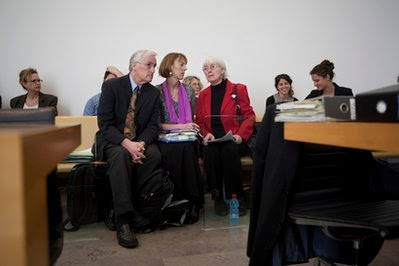
Cindy Corrie, right, and Craig Corrie, left, the parents of Rachel Corrie, a pro-Palestinian activist who was crushed to death by an Israeli bulldozer in Gaza in 2003, sit together with their daughter Sarah at the District Court in Haifa, Sunday, April 3, 2011. An Israeli commander testifying in a civil lawsuit over the death of the American activist during a protest in the Gaza Strip said the young woman and other activists ignored repeated warnings to move before she was crushed by an armored bulldozer eight years ago. (AP Photo/Oded Balilty)

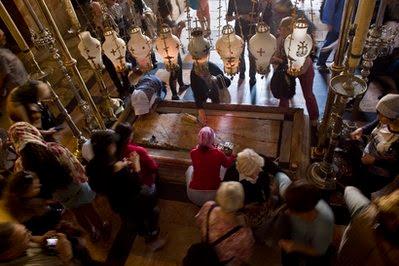
In this photo taken Wednesday, March 30, 2011 Christian pilgrims visit the Church of the Holy Sepulcher, traditionally believed to be the site of the crucifixion, in Jerusalem's Old City. Israel's vital tourism industry has been surprisingly resilient in the face of regional turmoil that has dried up visits to neighboring Arab countries, tourism officials say. In contrast to Egypt and Jordan, the number of tourists visiting the Jewish state appears to be holding steady, according to tourism experts. (AP Photo/Bernat Armangue)

In this photo taken Wednesday, March 30, 2011 religious items for sale are displayed in a window shop while tourists are reflected on the glass in Jerusalem's Old City in Jerusalem's Old City. Israel's vital tourism industry has been surprisingly resilient in the face of regional turmoil that has dried up visits to neighboring Arab countries, tourism officials say. In contrast to Egypt and Jordan, the number of tourists visiting the Jewish state appears to be holding steady, according to tourism experts. (AP Photo/Bernat Armangue)

Bank of Israel Governor Stanley Fischer (L) hands a report to Finance Minister Yuval Steinitz during a photo opportunity at the Finance Ministry in Jerusalem March 30, 2011. The Bank of Israel on Wednesday raised its forecast for Israel's economic growth to 4.5 percent in 2011 from a prior estimate of 3.8 percent after the economy grew faster than expected last year. REUTERS/Ronen Zvulun (JERUSALEM - Tags: POLITICS BUSINESS)

Palestinians gather outside the Freedom theatre headed by Juliano Mer Khamis, who was shot dead in near the West Bank city of Jenin, April 4, 2011. A masked gunman on Monday shot dead well-known Israeli actor and director Juliano Mer Khamis, who worked in the occupied West Bank town of Jenin, a Palestinian security source said. Khamis, 52, was killed in his car in Jenin's refugee camp in the northern West Bank, the source said, adding that the motive was not immediately clear. REUTERS/Abed Omar Qusini (WEST BANK - Tags: CIVIL UNREST CRIME LAW)

New housing units in the Israeli settlement of Har Gilo near the West Bank town of Bethlehem in November 2010. Jerusalem city council has approved the construction of 942 new homes in Gilo, a settlement neighbourhood in the city's mostly Arab eastern sector. (AFP/File/Hazem Bader)

In this image made available Thursday, March 31, 2011, by the Van Abbe Museum in Eindhoven, Holland, Pablo Picasso's painting Buste de Femme, 1943 is seen. Palestinian and Dutch curators are scrambling to bring the 7 million dollar painting by Picasso to the West Bank, a volatile region where it will travel through Israeli checkpoints before landing at an art academy without the proper facilities to house it. Organizers hope it will be on display in Ramallah by early summer, but aren't making any grand announcements until all details are ironed out. (AP Photo/Peter Cox, Van Abbe Museum, HO) NO SALES

Juliano Mer Khamis served in the Israeli army as a paratrooper... but he cast his lot with the Palestinians.

"A statement from the office of Palestinian Authority Prime Minister Salam Fayyad said that he had ordered security forces to work “round the clock” to find the assailant and bring him to justice. Fayyad called the killing “a despicable crime” that “goes against our people’s morals and beliefs in coexistence.”"
http://www.washingtonpost.com/world/israeli-actor-slain-in-jenin-refugee-camp/2011/04/04/AFWeAIfC_story.htmlMomen Sweitatno / REUTERS - Juliano Mer Khamis served in the Israeli army as a paratrooper and portrayed Israeli Jews in film and stage roles, but he cast his lot with the Palestinians.

Israeli actor slain in Jenin refu­gee camp

“We will not allow, under any circumstances, the return to chaos and lawlessness,” said Prime Minister Fayyad

Babylon & Beyond Observations from Iraq, Iran, Israel, the Arab world and beyondWEST BANK: Pro-Palestinian Israeli filmmaker killed in West Bank city

George Ibrahim, director of Kasaba theater and who performed in "The Chairs," said he was shocked when he heard the news of Mer-Khamis’ death. He accused people who were against seeing Palestinian cultural activities in the city of being behind the killing, but without naming them. He was clearly referring to fundamentalists who saw in the Freedom Theater a liberalization of a traditional and conservative Muslim society.

The Freedom Theater itself had come under attack twice in the past and a Jenin-based music school was set fire to at one point, giving some credence to Ibrahim’s charges.

“We will not allow, under any circumstances, the return to chaos and lawlessness,” said Prime Minister Fayyad in his statement.

Armed gunmen had at one point controlled the Palestinian streets until Fayyad, who took office in mid-2007, had in a short time put an end to this phenomena and brought stability and rule of law to the Palestinian territories....READ MORE

MIFTAH Strongly Condemns the Killing of Juliano Mer –Khamis

MIFTAH Strongly Condemns the Killing of Juliano Mer –Khamis
Date posted: April 05, 2011
By MIFTAH
On April 4, director Juliano Mer –Khamis was shot five times and killed in front of the Jenin Refugee Camp Freedom Theater by unidentified masked assailants. The director’s death comes as a shock to Palestinians, who have long honored Khamis for his courage and perseverance in fighting for the cause of justice through art in Palestine.

Juliano Mer-Khamis, who lived in the Jenin Refugee Camp for the past seven years, followed in the footsteps of his parents, a Palestinian-Christian father from Nazareth and a Jewish Israeli mother, Arna Mer, who originally established the theater during the first Intifada.

Mer-Khamis won international fame for, among other works, his documentary film “Arna’s Children” which tells the story of his mother’s journey with Jenin’s children during the difficult and violent years of the Intifada. He was insistent on offering an alternative to the violence of the camp through giving Jenin’s children a venue for creativity and entertainment and by his own example, portraying the possibility of coexistence. During a 2009 interview, Mer-Khamis described himself as “100 percent Palestinian and 100 percent Jewish.”

MIFTAH strongly condemns the director’s murder and calls on all relevant parties to seek justice for him and punishment for his killers. Such criminal and violent acts go against the grain of Palestinian morals and values and cannot be tolerated in our efforts to create a democratic and peaceful society.

Mer-Khamis’ death is a loss to the Palestinian art world and to our society as a whole. His vision of freedom through art allowed hundreds if not thousands of young Palestinians to experience something other than the bitter taste of Israel’s occupation. MIFTAH would like to offer its condolences to his wife and children and to all those whose lives he touched. The Freedom Theater is a legacy all Palestinians must ensure will continue in honor of Mer-Khamis’ memory.

Saturday, April 2, 2011

Hussein Ibish: Arabs yearn to move on... The end of the Israeli-Palestinian conflict

"Israelis need to understand that the "cold" nature of the treaties with Egypt and Jordan stems from popular outrage about the continued occupation in Palestine. If that were resolved, as the API anticipates, the potential for widespread Arab-Israel reconciliation at the cultural and emotional level, which is otherwise impossible, will likely develop over time. Warmth is too much to ask at first, but without occupation, both peace and reconciliation become achievable.

The Palestinian citizens of Israel are likely to play a crucial role in such a reconciliation. The end of the Israeli-Palestinian conflict would do more than anything imaginable to normalize their status as Israeli citizens, and they are perfectly positioned to become Israel's economic and cultural ambassadors to the Arab world. It could transform them from a beleaguered, discriminated-against minority to a crucially positioned and empowered group that can broker economic and cultural exchanges that are mutually beneficial and form the basis for a broader reconciliation.

It's become quite obvious that while almost all Arabs are still passionate about the plight of the Palestinians and committed to ending the occupation that began in 1967, most Arab states yearn to move past the pointless and exhausting conflict with Israel that began in 1948. All parties stand to gain from the normalization of relations between Israel and the Arab world, but, as the API makes very clear, that can only happen if the occupation is ended and a Palestinian state is established to live alongside Israel in peace and security"
Hussein Ibish: Arabs yearn to move on

Friday, April 1, 2011

Palestinian voices need support - The Hill's Congress Blog

Palestinian voices need support - The Hill's Congress Blog
By Rula Jebreal - 03/31/11 04:02 PM ET

Controversy continues to swirl over the recent release of “Miral,” a film about Palestinians made by acclaimed Jewish-American director Julian Schnabel. The spark was a remarkable and inspiring event that occurred at the United Nations building in New York in mid-March when the General Assembly played host to some of Hollywood’s biggest stars for the film's premiere.

Remarkable because “Miral” is the first mainstream Hollywood film about the Israeli-Palestinian conflict told from a Palestinian point of view, and inspiring because so many people came out in support of the filmmakers despite criticism from the Israeli government, the American Jewish Committee, and others who called for the cancellation of the screening.

Based on my autobiographical novel and directed by Julian Schnabel, “Miral” follows the lives of three generations of women in my family, including my own, from the creation of the State of Israel in 1948, through the 1967 War, the first Intifada in 1987, and the signing of the Oslo Accords in 1993.

Because “Miral” is a Palestinian story told through Palestinian eyes, it has been attacked by some as “anti-Israel.” It would seem that to these critics the mere existence of Palestinians is threatening. “Miral” is not “anti-Israel,” it is pro-understanding and pro-peace. It is intended to advance dialogue by giving voice to the Palestinian narrative, which has gone unheard in Israel and the United States for far too long....READ MORE

April is National Poetry Month: 30 Ways to Celebrate


Celebrate Poem in Your Pocket Day
The idea is simple: select a poem you love, carry it with you, then share it with co-workers, family, and friends.

Read a book of poetry
"Poetry is a response to the daily necessity of getting the world right."

Memorize a poem
"Getting a poem or prose passage truly 'by heart' implies getting it by mind and memory and understanding and delight."

Revisit a poem
"America is a country of second acts, so today, why not brush the dust off these classics and give them a fresh read?"

Put poetry in an unexpected place
"Books should be brought to the doorstep like electricity, or like milk in England: they should be considered utilities."

Bring a poem to your place of worship
"We define poetry as the unofficial view of being, and bringing the art of language in contact with your spiritual practices can deepen both."

Attend a poetry reading
"Readings have been occurring for decades around the world in universities, bookstores, cafes, corner pubs, and coffeehouses."

Play Exquisite Corpse
"Each participant is unaware of what the others have written, thus producing a surprising—sometimes absurd—yet often beautiful poem."

Read a poem at an open mic
"It's a great way to meet other writers in your area and find out about your local writing community."

Support literary organizations
"Many national and local literary organizations offer programs that reach out to the general public to broaden the recognition of poets and their work."

Listen on your commute
"Often, hearing an author read their own work can clarify questions surrounding their work's tone."

Subscribe to a literary magazine
"Full of surprising and challenging poetry, short fiction, interviews, and reviews, literary journals are at the forefront of contemporary poetry."

Start a notebook on Poets.org
"Poets.org lets users build their own personal portable online commonplace book out of the materials on our site."

Put a poem in a letter
"It's always a treat to get a letter, but finding a poem in the envelope makes the experience extra special."


Take a poem out to lunch
"Adding a poem to lunch puts some poetry in your day and gives you something great to read while you eat."

Put a poem on the pavement
"Go one step beyond hopscotch squares and write a poem in chalk on your sidewalk."

Recite a poem to family and friends
"You can use holidays or birthdays as an opportunity to celebrate with a poem that is dear to you, or one that reminds you of the season."

Organize a poetry reading
"When looking for a venue, consider your local library, coffee shop, bookstore, art gallery, bar or performance space."

Promote public support for poetry
"Every year, Congress decides how much money will be given to the National Endowment for the Arts to be distributed all across America."

Start a poetry reading group
"Select books that would engage discussion and not intimidate the reader new to poetry."

Read interviews and literary criticism
"Reading reviews can also be a helpful exercise and lend direction to your future reading."

Buy a book of poems for your library
"Many libraries have undergone or are facing severe cuts in funding. These cuts are often made manifest on library shelves."

Start a commonplace book
"Since the Renaissance, devoted readers have been copying their favorite poems and quotations into notebooks to form their own personal anthologies called commonplace books."

Integrate poetry with technology
"Many email programs allow you to create personalized signatures that are automatically added to the end of every email you send."

Ask the Post Office for more poet stamps
"To be eligible, suggested poets must have been deceased for at least ten years and must be American or of American descent."

Sign up for a poetry class or workshop
"Colleges and arts centers often make individual courses in literature and writing available to the general public."

Subscribe to our free newsletter
"Short and to the point, the Poets.org Update, our electronic newsletter, will keep you informed on Academy news and events."