Labels

Saturday, August 14, 2010

This Week in Palestine Artist of the Month: Samir Salameh

Artist of the MonthSamir Salameh


All journeys start with one step, yet no one can ever tell where a journey might lead or where it will end. The only certain thing is that journeys teach us about ourselves and connect us more deeply than we could ever imagine with our roots.

I invite you now to come with me to discover the journey of one artist, Samir Salameh, who has been living in exile and wandering the world in search of his roots and his lost homeland. He wanders among the colours and abstract representations that he has created along the way.

Samir Salameh was born in Safad in Palestine in 1944. During Al-Nakba in 1948, when Samir was four years old, he and his family were deported and forced to become refugees. From Majd al-Kroum, in the Galilee, to Lebanon and finally to Syria in Dira’a Refugee Camp, the young boy faced the harsh reality of losing home, stability, and freedom.

When Samir was 15, a new chapter started - he discovered his passion for drawing. Despite his annoying habit of drawing his classmates’ faces instead of paying attention to the teachers, his talent was soon recognised and appreciated by the school, and he was awarded a number of prizes, one of which was a visit by the late Egyptian president, Gamal Abdel Nasser.

After a series of successful exhibitions in Dara’a Cultural Center, Samir managed to gain entry into the Damascus Fine Arts Academy in 1967, where he was privileged to study under some of the finest teachers, including Fateh Al-Modarres, Nazir Nabaa, and Nasir Showra. He graduated in 1972 and moved to Lebanon to work at the media office of the PLO where he spent three years developing the political posters of the resistance movement.

He then studied at the Ecole Nationale des Beaux Arts in Paris and worked at a number of jobs that included drawing tourists’ faces, teaching art, and finally working on Arabic publications at UNESCO.

After the Oslo Agreement, Samir returned to Palestine, where he worked for two years on the technical designs for the Red Crescent Society hospital in Khan Younis. Afterwards he went to Ramallah to oversee Al-Hallaj Gallery before being seconded to work with the Red Crescent Society in Al-Bireh until his retirement in 2004. At present Samir lives and works in France.

The summer of 1996 was a significant step in Samir’s journey. He visited his hometown of Safed for the first time and was shocked and saddened by the impossibility of finding his childhood home as described by his parents. From that moment, Samir has refused to surrender to the consequences of Al-Nakba, and Palestinian Safed shines again through his lines and colours, as he becomes more and more determined to hold on to its roots and prepare to return.


Hanan Wakeem, Palestinian Art Court - al Hoash Gallery

Friday, August 13, 2010

Ziad J. Asali, M.D.: Fighting for a culture of enlightenment in Palestine and beyond

"Last week signaled the rolling launch of an effort to fundamentally reform the Palestinian education sector. This reform effort is taking place in the context of a wider effort initiated one year ago by Palestinian Authority President Mahmoud Abbas and Prime Minister Salam Fayyad to build the institutions of future Palestinian statehood....READ MORE"

Fighting for a culture of enlightenment in Palestine and beyond

Ziad J. Asali, M.D.

"Building our country means building our children’s future," Prime Minister Salam Fayyad

"Building our country means building our children’s future," Prime Minister Salam Fayyad

My letter to the Washington Post RE Program joins Palestinians and Israelis as interns in the District

RE: Program joins Palestinians and Israelis as interns in the District
http://www.washingtonpost.com/wp-dyn/content/article/2010/08/11/AR2010081105979.html

Dear Editor,

Thank you for publishing the fascinating story about the New Story Leadership for the Middle East program which joins Palestinians and Israelis as interns in the District. I don't think Israeli youth need more organizations and programs to help them become articulate and respected advocates for their county in mainstream American forums, but Palestinians certainly do... and most Israelis as well as many Americans certainly do need to better understand the very real plight of the Palestinians.

Sincerely,
Anne Selden Annab


Thursday, August 12, 2010

“LET KIDS BE KIDS” Op-ed by Chris Gunness Spokesman for the United Nations Relief and Works Agency


“LET KIDS BE KIDS”

Op-ed by Chris Gunness
Spokesman for the United Nations Relief and Works Agency

This week thousands of kids in Gaza romped into the Guinness Book of Records for the third time. Some seven thousand children simultaneously flew kites on a beach in northern Gaza, more than doubling the previous record they themselves set a year ago. As if this weren’t enough, just one week before, no less than 7,203 children went to the destroyed airport in Gaza and bounced their way into the Guinness Book of World Records by simultaneously dribbling basket balls for five minutes. Two world records in just one week, three in a year is surely another world record in itself.

These two events engendered iconic images which were emblazoned across the blogasphere and media outlets, old and new, in Gaza, Israel in beyond. Behind them lay a beautiful and inescapable symbolism. Here were thousands of children, grouping together co-operatively and creatively with one single ambition in mind, smiling and laughing as they worked in wrapped concentration, in an act of celebration and achievement to be number one in the world. Here was the next generation in Gaza demonstrating to the outside world that given the chance, they could show their true potential, just like kids anywhere. Such symbolism will surely not have been lost on the millions of people around the world who so sadly have become accustomed to the imagery of destitution and hopelessness that usually emanates from the Gaza Strip.

The world record breakers were part of the Gaza Summer Games organized by the United Nations Relief and Works Agency. In nearly one hundred and fifty locations across Gaza over a six week period, some quarter of a million children have been taking part in sporting, recreational and cultural activities. This is the fourth Summer Games season organized by UNRWA and for the fourth successive year, thousands of UNRWA teachers have given up their summer holidays to allow the children of Gaza simply to have fun like children anywhere in the world; to have a sense of normality despite the abnormality they face in their daily lives following the fighting a year ago and the bitter legacy it has left behind.

The subtext was clear for all to see. UNRWA gives to the children in Gaza a chance to achieve their full human potential and when allowed to do so, their energies can be channeled into world class achievement. Though Gaza often grabs the headlines, it is often forgotten that everyday in hundreds of schools throughout Arab countries and territories surrounding Israel, UNRWA likewise helps some half a million children achieve their full potential. With over twenty thousand teachers working in some seven hundred schools, empowering the next generation across the Middle East, education remains the key priority for UNRWA, to which the Agency devotes more than half its financial resources.

But UNRWA does so against odds which are both financial and logistical. The Agency has a shortfall in its budget for this year alone of about one hundred million US dollars. Services across the region are under threat, with all the worrying implications for stability in the Middle East. In Gaza the restrictions on humanitarian goods mean that we have been unable to build any new schools, let alone repair old ones for years. Over ninety per cent of our schools there are “double shifted” which means that though there may be one physical building, the school actually serves two completely different sets of pupils and staff. Our classes in Gaza have swollen to as many as 45 children per class.

Unable to build schools for an expanding population, we have been turning away thousand of five and six years olds whose parents want them to receive an UNRWA education. Today, 39,000 children are being denied a United Nations education in Gaza and are instead being absorbed by the education system of the local authorities. The restrictions looks set to have profound consequences for the next generation right on the door step of Israel. And with so many dozens of school that need to be built and many more repaired, the prospects for change this look dim.

But all is not lost. UNRWA remains steadfastly committed to its human development goals, assisting hundreds of thousand of children in one the world’s most unstable regions achieve their full potential, giving them a sense of self respect, of self reliance and a belief in a peaceful and dignified future. However, UNRWA does not operate in a vacuum in Gaza. We are educating children eventually to enter a job market where there is over forty per cent unemployment. Over three thousand businesses have gone under in the last three years alone, years which have seen a once thriving export economy decimated. An educated, unemployed population in Gaza is in no one’s interests. The economy must be revived. Exports have to be allowed out of Gaza if the next generation is to be given the full rights to employment, enabling self-reliance as communities, ultimately leading to the creation of a prosperous and stable society.

The time has come for vision. The world needs to look to those iconic images from the UNRWA Summer Games as pointers to where the future could lie for the next generation in Gaza and beyond.

An edited version of this opinion piece appeared in the Jerusalem Post Sunday 8th August 2010.

What If the Palestine Issue was Resolved?

"In other words, why have we lost the capacity to deal with the Palestinian issue in a realistic and normal manner? The Arab analysis of the situation constantly repast that it is the Israeli side that is afraid – to its very core – of the consequences of peace, and normalization of relations with the Arab world. This is a correct analysis, to a large extent, at least with regards to the Israeli right-wing who supports the current state of affairs. Peace means a re-imagining of the Israeli mentality, removing it from the strangleholds of isolation, panic and [the mentality of] the Jewish ghetto.

This analysis is true, but what is not mentioned is this: Do some Arab intellectuals and politicians also fear a peace agreement being signed, finally resolving the Palestinian Cause?"

What If the Palestine Issue was Resolved?

IF you are looking for positive ways to help support Palestine follow ATFP's lead... they really do have their eye on the ball:

In my opinion, as one who has been all over the map, if you are an American trying to understand the Middle East and you are looking for positive ways to help support Palestine follow their lead- the ATFP really does have their eye on the ball....

Sign up to receive the World Press Roundup!

Keep up to date with what is going on in the Middle East with ATFP's World Press Roundup

August 11th, 2010
The NYT says Pres. Abbas should return to direct talks. The reopening of the Jenin Cinema is part of the revival of the city. Israel's Gaza flotilla inquiry doesn't appear to be assigning responsibility. Israel's military chief of staff says his troops weren't ready for resistance during the raid. Nahum Barnea calls PM Netanyahu's testimony “catastrophic.” The UN launches its own inquiry, which may help restore Israel's ties with Turkey. Millions of dollars worth of aid to Gaza is piling up in warehouses. The CSM examines Hezbollah's “evidence” that Israel assassinated former Lebanese PM Hariri. The PA Justice Ministry asks for a clearer separation of powers. A Palestinian cleric is injured trying to block the demolition of a Muslim cemetery in Jerusalem. US officials say they are optimistic about the resumption of direct negotiations. UNRWA denounces an Israeli TV broadcast. Amira Hass says Israeli occupation forces often behave like bullying children with guns. Reports claim DM Barak wanted to launch a major attack on Lebanon following the recent border incident. Right-wing settlers clash with Israeli occupation troops in Jericho. Ali Ibrahim says Arabs should reach out to Israeli public opinion.


New ATFP book: What's Wrong with the One-State Agenda?

ATFP is strictly opposed to all acts of violence against civilians no matter the cause and no matter who the victims or perpetrators may be. The Task Force advocates the development of a Palestinian state that is democratic, pluralistic, non-militarized and neutral in armed conflicts.

Saturday, August 7, 2010

My letter to Al-Ahram RE Direct to where? In the face of US pressure, direct talks between Israel and the PA look inevitable.

RE: Direct to where? In the face of US pressure, direct talks between Israel and the PA look inevitable. But what will the results be, asks Dina Ezzat
http://weekly.ahram.org.eg/2010/1010/fr2.htm

Dear Editor,

Direct to where? That is an excellent question concerning Israel and Palestine, and a captivating headline.... "Direct to where?" makes me think of freedom- and open roads. A whole world of opportunities.

I very much hope that Abbas starts talks soon- for everyone's sake. Talks themselves are only the beginning of the process- only the first stirrings of real progress, real peace and a real state for Palestine. I look at all the many talented Zionist letter writers who are so eager and able to promote and defend Israel in every forum they can reach all through out America, and I can not help but hope that Palestine is eventually able to inspire the same fierce loyalty and creativity among its best and brightest citizens.

Sincerely,
Anne Selden Annab

Growing Gardens for Palestine

The Palestinian State and Institution Building Program
Documents detailing the state and institution building program of the 13th Palestinian Government, including the overall plan and priority interventions for 2010.

Palestinian State and Institution Building Resources


The Art Miles Mural Project TO Advocate Art rather than Violence, Cooperation instead of War, the Continuation of Life rather than Death mile by mile


Friday, August 6, 2010

ATFP Launches New Online Palestinian State and Institution Building Resources

The American Task Force on Palestine (ATFP) is pleased to announce the launching of a new section of its website devoted to compiling resources on the Palestinian state and institution building program. As far as we are aware this is the first effort to compile comprehensive set of resources on the Palestinian state building program. The compilation presently contains 277 separate resource documents, including the core founding documents of the program, documents detailing or analyzing progress, and some important precursor documents setting the stage for the adoption of the plan in August 2009. The state and institution building resource section of the ATFP website can be accessed directly.

ATFP is committed to continue to build this collection of important resources on Palestinian state and institution building as an ongoing and open-ended project, and welcomes input from any of its friends or supporters. If any important resource for document exists that is not presently in our collection, we welcome all suggestions at the bottom of the main resource page or directly. ATFP hopes these resources will help our fellow Americans and people around the world better understand the scope, progress and importance of state and institution building by the Palestinian people.

Please allow a few extra moments for the documents to load when accessing state and institution building resource section.

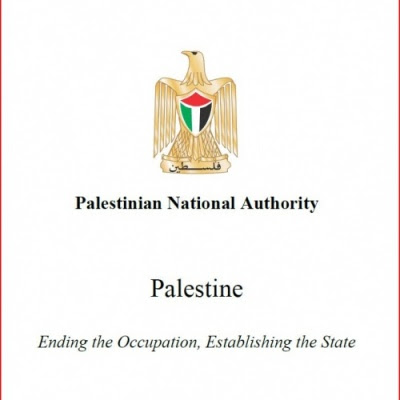
Palestine: Ending the Occupation, Establishing the State
Palestinian National Authority - August 31, 2009

The Palestinian State and Institution Building Program: Documents detailing the state and institution building program of the 13th Palestinian Government., available in English and Arabic.

Read More

Thursday, August 5, 2010

Hussein Ibish: The bottom line....

"The bottom line is that Abbas is going to have to go back into direct negotiations because the United States is insisting on them and the only real leverage the Palestinians have available at the moment at the highest diplomatic levels vis-à-vis Israel is to leverage the American national security priority in ending the conflict to their own advantage. At some fundamental level, the Obama administration and the PLO share a core goal of ending the conflict through a negotiated agreement that also ends the occupation and establishes a Palestinian state. It's not at all clear that this is something the present Israeli government either wants or could agree to, and they haven't been tested yet because of the lack of direct negotiations. Netanyahu has been able to maintain a degree of ambiguity on his attitude towards a real two state solution that has minimally satisfied both his right-wing coalition partners and the Obama administration, but this will be much more difficult as direct talks proceed if the Palestinians play their cards right. So while many people warn that direct talks can be a trap for the Palestinians, and they certainly could be, they can also be a trap for Netanyahu, or at least a real test of his willingness to go along with an agenda the United States considers imperative for its own national interest." Hussein Ibish

Ibishblog
The weblog of Hussein Ibish

Abdul Rahman Al-Rashed "Abbas: Either Fight or Negotiate!"

Abbas: Either Fight or Negotiate!

05/08/2010

No one ever tells the whole truth, even in simple cases such as negotiations, and here is a story to illustrate that. Of all the American Presidents, Barack Obama is actually the most enthusiastic to establish a Palestinian state and liberate the West Bank and Gaza. This is something that the Arabs and their supporters have failed to achieve through war, bombings, demonstrations or zealous speeches over the past 40 years. It is natural to regard negotiations as an alternative to defeat, and even the "Oslo Accords" that were criticized by many achieved more than empty rhetoric. It's thanks to those negotiations that [late Palestinian President] Yasser Arafat and the Palestinian Liberation Organization [PLO] returned home from exile in Tunisia, together with over 100,000 Palestinians, to live in the West Bank and Gaza rather than the Tunisian town of Hammamet, or the Beirut district of al-Fakhani. They returned to Palestine; and as a result of this the Israeli process of capturing [Palestinian] land and expelling its Palestinian citizens came to an end.

Today, Arafat's successor has been in a state of limbo ever since Obama sent him his first message immediately after he assumed power, nearly one and a half years ago; inviting him to negotiate. Although Abbas has always negotiated with the Israelis directly, he decided this time to add a new condition; aimed at stopping settlement construction. Though his intentions were correct, his condition served the interests of Israeli Prime Minister Benjamin Netanyahu, who does not wish to enter into negotiations, and is searching for an excuse to evade Obama's pressure. Therefore as a result of this, the Palestinian leadership missed out on the most important 18 months [of Obama's presidential term].

What people may not know is that Palestinian President Mahmoud Abbas is also subject to intense Arab pressure warning him against direct negotiations, despite the fact that the Arabs were silent about this issue, and about settlement construction, during the Arafat era... READ MORE