Labels

Tuesday, May 15, 2012

Randa Jarrar: Imagining Myself in Palestine

May 14, 2012
On a recent trip to Israel, Randa Jarrar gets detained, denied entry, and sent to 'the Arab Room.'
 
 [AS ALWAYS PLEASE GO TO THE LINK TO READ GOOD ARTICLES IN FULL: HELP SHAPE ALGORITHMS (and conversations) THAT EMPOWER DECENCY, DIGNITY, JUSTICE & PEACE... and hopefully Palestine] 

Image from Flickr via Rusty Stewart

Trouble began weeks before I boarded my flight to Tel Aviv’s Ben Gurion Airport. I had heard horror stories about a detention area there, dubbed The Arab Room, and in my anxious and neurotic style, I had emailed a dozen people—American academics and artists of Arab, Indian, Jewish, and European descent— and asked them what I was supposed to tell the immigration officers at Ben Gurion once I arrived. They all wanted to know if I was using my American passport, and I assured them that I was. The vast majority told me not to tell the officers I would be staying at my sister’s in Ramallah. They said this would cause trouble, and offered up the names of friends and family for my use. The generosity of people poured in, and I was advised to say that I was staying with this writer, or that visual artist, or this former-IDF soldier—people I had never met, but who had volunteered themselves to be my proxy hosts. A friend of mine, who is a phenomenal photojournalist, gave me her phone number and said to tell the officers I would be staying with her, and I agreed. She told me to prepare for the officers to call her themselves once I gave them her number, as this is something they are known to do.

I was so afraid of facing the guards at the airport that I had a difficult time imagining the rest of my trip. I would picture myself walking around Ramallah with my sister, or attending a concert, or visiting my aunts, or seeing the separation wall, or staying at the American Colony Hotel for an evening, and I would draw a blank. There was a wall there, too, between my thoughts and Palestine.

Growing up, my Palestinian identity was mostly tied to my father. He was the Palestinian in the family, and when we went back to the West Bank it was to see his brothers and sisters and parents. We always entered Palestine through Amman, crossing the Allenby Bridge over the river Jordan and waiting in endless inspection lines. I remember these trips dragging on through morning and midday and well into the afternoon. My father would sit quietly, and when I complained my Egyptian mother would tell me that the Israelis made it difficult for us to cross into the West Bank. She told me that they wanted us to give up, that they would prefer we never go back. “We must not let them win,” she’d said. My relationship with my Palestinian identity was cemented when I enrolled in a PLO-sponsored girls’ camp as a tween. We learned nationalistic songs and dances and created visual art that reflected our understanding of the occupation. After my family and I moved to America in 1991, my Palestinian identity shifted again, and I began to see myself as an Arab-American. My father’s fiery rants on Palestine died out when Yitzak Rabin was murdered by a Jewish-Israeli extremist. I remember my father weeping in our American wood-paneled den. He said that Rabin had been the Palestinians’ last chance.

When my sister got a job in Ramallah last year, teaching music to children, I knew I would want to visit her. I had not been to Palestine since 1993. I had planned to go back in the summer of 1996, but I was pregnant and unmarried. My parents did not want to speak to me, let alone take me with them, in such a shameful condition, to the West Bank. I never went back with family after that. I led my own life....READ MORE

Hanan Ashrawi: Recognizing Nakba, Reaching Peace

Hanan Ashrawi, head of the PLO’s Department of Culture and Information
 [AS ALWAYS PLEASE GO TO THE LINK TO READ GOOD ARTICLES IN FULL: HELP SHAPE ALGORITHMS (and conversations) THAT EMPOWER DECENCY, DIGNITY, JUSTICE & PEACE... and hopefully Palestine]

May is the cruelest month despite the promise of spring. It carries the bitter memories of ongoing loss and injustice for a nation, my nation. Every year, Palestinians mark Al-Nakba, or the Catastrophe, of 1948, to remember how our vibrant society was physically and politically crushed by violence and forced expulsion.
 
It was not a natural disaster. Indeed, we have no doubt that itwasa detailed plan of systematic destruction carried out with chilling efficiency. It was the biggest assault and threat Palestinian heritage has ever endured and the beginning of a deliberate effort to suppress the Palestinian narrative.  

For many Israelis, recognizing what happened back in 1948 is a painful process. The slogan “Your independence is our Nakba”, which is on display in many Palestinian cities is indeed correct. Many Israeli historians have researched and written about this dark era, demonstrating that Palestine was a land with a vibrant society and rich culture. These brave historians ended decades of denial about Palestinian society and suffering.  

By 1948, Palestine was one of the most developed Arab societies, boasting one of the healthiest economies under the British mandate and a high school enrolment rate, second only to Lebanon. Commerce, the arts, literature, music, and other cultural aspects of life were thriving in Palestine. 

We remember that between 1911 and 1948, Palestine had no less than 161 newspapers, magazines and other regular publications, including the pioneer “Falastin” newspaper, published in Jaffa by Issa al-Issa. 

Dozens of bookstores across the country selling hundreds of Palestinian and internationally-authored books could hardly keep up with the demand. Books like “The Arab Woman and the Palestine Problem” by Matiel Moghannam, a feminist leader, and George Antonious’ “The Arab Awakening”, were highly popular in Palestine, England, the US, and beyond. 

Palestine had a strong women’s movement as early as the 1920’s. Women excelled in many fields, including education, journalism, and political activism. Women activists were among the first to lobby for Palestinian self-determination at the beginning of the British Mandate. 

Palestinian dedication to education is deeply rooted in our culture. By 1914, there were 379 private schools in Palestine, including the country’s first girls’ school, Al Moscobiye, in Beit Jala, founded in 1858 as the first school for girls in Palestine, and the Friends School, founded by the Quakers in 1869, which continues to be among the most advanced education institutions in Palestine. 

In the area of arts, music, and drama, Palestinian creativity was boundless, inspiring artists around the region. Composers like Yehya Al-Lababidi collaborated with famous Arab singers of the time, like Farid Al-Atrach. Other singers like the legendary Um Kalthoum and Mohamad Abdel Wahab regularly performed to Palestinian audiences in Haifa, Jaffa, and Jerusalem. Our cinemas, from Gaza to Akka, were showing the latest films of the time. 

Al-Nakba represents the abrupt and unnatural disruption of these accomplishments and signaled the beginning of a culture of exile and dispossession. In being forcibly expelled from their homes, Palestinians lost their properties, personal history, and cultural assets. 

This included thousands of books. In West Jerusalem alone, 30,000 books were “collected” from Palestinian houses, as well as around 50,000 other books from homes in Jaffa, Haifa, Tiberias and Nazareth. Khalil Sakakini was one of those people who lost his entire library. A number of his books can be found today in the National Library of Israel, marked ‘AP’, meaning “Abandoned Property.” 

Al-Nakba is therefore not merely a historical date to be commemorated.  It is the collective memory of Palestinians, which shapes their identity as a people. Al-Nakba is not a distant memory but a painful reality that continues to fester, as the rights of refugees continue to be denied and the inalienable rights of our nation remain unfulfilled. 

It is time to recognize that Al-Nakba is as real for Palestinians as it should be for Israelis. It is an inescapable story of loss, dispossession and a great historic injustice that targeted the most precious characteristic of any people: its identity. 

But Al-Nakba to Palestinians is not about defeat. Stripping the Palestinian people of their national and cultural symbols, as well as stunting the growth of Palestinian cultural life was a merciless crime, no doubt. But our people have persevered, rebuilding, time and again, their heritage of cultural and educational excellence. 

There have been many new challenges and setbacks since Al-Nakba, especially the military occupation that began in 1967 and its oppressive policies targeting culture and education. But Palestinians kept marching forward, holding on to the proud memories of excellence and building new ones. 

For peace to prevail, for two states to live side by side, for a future of security and prosperity to begin in the region, Israel should not be afraid to recognize Al-Nakba and learn the lessons of its history. Israel must come to recognize its historic accountability in creating Al-Nakba for neither denial nor distortion can serve the cause of peace.  

Genuine recognition is a sine qua non for the process of historical redemption. Peace is a phase of healing that must be established on truth, justice, transparency, and equality. There is no other formula. By recognizing our historical narrative and suffering, Israel will be embarking on a true journey for a just and comprehensive peace.
 
Dr. Hanan Ashrawi is a member of the PLO Executive Committee and head of the PLO’s Department of Culture and Information

Haaretz Editorial: Nakba is part of Israel's history

http://www.haaretz.com/opinion/nakba-is-part-of-israel-s-history-1.430501
Palestinian children hold a key to commemorate Nakba day. Photo by AP

Nakba is part of Israel's history

A person who understands that an Arab citizen should not be forced to sing 'a Jewish soul still yearns' should be expected to let that citizen commemorate the Nakba without having to pay for it.

Haaretz Editorial | May.15, 2012

"I don't expect an Arab national to sing 'A Jewish soul still yearns,' Prime Minister Benjamin Netanyahu said two months ago, after Supreme Court Justice Salim Joubran refrained from singing the national anthem. Although the message was conveyed to Joubran indirectly, it reflected Netanyahu's understanding of the fundamental contradiction underlying an anthem that addresses only one people, the Jewish one.

Yet such an understanding is nonexistent when it comes to remembering the Nakba, or "catastrophe" - the Palestinians' term for what happened to them when the state was founded in 1948. This is the tragedy of hundreds of thousands of refugees and their millions of relatives, for whom May 15 - the day the establishment of the State of Israel was announced - symbolizes the day they lost their land, property and status.

The historic controversy over the responsibility for the Palestinian people's tragedy is still pending. It will continue to hover over both nations, and its explosive potential will continue to grow as long as the conflict is not settled at the negotiating table....READ MORE

 [AS ALWAYS PLEASE GO TO THE LINK TO READ GOOD ARTICLES IN FULL: HELP SHAPE ALGORITHMS (and conversations) THAT EMPOWER DECENCY, DIGNITY, JUSTICE & PEACE... and hopefully Palestine]

The task before us is to make sure that no further nakbas, no more pogroms or unspeakable horrors, ever occur again

A girl leans on a chain, during a protest to mark the 64th anniversary of Nakba, at Ain al-Hilweh Palestinian refugee camp near the port-city of Sidon, in south Lebanon May 15, 2012. Nakba, or catastrophe, marks Israel's founding in 1948 war, when hundreds of thousands of Palestinians fled or were forced to leave their homes. REUTERS/Ali Hashisho
*******

Bradley Burston:  "And now I learn, from studying the terrible events of a terrible war, that Abu Shusha, the village that had once stood on the slopes of Tel Gezer, overlooking the kibbutz, had been the site of a massacre. 

And that, in the way of catastrophe and of true history, the massacre of the Arabs of the village of Abu Shusha was followed by killings and expulsion of the Jews of Kibbutz Gezer.

On the 13th of May, 1948, Abu Shusha was stormed by the pre-state Haganah militia. Accounts differ as to how many villagers were killed in the attack, and how many were subsequently lined up against a wall and executed. There were reports of rape. There were reports that only women were left to bury the dead. Several days later, every villager who remained was expelled. 

The next month, just before a UN-imposed truce was scheduled to take effect, a battalion of Arab Legionaires and irregulars, backed by a dozen armored cars, attacked and captured Gezer, shouting "Deir Yassin, Abu Shusha." Here, also, there were executions. Irregulars and neighboring villagers looted the kibbutz. Defenders, who were still alive, were taken prisoner and driven off. 

This is where the story diverges, and the Nakba begins. Gezer was rebuilt, and remains a kibbutz to this day. The people of Abu Shusha lost their village, and were never allowed to return and rebuild. 

The sense that both stories need to be told, informs a remarkable Open Zion essay by Jerusalem-born physician Ziad J. Asali, founder of the American Task Force on Palestine, on the fundamental lessons of Nakba Day. 

Sixty-four years, Dr. Asali writes, "after I lost my home and suddenly found myself a refugee at age six, the task before us is to make sure that no further nakbas, no more pogroms or unspeakable horrors, ever occur again." 

In order that this may happen, "Palestinians must recognize and accept Israel, which is a legitimate member state of the United Nations. The Palestinians must have one place on earth, the territories occupied in 1967, where they can live freely as first class citizens in their own independent state. There is no other way to end the cycle of bloodshed, pain and hatred has that lasted for so long." 

"The only way to honor our tragic histories is to create a future for our children free of manmade tragedy. This means making peace fully, completely and without reservation, between Israel and a State of Palestine."

If I had Alex Miller's ear - as he, for better or worse, has mine - I would suggest that on this Nakba Day, there is a Jerusalem physician in exile in America, who has something that Miller needs to hear." 

Thank you, Russian immigrant to Israel, for Nakba Day

Alex Miller will go down in history as the Israeli politician who tried his damnedest to erase the memory of the Nakba - and, in doing so, made the Nakba an indelible part of our lives.

 [AS ALWAYS PLEASE GO TO THE LINK TO READ GOOD ARTICLES IN FULL: HELP SHAPE ALGORITHMS (and conversations) THAT EMPOWER DECENCY, DIGNITY, JUSTICE & PEACE... and hopefully Palestine]

Qalqiliya unveils 'train of return' to mark Nakba & Abbas applauds steadfastness on Nakba Day

The train symbolizes return from exile.
http://www.maannews.net/eng/ViewDetails.aspx?ID=486138
QALQILIYA (Ma'an) -- Hundreds of students, local officials and activists gathered in Qalqiliya on Tuesday to commemorate the Nakba, the mass expulsion of Palestinians from their homes in 1948.

Qalqiliya governor Ribhi Khandaqji unveiled the "train of return," a model train symbolizing the right of refugees to return from exile.

Khandaqji said the train was facing Israel, and noted that the northern West Bank city was a short distance from Palestinian villages and towns confiscated in the Nakba.

"This train will remind us, and will remind our children of the right of return," the governor added.

Hundreds of thousands of Palestinians were forced or fled from their homes in fighting to create the state of Israel.

Abbas applauds steadfastness on Nakba Day

BETHLEHEM (Ma'an) -- President Mahmoud Abbas applauded Palestinian steadfastness on Monday, in a speech commemorating the 64th anniversary of the Nakba, or catastrophe, of Palestinian expulsion in 1948.

"We will remain on this land. We will remain like oak trees. We will remain like our olive trees," Abbas said, lauding Palestinian prisoners in Israeli jails and people killed in conflict with Israel.

The president also applauded Palestinian leaders, "who led us from Nakba to revolution, to statehood," in his speech.

Abbas also insisted that any peace deal include Jerusalem as the capital of the Palestinian state.

"Jerusalem is the key and the gate to peace. Any attempt by the occupation to mess with the holy city means igniting tension and wars in the region and in the world," he said.

"We insist on each particle of soil and each stone in Jerusalem," he continued.

"Words are not enough -- we need deeds which support the heroic steadfastness of our Jerusalemites defending Al-Aqsa Mosque and the Church of Holy Sepulcher. This can be achieved if our Arab brothers pay what they pledged during Arab League summits."

Palestinians on Tuesday mark the 64th anniversary of forced displacement of more than 700,000 Palestinians from their homes by pre-state Jewish militias in 1948, known as the Nakba or catastrophe.

Thousands of Palestinians rally every year in the West Bank, the Gaza Strip, Israel and the Diaspora to defend their right to return to their homes and lands.


The Key


Exodus 1948 التهجيرعام (19 photos)


Palestinians march in annual mourning ritual

Pro-Palestinian demonstrators hold boards during a rally marking Nakba Day, outside Tel Aviv University, as a counter-protest (not pictured) was held nearby, May 14, 2012. On May 15, Palestinians will mark Nakba Day, or day of catastrophe, of Israel's founding in a 1948 war, when hundreds of thousands of their brethren fled or were forced to leave their homes. REUTERS/Nir Elias (ISRAEL - Tags: POLITICS CIVIL UNREST)
 [AS ALWAYS PLEASE GO TO THE LINK TO READ GOOD ARTICLES IN FULL: HELP SHAPE ALGORITHMS (and conversations) THAT EMPOWER DECENCY, DIGNITY, JUSTICE & PEACE... and hopefully Palestine]
http://news.yahoo.com/palestinians-march-annual-mourning-ritual-090357021.html
RAMALLAH, West Bank (AP) — Palestinians on Tuesday marked their mass displacement that followed Israel's creation with a blend of sadness and hope, stopping in their tracks for a mournful siren but also flashing victory signs and carrying banners proclaiming their right of return.

Hundreds of thousands of Palestinians fled or were forced from their villages during the war that established the Jewish state in 1948, an event they commemorate every year as their "Nakba," or catastrophe.

Today, surviving refugees and their descendants number several million who are scattered across the globe, many still living in squalid camps in the West Bank, Gaza Strip and surrounding Arab countries.

Saadat Jaber, 62, said he has passed on the story of his family's uprooting from what is now the Israeli city of Lod to his offspring.

"I still have hope," Jaber said as he marched with thousands of others to the center of the West Bank town of Ramallah. "Now Israel is a great power, but there were empires in history that collapsed and people that were oppressed by these empires took back their rights."

In three West Bank areas north and south of Jerusalem, dozens of Palestinian stone-throwers clashed with Israeli troops who fired tear gas and rubber-coated steel pellets. The Palestinian Red Crescent said 30 people were hurt by the rubber bullets and dozens suffered from tear gas inhalation.

The 64th anniversary of the Nakba comes after nearly two decades of failed efforts to negotiate the terms of a Palestinian state with Israel....READ MORE
A Palestinian with his face painted in the colours of the Palestinian flag takes part in a rally marking Nakba in Gaza City May 15, 2012. Israeli security forces were on high alert for violence on Tuesday, the day when Palestinians mark "Nakba", or catastrophe, of Israel's founding in a 1948 war, when hundreds of thousands of their brethren fled or were forced to leave their homes. REUTERS/Mohammed Salem (GAZA - Tags: POLITICS CIVIL UNREST)
Members of Hamas security forces carry a large Palestinian flag during a rally marking Nakba in Gaza City May 15, 2012. Israeli security forces were on high alert for violence on Tuesday, the day when Palestinians mark "Nakba", or catastrophe, of Israel's founding in a 1948 war, when hundreds of thousands of their brethren fled or were forced to leave their homes. REUTERS/Mohammed Salem (GAZA - Tags: POLITICS CIVIL UNREST ANNIVERSARY)
Palestinians take part in a rally marking Nakba in the West Bank city of Ramallah May 15, 2012. On Tuesday, Palestinians mark "Nakba", or catastrophe, of Israel's founding in a 1948 war, when hundreds of thousands of their brethren fled or were forced to leave their homes. REUTERS/Mohamad Torokman (WEST BANK - Tags: POLITICS CIVIL UNREST ANNIVERSARY)
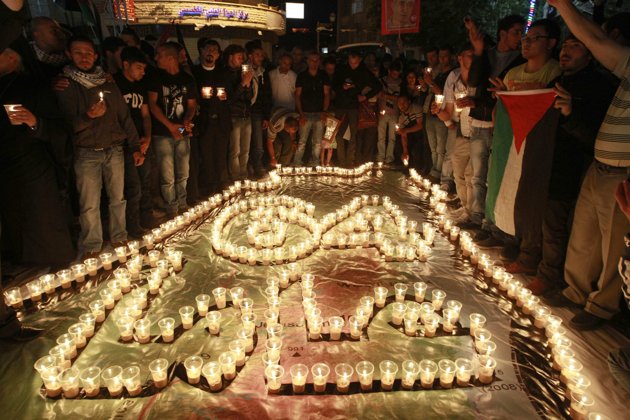
Palestinians gather around candles lit ahead of Nakba, in the West Bank city of Ramallah May 14, 2012. On May 15 Palestinians will mark Nakba, or catastrophe, of Israel's founding in a 1948 war, when hundreds of thousands of their brethren fled or were forced to leave their homes. REUTERS/Ammar Awad (WEST BANK - Tags: POLITICS CIVIL UNREST)

EU foreign ministers on Monday issued a harsh critique of Israel, saying the gathering pace of settlement-building, settler extremism and ill-treatment of Palestinians threatens a two-state solution.

[AS ALWAYS PLEASE GO TO THE LINK TO READ GOOD ARTICLES IN FULL: HELP SHAPE ALGORITHMS (and conversations) THAT EMPOWER DECENCY, DIGNITY, JUSTICE & PEACE... and hopefully Palestine]
http://news.yahoo.com/eu-slams-israel-over-settlements-palestinians-151434976.html
EU foreign ministers on Monday issued a harsh critique of Israel, saying the gathering pace of settlement-building, settler extremism and ill-treatment of Palestinians threatens a two-state solution.

"The EU expresses deep concern about developments on the ground which threaten to make a two-state solution impossible," the bloc's 27 ministers said in a statement issued during talks in Brussels.

"The viability of a two-state solution must be maintained," the three-page European Union statement added.

Israeli settlement watchdog Peace Now said on Monday that Israel was moving ahead with plans to build around 2,000 new homes in the settlement of Gilo, in Israeli-annexed east Jerusalem.

"There was an announcement of depositing for public review, plans for 942 housing units with an option for 300 more," the group's Hagit Ofran told AFP. "The public now has 60 days to present objections."

"Next week, on May 22, there will be a discussion on objections to a different plan for Gilo, for 900 units," she added. "Another stage in the approvals process."

The Jerusalem Post daily said it could take years before all steps were complete and construction could begin.

Reiterating that settlements on occupied land are illegal under international law, the ministers notably condemned "the marked acceleration" of settlement building since the end of a 2010 moratorium and expressed "deep concern" over settler extremism in the West Bank.

They also voiced concern over evictions and the demolition of Palestinian homes in east Jerusalem "and the prevention of peaceful Palestinian cultural, economic, social or political activities".

Turning to the so-called Area C zone of the occupied West Bank, where Israel has full civil and security control, the statement noted "the worsening living conditions" of the Palestinian population in general.

The ministers' stand came on the heels of a damaging report by NGOs this weekend alleging that Israel last year demolished dozens of Palestinian homes, water cisterns and farm buildings built with European funds.

In Area C, Israel has placed "serious limitations" on the Palestinian Authority's ability to promote economic development, the statement said.

Saying the future of Area C was critical to a future Palestinian state because this was its main land reserve, the EU urged Israel to halt demolitions and simplify the granting of building permits....READ MORE

View of the Jewish settlement of Har Homa near the West Bank town of Bethlehem. EU foreign ministers have issued a harsh critique of Israel, saying the gathering pace of settlement-building, settler extremism and ill-treatment of Palestinians threatens a two-state solution. (AFP Photo/Jack Guez)

Ambassador Maen Rashid Areikat: For a more constructive Congress on Palestine

"The U.S. administration realizes very well that Palestinians have been forthcoming and engaged in the past three years. We offered proposals, and made suggestions and ideas only to be met with a lack of substantive counterproposals from the Israelis. Instead of a meaningful and sincere engagement by the Israeli government, its answer was to accelerate settlement activities in the occupied West Bank, including East Jerusalem, in a manner that clearly indicates their desire to destroy, once and for all, the two-state solution. Ambassador Maen Rashid Areikat, Chief Representative of the General Delegation of the Palestine Liberation Organization to the United States. - 05/14/12

 General Delegation of the PLO to the United States
Read today's op-ed in The Hill paper by Ambassador Areikat, entitled "For a more constructive Congress on Palestine." http://t.co/NZAuKWkr


Arab writers returning from Gaza condemn Hamas repression, lament erasure of Palestinian character

Arab writers return from Gaza, overshadow literature festival with anti-Hamas testimonies
May 14, 2012

Mohammed Saad
Ahram Online
May 13, 2012 - 12:00am
http://english.ahram.org.eg/NewsContentP/18/41545/Books/Arab-writers-return-from...


The closing ceremony of the fifth Palestine Festival of Literature (aka Palfest) was overshadowed by politics as writers who returned from a trip to the Gaza Strip gave their testimony on the situation there and described Hamas’s “repressive rule.”

At the Palfest closing ceremony, which was held in Cairo on Friday at the Rawabet Theatre, writer Ahdaf Soueif presented the Egyptian and Arab guest writers, including Khaled El-Khamisi, Sahar El-Mougy, poet Amin Haddad, Tunisian writer Khaled Najjar and Palestinian Poet Tariq Hamdan.

“We’re holding the closing ceremony here in Cairo, not Gaza, for two reasons: firstly, we wanted you to share this event with us and, secondly, we wanted to underline the importance of reviving the Egyptian-Palestinian relations,” Soueif explained.

During the past four editions of the Palfest, no Egyptian or Arab writers were among the members of the delegation that visits Gaza. Delegates were mostly European and American writers, who would have less trouble entering Gaza than their Egyptian colleagues. Not only would Egyptians struggle to pass the Egyptian-Palestinian border, but they may need an Israeli visa, which would be prejudicial against them because intelligence agencies at home would suspect them of spying. But after the January 25 Revolution, there has been a stark change, with most of the writers in the delegation coming from Egypt and other Arab countries.

“The past Palfests used to be held in the West Bank, but this time we decided to hold it in Gaza to stress the new reality in Egypt,” Soueif said, referring to the Mubarak regime’s role supporting the Gaza blockade.

Palfest mainly consists of three activities: first, literary and creative writing workshops in Palestinian schools and universities; second, sightseeing; third, cultural discussions and concerts in the evening.

Fierce blockade, Egyptian praise
The people of Gaza are living in inhumane conditions due to the blockade imposed by Israeli authorities. Officially, Israel withdrew from Gaza in 2005, but it imposed a road and naval blockade since Hamas was voted into power in 2006. According to many Palestinians at the event, Gaza is still under occupation.

“The main feeling you get while in Gaza is anger, and there are many reasons there for that. The situation there is atrocious; the blockade is everywhere, and this creates chaos that inevitably leads to fear,” Khaled El-Khamisi said.

The people of Gaza are angry not only towards Israel, but also towards Egypt and — more significantly — Hamas.

”The approach of Egyptian authorities towards Gaza is despicable. We’re following the American and Israeli agendas by helping to blockade Gaza. This should change in post-revolution Egypt. We should decisively boycott Israel and open all the crossings at the Gaza border,” El-Khamisi asserted.

Cultural hunger
Most of the writers who visited Gaza had one opinion with respect to cultural activities in Gaza: “deplorable.” They say the aim appears to be to erase the Palestinian character and culture, which gave the world thinkers and poets like Mahmoud Darwish and Edward Said.

Professor of English Literature Sahar El-Mougy said that there’s a deplorable condition of cultural hunger. There aren’t even cinemas, libraries, or shops that sell books on the arts, philosophy or literature. The only available books are those on Islamic Sharia (Islamic jurisprudence) and Fiqh (thinking).

“There’s a conspiracy against the Palestinian character, to destroy its beauty. Hamas is erasing Palestinian culture, replacing it with an extremist version of Islam. They don’t even allow men and women to be in the same place!” El-Mougy objected.

“But through all this, and despite the security and intelligence, who we saw everywhere in Gaza, students we met have the spirit of resistance — not against Israel this time, but against the repressive practices of Hamas.”

“When we started writing workshops with young girls in schools, they first wrote about resistance against Israel,” said El-Mougy. “But when we showed them that writing could also express your inner feelings, the results were magnificent. Girls started to realise that writing is also about the self.”

El-Mougy says that Hamas, the resistance movement against occupation, became itself a movement of repression. “Hamas stands between Palestinians and life.”

Palestinian Spring
Palestinians attending the event were impelled to participate in discussions about Hamas violations in Gaza after observations form the delegation overshadowed other talks in the ceremony.

Some argued that blaming Hamas for the conditions in Gaza wrongfully lifted some of the guilt off Israel, the main enforcers of the Gaza blockade.

The 15 March protests to end the Fatah-Hamas division were discussed too. Some saw it as a revolution; others thought it was just a mistake and the right option would be to topple both from power, since neither work for the sake of the people.

At the conclusion of the ceremony, Ahdaf Soueif declared that Palfest is still boycotting Israel at all levels and won’t change its mind anytime soon.