
ADC Research Institute (ADC-RI) | www.adc.org
1732 Wisconsin Ave., NW | Washington, DC | 20007
Tel: 202-244-2990 | Fax: 202-333-3980 | E-mail: media@adc.org


| Date posted: May 17, 2010 By Joharah Baker for MIFTAH | |
| Every year Palestinians commemorate this tragic event. And every year, the hope that the injustice caused by this event will be rectified becomes slimmer and slimmer. Al Nakba or the Catastrophe is a wound all Palestinians bear, refugee or otherwise. Sixty-two years ago, hundreds of thousands of Palestinians fled or lost their homes in fear for their lives from attacking Jewish gangs. Some were massacred in their homes, some died the fighting, some were forced out of their villages and towns and some fled in order to stay alive, only to be denied reentry after Israel was created. Today, many of the original refugees have perished, those who carried a few precious belongings on their backs, their children at their sides and the keys to their homes securely tied around their necks. The younger refugees may still be around, aging Palestinians, some of whom have never seen Palestine but who can recount the events of 1948 like it was yesterday, who can tell you the name and location of their lost village and the house in which they never set foot. Perhaps it is the fact that this tragedy is so immense and so deep-cutting that Palestinians find themselves united in its commemoration. For whatever reason, Palestinians in the Diaspora, in refugee camps in Palestine and in neighboring countries, inside the Green Line in what is now Israel and here in Palestine have rallied around this painful memory as one voice and one force calling for one thing: the right of return. For us beleaguered Palestinians who have witnessed the bitter internecine fighting for years between the various factions, this has been, ironically, a breath of fresh air. Factions banded together in Gaza, the Hamas-controlled Strip to commemorate the loss of Palestine and the homes and villages of so many of its people. Reminiscent of the days of the first Intifada in particular, Al Nakba commemoration this year transcended all factional lines. The right of refugees to return has always been a Palestinian demand and is an inalienable right enshrined in international law. Today, that right is no less of a demand than it was in the early days of the Palestinian exile. The turnout at Nakba commemorations and the unity the Palestinians projected is clear evidence of this fact. However, what is most striking this year is not only the heart-wrenching pictures of refugees in exile but the heartwarming images of unified Palestinians. Such images also beg a very important question, which is, if the Palestinians are so resolved on an issue such as this, why can they not agree on other equally as important points? At the risk of coming across as simplistic, it seems that Palestinians have a bottomless reservoir of hope, determination and patience, which they tap into whenever they choose. Can they not dip into this eternal reserve and find the strength to overcome their political divisions? Nothing is impossible, especially this. It is about time, too. The situation as its stands is lethal. Hamas in Gaza accuses the Abbas-run government in the West Bank of rounding up its men, interrogating them under difficult circumstances and blocking jobs to them because of their affiliation. Fateh and the government, on the other hand, say Hamas is smuggling arms into the West Bank as a means of contesting the PA's authority and is persecuting the few remaining Fateh loyalists still in Gaza. Where rumor and truth coincide is hard to say but like the popular Arabic saying goes, "There is no smoke without fire." For one, the thirst for power has blinded Palestine's leaders to a point where the ultimate goal is often lost. Unfortunately, the power the sides are vying for is nothing but illusory given the fact that Palestinians are still very much under Israel's occupation. In any case, the liberation of Palestine is the slogan all factions continue to uphold but the fact of the matter remains that seats of 'false' power are the immediate goal. Take for example, the failure of Hamas and Fateh to reconcile. “The message today is a message of national unity in facing the Israeli occupation," said one Fateh leader in Gaza. "“National unity is the way to preserve the right of return," a Hamas leader insisted. They are right, of course, at least in paying lip service. In reality, a Palestinian reconciliation at the political level seems like a bleak possibility. Until, of course, one sees the Nakba commemorations. It is a shame the Palestinians have lost their way. Nothing pains us more than seeing our leaders so divided. We should take a leaf out of Israel's book when it comes to showing a united front. Irrespective of the governments in office, Israel's goal has always been unwavering: Expand Israeli territory including illegal settlements as fast as possible with as few Palestinians on the remaining areas. The status quo of Palestine today is witness to Israel's resolve. Internal Israeli politics are wracked with dissent, corruption, backstabbing and strange bedfellows, just like in any other political system. But this does not deflect from their national goal, which they have forwarded steadily ever since Israel's creation. Palestinians need to learn that valuable lesson and who better to learn it from than the root of the problem itself? We have the potential; the symbolic keys held up in unison in Gaza, the West Bank, the US, Europe and the Arab world all point to that bottomless reservoir of hope and promise. Let us take advantage of that so that legitimate Palestinian demands such as the right of return are not lost in the chaos of our egotistic hunger for power. Joharah Baker is a Writer for the Media and Information Department at the Palestinian Initiative for the Promotion of Global Dialogue and Democracy (MIFTAH). She can be contacted at mid@miftah.org. | |
Should anyone like to congratulate Israel for its creation, it would be equivalent to congratulating it on the success of its daylight robbery of Palestine and the systematic expulsion of the Palestinian people from their land and homes. As Palestinians mark yet another day remembering the Nakba, the catastrophe of Israel’s creation in 1948, any congratulations being extended should go to their evictor-turned-jailor of the world’s largest prison.
The Nakba are the days of infamy that created what has become the largest diaspora of refugees in the world. On May 14 the state of Israel was declared and the first Arab-Israeli war broke out in earnest the next day. The prospective state of Israel launched a massive military incursion into Palestinian territory, creating in its wake three quarters of a million Palestinian refugees, the destruction of hundreds of entire villages not only depopulated but obliterated, and houses blown up or bulldozed.
As a result, five million Palestinian refugees and their descendants are now scattered across the West Bank, Gaza, Lebanon, Jordan and Syria. About one-third still live in UN-supported refugee camps.
Their plight is one of the most emotionally charged issues of the conflict. The Israeli side has not given an inch on its basic premise: The confiscated Palestinian land, which comprises 92 percent of Israel’s area, will not be returned to its rightful owners, and the inhabitants of villages and towns who were expelled by Israeli forces in 1948 will not be allowed to return home. The standard explanation is an influx of refugees would dilute Israel’s Jewish majority and threaten the existence of the state.
In this, Israel is backed by Washington which would like to see the Palestinians, displaced in 1948 and 1967, assimilated wherever they are now living or resettled in countries, Arab or otherwise, that are ready to receive them.
On the other hand, the five million Palestinian refugees who have endured 62 years of wars, destitution and exile, refuse to accept this diktat and insist on their right to return home. They have strong bases for that claim. The right of return is legal, pursuant to UN Resolution 194, which calls for both repatriation and indemnification.
There is no precedent in UN history for the universal, sustained and firm consensus accorded to the right of the refugees to return to their homes. It has been affirmed over 100 times by the UN. The right to return home has been affirmed by the Universal Declaration of Human Rights and by similar European, American and African charters.
It might be suggested that as the indirect Palestinian-Israeli negotiations, which are scheduled to discuss the core issues of the conflict, begin this is not the time to talk about the right of return in the absence of not just a Palestinian state but substantive progress on other issues of the conflict. The Israelis are expanding the settlements on a daily basis, Judaizing what is left of Jerusalem, and narrowing Palestinian horizons in every conceivable manner. Under these circumstances, it is argued, the right of return should take a back seat in negotiations.
But there is a centrality to the right of return and any resolution of the Palestinian-Israeli conflict not including the repatriation of millions of uprooted refugees to their original homes and villages in what is now called Israel would be strongly rejected by the Palestinian people, especially those forced out, seemingly never to be allowed in again.
|
Palestinian Diana Safieh, 69, shows old identity cards and photographs at her house in the mostly Arab east Jerusalem on May 14. Safieh was just seven years old when her family fled their west Jerusalem home on a spring night in 1948 in fear of bloody clashes between Jewish and Arab forces.(AFP/Marina Passos)JERUSALEM (AFP) – Diana Safieh was just seven years old when her family fled their west Jerusalem home on a spring night in 1948 in fear of bloody clashes between Jewish and Arab forces.
Now at nearly 70, she wants to catch at least a glimpse of a fading memory.
"My father would say: 'We will never leave Jerusalem,'" the elegant and sprightly Palestinian woman from an upper middle-class Christian family tells AFP on an emotional journey of return.
On Saturday, the Palestinians were in mourning to mark the "Naqba," or catastrophe, of Israel's establishment 62 years ago in British-mandated Palestine and with it the exodus of hundreds of thousands of Arab inhabitants.
Safieh remembers that on the morning of May 13, 1948, she was picking flowers for the nuns of Saint Joseph convent.
"If we had known what was to befall us, we would have done something else," she says with a smile. By the end of the day, the house and its furniture as well as money and jewellery in the bank had all been lost.
Panic had been spreading in the neighbourhood for months, with people abandoning homes. "By May 13, it had become unbearable," says Safieh.
In the middle of the night, little Diana and her brother Jean were woken up by their father. The family was packed into the car and sped off to the convent where a relative was a nun.
On May 14, the state of Israel was declared and the first Arab-Israeli war broke out in earnest the next day.
The Safieh family stayed three months at the convent before deciding, like many others, to move to Beirut. Father Emile decided it was time to return nine months later to Jerusalem, where they settled in the Arab eastern sector.
More than 760,000 Palestinians -- estimated today to number more than five million with their descendants -- were pushed into exile by the conflict or driven out of their homes.
"We were very lucky," admits Safieh, whose two brothers live abroad. "We did not end up in a refugee camp, and we had the means to travel and to have an education."
Today she lives in the Beit Hanuna district of east Jerusalem, which Israel captured in the 1967 Middle East war.
Safieh has only seen the old family house once since Israeli independence, and that was a painful experience back in 1967 with parents Emile and Odette, who had both since died.
"I don't know if I will remember it. In '67, there was a palm tree and the house next door had a tiled roof," she says ahead of the trip down memory lane to what it now the upper-class Jewish district of Baqaa....READ MORE
A Palestinian refugee boy walks in an alley near his family's house in the Jabaliya refugee camp, northern Gaza Strip, Friday, May 14, 2010. Palestinians mark the 62nd anniversary of the creation of the state of Israel on Saturday May 15, 2010, calling it 'Nakba' or the 'day of the catastrophe', when in 1948 many thousands were forced from their lands and homes.(AP Photo/Adel Hana)
Nakba Palestinians ride their horses during a protest marking the anniversary of the 'Nakba', Arabic for catastrophe, inside the Balata refugee camp, in the West Bank city of Nablus, Friday, May 14, 2010. The 62nd anniversary for the Nakba will be marked by Palestinians on Saturday, May 15, when they commemorate the creation of Israel which forced Palestinians from their lands, and is called Nakba or the 'day of the catastrophe'.(AP Photo/Nasser Ishtayeh)
Palestinian children gather before the funeral of Aysar Zaben, 16, in the West Bank town of Mazra'a al Sharqiya, near Ramallah, Friday, May 14, 2010. Zaben, was found dead from a gunshot wound near his village, and Palestinians said Friday he was likely shot by an Israeli settler while throwing stones at cars. The Israeli military, which exercises overall control in the West Bank, said its troops were not involved in the incident. (AP Photo/Bernat Armangue)
Nakba,Palestinians shout slogans as they mark the 62nd anniversary of the 'Nakba,' Arabic for catastrophe, during a rally organized by Hamas in the southern border village of Maroun el-Rass, Lebanon, Friday, May 14, 2010. Protesters commemorated on Friday the dispersal of Palestinians during the 1948 war over Israel's creation.(AP Photo/Mohammed Zaatari)
A Palestinian man looks through a pair of binoculars at the border with Israel during a sit-in to mark the 62nd anniversary of Nakba in the village of Maroun Al Ras, southern Lebanon, near the border between Lebanon and Israel, May 14, 2010. Palestinians will mark "Nakba" (Catastrophe) on May 15 as a day of mourning for the establishment of Israel in 1948 after which an Arab-Israeli war brought the displacement of hundreds of thousands of Palestinians. REUTERS/Ali Hashisho (LEBANON - Tags: ANNIVERSARY CIVIL UNREST)
Palestinian children learn about Nakba to mark the 62nd anniversary of Nakba at Ain el-Hilweh refugee camp, southern Lebanon May 14, 2010. Palestinians will mark "Nakba" (Catastrophe) on May 15 as a day of mourning for the establishment of Israel in 1948 after which an Arab-Israeli war brought the displacement of hundreds of thousands of Palestinians. REUTERS/ Ali Hashisho (LEBANON - Tags: ANNIVERSARY EDUCATION)
Palestinian men speak as a Palestinian child looks on during a sit-in to mark the 62nd anniversary of Nakba in the village of Maroun Al Ras, southern Lebanon, near the border between Lebanon and Israel, May 14, 2010. Palestinians will mark "Nakba" (Catastrophe) on May 15 as a day of mourning for the establishment of Israel in 1948 after which an Arab-Israeli war brought the displacement of hundreds of thousands of Palestinians. REUTERS/ Ali Hashisho (LEBANON - Tags: ANNIVERSARY CIVIL UNREST)
Palestinian hold a symbolic key during a protest in the West Bank village of Bilin, near Ramallah May 14, 2010. Palestinians mark "Nakba" (catastrophe), a term is used by Palestinians to describe the founding of Israel in a 1948 war when some 700,000 Palestinians fled or were expelled from their homes, on May 15. REUTERS/Ammar Awad (WEST BANK - Tags: ANNIVERSARY CIVIL UNREST)
A Palestinian protester dressed as Handallah, a Palestinian cartoon character, stands near tear gas fired by Israeli soldiers, not pictured, during a protest by Palestinians against Israel's separation barrier and marking the anniversary of the 'Nakba', Arabic for catastrophe, outside the West Bank village of Bilin, near Ramallah, Friday May 14, 2010. The 62nd anniversary for the Nakba will be marked by Palestinians on Saturday, May 15. (AP Photo/Nasser Ishtayeh)
Palestinian protesters dressed as Handallah, a Palestinian cartoon character, stand in front of a large key, during a protest by Palestinians against Israel's separation barrier and marking the anniversary of the 'Nakba', Arabic for catastrophe, in the West Bank village of Bilin, near Ramallah, Friday May 14, 2010. The 62nd anniversary for the Nakba will be marked by Palestinians on Saturday, May 15, 2010. (AP Photo/Nasser Ishtayeh)
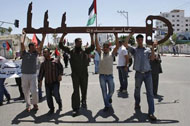
Palestinian men hold keys symbolizing the keys to houses left by Palestinians in 1948 during a rally marking the anniversary of the 'Nakba', Arabic for catastrophe, in the Jabaliya refugee camp, northern Gaza Strip, Friday, May 14, 2010. The 62nd anniversary for the Nakba will be marked by Palestinians on Saturday, May 15, 2010. (AP Photo/Hatem Moussa)
An elderly Palestinian carries a symbolic key during a sit-in marking the 62nd anniversary of the 'Nakba,' Arabic for catastrophe, organized by the Democratic Front for the Liberation of Palestine in front of the United Nations House in Beirut, Lebanon, Friday, May 14, 2010. Protesters commemorated on Friday the dispersal of Palestinians during the 1948 war over Israel's creation.(AP Photo/Bilal Hussein)
Nakba. A Palestinian boy carries a banner in Arabic that reads :' What about the children of Palestine,' during a sit-in marking the 62nd anniversary of the 'Nakba,' Arabic for catastrophe, in front of the United Nations House in Beirut, Lebanon, Friday, May 14, 2010. Children commemorated on Friday the dispersal of Palestinians during the 1948 war over Israel's creation. The Arabic on their shirts read :' The birds of return.' (AP Photo/Bilal Hussein)
Nakba, A Palestinian girl carries a banner with a writing in Arabic that reads:' I'm not staying as a refugee, I'm returning,' during a sit-in marking the 62nd anniversary of the 'Nakba,' Arabic for catastrophe in front of the United Nations House in Beirut, Lebanon, Friday, May 14, 2010. Children commemorated on Friday the dispersal of Palestinians during the 1948 war over Israel's creation. (AP Photo/Bilal Hussein)
Nakba. Palestinian children carry balloons and pictures during a sit-in marking the 62nd anniversary of the 'Nakba,' Arabic for catastrophe in front of the United Nations House in Beirut, Lebanon, Friday, May 14, 2010. Children commemorated on Friday the dispersal of Palestinians during the 1948 war over Israel's creation. The Arabic writing reads :' We're staying,' right, ' We're returning.' (AP Photo/Bilal Hussein)
A boy holds up a Palestinian flag during a Nakba rally in Kafar Kana May 14, 2010. Palestinians will mark "Nakba" (Catastrophe) on May 15 to commemorate the time when hundreds of thousands of Palestinians were expelled or fled from their homes in the war that led to the founding of Israel in 1948. REUTERS/Ammar Awad (ISRAEL - Tags: POLITICS CIVIL UNREST ANNIVERSARY)
People watch as big balloons attached to a giant keffiyeh, a traditional headscarf, are released during a rally celebrating Palestinian culture in the West Bank city of Ramallah May 13, 2010. REUTERS/Mohamad Torokman (WEST BANK - Tags: SOCIETY)
Palestinian youths play with a ball during sunset at the beach of Gaza City May 13, 2010 REUTERS/Suhaib Salem (GAZA - Tags: SOCIETY TRAVEL)
A Palestinian man rides a horse during sunset at the beach of Gaza City May 13, 2010 REUTERS/Suhaib Salem (GAZA - Tags: SOCIETY ANIMALS TRAVEL)
Beyond negotiations: Palestinian strategies for advancing peaceby Hussein Ibish 13 May 2010 |
by Hussein Ibish
Dear AP,
Edward Said and sister, Rosemarie 1940Fayeq Oweis "The piano keys honor Edward Said’s artistic talent. They also honor his efforts in using music to bridge the Palestinian-Israeli divide (Riding 2006). Together with conductor Daniel Barenboim, he created the East-West Diwan Orchestra" Honoring Edward Said: Outline and Element Descriptions 9, featuring young Israeli and Palestinian musicians.
Select a novel, play, or epic in which a character experiences such a rift and becomes cut off from “home,” whether that home is the character’s birthplace, family, homeland, or other special place. Then write an essay in which you analyze how the character’s experience with exile is both alienating and enriching, and how this experience illuminates the meaning of the work as a whole. You may choose a work from the list below or one of comparable literary merit. Do not merely summarize the plot.
The American
Angle of Repose
Another Country
As You Like It
Brave New World
Crime and Punishment
Doctor Zhivago
Heart of Darkness
Invisible Man
Jane Eyre
Jasmine
Jude the Obscure
King Lear
The Little Foxes
Madame Bovary
The Mayor of Casterbridge
My Ántonia
Obasan
The Odyssey
One Day in the Life of Ivan Denisovich
The Other
The Poisonwood Bible
A Portrait of the Artist as a Young Man
The Road
Robinson Crusoe
Rosencrantz and Guildenstern Are Dead
Sister Carrie
Sister of My Heart
Snow Falling on Cedars
The Tempest
Things Fall Apart
The Women ofBrewster Place
Click on 2010 Free Response Questions
2010 Free-Response Questions (.pdf/182K)**************