Labels

Wednesday, April 7, 2010

Sheer theft - Jordan Times Editorial

Sheer theft

Israeli settlers are using Ottoman era documents as proof of ownership of houses in East Jerusalem.

While this is not a new practice - settlers have used documents from British Mandate times as well - it would be good that this practice either be understood for what it is or be ended.

In Jerusalem they say that these documents are forged. This, of course, would be no great surprise, since settlers can’t stoop too low in their project to clear Palestine of its indigenous population. The Israeli courts are biased in favour of the settlers, but there’s no surprise there either. For a country that prides itself on its democracy and rule of law, Israel’s legal system remains fundamentally skewed against Palestinians.

There is, for instance, the Law of Absentee Property, a piece of legislation that was brought in 1950 for the express purpose of legitimising the appropriation - read theft - of Palestinian property left unguarded when some 800,000 people fled or were forced to flee in 1947-48.

Of course, the law targets Palestinians without saying so explicitly, a time-honoured Israeli practice. It does not mention Arabs or Palestinians and their properties. It talks only about landlords who fled to enemy territory, i.e., the entire surrounding Arab neighbourhood and the only place to which Palestinians could flee. Their properties subsequently became the property of the state of Israel in what is quite possibly the largest case of real estate theft in history.

Palestinians quite rightly demand this outrageous wrong be righted. They demand that their properties be restored to them and they be granted the right, if they so choose, to return to them. This is a right enshrined in international law. The whole world may have given up on this, but that is only because the international community has slowly but surely given up on human rights.

Of course, nothing annoys an Israeli more than the Palestinians’ right of return. So palpable is this annoyance that it is clear that it agitates the conscience.

If the Palestinian-Israeli conflict is about just one thing, as Israelis know deep down, it is 1948 and the wholesale dispossession of an entire nation.

For the Israeli legal system to allow the contrary, i.e., the restitution of property pre-1948 or 1967 in occupied territory to Jewish owners (when such claims have a basis in reality) is therefore a fantastic provocation that will only incite greater anger and more violence.

It is also clear testament to the racist nature of the Israeli legal system.

8 April 2010

Textbooks, Grasshoppers, and the Question of Incitement by Ghassan Khatib

Ghassan Khatib

Ghassan Khatib

Posted: April 5, 2010 04:25 PM

There is a great opportunity in the next few months to reach a just peace between Israelis and Palestinians. This may seem a surprising view just now, but there is a competent and responsible Palestinian government in place which is serious about establishing a sovereign Palestinian state alongside Israel. And there is strong public support for this objective. The evidence is all around you if you come to see the reality.

It would be tragic if Israel were to miss this opportunity -- tragic for Israel as well as for Palestinians. It is profoundly mysterious to us as to why the current Israeli government seems unable to envision how the Palestinian state which we are building is the best way of ensuring a lasting peace. Not to mention righting the many injustices of its long and costly occupation.

Yet instead, the Israeli government seems determined to ignore the positive reality and hark back to previous times. Take for example Israeli accusations of Palestinian 'incitement.' Incitement is a very elastic concept and hard to define. If it means putting incitement propaganda into schools, the Palestinian National Authority has already made successful efforts to deal with this...READ MORE


Winnipeg churches welcome Palestinian refugee family

Winnipeg churches welcome Palestinian refugee family

By Renée Joette Friesen | Tuesday, March 30, 2010

WINNIPEG, MB—Fatema Abdulraheem sets the table in her tiny, modest apartment that she shares with two adult sons. She puts out a spread of fried chicken on a bed of rice, finely cut potatoes and peas, accompanied by homemade naan bread and sour cream.

The Palestinian woman explains through a translator that the sour cream is not the proper traditional accompaniment. She meant to buy yoghurt, but the packaging was so similar she couldn't tell the difference between the two dairy products. On another occasion, she bought cottage cheese by mistake, she says with a laugh.

The problems Fatema encounters at the grocery store are just some of challenges she and her family face on a daily basis as newcomers to Canada.

"Language is huge; it's the biggest hurdle. Stores and shopping malls can be overwhelming at times," says Heather Rochon, a volunteer with Hospitality House, a refugee ministry that has helped Fatema's family adapt to their new country since they left a refugee camp near Syria last fall.

Rochon explains that refugees often have to be fiercely independent and survive horrific circumstances before coming to Canada. When they finally arrive, they experience the opposite and must rely completely on others because of language and cultural barriers. "Just being so dependent on other people is very hard on them. It's a total culture shock."

But having sponsors to help them is making the transition a bit easier for Fatema and her family.

Three Manitoba faith-based groups banded together to bring Fatema's family of 14 refugees to Winnipeg. They responded to an opportunity the Canadian government presented to private sponsors when it agreed to assist Palestinians trapped in refugee camps on the border between Syria and Iraq.

The Fort Garry Mennonite Fellowship, the Anglican Diocese of Rupert's Land and Aberdeen Evangelical Mennonite Church each agreed to privately sponsor different members of Fatema's extended family for one year.

"Canada asked if people would take it on as privately sponsored cases," says Tom Denton of the Anglican Diocese, which is hosting Fatema and her two sons.

"We are responding to a human need," says Herb Heppner of Aberdeen EMC, which is sponsoring another of Fatema's relatives and her small children. He adds that the two church congregations and the Anglican Diocese each committed between $25,000 and $30,000 to cover all expenses for the one-year sponsorship.

Fatema, her two sons, Ahmed and Kaheder Abu-Khrait, arrived in Canada last fall. Another of her sons, his wife and four small children, along with a sister to the wife and her three children had come to Canada shortly before.

Back in 2006, Fatema's entire family lived in the same house in Iraq. But after Saddam Hussein fell from power, Iraq excommunicated Palestinians. Fatema says an Iraqi came to her house and killed another of her sons who was just 27 at the time.

A month later, Fatema and Ahmed fled to the refugee camp where they were reunited with other family members. They endured strict food rations, poor water and sub-standard shelter for four years before coming to Canada.

"We will be grateful all our lives to our sponsors and to Canada," Fatema says.

"We were so happy when we reached Canada," says Kaheder of the "freedom and safety" they now enjoy. "No one asks you for identification here."

Fatema and her family moved to Winnipeg at different times last fall, and they now live in relatively close proximity to one another in the city's south end.

"We decided to do that so that the family can be a support to each other," Heppner explains.

"We felt as a congregation this [sponsorship] was something we wanted to be involved in," says Deborah Martin-Koop, a member of Fort Garry Mennonite Fellowship who serves on the Welcoming Committee.

"We're very aware this is not a panacea. It is not the only answer. But this is a small conference and we can make a difference for a number of people," Martin-Koop says of the family of six they are hosting.

"They are a wonderful family to work with," Rochon says. "They seem very happy and motivated to settle."

The first priority for all members of Fatema's family has been to learn English.

Her sons are eager to find jobs once they have a handle on the language. Kaheder worked in construction and Ahmed was an electrician before the war in Iraq began.

While much of the family is fortunate to now be together, some of Fatema's other children are still separated—two of her sons are in the U.S. and she has three daughters in Baghdad.

"In Iraq we were surrounded by our family. At Ramadan we were all together. I wish we could bring them all here," says Ahmed.

Easter in Jerusalem Lacks Palestinians

Date posted: April 03, 2010
By MIFTAH

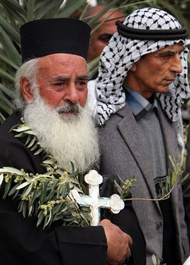
This week marks both Easter and the Jewish holiday of Passover. On these two occasions, thousands of Christian and Jewish worshippers from around the world flocked to Jerusalem to observe the holidays along with an approximate 2,500 Israeli military personnel patrolling the streets. One group that was clearly absent, however, were Palestinian Christians, many of whom were not allowed into the holy city. On March 28, Israeli authorities imposed a closure on the West Bank for a period of eight days, or the entire Passover period. Christian Palestinians, who usually are granted permits into Jerusalem for Easter, were reported to have been turned back at checkpoints when trying to enter.

On March 28, a group of Palestinian Christians and Muslims along with international and Israeli peace activists joined in a march demanding freedom of movement for the Palestinians. The march, which took place in Bethlehem, made its way to an army checkpoint on Palm Sunday but were stopped and some arrested by Israeli soldiers after crossing over. While Israel released the foreign and Israeli participants, it held the Palestinians, including Fateh Central Council member Abbas Zaki in custody for four days, charging them with entering a closed military zone.

Furthermore, throughout this week, Israel has limited the entry of Palestinians into the Aqsa Mosque, allowing only men above 50 entry into the mosque.

Also on April 2 in Ramallah, Jewish settlers attacked an elderly Palestinian and her daughter in Sheikh Jarrah during a protest against settler "provocations" in the neighborhood. The elderly woman, 89-year-old Rifqa Al-Kurd was taken to Al-Maqassed Hospital along with her daughter, 50-year-old Nadiya.

On April 1, Israeli settlers and soldiers attacked Palestinians in the east Jerusalem district of Silwan. According to eyewitnesses, settlers broke into the local Ibda and Wad Helwa cultural centers in the neighborhood. Fifteen-year-old Yezen Siam was arrested by Israeli soldiers and taken to an undisclosed location. Several others were injured in the attack.

In the West Bank, 21-year-old Samar Radwan was killed when an Israeli settler hit her with his car west of Ramallah. Radwan was killed near Al-Lubban Al-Gharbi, between Israel's separation wall and the settlements of Ofarim and Bet Arye.

Unrest was not only in Jerusalem, however, but also in the Gaza Strip, spilling over from the clashes last week. On April 2, Israeli warplanes fired attacks across the Strip, destroying several buildings. The attacks, said Israel, were in response to Palestinian rockets fired into Israeli territory. According to Palestinian press reports, Israeli missiles hit a building housing the Hamas-run Al Aqsa TV network and a cheese and dairy factory in Gaza City. Another two missiles were fired at a police station in the Nusseirat refugee camp including a telecommunications company. Palestinian medical sources reported that at least three children were injured in the attacks. Days earlier, Israeli planes dropped flyers along the Israel-Gaza border warning residents to get ready for a “response” to what Israel says is Hamas’ escalation of violence against Israeli targets.

The recent violence has even gotten the US concerned. On April 2, US State Department spokesperson Philip Crowley said that while Israel has a “right to defend itself” his government believed military action would not solve the conflict. “Therefore, Israel and the Palestinian Authority need to engage in direct negotiations.”

London also expressed concern with Israel’s air strikes on April 2, saying that it was “concerned with the escalation of violence in Gaza and southern Israel over the past week, “encouraging all parties to show restraint.

Meanwhile, Palestinians marked Land Day on March 30, commemorating the killing of six Palestinians inside the Green Line during a demonstration against Israeli land confiscations in 1976. Palestinians across the board marked the day with demonstrations and marches. One Palestinian was killed and 16 injured by Israeli air strikes on that day.

Also on the occasion of Land Day, the Palestinian Central Bureau of Statistics announced that Israel controls over 85% of the area of historical Palestine, with Jewish settlements in the West Bank focused in and around Jerusalem where 55% of the settlers live.

On that note, Israel received some tough love from US President Barak Obama. On March 31, Obama said in an interview with MSNBC that “I think Prime Minister Netanyahu intellectually understands that he has got to take some bold steps. I think politically he feels it” adding that the Palestinians also had to take steps in return. The US has reportedly demanded that Israel freeze settlements in east Jerusalem for a period of four months so indirect negotiations could resume. This demand is supposedly among 10 others Obama wants Israel to meet including opening a Palestinian commercial interests’ office in east Jerusalem and ending the razing of Palestinian homes in the city.

Prime Minister Salam Fayyad seems to have a plan of his own, describing it in a detailed interview with Haaretz on April 2. Fayyad, who has marketed his two-year plan for establishing a Palestinian state seems to be undeterred by the failed diplomatic attempts at peace.

“The birth of a Palestinian state will be celebrated as a day of joy by the entire community of nations," Fayyad said in the interview. “The time for this baby to be born will come," he said, "and we estimate it will come around 2011. That is our vision, and a reflection of our will to exercise our right to live in freedom and dignity in the country [where] we are born, alongside the State of Israel in complete harmony."

Israeli Prime Minister Benjamin Netanyahu, said Fayyad, “has succumbed to the settlers,” stressing that "peace will be made between equals, not between masters and slaves."

"It is the right of an oppressed nation to say 'enough'," said Fayyad. "No one should be expected to stand for injustice, not least the Palestinians.”

Finally, the 22nd Arab Summit was held in the Libyan city of Serte from March 27 to March 28. President Abbas, who attended the summit and who also met on the margins with Libyan President Muammar Qaddaffi, said he was “satisfied” with the summits results and hoped to see them implemented, especially those concerning Jerusalem and Palestine. Arab foreign ministers had previously pledged $500 million to Al Aqsa and Arab leaders said they would not back a return to negotiations without a freeze of settlements.

My letters to the New York Times & The Washington Post RE Obama weighs new peace plan for the Middle East & Palestinians building a non-violent state

RE: Obama weighs new peace plan for the Middle East
http://www.washingtonpost.com/wp-dyn/content/article/2010/04/06/AR2010040602663.html

Dear Editor,

I very much hope that a solid peace plan securing a secular two state solution to end the Palestine/Israel conflict emerges soon, and that it is fully in line with The Arab Peace Initiative on all the core issues:

I- Full Israeli withdrawal from all the territories occupied since 1967, including the Syrian Golan Heights, to the June 4, 1967 lines as well as the remaining occupied Lebanese territories in the south of Lebanon.

II- Achievement of a just solution to the Palestinian refugee problem to be agreed upon in accordance with U.N. General Assembly Resolution 194. (United Nations A/RES/194 (III) 11 December 1948 Resolves that the refugees wishing to return to their homes and live at peace with their neighbours should be permitted to do so at the earliest practicable date, and that compensation should be paid for the property of those choosing not to return and for loss of or damage to property which, under principles of international law or in equity, should be made good by the Governments or authorities responsible)

III- The acceptance of the establishment of a sovereign independent Palestinian state on the Palestinian territories occupied since June 4, 1967 in the West Bank and Gaza Strip, with East Jerusalem as its capital.

Sincerely,
Anne Selden Annab

*******************************

RE: Palestinians Try a Less Violent Path to Resistance, Palestinians headed to plant trees last month in the West Bank, part of a new, nonviolent approach to assert their land claims.
http://www.nytimes.com/2010/04/07/world/middleeast/07westbank.html?ref=world

Dear Editor,

Excellent to see this report noticing Palestinians taking a nonviolent approach- focusing in on self empowerment... taking ownership of the process of building a state.

I very much hope that Israel decides soon to end its illegal occupation, to stop its Apartheid policies and its land grabs, to respect international law and to work with Palestine to create a just and lasting peace for everyone's sake.

Sincerely,
Anne Selden Annab

Suleiman Alqam marks a lifetime with UNRWA: Benefiting from UNRWA schools, shelters and social services


Suleiman Alqam marks a lifetime with UNRWA

Amman
6 April 2010

Suleiman Alqam has spent nearly 60 years with UNRWA. As a child he attended UNRWA schools and received food aid in the West Bank. Later he worked for UNRWA’s health department and food distribution centres in Amman. As he approaches retirement, the years he has spent with the Agency have left him grateful for the opportunities given to him.

Born in Nuweimi camp in 1951, Suleiman’s family was originally from Barfilia, near Ramla. As refugees, Sulieman’s mother and father moved to Nuweimi camp in the West Bank in 1950 “in order to benefit from UNRWA schools, shelters and social services”.

Education

Suleiman and his three younger sisters received a free education at UNRWA’s Nuweimi school, along with food that the agency distributed. When war broke out in 1967, the family relocated to Al Jaffah in Jordan. Soon after, Suleiman’s father died of a heart attack and Suleiman, despite being a good student with high grades, was forced to leave school while only in the 8th grade to support his family.

Suleiman began his work with UNRWA in 1971 and has continued to work for UNRWA in different capacities for nearly 40 years. “The work was not always easy,” Suleiman says.

“It was a difficult decision to work as a sanitation labourer in the camps while my friends and neighbours were all at school,” he says. “The camps were especially difficult to clean back then as the streets were not paved, making it difficult to drive carts and there were no plastic bags so garbage was thrown on the streets.”

Grateful

Suleiman remembers people looking down on him for his work, but as the head of his family, Suleiman was grateful for the salary necessary to support his mother and sisters.

After forty years of work with UNRWA, Suleiman says the Agency has improved. It now provides more essential medicine and services, but, says Sulieman, could use more staff to carry out its work.

As for Suleiman’s family, his four children also went to UNRWA schools. They now have degrees in accounting and vehicle maintenance.

Important role

Suleiman says UNRWA has played an important role in his life. The Agency has provided an opportunity for education for him and his family, continued employment and stability.

Suleiman will retire next year, and looking back on his life with UNRWA, he is proud that his work has benefited not only his family but the families of other Palestine refugees.


To mark World Refugee Day on 20 June, the United Nations Relief and Works Agency (UNRWA) is holding a short-film competition... “Will We Meet?”

“Will We Meet?” young filmmakers’ competition to mark World Refugee Day

To mark World Refugee Day on 20 June, the United Nations Relief and Works Agency (UNRWA) is holding a short-film competition.

If you are an ambitious young film maker (under 26), or just have an idea for a clip, this is your chance to share, with an international audience, what you want to say about your world and the people in it, your hopes and aspirations.

Your film must reflect the theme “Will We Meet?” in an original and creative way and be between 1 and 5 minutes long.

Entries will be judged by a panel of UNRWA and Palestinian film makers. Entrants will compete in two age categories: under 18 and 18-26.

Prizes

First, second and third prizes will be awarded in each age category and will receive a cash prize.

First prize: US$1,500
Second prize: US$1,000
Third prize: US$500

All prize-winning films will be screened at an event to mark World Refugee Day.

Submissions of entries

Submit your film by sending it on DVD region 1 in avi or mpeg format to your nearest field office. Please mark the envelope 'Public information - film competition’

Find field office addresses

Please ensure that with the DVD you include your name, age, address, email and phone number.

All films must reach UNRWA by Sunday 30 May 2010.

All materials submitted must be original and produced for the purposes of this competition and not screened elsewhere.

UNRWA reserves the rights to later use of the submitted films.

If you have any questions please email y.azgad@unrwa.org

Tuesday, April 6, 2010

My Letter to FT RE Israel knows apartheid has no future by Mustafa Barghouthi

RE: Israel knows apartheid has no future
http://www.ft.com/cms/s/0/8012a780-40d3-11df-94c2-00144feabdc0.html

Dear Sir,

Excellent to see Mustafa Barghouthi's "Israel knows apartheid has no future", as I very much hope that Palestine and a fully secular
two state solution to end the Israel/Palestine conflict can survive the many challenges ahead.

In the spirit of that, for Palestine's sake, I have to add that I suspect that American politicians would be much more likely to "
embrace the Palestinian struggle" if the people's boycott energy was also going towards boycotting religious extremism and militancy.

Sincerely,
Anne Selden Annab

Al Jazeera English - GENERAL - Rhythms of resistance

Al Jazeera English - GENERAL - Rhythms of resistance

My letters 4-6-2010 to USA Today, The Daily Star, & The Guardian regarding the Israel/Palestine conflict

RE: Our view on the Middle East: Israeli settlement push hurts U.S. interests, peace process, Support for Israel doesn’t mean accepting its misguided policies.
http://blogs.usatoday.com/oped/2010/04/debate-on-the-middle-east-our-view-israeli-settlement-push-hurts-us-interests-peace-process.html#more

Dear Editor,

Good to see USA Today taking the stand that the Israeli settlement push hurts U.S. interests and the peace process. I very much agree with that headline and I hope it helps prod more people into putting more energy and thought into calming down and ending the Israel/ Palestine conflict.

Dr. Hussein Ibish of the American Task Force on Palestine, wisely points out that the Obama administration is taking a more holistic approach to the Middle East and
has "rightly identified Palestine and the Israeli occupation that began in 1967 as the center of this dynamic pattern because of its political and symbolic importance throughout the region." http://www.americantaskforce.org/in_media/pr/2010/03/31/1270008000

Sincerely,
Anne Selden Annab

************************************
RE: Divided, the Palestinians won't risk a third intifada By Hossam Ezzedine
http://www.dailystar.com.lb/article.asp?edition_id=10&categ_id=5&article_id=113476#axzz0kJzsOEFE

Dear Editor,

I totally agree that
Israel is trying to provoke Palestinians. However I think Israel is trying to provoke much more than the potential violence of a third intifada: I think Israel is doing all it can to provoke radicals and empower religious extremism in hopes of completely destroying Palestine.

By seriously working towards a secular two state solution to end the Israel/Palestine conflict, Palestinians are positioned to gain serious mainstream support and real political power. Radicals and religious extremists are eager to derail a negotiated end to the Israel/Palestine conflict and their bellicose stupidity shifts mainstream sympathy and support away from Palestine.

Sincerely,
Anne Selden Annab

************************************
RE: Israelis must integrate to survive, The increase in ultra-Orthodox Jews and Arabs is a social timebomb that threatens the Jewish state's long-term survival
http://www.guardian.co.uk/commentisfree/2010/apr/06/israel-integration-orthodox-jews-arabs

Dear Sir,

I very much appreciated the forthright honesty of "Israelis must integrate to survive, The increase in ultra-Orthodox Jews and Arabs is a social timebomb that threatens the Jewish state's long-term survival"

I wish I could object to the way the author lumps ultra-Orthodox Jews and Arabs into one category, but I can't since his main point is that "We at the mainstream must change our view of the growing minorities and treat them as the next frontier of economic opportunity and growth. If they prosper, we will all prosper"


Sincerely,
Anne Selden Annab

Before it is too late...

"It is dangerous out there and you don't know who's listening or what they might do to act on what you say. It is time to lower the temperature and tone down the rhetoric, before it is too late."
James J. Zogby

Monday, April 5, 2010

In Growing Gardens for Palestine... The American Task Force on Palestine


Growing Gardens for Palestine

Hallway leading towards Dr. Ziad Asali's office

"With the turbulence surrounding diplomacy and the Middle East peace process, it is more urgent than ever for civil society to unite around the obvious reality that a conflict-ending solution can only be attained through the creation of a Palestinian state living side by side with Israel in peace and security.

The two-state solution became official US policy under President George W. Bush, and it is today seen as a national security priority under President Barack Obama. It has been adopted internationally by the United Nations, the Middle East Quartet, the Palestinian Liberation Organization, the Arab League and by successive Israeli governments.
" Build a partnership for Middle East peace within the United States By Ziad Asali

Dr. Ziad Asali of ATFP in his office

This past Saturday my husband Jaffar and I had a delightful visit with Dr. Ziad Asali the founder of the American Task Force on Palestine, his fascinating wife Nailia, and the brilliant Hussein Ibish, having arranged to stop by to see their 7th floor offices in Washington DC and to have a chat.

Dr. Hussein Ibish & Nailia Asali of ATFP

I went with trepidation- and I left totally impressed. These people really do know how to listen and speak to America, they know how the system works and how to influence policy in positive ways for Palestine AND America.

Impressive views from ATFP office windows

I feel honored to have been in their 7th floor offices, to have seen the intriguing artwork on the walls, gazed out the big windows to the busy city below- and sat in comfort in Dr. Ziad Asali's office as we spoke easily about awkward and difficult topics.

Ziad & his wife Nailia are charming, kind, compassionate, thoughtful, well informed, well educated people... both are very bright and experienced- seasoned but not cynical- obviously modest and interesting people indeed.

Hussien Ibish in his office

Dr. Ibish told me privately that "in all their work with the Arab-American community over decades, and for the past seven years at ATFP both Ziad and Nailia have been completely volunteers and have never taken a penny of compensation for their efforts. On the contrary, they've devoted a good deal of their private resources to helping to found and sustain this organization."
(Visit their webpage to help keep them going- click on KEEP ATFP INDEPENDENT if you want to donate online or to find information on how to make a donation via mail, wire, fax or phone)

Dr. Ziad Asali has a knack for attracting and valuing the best and the brightest and he has assembled a highly competent team of articulate people, right in the heart of Washington DC where they can confer and do the most good.

They have compelling priorities: They believe in a healthy and serious debate to define and defend the national interest. Not long ago Dr. Asali testified before Congress (ATFP Press Release), and Dr. Hussein Ibish has been very busy with speaking engagements on college campuses. Ibish wrote a book, published this past year, patiently explaining what is wrong with the one-state agenda

The ATFP is dedicated to "advocating that it is in the American national interest to promote an end to the conflict in the Middle East through a negotiated agreement that provides for two states - Israel and Palestine - living side by side in peace and security".... furthermore the "ATFP is strictly opposed to all acts of violence against civilians no matter the cause and no matter who the victims or perpetrators may be. The Task Force advocates the development of a Palestinian state that is democratic, pluralistic, non-militarized and neutral in armed conflicts." http://www.americantaskforce.org/about_us

ATFP's website is a treasure trove of up to date, highly relevant information, news and opinion concerning Palestine. They don't use cheap tricks- they use hard work, careful analysis and diplomacy to do what they can to help end the contentious Israel/Palestine conflict...for every one's sake.

They are Golden Rule people through and through: By wisely nurturing a totally civilized, reasonable and sustainable conversation they are creating real respect for a real Palestinian state.


The Palestinian State and Institution Building Program
Documents detailing the state and institution building program of the 13th Palestinian Government, including the overall plan and priority interventions for 2010.

FOLLOW IBISH & the ATFP

"The fact is that the one-state argument completely lets Israel off the hook with regard to settlements. First, if it's one state, it hardly matters where people live (it might be a civil tort about payments for expropriated lands, at most). Second, if it's a single state, they're not settlements, because there is also no occupation. Third, it allows the Israeli right to say that the occupation is defensive and legitimate and so are the settlements because all forms of Palestinian nationalism are antithetical to the continued existence of Israel, a member state of the United Nations. All arguments about settlements and occupation immediately go right out the window. People who advocate a single state need to understand this clearly." Hussein Ibish


Become my friend on <span class= Become Hussein's friend
Follow <span class= Follow Ibish on Twitter
*************************

Sign up to receive the World Press Roundup!

Keep up to date with what is going on in the Middle East with ATFP's World Press Roundup


copyright ©2010 Anne Selden Annab


Friday, April 2, 2010

Only an Arab Palestine Makes a 'Jewish' Israel Meaningful By Hussein Ibish

Date posted: April 01, 2010
By Hussein Ibish

Israeli Prime Minister Benjamin Netanyahu is insisting the Palestinians recognize Israel as, in his words, “the nation-state of the Jewish people,” a new and problematic demand that raises serious questions about Israel’s “Jewish character.”

The Balfour Declaration of November 2, 1917, began with the phrase: “His Majesty’s government view with favor the establishment in Palestine of a national home for the Jewish people …” This declaration introduces the concept of a Jewish national home into international relations in a most decisive manner.

On July 24, 1922, the Mandate for Palestine adopted by the Council of the League of Nations made the Zionist project a practical reality rather than a rhetorical position by holding that “the principal Allied Powers have also agreed that the Mandatory [power] should be responsible for putting [the Balfour Declaration] into effect.”

Guided by British policy and interests, the international community, such as it was at the time, seems to have regarded the Jewish national project in Palestine as legitimate and simply refrained from commenting on the Palestinian national project, unless to damn it by silence.

However, given the increasing assertion of Palestinian national identity and ambitions during the Mandatory period, this willful blindness could not extend itself into international decision-making about the end of the Mandate, as it had at its beginning. Beginning in the 1930s, several proposals, most notably the Peel Commission Report of 1937, suggested that Palestine be partitioned into Jewish and Arab states. A decade later, UN General Assembly Resolution 181 called for the establishment of “independent Arab and Jewish states and a special international regime for the city of Jerusalem.” This partition resolution, along with a unilateral declaration of “a Jewish state in Eretz Israel” by the Jewish leadership, is generally regarded as the birth certificate of the Israeli state.

A central irony is that if the 1947 partition resolution has served as the primary international birth certificate for Israel, it must do the same for the yet-to-be-established Palestinian state. In its “land for peace” formula, United Nations Security Council Resolution 242 of 1967 and its numerous legal successors logically extend the fundamental attitude that seeks to balance Jewish and Arab rights in Palestine through two states.

Israel’s status as a Jewish state plainly rests primarily on the fact that it has a substantial Jewish majority of more than 75 percent. As a sovereign member state of the UN, Israel defines its own character, and the question of Israel’s Jewishness was never raised and is not reflected in its peace treaties with Egypt or Jordan.

The Palestinians have already recognized Israel as a Jewish state. This is most notable in PLO chairman Yasser Arafat’s September 9, 1993, letter to Premier Yitzhak Rabin, in which he stated unambiguously, “The PLO recognizes the right of the state of Israel to exist in peace and security.” Yet today, Palestinians are justifiably concerned that if they were to recognize Israel explicitly as “the nation-state of the Jewish people” (to use Netanyahu’s words), they might be perceived as endorsing measures that discriminate against the Palestinian citizens of Israel. Palestinians and many others also view this demand as an effort to pre-empt the refugee issue, a core permanent status negotiating issue.

Having asserted that Israel plainly is a Jewish state in one sense, one must assert that, in another sense, Israel at present is clearly not a Jewish state. The interpretation depends entirely on which version of Israel one is talking about. If we refer to Israel in its internationally recognized boundaries, then the state is indeed Jewish; but if we include the Occupied Territories, then it plainly is not.

Israel de jure, which excludes the Occupied Territories and assumes the creation of a Palestinian state in the foreseeable future, can certainly be considered both Jewish and democratic, although it still struggles to afford equality to a large non-Jewish minority. However, Israel de facto, on the other hand, includes the Occupied Territories, and assuming that no Palestinian state is created in the foreseeable future, one cannot consider this state either Jewish or democratic in any meaningful sense.

It could be seen as ironic, but it is also eminently logical, that a Jewish Israel requires an Arab Palestine alongside it in order to be itself and not something radically different.

Hussein Ibish is a senior fellow at the American Task Force on Palestine. THE DAILY STAR publishes this commentary in collaboration with the Common Ground News Service (commongroundnews.org), with the author’s permission.

Source: The Daily Star, 1 April. 2010

My letter PUBLISHED in USA Today 4-2-2010: Peace and Palestine need to be a priority — for everyone's sake.

http://blogs.usatoday.com/oped/2010/04/letters-as-sovereign-state-israel-has-right-to-disagree-with-us-.html#more

Policies create poverty

Anne Selden Annab - Mechanicsburg, Pa.

Good to see DeWayne Wickham's probing but polite commentary on Israel. It really is rather disturbing to find out that "while unemployment in Israel dropped to 7.4% in the last quarter of 2009, joblessness during that period in the U.S. hovered around 10%." In addition, contrast that to unemployment for Palestinians, and the difference is even more jarring. According to the CIA's World Factbook, unemployment in Gaza is 40%, and unemployment in the West bank is 19%.

Israel's Jews-preferred policies in Israel proper as well as the illegally occupied Palestinian territories have been creating poverty and despair for countless native non-Jewish Palestinian families and communities for decades. That alone should be reason enough for America to be firm about supporting a fully secular two-state solution to end the conflict.

Peace and Palestine need to be a priority — for everyone's sake.

Thursday, April 1, 2010

April 2010 National Poetry Month... The Words Under the Words a poem by Naomi Shihab Nye

Inaugurated by the Academy of American Poets in 1996, National Poetry Month is now held every April, when publishers, booksellers, literary organizations, libraries, schools and poets around the country band together to celebrate poetry and its vital place in American culture. Thousands of businesses and non-profit organizations participate through readings, festivals, book displays, workshops, and other events.
What is National Poetry Month?: Frequently asked questions about NPM.

Poster Gallery: Visit the NPM Gallery to view or purchase copies of posters from previous years.

Poem In Your Pocket Day: Join thousands of individuals across the U.S. by carrying a poem in your pocket on April 29, 2010.

The Words Under the Words
by Naomi Shihab Nye
for Sitti Khadra, north of Jerusalem
My grandmother's hands recognize grapes, 
the damp shine of a goat's new skin.
When I was sick they followed me,
I woke from the long fever to find them
covering my head like cool prayers.

My grandmother's days are made of bread,
a round pat-pat and the slow baking.
She waits by the oven watching a strange car
circle the streets. Maybe it holds her son,
lost to America. More often, tourists,
who kneel and weep at mysterious shrines.
She knows how often mail arrives,
how rarely there is a letter.
When one comes, she announces it, a miracle,
listening to it read again and again
in the dim evening light.

My grandmother's voice says nothing can surprise her.
Take her the shotgun wound and the crippled baby.
She knows the spaces we travel through,
the messages we cannot send—our voices are short
and would get lost on the journey.
Farewell to the husband's coat,
the ones she has loved and nourished,
who fly from her like seeds into a deep sky.
They will plant themselves. We will all die.

My grandmother's eyes say Allah is everywhere, even in death.
When she talks of the orchard and the new olive press,
when she tells the stories of Joha and his foolish wisdoms,
He is her first thought, what she really thinks of is His name.
"Answer, if you hear the words under the words—
otherwise it is just a world with a lot of rough edges,
difficult to get through, and our pockets full of stones."


Naomi Shihab Nye
Naomi Shihab Nye
Born to a Palestinian father and an American mother, Naomi Shihab Nye gives voice to her experience as an Arab-American through poems about heritage and peace that overflow with a humanitarian spirit....
More >