
Friday, December 18, 2009
For love of land
 | 17 - 23 December 2009 Issue No. 977 Reader's corner | |||
| Published in Cairo by AL-AHRAM established in 1875 | ||||
For love of land
Sir-- Ramzy Baroud quotes US President Roosevelt in 'A people's history of Thanksgiving' (3-9 December, Al-Ahram Weekly): "The European settlers moved into an uninhabited waste... the land is really owned by no one... The settler ousts no one from the land. The truth is, the Indians never had any real title to the soil."
Roosevelt was right. Native tribes (I am a citizen of the Choctaw Nation) did not own land. They considered it impossible to own land. Anyone could farm any land that was not being used by someone else. There was plenty of unused land for the European settlers to occupy and farm without displacing any natives because North America was sparsely populated by native tribes. The more peaceful tribes, such as the Choctaw, welcomed white settlers who obeyed the law and willingly let them marry Choctaws. However, tribes did mark territory for hunting and jealously guarded it against other tribes. In fact, native tribes regularly massacred each other over claims to hunting grounds or simply the desire to loot another tribe. Each tribe considered all other tribes to be animals worthy of slaughter like buffalo. They only united against the European Americans in the early 20th century.
The US government treated native peoples terribly and is guilty of many crimes against them, not the least of which is murder. But the analogy between Native Americans and Palestinians is false. Native Americans had no concept of property in land and there was a lot of empty land with room for European settlers.
Roger McKinneyOklahom
'Sadly still needed' UNWRA's Karen Abu Zayd talks to Al-Ahram's Dina Ezzat about a lifetime's commitment to fighting injustice
http://weekly.ahram.org.eg/2009/977/re72.htm
'Sadly still needed'
As Karen Abu Zayd approaches the end of her mandate as UNRWA commissioner-general, she talks to Dina Ezzat about a lifetime's commitment to fighting injustice
 Click to view caption Click to view caption |
| Karen Abu Zayd |
Later this month, Karen Abu Zayd will end her mandate as commissioner-general of the United Nations Relief and Works Agency (UNRWA), which looks after the destiny of over four million Palestinian refugees.
In Cairo this week as part of an emergency appeal for financial assistance for UNRWA's operations, Abu Zayd launched the appeal from the headquarters of the Arab League, where the organisation's secretary-general, Amr Moussa, paid tribute to what he called Abu Zayd's "remarkable" efforts to speak up for the rights of Palestinian refugees.
For Abu Zayd, this last appeal, to be followed by others launched by her successor, was "a last warning call" on behalf of the refugees.
The appeal asked for a little over $323 million to cater for the immediate needs of refugees in the occupied Palestinian territories in Gaza and the West Bank. These basic needs include food, healthcare and the elimination of environmental hazards.
UNRWA, Abu Zayd said, faces serious financial constraints that are undermining its performance at an exceptionally challenging time, with Palestinian refugees, especially in Gaza, suffering from the heavy-handed closures that Israel has imposed on the increasingly impoverished Strip.
"There must be a relaxation of the closures," Abu Zayd said.
As part of her work with UNRWA, Abu Zayd has attended to the needs of Palestinian refugees in the occupied Palestinian territories, as well as in neighbouring Arab countries including Lebanon, Jordan and Syria.
Speaking to Al-Ahram Weekly in UNRWA's humbly furnished office in Garden City in Cairo, Abu Zayd recalled her early months as UNRWA commissioner-general with affection, remembering that she arrived in Rafah in the wake of an Israeli attack that had demolished Palestinian houses.
"I will always remember a lady who called me from amidst the rubble of her house to show what the Israeli raids had done," Abu Zayd said.
For Abu Zayd, these were among the hardest moments of her career -- having to bear witness to the suffering of refugees deprived of the little they had in the first place.
Yet, "somehow my best moments as UNRWA commissioner-general were also wonderful moments," Abu Zayd said, adding that it was moments such as these when a refugee still had the will to describe her personal tragedy in detail that showed "the real strength of the Palestinian people" living under occupation in refugee camps.
It was also at this time, and with the outbreak of the second Intifada, that Abu Zayd took up her mandate, succeeding another prominent UNRWA commissioner-general, Peter Hansen.
Abu Zayd looked back on years marked by hard work, mediation between the Palestinians and the Israeli government, and making contacts with governments and others worldwide in order to generate funds to meet the needs of refugees who "have been suffering for six decades with dignity as a result of the failure to resolve the Palestinian-Israeli conflict."
During her years as head of UNRWA, Abu Zayd was never short on carefully worded criticism of Israeli violations of international law towards the Palestinian refugees.
Most recently, she spoke up against the Israeli demolition of Palestinian houses in occupied East Jerusalem. Standing before one of the targeted houses in Sheikh Jarrah, Abu Zayd said that "to date four of the 28 families have lost their homes in Sheikh Jarrah, affecting over 55 people, including 20 children."
"At present, a further eight families are under direct threat of forced eviction, having been served with orders to vacate their homes, potentially affecting as many as another 120 people."
She added that in all such incidents Israeli "settlers have taken over, with the protection and assistance of the Israeli authorities. But the numbers alone do not convey the human suffering and trauma that have been the hallmark of these forced evictions."
Nevertheless, Abu Zayd's words have all too often fallen on deaf ears in the international community. She has never been short on criticism of the role that this has played in prolonging the suffering of millions of Palestinian refugees since the Nakba in 1948.
The international community, she said, has not done enough to find a fair settlement to the conflict, including resolving the issue of the Palestinian refugees in line with the relevant UN resolutions that stipulate repatriation or compensation.
She also blamed the international community for failing to put pressure on the Israeli government to allow reconstruction materials into Gaza, in order to carry out desperately needed reconstruction of the Strip after damage sustained during the three-week Israeli aggression.
Abu Zayd is sceptical about the chances of the inhabitants of the Gaza Strip being able to return to anything like normal life any time soon, given the Israeli blockade, the insufficient humanitarian assistance, and what she says, using carefully chosen words, are the "unfair conditions imposed by the Quartet that leave room for question marks over compatibility with international law."
Abu Zayd criticises accusations of terrorism made against those living in Gaza to indicate opposition to Hamas's control of the Strip since June 2007. "Unfortunately, once you call someone a 'terrorist,' you can do anything without much observation of international law," she said.
Compounding the suffering of Gaza, Abu Zayd says carefully, is the fact that the Rafah border linking Gaza to Egypt "has not always been a good border." However, she credits the Egyptian government with the "periodical opening of the Rafah border," adding that the Egyptian authorities "have been especially good this year."
Yet, she does not hide her concern at the possible impact of "the wall" that she says the Egyptian authorities are building on the border with Gaza, "part underground and part above ground," in combination with sensitive detectors to block the construction of the tunnels that the Palestinians use to smuggle "basic goods, including food and medicine," into the besieged Strip.
Abu Zayd said that she shared her concerns with the Egyptian officials she met during her four-day visit to Cairo. "They were reassuring and said it was only going to be a wall across 10 kilometres" of the little-over 14 kilometre border between Egypt and Gaza.
For Abu Zayd, the wall could reduce the flow of commodities into Gaza. Even if some of the tunnels are built very deep, they could still be detected and shut down. This, she said, would be "problematic" because if the world wants to end smuggling into Gaza then it has to find a way to get Israel to end the blockade and allow access for desperately needed humanitarian assistance.
Abu Zayd does not throw the blame on the Egyptian authorities. "They also have their concerns, and it is fair to say that they cannot be expected to carry the responsibilities" that Israel should be honouring in any case as the occupying power.
"There is a role for the international community to play there as well," Abu Zayd stressed.
Brought up in Chicago in the US and married to a Sudanese man, Abu Zayd is now contemplating her next project after a lifetime catering to refugees in different parts of the world. She was on the verge of tears as she spoke about her days in the occupied Palestinian territories and the Palestinians. For her, the territories "were home" and the Palestinians family.
Today, Abu Zayd is moving on, saddened in many ways that she will no longer be there to reach out to those who need assistance and saddened, too, that "after 60 years UNRWA is still needed."
Abu Zayd has been honoured by many organisations in recognition of the work she has done in the face of apparently endless political and financial challenges.
For Abu Zayd, however, the most touching tribute has come in the waving, frail hands of elderly Palestinian ladies and the bright smiles of Palestinian children who are third-generation refugees.
Does she feel fulfilled at the end of her career in humanitarian assistance?
"A colleague from UNRWA sent me a farewell e-mail, and he told me, 'you have failed with distinction.' I think this is exactly right," Abu Zayd said with a sad smile.
Arab diplomats who have met Abu Zayd agree that she has done everything she possibly could do and more to alleviate the suffering of the Palestinian refugees, always speaking out bravely for their rights.
However, they also agree that the diligent endeavours and heartfelt commitment of this dedicated lady alone could never be enough to relieve the pain that Israel is mercilessly inflicting on the Palestinian people.
Wednesday, December 16, 2009
if i were mossad
 if i were mossad
i'd empower
weak men
and bad arguments
to disenfranchise
palestine
i'd elevate
the most incompetent
and celebrate
the insane
if i were mossad
i'd be everywhere
playing all sides away
from peace
poem copyright ©2009 Anne Selden Annab
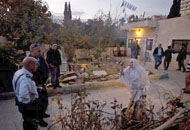
 Manger Square lights : Members of a Palestinian Christian family hold candles in front of the Church of the Nativity as they watch the mayor of the biblical West Bank town light the Christmas tree in Manger Square. (AFP/Musa al-Shaer)
Speech by UNRWA Commissioner-General at the Arab League Special Session marking UNRWA’s 60th Anniversary

Speech by the Commissioner-General of UNRWA, Karen Koning AbuZayd, at the Arab League Special Session marking UNRWA’s 60TH Anniversary 13 December 2009 |  |
Mr. Secretary General, Excellencies, distinguished guests,
I am very grateful to Secretary General Moussa for giving UNRWA this opportunity to stage one of the key events in a year of special events marking the 60TH anniversary of the founding of UNRWA. Similarly I am grateful to Ambassador Khairat of Egypt, the current Chair of UNRWA’s Advisory Commission, and to Ambassador Qattan of Saudi Arabia, the Vice-Chair, for sharing the platform with me. I am also grateful to Ambassador El-Farra of Palestine and Mr. Mahmoud Qabil, UNICEF goodwill Ambassador, for their participation.
A shared history
UNRWA and the Arab League emerged at roughly the same time, six decades ago, from related historical circumstances. Both came into being as part of the fallout from the cataclysm of the Second World War.
Whereas UNRWA was intended to be temporary, the Arab League was created as a permanent organization. Sadly, UNRWA is still needed after 60 years, in the absence of the necessary firm resolve on the part of the international community to create the circumstances in which Palestine refugees could make choices regarding their future, based on the relevant international resolutions, including UNGAR 194.
The two institutions have developed over the years in parallel, always with a strong link. That link has come via the primordial importance of the issue of Palestine, both for Arab states who are members of the Arab League, and for the UN agency, UNRWA, whose mission it has been to give succour and protection to the Palestine refugees who have been among the chief sufferers from the failure to resolve the Palestinian/Israeli conflict.
Tribute to Arab hosts
Some Arab countries and administrations, those hosting large populations of Palestine refugees, have made enormous sacrifices, political as well as economic and social, to share with UNRWA the necessity of providing basic support to the registered refugees who now number 4.7 million in the region. This is often overlooked in assessing who has done most for the refugees. The brochure UNRWA has produced for this occasion draws attention to how much the host countries have done.
...and donors
The booklet also pays tribute to generous Arab donors and institutions that have not stinted in making donations to UNRWA, especially for emergency relief and camp infrastructure. This year has seen the biggest ever single Arab donation, a supremely generous $34 million for Gaza relief from His Highness the Amir of Kuwait. Saudi Arabia has made a timely pledge of $25 million for rebuilding part of Nahr El Bared Camp in Lebanon. Were it not for the Israeli restrictions on access of building materials into Gaza, I am sure we would have seen even larger donations.
Some try to make propaganda out of a supposed contrast between vocal Arab concern for Palestine refugees and oil price windfalls on the one hand, and contributions to UNRWA on the other. UNRWA does what it can to set the record straight in this regard. It is unfair to discount the sacrifices made and those still being made by the host countries, and the generous contributions made by Arab donors.
... but
It is, however, an unfortunate truth that Arab financial contributions have decreased in relative terms. In the early 1980s Arab donations accounted for almost 8% of UNRWA’s budget, whereas the level today is closer to 1% for UNRWA’s core services - the schools for half a million children, the clinics receiving ten million patient visits a year, the social services supporting a quarter of a million of the very poor and the 58 camps housing 1.4 million refugees. Only a few weeks ago, the Arab League Council reiterated its exhortation to member states to restore contributions to their level in the 1980s. UNRWA asks for no more than that.
We deeply appreciate the donations for emergencies and infrastructure and hope they will be sustained. We also urge Arab governments, some of whom have not increased their annual contributions for over a decade, to heed our plea for more support for basic services. This is not money for overheads. This covers salaries for the teachers, doctors, nurses, social workers and sanitation labourers, as well as funds for food for the poorest refugees and the purchase of schoolbooks and medicines.
A warning bell
I do not wish to dwell on UNRWA’s financial difficulties. But I owe it to the refugees to sound a warning bell here, as I have in recent weeks in visits to Europe and the United States. Unless donors significantly increase their donations in the coming year, UNRWA will have major problems with its own staff, nearly all of them Palestinians, whose salaries have been frozen for a year already. And we may be forced to make painful cuts in the services we provide to refugees. The effect, I am afraid, will be dramatic.
The theme of the brochure I mentioned is “So much achieved together. . . . So much still to do”. Indeed, a great deal has been achieved over the past 60 years. Many students educated in UNRWA schools and training centres have gone on to make valuable contributions to the economy and social life in the host countries, and further afield in Arab countries. Even today our schools and training centres are widely admired, notwithstanding the lack of finance to maintain them to their previous standard.
Politics compounds the financial difficulties
Lack of adequate funding, however, is only one of the problems faced by UNRWA and the refugees. The political situation compounds the financial difficulties. Since the outbreak of the Second Intifada and the resulting economic dislocation, UNRWA has been forced to seek ever increasing amounts of money from donors to alleviate the consequent suffering. This year saw two special appeals for Gaza as a result of the ferocious attack on the Strip which left thousands dead, injured and homeless, and the already battered economy torn to shreds.
I must pay tribute to Arab donors for responding in an unprecedentedly generous way to those appeals. Tomorrow, here at the Arab League, I shall be launching the Emergency Appeal for 2010 for the occupied Palestinian territory. I wish I could say that I am hopeful that this, the eleventh such Appeal, will be the last. For that to occur, however, there must be a radical change of policy on the part of the occupying power—and the international community. There must be a relaxation of the closure regime over Gaza, and a serious attempt to deal with the causes rather than the symptoms of deprivation on the West Bank, one of the former being the privileges given to settlers, including in East Jerusalem.
Attention must be paid to the absence of every single one of the rights mentioned in the Universal Declaration of Human Rights, a document whose promulgation we celebrated three days ago. And most important, from an UNRWA point of view, the marginalization of the refugee issue in the peace process must be overcome for there to be a sustainable outcome of negotiations, and for there to be a real opportunity for an independent Palestinian state, living in peace with its neighbours, to emerge.
Conclusion on a personal note
My remarks today represent my next-to-the-last formal speech before I retire at the end of this month. In parting, therefore, I ask you to acknowledge the people whom we are commemorating here this evening, the refugees, who, for 60 years, have counted on UNRWA for protection and assistance. They have withstood six decades of exile, dispossession, conflict, tragedies and sorrow. They have done so with dignity and steadfastness which know no equal.
It has been my privilege to work with and for them—and with all of you.

Bethlehem Mayor: Light of Christmas shines despite wall

Bethlehem Mayor: Light of Christmas shines despite wall
Published yesterday (updated) 16/12/2009 09:52
Bethlehem`s Tree lighting [MaanImages] -click for more -
Bethlehem - Ma'an - "Our message to the world in this glorious Christmas season is a message of love, peace and justice," Bethlehem Mayor Victor Batarseh told assembled revelers at the official lighting ceremony for the city tree.
Amid clergy, foreign diplomats, pilgrims and Palestinians, a bevy of local leaders joined hands and together turned on the lights of the tree. Among those present were the current and former governors of Bethlehem, the current and former ministers of tourism, representative of the president's office Rafiq Al-Husseini and local police chiefs.
The tree, a 20 foot tall pine that stands outside the Nativity Church in Bethlehem's Manger Square, was set alight, following a Christmas message from Bethlehem to the world, delivered by the city's mayor.
"Even though the message of our Lord Jesus Christ is a message of love and peace, Bethlehem and our country Palestine are still living a struggling throe towards achieving freedom, stability and liberty," Batarseh said.
"In spite of the wall that surrounds Bethlehem and the deterioration of the political and economical situation, the light of Christmas shines in these times again, making us more determined to cherish the Christmas message with its spirituality, and lights for us the hope of a living liberty and with dignity," he continued.
The delivery of the Christmas message and the lighting of the tree came only days after Palestinian Christians from all denominations congregated in Bethlehem to sign a document demanding sanctions on Israel and to jointly reject Christian Zionism.
Clergy termed the movement the Palestine Kairos Initiative, modeled after black South Africa's 1985 Kairos Document, a theological statement that called on churches to join the fight against apartheid.
Amid clergy, foreign diplomats, pilgrims and Palestinians, a bevy of local leaders joined hands and together turned on the lights of the tree. Among those present were the current and former governors of Bethlehem, the current and former ministers of tourism, representative of the president's office Rafiq Al-Husseini and local police chiefs.
The tree, a 20 foot tall pine that stands outside the Nativity Church in Bethlehem's Manger Square, was set alight, following a Christmas message from Bethlehem to the world, delivered by the city's mayor.
"Even though the message of our Lord Jesus Christ is a message of love and peace, Bethlehem and our country Palestine are still living a struggling throe towards achieving freedom, stability and liberty," Batarseh said.
"In spite of the wall that surrounds Bethlehem and the deterioration of the political and economical situation, the light of Christmas shines in these times again, making us more determined to cherish the Christmas message with its spirituality, and lights for us the hope of a living liberty and with dignity," he continued.
The delivery of the Christmas message and the lighting of the tree came only days after Palestinian Christians from all denominations congregated in Bethlehem to sign a document demanding sanctions on Israel and to jointly reject Christian Zionism.
Clergy termed the movement the Palestine Kairos Initiative, modeled after black South Africa's 1985 Kairos Document, a theological statement that called on churches to join the fight against apartheid.

Palestinian Christians to declare occupation 'a sin'
Published Friday 11/12/2009 (updated) 14/12/2009 16:10
Bethlehem - Ma'an - Palestinian Christians from all denominations were in the West Bank city of Bethlehem on Friday to demand sanctions on Israel and to jointly reject Christian Zionism.
Clergy have termed their movement the Palestine Kairos Initiative, modeled after black South Africa's 1985 Kairos Document, a theological statement that called on churches to join the fight against apartheid.
In the same theme, over a dozen leaders of the region's Catholic, Greek Orthodox, Lutheran, Anglican and Baptist traditions co-authored "A moment of truth," a point-by-point rejection of the occupation and a call for action against it.
"The aggression against the Palestinian people which is the Israeli occupation, is an evil that must be resisted. It is an evil and a sin that must be resisted and removed," the document declares. "Primary responsibility for this rests with the Palestinians themselves suffering occupation. Christian love invites us to resist it."
The initiative urges the international community to begin "a system of economic sanctions and boycott to be applied against Israel," and to "engage in divestment and in an economic and commercial boycott of everything produced by the occupation."
The message insists, however, "These advocacy campaigns must be carried out with courage, openly sincerely proclaiming that their object is not revenge but rather to put an end to the existing evil, liberating both the perpetrators and the victims of injustice."
Christian Zionism
A portion of the document is addressed to Christians abroad, with particularly strong language reserved for "certain theologians in the West [who] try to attach a biblical and theological legitimacy to the infringement of our rights." Their interpretation of scripture has "become a menace to our very existence. ... The 'good news' in the Gospel itself has become 'a harbinger of death' for us."
"In face of those who use the Bible to threaten our existence as Christian and Muslim Palestinians, we renew our faith in God because we know that the word of God can not be the source of our destruction," it adds. "We call on these theologians to deepen their reflection on the Word of God and to rectify their interpretations so that they might see in the Word of God a source of life for all peoples."
The Kairos Initiative was first proposed in Amman, Jordan by Patriarch Emeritus Michel Sabbah, Lutherans Bishop Munib Younan and Rev. Mitri Raheb, Greek Orthodox Archbishop Atallah Hanna, Anglican Rev. Naim Ateek, Baptist Rev. Yohana Katanacho and other leading Palestinian Christian officials.
"After sitting and theologically reflecting on the situation, the injustice of the situation, we came up with this document," said initiative spokesman Ranjan Solomon in an interview Thursday. "Palestinians perceive this as a moment of truth."
Solomon added, "In the 1980s, a similar document had the effect of galvanizing churches around the world and creating unity amongst them, from which not even 10 years later came the end of apartheid.
"Whether the two are linked, one will never know, but it's the effect on public opinion that inspired Palestinian Christians to look at its potential, too."
Clergy have termed their movement the Palestine Kairos Initiative, modeled after black South Africa's 1985 Kairos Document, a theological statement that called on churches to join the fight against apartheid.
In the same theme, over a dozen leaders of the region's Catholic, Greek Orthodox, Lutheran, Anglican and Baptist traditions co-authored "A moment of truth," a point-by-point rejection of the occupation and a call for action against it.
"The aggression against the Palestinian people which is the Israeli occupation, is an evil that must be resisted. It is an evil and a sin that must be resisted and removed," the document declares. "Primary responsibility for this rests with the Palestinians themselves suffering occupation. Christian love invites us to resist it."
The initiative urges the international community to begin "a system of economic sanctions and boycott to be applied against Israel," and to "engage in divestment and in an economic and commercial boycott of everything produced by the occupation."
The message insists, however, "These advocacy campaigns must be carried out with courage, openly sincerely proclaiming that their object is not revenge but rather to put an end to the existing evil, liberating both the perpetrators and the victims of injustice."
Christian Zionism
A portion of the document is addressed to Christians abroad, with particularly strong language reserved for "certain theologians in the West [who] try to attach a biblical and theological legitimacy to the infringement of our rights." Their interpretation of scripture has "become a menace to our very existence. ... The 'good news' in the Gospel itself has become 'a harbinger of death' for us."
"In face of those who use the Bible to threaten our existence as Christian and Muslim Palestinians, we renew our faith in God because we know that the word of God can not be the source of our destruction," it adds. "We call on these theologians to deepen their reflection on the Word of God and to rectify their interpretations so that they might see in the Word of God a source of life for all peoples."
The Kairos Initiative was first proposed in Amman, Jordan by Patriarch Emeritus Michel Sabbah, Lutherans Bishop Munib Younan and Rev. Mitri Raheb, Greek Orthodox Archbishop Atallah Hanna, Anglican Rev. Naim Ateek, Baptist Rev. Yohana Katanacho and other leading Palestinian Christian officials.
"After sitting and theologically reflecting on the situation, the injustice of the situation, we came up with this document," said initiative spokesman Ranjan Solomon in an interview Thursday. "Palestinians perceive this as a moment of truth."
Solomon added, "In the 1980s, a similar document had the effect of galvanizing churches around the world and creating unity amongst them, from which not even 10 years later came the end of apartheid.
"Whether the two are linked, one will never know, but it's the effect on public opinion that inspired Palestinian Christians to look at its potential, too."
Tuesday, December 15, 2009

...Fairy Doors...a poem by Anne Selden Annab
Tuesday, December 15, 2009
 Our own academic freedom
is hugely real in a vast
marketplace of ideas...
doors and windows everywhere
and long meandering corridors
in a palace of thought.
Ballrooms and balconies
and cupboards of every type
Some prefer dungeons- others like
tall towers & turrets...
Libraries and media rooms
and keyboards of every type
Fields and forests
and rambles of every kind
What might be true here
is contradicted there
for there is no final authority
no end to the process
of thought
as every one owns
both right and wrong and the power
to move away- or towards...
to step up- or back
to know what to bother with-
and what to abandon
and where to find
fairy doors.
poem copyright ©2009 Anne Selden Annab
The Fairy Garden Poems # 51
Special Letter from ATFP by Ziad Asali

December 14, 2009
Greetings----
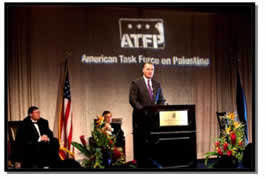
I'm delighted to report to you that our October 15 gala in Washington, DC, demonstrated without any question that the American Task Force on Palestine has become a major player in Middle East policy circles in our nations' capital. The gala was attended by over 650 people, including current and former senior administration officials; numerous ambassadors and several cabinet ministers from various countries; members of Congress and Congressional staff; over 50 journalists from major news organizations around the world; and a veritable who's who of Washington Middle East policy movers and shakers, including for the first time senior leaders of major Jewish pro-Israel organizations. The event confirmed that ATFP is at the forefront of efforts in Washington and around the country to end the occupation and promote peace based on the creation of a Palestinian state alongside Israel. As always, your support is the bedrock of all our activities. I want to update you on the vital work your generosity is underwriting, and encourage you to renew your support for ATFP.
Our Gala keynote speaker, National Security Advisor Gen. James L. Jones, acknowledged that ATFP "has worked to bring the Palestinians closer to fulfilling their legitimate aspirations for statehood, and to unleash the extraordinary potential of the Palestinian people," and assured the audience that, "the President is committed to achieving two states, Israel and Palestine, living side-by-side in peace and security. Make no mistake about that."
We were also delighted to receive a letter of support from Rep. Howard L. Berman (D-CA), the Chairman of the House Committee on Foreign Affairs, who wrote:
 "I want you to know how much I, as Chairman of the House Committee on Foreign Affairs, value my association with you and your colleagues at ATFP. Your integrity, your knowledge of the issues, and your unswervingly principled stand on behalf of peace and fairness -- as well as your deep commitment both to the land of your birth, Palestine, and your adopted homeland, America -- have all had a powerfully positive impact on discourse in Washington about the Middle East. You and your colleagues have also been an important influence on my own thinking about Middle East peacemaking and that of many of my colleagues in the Congress."
We believe that this unprecedented letter to a Palestinian-American organization coming from one of the most powerful members of Congress on the subject of foreign affairs and a stalwart Jewish-American supporter of Israel demonstrates how far the transformation into thinking about peace and the need for a Palestinian state has permeated official circles in Washington, creating heretofore unimaginable alliances and opportunities for cooperation and progress.
In a similar vein, ATFP was represented at the first annual conference of the new pro-peace, pro-Israel lobby group J Street by Senior Fellow Hussein Ibish. Our other Senior Fellow, Ghaith Al-Omari, has been involved with exceptionally influential policy work dealing directly with many of the most prominent individuals and institutions in and around our government. Meanwhile, our engagement with both the domestic and international media has never been stronger, with a continuous flow of commentary and opinion pieces and quotations from our experts in reportage. And our website goes from strength to strength, now ranked in the top 200,000 sites in the United States, with traffic far exceeding almost all other Middle East-related American organizations.
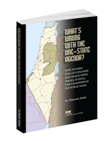 ATFP has also just published two new books to further develop its advocacy and elaborate its analysis. First, "What's Wrong with the One-State Agenda?" by Hussein Ibish is a comprehensive defense of the imperative of ending the occupation and to sustained reputation of the idea that peace with Israel is either impossible or undesirable. It was launched at an impressive event at the prestigious Wilson Center with Aaron David Miller and Rob Malley. Second, ATFP has just released a new collection of its key documents, "Palestine and the Quest for Peace," edited and compiled by Board member Prof. Saliba Sarsar. These publications demonstrate that ATFP is not only a politically effective organization, but and intellectually productive one and a force to be reckoned with in the forum of public opinion.
Meanwhile, ATFP’s sister organization, American Charities for Palestine, continues to pursue its vital humanitarian efforts, thus far investing over $600,000 on health and education projects in the occupied territories. Recently I was proud to join Prime Minister Salam Fayyad, US Consul General Daniel Rubenstein, officials from USAID and other dignitaries proud to announce the inauguration of the $400,000 infrastructure construction project in the West Bank town of Beit Ur al Tahta.
To do all of this crucially important work, we rely, as we always have, on your generous support. Please do whatever you can to support the Task Force, and help us continue to make this kind of serious and effective progress on advocacy in Washington for peace and Palestine.
As always, your support is completely tax-deductible due to ATFP’s designation by the IRS as a 501(c)(3) charitable organization.
Sincerely,
Ziad J. Asali, M.D.
President
Please note that as of December 1, 2009 the American Task Force on Palestine will be located at a new address: 1634 Eye Street N.W., Suite 725, Washington, D.C. 20006.

Monday, December 14, 2009

Silently Stealing Jerusalem By Joharah Baker for MIFTAH
| Date posted: December 14, 2009 By Joharah Baker for MIFTAH The number is staggering, to say the least. A total of 4,577 Palestinian residents of Jerusalem were stripped of their residency rights in 2008 alone, 35 percent of all east Jerusalemites who lost their residency rights since 1967 and more than any average year since Israel's occupation of the eastern sector of the city almost 42 years ago. For the less versed in the ways of Israel where Palestinian residency rights in Jerusalem are concerned, here is a quick rundown. Upon Israel's occupation in 1967 of east Jerusalem, those Palestinians who had stayed in their homes were included in Israel's census of the city and granted "permanent residency". This, by no means is citizenship, which Israel also duly offered to the war torn residents of the even more war torn neighborhoods of Jerusalem. But taking on Israeli citizenship was, for most Palestinians, tantamount to high treason, given that they would assume the nationality of the country that had usurped most of their homeland and made hundreds of thousands of their fellow Palestinians refugees either outside the borders of Palestine or within it. Not to mention that one condition for citizenship was to swear allegiance to Israel. Since then, the majority of Jerusalem's Palestinians have lived the precarious existence of permanent residents. Falling short of a full-fledged citizen, Israeli authorities impose strict conditions for Jerusalemites to maintain this residency. As the Israeli human rights organization B'Tselem writes, "Israel treats Palestinian residents of East Jerusalem as immigrants who live in their homes at the beneficence of the authorities and not by right." According to Israeli interior ministry sources, the majority of Jerusalem residents whose residency rights have been revoked were living abroad, which according to Israeli "law" is illegal. Palestinians, of course, see it in a different light altogether. Following the 1995 legislation to impose the "center of life" policy on Jerusalem residents, more and more Jerusalemites are finding that their blue ID card was no longer valid. The center of life policy is draconian in nature and is aimed at making it as difficult as possible for Palestinians to remain in their homes in Jerusalem. It demands that Palestinians living in Jerusalem prove that every element of their lives is cemented within the boundaries of the Israeli municipal borders for Jerusalem. That is, rent, land taxes, schools, work, immunization records, phone bills and a slew of other proofs must be ready at any minute to provide as evidence of a person's life in Jerusalem. If something doesn't add up, this could mean bidding farewell to any rights in the city, namely the right to live in your own home. The most obvious Israeli plot behind these measures is to rid Jerusalem of its Palestinian Arab residents, thus claiming the city as Israel's "undivided and eternal capital." Coupled with Israel's other oppressive measures against Palestinians such as house demolitions, land confiscation and discrimination in education and basic services, this seems like a fair assumption, especially if one is to compare east Jerusalem with its western (Israeli) counterpart. Modern roads and buildings characterize west Jerusalem, which gives off any overall air of economic prosperity whereas east Jerusalem's dank and shabby roads and houses mirrors quite a different reflection. Perhaps Israel is upping its policies on Palestinian residency rights with other intentions. If they cannot force all Palestinians out, either by demolishing their homes or revoking their residency cards, perhaps such measures will scare others into applying for Israeli citizenship. This, for Israel, is the best of two evils – if they can't force Palestinians out, they can at least shift the demographic scales in Jerusalem where even the Palestinians there are Israeli citizens, thus undistinguishing them from Israeli Jews in terms of demographic statistics. According to reports from Israel's interior ministry itself, this is a disturbing but growing phenomenon among Palestinian Jerusalemites. According to one Israeli Interior Ministry report, up to 500 Palestinians in Jerusalem applied for Israeli citizenship in 2007. It is not only Israel we can blame however for this trend in particular. Unfortunately, with the constant talk of dividing Jerusalem to make way for a Palestinian capital, there are those Palestinians in Jerusalem who are willing to sacrifice their duty to Palestine for their personal benefit. Taking Israeli citizenship before any final status on the city is reached would guarantee that all the benefits they enjoy such as national and health insurance would continue. Their jobs in Israel would be unthreatened and they would not have to worry about proving residency in their own homes. However, they would then become a permanent part of Israel's establishment and would have helped to hand over Jerusalem to Jewish Israeli sovereignty first handedly. In a roundabout way, this is in Israel's favor, at least in Jerusalem. Inside the 1948 borders, or what is now Israel, it knows the Palestinian residents there are people who managed to remain despite the massacres, fighting and exile that occurred in 1948. Thus, they are a threat in their very existence. However, any Palestinian Jerusalemite who wishes by their own free will to trade in their permanent residency card for Israeli citizenship is hardly a threat to Israel. On the contrary, they have chosen this path rather than the much harder path of proving their Arab and Palestinian roots in the city. Sadly, this is an extremely dangerous and slippery slope. Palestinians have been fighting an uphill battle on Jerusalem for decades, one which most of them are not willing to surrender. The past year's numbers on residency card revocations is evidence that Israel is moving slowly but surely towards the goal of annihilating any strong Palestinian presence in the city. It is a pity when some of us help them along. Joharah Baker is a Writer for the Media and Information Department at the Palestinian Initiative for the Promotion of Global Dialogue and Democracy (MIFTAH). She can be contacted at mid@miftah.org. |
Subscribe to:
Posts (Atom)