Labels

Tuesday, December 21, 2010

Tutu, Carter: Time to move on Mideast peace

As always- PLEASE go to the original link to read the story in full- and help make it more popular...
The Elders: Standing around Nelson Mandela are, from left, his wife, Graca Machel, Fernando Henrique Cardoso, Desmond Tutu, Jimmy Carter, Mary Robinson, Kofi Annan, Gro Brundtland, Martti Ahtisaari, Ela Bhatt and Lakhdar Brahimi.

Tutu, Carter: Time to move on Mideast peace
For nearly two decades, there have been peace processes in the Middle East but no peace. In recent visits to the region — including Israel and the occupied Palestinian territory — we have heard a consistent message: People want peace but are skeptical about the process and have little faith in the international community to deliver.

There is now an opportunity to reassess the entire approach to the negotiations. The U.S. effort to secure from Israel another partial freeze on settlement-building as a way of resuming direct talks between Israeli and Palestinian leaders has failed.

We urge a renewed effort, firmly based in international law and respect for human rights that first aims to define boundaries between Israel and a new Palestinian state and address security issues. Without such focus, we will see the possibility of a two-state solution slipping even further away.

This approach sets challenges for Israelis and Palestinians, for their regional neighbors, for the international community — especially the U.S. government — and for each of us as concerned global citizens.

Applying international law and human rights principles means that the occupation must end, and the focus of negotiations should be on the boundaries of a future Palestinian state based on 1967 borders,with its capital in East Jerusalem. Such an accord could entail, if agreed, a one-to-one land swap to allow for minor adjustments. Initial negotiations should also aim at security arrangements in which both Israelis and Palestinians have confidence.

Change is needed

Israeli settlement activity must stop throughout the occupied territories, which include East Jerusalem. These settlements are illegal under international law. So, too, is the inhumane blockade of Gaza. It must be lifted fully except for armaments. The demolition and seizure of Palestinian homes must also end.

In ensuring the rights of all are respected, we call on leaders and citizens to ensure that Israel's right to exist is not denied. Incitement and calls for the destruction of Israel must not be tolerated.

The upholding of human rights and the rule of law also places demands on the Palestinian authorities of the West Bank and Gaza. They must end all human rights violations against political critics and rivals.

Across the region, we believe that the Arab peace initiative should serve as the basis for normalization of relations between Israel and the Arab world.

It is clear, of course, that Israelis and Palestinians must ultimately agree to a solution, but they cannot do it alone. The international community must help them through fair and robust mediation and by reconfirming prior agreements, United Nations Security Council resolutions, the Geneva Conventions and the Universal Declaration of Human Rights, all of which are being violated.

Nor can we, as citizens, leave such a vital issue to our governments. Each of us has to keep up pressure on our leaders to show the importance we attach to achieving peace in the Middle East.

As Elders— a group of global leaders brought together by Nelson Mandela to promote peace— we will continue to do all we can to persuade governments around the world to apply a rights-based approach to this terrible conflict and to turn the focus of initial negotiations to border and security issues.

Waiting too long

We have already given our support to non-violent protest and creative civil action for peace. We will continue to do so, both morally and in person whenever we can. This is too important an issue to be left to politicians alone.

Without a strategy that can deliver a peace agreement based on a two-state solution, Palestinians will continue to live under Israeli occupation, millions of Palestinian refugees will continue to live without hope, and Israel's survival and security remain under threat. If there is no real progress, more violence is the likely outcome.

The world has lived far too long with this conflict. The obstacles to peace are daunting. But one of the advantages of observing public events over many years is that we have seen how apparently irreconcilable divisions can be bridged with courage, commitment and humanity. We desperately need to see these qualities now.

Former president Jimmy Carter and Archbishop Emeritus of Cape Town Desmond Tutu are members of The Elders (www.theElders.org).

Monday, December 20, 2010

Growing Up Palestinian in the Age of the Wall

Growing Up Palestinian in the Age of the Wall

PLO official: any deal with Israel won't succeed without refugees

PLO official: any deal with Israel won't succeed without refugees

09:09, December 21, 2010

An official from the Palestine Liberation Organization (PLO) said on Monday that any future deal with Israel will not succeed if it dropped Palestinian refugees' rights of return.

"It is not only the refugees who will reject the solutions, it is all the Palestinians, including the leadership and the PLO," said Zakareya Al-Agha, a member of the PLO's Executive Committee.

Al-Agha said that "the fair solution" to the issue of refugees is the implementation of the United Nations Resolution 194 "and rejecting any interpretation that might weaken or play it down."

The resolution, which the UN General Assembly passed in December 1948, calls for the return of the refugees to their homelands and villages that Israel took over before it declared its statehood.

"The resolution enjoys Arab and international agreement and " for the Palestinians, it is a legal and political reference to resolve the refugees' issue," Al-Agha said.

The issue of the refugees, especially those who settled in camps in Lebanon, Syria and Jordan, is one of the final-status issues in stalled peace negotiations between Israel and the Palestinians.

The negotiations stopped in late September, after Israel resumed building Jewish settlements in the West Bank. However, the negotiations were still far away from the final issues.

Mideast journalists want bigger EU role in conflict

Mideast journalists want bigger EU role in conflict

By Omar Obeidat

ROME –– Despite airing different views on how to achieve peace in the Middle East, journalists from across the region agreed that the European Union (EU) is not doing enough to end the Arab-Israeli conflict.

The EU does not have a clear policy on the region and it should distinguish itself from the US, which has become unable to achieve any progress in the peace process, said the journalists, who gathered at a media forum held in Rome last week titled: “The Middle East Through A Media Lens: Problems and Opportunities”, calling on European countries to increase their political and economic presence in the region.

At the forum held at the Italian foreign ministry headquarters, Hafez Barghouti, chief editor of the Ramallah-based Al Hayaat Al Jadida newspaper, accused the West of not exerting serious efforts to bring about peace and stability to the troubled region in order to continue dominating regional natural resources.

Stressing that the Palestinian-Israeli conflict is the core issue in the Middle East, Barghouti said: “Instability will prevail in the region because of oil resources and the intransigence of Israel, which does not want peace.”

Barghouti elaborated that the Middle East will be dragged into a religious conflict if the status quo, no-peace, no-war state, continues. “I can see a bleak future for the region due to extremist Jews, Muslims and radical Iran.”

If the conflict continues, the future will be for rabbis, mullas and Al Qaeda, the Palestinian veteran journalist warned, explaining that in addition to the Israeli plans to control the area, Iran and Turkey also have their own agendas in the region.

“Unfortunately, the Arabs do not have their own enterprise and their weakness allowed these countries to have ambitions in the region,” he stated.

Alon Ben David, senior defence correspondent for Israel’s Channel 10 television, agreed with Barghouti that there is change in the traditional power balance in the region with the roles of Saudi Arabia and Egypt diminishing, while Iran and Turkey are assuming the leading role.

Regarding the possibility of achieving peace, the Israeli journalist stated that currently the Israeli government is not ready to give any concessions, including halting settlement building, charging the US administration of being lenient with stakeholders.

However, Ben David argued that the central worry in the Middle East is no longer the slow progress in solving the Arab-Israeli conflict but Iran, which, according to him, created a monster inside Lebanon, in reference to Hizbollah.

Nadim Ladki, from the Lebanese Daily Star, countered Ben David, saying that Israel is the major threat to the entire region.

“Israel is occupying the lands of three Arab countries and Hizbollah power emerged as a reaction to this occupation,” Ladki noted, adding that neither the US nor the EU are able of convincing Israel to stop illegal settlements.

One of the forum’s sessions was attended by Italian Foreign Minister Franco Frattini, who expressed hope that the EU has had a bigger role in ending the regional conflict.

“I would have loved to see Europe more involved from the beginning in direct talks between Palestinians and Israelis, particularly in the Washington summit,” he said, saying that however, the EU will continue to support US efforts in the region.

The Italian top diplomat stressed that the two-state solution, which includes establishing an independent state for Palestinians, is the only option to end the conflict.

Israel should multiply its efforts and should stop settlement building, which is an obstacle for the peace process.

“Yes Italy is a friend of Israel but also a good friend of Palestinians,” he said, adding that the EU is also eager to have better ties with Syria.

Syria should rethink considering resuming indirect talks with Israelis, Frattini said, expressing hope that Turkey can promote directly or indirectly peace negotiations between Syrians and Israelis.

Acknowledging that reaching a solution to end the regional conflict in a year is very ambitious, the Italian official however said it is still within reach.

The media forum, organised by the Italian foreign ministry and Agenzia Italia, brought together journalists from Jordan, Lebanon, Egypt, Israel, Turkey, Saudi Arabia, Iraq and Palestine as well as journalists from Italy to discuss ways on how to increase political and economic cooperation between regional countries and the EU.

20 December 2010

Al Hanouneh - protecting the collective Palestinian memory

http://www.jordantimes.com/?news=32768
Al Hanouneh - protecting the collective Palestinian memory Al Hanouneh troupe members dance in traditional Palestinian outfits in Amman on Saturday evening (Reuters photo by Muhammad Hamed)

By Mohammad Ben Hussein

AMMAN - Arab nationalism and Palestinian folk traditions were set to live music in a performance in the capital on Saturday evening.

In a concert held to express solidarity with the Palestinians, Al Hanouneh folk troupe took to the stage at the Royal Cultural Centre and danced to popular tunes such as “Youya” “Alee Narak”.

Band leader Musa Saleh said the performance titled, "Guardians of the Memory", is part of the group’s mission to preserve the recent and historical memory of Palestine and the greater Arab world.

“We have a duty as a band to protect the collective Palestinian memory. Our memory is part of our identity and Israel is doing its best to tarnish that memory to destroy our identity,” Saleh told The Jordan Times after the concert, which marked the anniversary of the partition of Palestine by the UN General Assembly in 1947.

“We see Israel as trying to rob everything from us, not only the land. They dress air hostesses on their planes with Palestinian attire and claim to have invented falafel among other things. We should not allow them steal our tradition and culture,” he added.

This year’s event featured prominent bands and poets from across the region, including Tawfiq Al Halabi, Rayek Kheir, Shadi Mousa, Najeeb Yuakbi, Ahmad Fahmawi, Flayeh Al Jubour, Sana Mousa, Talal Haidar and Ahmad Fahmawi, among others.

Al Hanouneh was established in 1993 in Amman with the goal of protecting and safeguarding the culture and folklore of the area through the selection and classification of Palestinian folklore.

The group comprises over 80 dancers, musicians and singers.

20 December 2010

Hamas in dispute with UN over school trips for Palestinian pupils

Group objects to Holocaust aspect of trips for Gaza students which it claims 'promotes solidarity with Jewish suffering'
The Yad Vashem Holocaust Memorial in Jerusalem. Photograph: Oded Balilty/AP

Ana Carbajosa in Jerusalem
guardian.co.uk,

Hamas, the Islamist movement ruling the Gaza strip, has asked the United Nations to stop exposing Palestinian children to the Holocaust during trips organised for outstanding students from Gaza, and instead concentrate on Palestinian victims.

"The UNRWA [the agency for Palestinian refugees] has to stop the visits they do, where they teach the Holocaust and where they promote solidarity with Jewish suffering created by the Nazis," said a statement from the department for refugee issues.

Hamas also said that "the minds of the children are not big enough to understand the suffering of all the victims around the world", adding that "the Palestinian suffering caused by the Jewish occupiers is enough of an example". In the statement, Hamas suggested that instead of organising trips to the US, the UN should take the Gazan children to Vietnam, the US prison in Guantánamo Bay or Abu Ghraib detention facility in Iraq.

UNRWA refused today to comment on Hamas's statement.

Human rights are part of the curriculum at UNRWA schools, where there are about half a million pupils from Palestinian refugee families. The classes are based on the Universal Declaration of Human Rights. Students who obtain outstanding marks may travel to several countries to learn more about the subject. About 50 children have participated in past human rights trips. In one of the journeys, the pupils travelled to South Africa, where they met Nobel Peace Prize winner Nelson Mandela. In another, they attended the trial of former Bosnian Serb leader Radovan Karadzic in the Hague.

These trips are a rare opportunity for the Gazan children to travel. For the past four years, Israel has blocked people and goods from moving into and out of Gaza.

Sunday, December 19, 2010

"The Palestinian state that will end the conflict is already on its way." Ziad J. Asali

The Daily Star - Opinion Articles - Giving up on an Israeli-Palestinian settlement is simply not an option

December 2010: [Israeli] Settlers [for the umpteenth time] attack [Palestinian] shepherd

PA official: Settlers attacked shepherd
Published Wednesday 15/12/2010 (updated) 19/12/2010 13:48

NABLUS (Ma’an) – Israeli settlers attacked a shepherd and killed two of his sheep Wednesday afternoon, a Palestinian official said.

Ghassan Doghlas, a Palestinian Authority official who monitors settlements in the northern West Bank, told Ma'an that the attack targeted Ibrahim Hassan, 28, from a village south of Nablus.

Hassan managed to escape but two of his sheep were not so lucky, Doghlas said.

The settlers were from the Kistra settlement south of Asira village, he said.

Israel/West Bank: Separate and Unequal. Under Discriminatory Policies, [Israeli] Settlers Flourish, Palestinians Suffer

Israel/West Bank: Separate and Unequal
Under Discriminatory Policies, Settlers Flourish, Palestinians Suffer
December 19, 2010

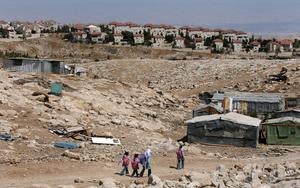
Palestinians face systematic discrimination merely because of their race, ethnicity, and national origin, depriving them of electricity, water, schools, and access to roads, while nearby Jewish settlers enjoy all of these state-provided benefits. While Israeli settlements flourish, Palestinians under Israeli control live in a time warp - not just separate, not just unequal, but sometimes even pushed off their lands and out of their homes.

Carroll Bogert, deputy executive director for external relations at Human Rights Watch

(Jerusalem) - Israeli policies in the West Bank harshly discriminate against Palestinian residents, depriving them of basic necessities while providing lavish amenities for Jewish settlements, Human Rights Watch said in a report released today. The report identifies discriminatory practices that have no legitimate security or other justification and calls on Israel, in addition to abiding by its international legal obligation to withdraw the settlements, to end these violations of Palestinians' rights.

The 166-page report, "Separate and Unequal: Israel's Discriminatory Treatment of Palestinians in the Occupied Palestinian Territories," shows that Israel operates a two-tier system for the two populations of the West Bank in the large areas where it exercises exclusive control. The report is based on case studies comparing Israel's starkly different treatment of settlements and next-door Palestinian communities in these areas. It calls on the US and EU member states and on businesses with operations in settlement areas to avoid supporting Israeli settlement policies that are inherently discriminatory and that violate international law.

"Palestinians face systematic discrimination merely because of their race, ethnicity, and national origin, depriving them of electricity, water, schools, and access to roads, while nearby Jewish settlers enjoy all of these state-provided benefits," said Carroll Bogert, deputy executive director for external relations at Human Rights Watch. "While Israeli settlements flourish, Palestinians under Israeli control live in a time warp - not just separate, not just unequal, but sometimes even pushed off their lands and out of their homes."

By making their communities virtually uninhabitable, Israel's discriminatory policies have frequently had the effect of forcing residents to leave their communities, Human Rights Watch said. According to a June 2009 survey of households in "Area C," the area covering 60 percent of the West Bank that is under exclusive Israeli control, and East Jerusalem, which Israel unilaterally annexed, some 31 percent of Palestinian residents had been displaced since 2000.

Human Rights Watch looked at both Area C and East Jerusalem and found that the two-tier system in effect in both areas provides generous financial benefits and infrastructure support to promote life in Jewish settlements, while deliberately withholding basic services, punishing growth, and imposing harsh conditions on Palestinian communities. Such different treatment on the basis of race, ethnicity, and national origin that is not narrowly tailored to legitimate goals violates the fundamental prohibition against discrimination under human rights law.

Israeli policies control many aspects of the day-to-day life of Palestinians who live in Area C and East Jerusalem. Among the discriminatory burdens imposed on Palestinians that Human Rights Watch found are Israeli practices of expropriating land from Palestinians for settlements and their supporting infrastructure; blocking Palestinians from using roads and reaching agricultural lands; denying access to electricity and water; denying building permits for houses, schools, clinics, and infrastructure; and demolishing homes and even entire communities. Such measures have limited the expansion of Palestinian villages and imposed severe hardships on residents, including leaving them with limited access to medical care.

By contrast, Israeli policies promote and encourage Jewish settlements to expand in Area C and East Jerusalem, often using land and other resources that are effectively unavailable to Palestinians. The Israeli government grants numerous incentives to settlers, including funding for housing, education, and infrastructure, such as special roads. Those benefits have led to the consistent and rapid expansion of settlements, the population of which grew from approximately 241,500 inhabitants in 1992 to roughly 490,000 in 2010, including East Jerusalem.

"While Israeli policy makers are fighting for the ‘natural growth' of their illegal settlements, they're strangling historic Palestinian communities, forbidding families from expanding their homes, and making life unlivable," Bogert said. "The policies surrounding Israel's settlements are an affront to equality and a major obstacle to ordinary Palestinian life."

One of the Palestinian communities that Human Rights Watch examines in the report is Jubbet al-Dhib, a village with 160 residents southeast of Bethlehem that dates from 1929. The village is often accessible only by foot because its only connection to a paved road is a rough, 1.5 kilometer-long dirt track. Children from Jubbet al-Dhib must walk to schools in other villages several kilometers away because their own village has no school.

Jubbet al-Dhib lacks electricity despite numerous requests to be connected to the Israeli electric grid, which Israeli authorities have rejected. Israeli authorities also rejected an international donor-funded project that would have provided the village with solar-powered street lights. Any meat or milk in the village must be eaten the same day due to lack of refrigeration; residents often resort to eating preserved foods instead. Villagers depend for light on candles, kerosene lanterns, and, when they can afford to fill it with gasoline, a small generator.

Approximately 350 meters away is the Jewish community of Sde Bar, founded in 1997. It has a paved access road for its population of around 50 people and is connected to Jerusalem by a new, multi-million-dollar highway - the "Lieberman Road" - which bypasses Palestinian cities, towns, and villages, like Jubbet al-Dhib. Sde Bar operates a high school, but Jubbet al-Dhib students may not attend. Settlements are designated closed military areas that may be entered only with special military permits. Residents of Sde Bar have the amenities common to any Israeli town, such as refrigerators and electric lights, which Jubbet al-Dhib villagers can see from their homes at night.

"Palestinian children in areas under Israeli control are studying by candlelight while watching the electric lights in settlers' windows," Bogert said. "Pretending that depriving Palestinian kids of access to schools or water or electricity has something to do with security is absurd."

In most cases where Israel has acknowledged differential treatment of Palestinians - such as when it bars them from "settler-only" roads - it has asserted that the measures are necessary to protect Jewish settlers and other Israelis who are subject to periodic attacks by Palestinian armed groups. But no security or other legitimate rationale can explain the vast scale of differential treatment of Palestinians, such as permit denials that effectively prohibit Palestinians from building or repairing homes, schools, roads, and water tanks, Human Rights Watch said.

Moreover, in addressing security concerns, Israel often acts as if all Palestinians pose a security threat by virtue of their race, ethnicity, and national origin, rather than narrowly tailoring restrictions to specific individuals who are shown to pose a threat. The legal prohibition of discrimination prohibits such broad-brush restrictions.

"The world long ago discarded spurious arguments to justify treating one group of people differently from another merely because of their race, ethnicity, or national origin," Bogert said. "It's time for Israel to end its policies of discrimination and stop treating Palestinians under its control markedly worse than Jews in the same area."

Israel's highest court has ruled that certain measures against Palestinian citizens of Israel were illegal because they were discriminatory. However, Human Rights Watch is not aware that the courts have adjudicated whether any Israeli practice in the West Bank discriminated against Palestinians, although petitioners have raised such claims in a number of cases.

Human Rights Watch said that the blatantly discriminatory practices make it an urgent matter for donor countries to avoid contributing to or being complicit in the violations of international law caused by the settlements. These countries should take meaningful steps encourage the Israeli government to abide by its obligations, Human Rights Watch said.

Human Rights Watch reiterated its recommendation that the United States, which provides US$2.75 billion in aid to Israel annually, should suspend financing to Israel in an amount equivalent to the costs of Israel's spending in support of settlements, which a 2003 study estimated at $1.4 billion. Similarly, based on numerous reports that US tax-exempt organizations provide substantial contributions to support settlements, the report urges the US to verify that such tax-exemptions are consistent with US obligations to ensure respect for international law, including prohibitions against discrimination.

Human Rights Watch called on the EU, a primary export market for settlement products, to ensure that it does not provide incentives for settlement exports through preferential tariff treatment, and to identify cases where discrimination against Palestinians has contributed to the production of goods. For example, the report documents how crops exported from settlements using water from Israeli-drilled wells have dried up nearby Palestinian wells, limiting Palestinians' ability to cultivate their own lands and even their access to drinking water.

The report also describes cases in which businesses have contributed to or benefited directly from discrimination against Palestinians, for example through commercial activities on lands that were unlawfully confiscated from Palestinians without compensation for the benefit of settlers. These businesses also benefit from Israeli governmental subsidies, tax abatements, and discriminatory access to infrastructure, permits, and export channels. Human Rights Watch called on businesses to investigate, prevent and mitigate such violations, including ending any operations that cannot be separated from discriminatory Israeli practices.

"Discrimination of the kind practiced daily in the West Bank should be beyond the pale for anyone," Bogert said. "Foreign governments and businesses at risk of being tainted by Israel's unlawful practices should identify and end policies and actions that support them."

South Africa: Despite the lifting of apartheid in the early 1990s, many blacks still live in terrible conditions.

Smoke from a cooking fire rises in Diepsloot, South Africa, a township near Johannesburg. Despite the lifting of apartheid in the early 1990s, many blacks still live in terrible conditions. Melanie Stetson Freeman/Staff

Best of Monitor Photography 2010 International

December 1, 2010

Palestinian communities stifled by Israel

As always- PLEASE go to the original link to read the story in full- and help make it more popular...A Palestinian demonstrator carrying a Fatah and Palestinian flag runs from tear gas fired by Israeli soldiers, top, during a weekly protest against Israel's separation barrier in the West Bank village of Bilin near Ramallah, Friday, Dec. 17, 2010. Israel says the barrier is necessary for security while Palestinians call it a land grab. (AP Photo/Majdi Mohammed)

Group: Palestinian communities stifled by Israel

JERUSALEM – Israel systematically stifles the development of Palestinian communities in the West Bank and east Jerusalem while fostering the growth of Jewish settlements on those lands, the New York-based Human Rights Watch said in a report Sunday, urging the U.S. to slash aid to Israel because of "blatantly discriminatory" practices.

No security rationale or other legitimate reason can explain the "vast scale of differential treatment," said the 166-page report, which compared several Palestinian communities with neighboring settlements.

In one case, Israel refused to connect a West Bank village to the electricity grid and denied approval for a foreign-funded solar energy project there, while a nearby settlement enjoyed all standard services, the report said.

"Palestinians face systematic discrimination merely because of their race, ethnicity, and national origin, depriving them of electricity, water, schools, and access to roads, while nearby Jewish settlers enjoy all of these state-provided benefits," said Carroll Bogert, a spokeswoman for the group.

Israeli officials were reviewing the report and had no immediate comment.

The Palestinians want to establish a state in the West Bank, Gaza and east Jerusalem, the territories captured by Israel in the 1967 Mideast war.

Israel has built dozens of settlements in the West Bank and east Jerusalem over the past four decades to buttress its control there. The international community considers the settlements to be illegal.

Israel annexed east Jerusalem immediately after the 1967 war, a step not recognized internationally, while the West Bank remained under military occupation.

As part of interim peace deals in the mid-1990s, Palestinians were given a say in administering 38 percent of the West Bank, while Israel retained exclusive control over the rest, known as "Area C."

The report examined policies in east Jerusalem and in Area C, where about 490,000 Israeli settlers and 420,000 Palestinians live.

In Area C, Palestinians can in practice only build without restrictions on 1 percent of the land, while much of the rest is set aside for Israeli settlements, nature reserves and military zones, according to the U.N.

Israel has razed nearly 2,800 Palestinian homes, shacks and animal shelters in Area C in the past 13 years, the U.N. says. Israel says the structures were illegally built. During the same period, the settler population in the West Bank nearly tripled.

Israeli officials note that previous governments proposed two final peace deals during that period that would have turned over between 90 percent and 94 percent of the West Bank for a Palestinian state, and some Israeli territory in exchange for areas where major settlement blocs stand. The Palestinians did not accept either plan or publicly counter with an alternative.

Human Rights Watch urged Israel to enable Palestinian communities to develop without restrictions.

It also asked the U.S. to suspend aid to Israel in an amount equivalent to what Israel spends in support of settlements, which a 2003 study estimated at $1.4 billion, the group said.

Israel receives about $2.75 billion from the U.S. a year.

Palestinian PM says not seeking UDI: "We're not looking for a Mickey Mouse state..."

Palestinian PM says not seeking UDI

JERUSALEM (AFP) – Palestinian prime minister Salam Fayyad has said a unilateral declaration of independence by his people would only lead to a "Mickey Mouse state" as long as Israel remains the occupying power.

In an interview with Israel's Channel Two television, recorded in Washington and broadcast on Saturday, he was asked to pledge that Palestinians would not unilaterally declare independence in 2011, the year he has set as a target, even if they do not reach a peace deal with Israel.

"What we're looking for... is a state of Palestine, we're not looking for yet another declaration of statehood," he said.

Fayyad, a US-educated former World Bank economist well regarded by the international community, said his plan to build the institutions of statehood by August 2011 is well on track, but sovereignty depends on Israeli assent.

"The reality of the state may be there in terms of the functional institutions of the state, but if the Israeli army is still in our territory that's not a sovereign state, that's a Mickey Mouse state," he said.

"We're not looking for a Mickey Mouse state, we're not looking for some form of self-rule, we're looking for a sovereign state of Palestine where we Palestinians can live as free people," Fayyad added.

Palestinians have repeatedly said they will unilaterally declare a state or ask for UN recognition of their independence, out of frustration with so far ineffective US efforts to relaunch peace negotiations with Israel.

Bolivia on Friday joined Brazil, Argentina and Uruguay in recognising Palestine as "an independent and sovereign state" within the borders preceding Israel's 1967 occupation.

Israel opposes the steps by the South American governments, saying they go against an Israeli-Palestinian agreement that a Palestinian state be recognised only with Israeli approval.

On Wednesday, the US House of Representatives approved a measure condemning unilateral measures to declare or recognise a Palestinian state, and backing a negotiated solution to the Israeli-Palestinian conflict.