Labels

Tuesday, May 18, 2010

Palestinian girls nab science prize in Silicon Valley, praise at UN headquarters

Palestinian girls nab science prize in Silicon Valley, praise at UN headquarters

Secretary-General Ban Ki-moon with students from UNRWA school

18 May 2010 – Three Palestinian girls educated in a United Nations-funded school in a refugee camp have made history by winning a top spot at an international science fair in Silicon Valley for a revolutionary walking cane for the blind which they demonstrated today for Secretary-General Ban Ki-moon in New York.

“This is a story about brain power not fire power. You are not only helping the blind, but helping the world to see,” Mr. Ban told the girls during their meeting today at UN Headquarters.

“I am very impressed by your brilliant idea. This is the truth that I repeat every day. By empowering women, we can achieve anything in the world,” the Secretary-General added.

Aseel Abu Aleil, Aseel Alshaar and Noor Alarada earned the “special award in applied electronics” out of 1,500 finalists in last week’s Intel International Science and Engineering Fair, considered the largest pre-college science fair in the world, bringing together “young geniuses” as the Secretary-General called the girls, Nobel Laureates, and other leading scientific thinkers and future employers.

The three 14-year-old girls attend the school run by the UN Relief and Works Agency for Palestine Refugees in the Near East (UNRWA) in Aska Refugee Camp in Nablus, north of Jerusalem, where they designed the prototype walking cane as a school science project with $200 worth of materials.

Unlike other electronic canes that send an infrared signal forward, the girls’ invention has a “seeing” sensor below that beeps when the surface changes, such as near stairs, holes or water, up to 30 inches away.

“How does it make sound?” the Secretary-General asked trying out the walking stick – a three-foot hollow piece of wood with a comfortable handle, covered with reflective orange strips, and wired inside with a sensor.

Mr. Ban brought the cane near the door – it beeped. He then ran the bottom of the cane against his board room table. At the edge, the cane beeped indicating there was no ground below it.

The girls came up with the idea after watching their relatives struggle on the changing terrain in the refugee camp. It was then perfected with input from organizations that work with visually impaired people, and from the girls’ science and technology teacher, Jamilah Khaled.

“The UNRWA schools have a high level of teaching,” Ms. Khaled told the UN News Centre, listing its modern computer lab and technology workshop, as just two of the resources which help students excel.

“It is important for our society to help people. It is important for Palestinian refugees to continue to learn.”

The girls’ invention was selected as one of three finalists from among 56 projects at the Palestine Science and Technology Exhibition to participate at the Intel ISEF.

“These students show the enormous potential of Palestinian girls and boys. UNRWA in its education programmes want to bring this out. It makes me wonder what we could achieve if our education system were not in the midst of a cash crisis,” said Margot Ellis, UNRWA Deputy Commissioner-General.

The girls return to the West Bank later today, each with a $250 prize, and they plan to “have a big party,” eat Palestinian food, see their parents and sleep, following a whirlwind nine-day visit to the United States, that included seeing the Statue of Liberty and Times Square in New York.

“This has been so unbelievable,” Ms. Alshaar said following the meeting with the Secretary-General.

“Wonderful,” said Ms. Khaled.

“Amazing,” said Ms. Aleil.

“We are so grateful to everyone for helping us,” said Ms. Alshaar showing the walking stick to journalists.

Moments later, the international science award winners were back to being regular teenagers, taking photos of themselves with the artwork on exhibit at the UN Headquarters and telling one of the journalists where they like to go shopping.

As of now, there are no plans to mass produce the walking stick, but the girls would like to see that happen and to continue their science education. Ms. Alshaar plans to be a genetic engineer; Ms. Alarada a cancer researcher and Ms. Aleil a professor of medicine.

News Tracker: past stories on this issue

Palestinian girls take science project from UN school to Silicon Valley

A Palestinian woman is back dropped by the Dome of the Rock Mosque, in the Al Aqsa Mosque compound, also known to Jews as Temple Mount, in Jerusalem's Old City, Tuesday, May 18, 2010. U.S. Mideast envoy George Mitchell is in the region for meetings with the Palestinians and the Israelis separately as part of the indirect talks. The Palestinians refuse to hold direct talks with Israeli Prime Minister Benjamin Netanyahu unless he freezes all Jewish construction in the West Bank and east Jerusalem. (AP Photo/Bernat Armangue)

Palestinian teenagers form the number 62 in reference to the 62nd anniversary of the "Nakba" during a rally in the West Bank village of Jalameh, near Jenin May 17, 2010. Nakba is a term used by Palestinians to describe the founding of Israel in a 1948 war when some 700,000 Palestinians fled or were expelled from their homes. REUTERS/Abed Omar Qusini (WEST BANK - Tags: POLITICS CIVIL UNREST)

Palestinian refugee Ali Basuni, age 72, holds a deed from his grandfather Ahmed Basuni's land which his family fled from during the 'Nakba', which is Arabic for catastrophe, in 1948, inside the Balata refugee camp, in the West Bank city of Nablus, Monday May 17, 2010. Basuni's family had land prior to 1948 in the village of Yagur, north of Tel Aviv, but they fled to Balata during the Nakba, which uprooted hundreds of thousands of Palestinians from their homes during the 1948 Israeli-Arab war. (AP Photo/Nasser Ishtayeh)

The Christian Science Monitor May 2010 Photo of the DAY Inside the Balata refugee camp, in the West Bank city of Nablus, Ali Basuni, a Palestinian refuguee holds a deed from his grandfather's land. His family had to flee from their land in 1948 during the Nakba, Arabic for catastrophe. Nakba uprooted some hundreds of thousands of Palestinians from their homes during the 1948 Israeli-Arab war. Palestinians marked the 62nd anniversary of Nakba with demonstrations calling for their 'right of return' to their former homes and land. Nasser Ishtayeh/AP

from Growing Gardens for Palestine: Ibtisam ... a poem by Anne Selden Annab

Ibtisam

Her long brown hair
holds lines
check points
and spelling bees
young America
and old Palestine

Deir Yassin
remembers
the sound of children
growing up- all ages
and moods
... and the massacre

and the refugees...

Her long brown hair
holds lines
of poetry
lifting in the breeze...
shoes get lost
on moonless nights
but memories don't.

Growing Gardens for Palestine


poem copyright ©2010 Anne Selden Annab

Elvis Costello cancels Israel gig

Elvis Costello cancels Israel gig

JERUSALEM (AFP) – Rocker Elvis Costello has called off planned gigs in Israel, citing what he called the "intimidation" and "humiliation" of Palestinians.

The singer-songwriter is the latest music star to cancel performances in Israel after rock guitarist Carlos Santana and rap forefather Gil Scott-Heron called off their shows.

"It is after considerable contemplation that I have lately arrived at the decision that I must withdraw from the two performances scheduled in Israel on the 30th of June and the 1st of July," Costello said on his webpage.

"I must believe that the audience for the coming concerts would have contained many people who question the policies of their government on settlement and deplore conditions that visit intimidation, humiliation or much worse on Palestinian civilians in the name of national security," he said.

Some pro-Palestinian movements advocate an academic and cultural boycott of Israel to protest its occupation of Palestinian territory.

CNN: Arab-American crowned Miss USA

Monday, May 17, 2010

A Palestinian woman holds up a symbolic key during a rally marking "Nakba" (Catastrophe) in the West Bank city of Ramallah May 17, 2010. Nakba is a term used by Palestinians to describe the founding of Israel in a 1948 war when some 700,000 Palestinians fled or were expelled from their homes. REUTERS/Mohamad Torokman (WEST BANK - Tags: CIVIL UNREST POLITICS IMAGES OF THE DAY)

Noam Chomsky, a leading American intellectual highly critical of Israel's policies toward the Palestinians, looks at a computer with his daughter Avi in Amman May 17, 2010. Chomsky was denied entry to the West Bank on Sunday by Israeli immigration officials. REUTERS/Majed Jaber (JORDAN - Tags: POLITICS)

Palestinian women in yellow head scarves, the color symbolizing the Fatah movement, hold flags and others holding a key symbolizing the keys to houses left by Palestinians in 1948, during a rally marking the anniversary of the 'Nakba', Arabic for catastrophe, in Gaza City, Saturday, May 15, 2010. The Nakba commemorations mark the uprooting of hundreds of thousands of Palestinians who fled or were driven out of their homes during the 1948 Israeli-Arab war. (AP Photo/Hatem Moussa)

A Palestinian youth is wrapped in a Palestinian flag during a rally marking the anniversary of the 'Nakba', Arabic for catastrophe, in east Jerusalem, Saturday, May 15, 2010. The Nakba commemorations mark the uprooting of hundreds of thousands of Palestinians who fled or were driven out of their homes during the 1948 Israeli-Arab war. (AP Photo/Sebastian Scheiner)

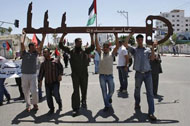
A Palestinian man carries an olive tree during a protest, against the settlements and to mark the anniversary of the 'Nakba', Arabic for catastrophe, in the West Bank village of Salem near Nablus, Sunday, May 16, 2010. The Nakba commemorations mark the uprooting of hundreds of thousands of Palestinians who fled or were driven out of their homes during the 1948 Israeli-Arab war. (AP Photo/Nasser Ishtayeh)

A Palestinian woman holds up a symbolic key during a rally marking the "Nakba" (Catastrophe) in the West Bank city of Ramallah May 17, 2010. Nakba is a term used by Palestinians to describe the founding of Israel in a 1948 war when some 700,000 Palestinians fled or were expelled from their homes REUTERS/Mohamad Torokman (WEST BANK - Tags: CIVIL UNREST POLITICS)

Palestinians hold a symbolic key during a Nakba rally in Gaza City May 15, 2010. Palestinians mark "Nakba" (Catastrophe) on May 15 to commemorate the time when hundreds of thousands of Palestinians were expelled or fled from their homes in the war that led to the founding of Israel in 1948. REUTERS/Mohammed Salem

Palestinian children participate in a rally to commemorate 'Nakba', which is Arabic for catastrophe, in the West Bank city of Ramallah, Monday, May 17, 2010. The 62nd anniversary of Nakba, which was marked on Saturday, May 15, 2010 commemorates the uprooting of hundreds of thousands of Palestinians who fled or were driven out of their homes during the 1948 Israeli-Arab war. The Arabic on the headband reads 'Sons of Yasser'.(AP Photo/Majdi Mohammed)

A Palestinian girl participates in a rally to commemorate 'Nakba', which is Arabic for catastrophe, in the West Bank city of Ramallah, Monday, May 17, 2010. The 62nd anniversary of Nakba, which was marked on Saturday, May 15, 2010 commemorates the uprooting of hundreds of thousands of Palestinians who fled or were driven out of their homes during the 1948 Israeli-Arab war. The arabic on the headband reads 'Sons of Yasser'. (AP Photo/Majdi Mohammed)


Palestinian children hold up a large kaffiyeh, a traditional Arab headdress, with Palestinian flags as they participate in a march to commemorate 'Nakba', which is Arabic for catastrophe, in the West Bank city of Ramallah, Monday, May 17, 2010. The 62nd anniversary of Nakba, which was marked on Saturday, May 15, 2010 commemorates the uprooting of hundreds of thousands of Palestinians who fled or were driven out of their homes during the 1948 Israeli-Arab war. (AP Photo/Tara Todras-Whitehill)

Palestinian children hold up a large kaffiyeh, a traditional Arab headdress, as they participate in a march to commemorate 'Nakba', which is Arabic for catastrophe, in the West Bank city of Ramallah, Monday, May 17, 2010. The 62nd anniversary of Nakba, which was marked on Saturday, May 15, 2010 commemorates the uprooting of hundreds of thousands of Palestinians who fled or were driven out of their homes during the 1948 Israeli-Arab war.(AP Photo/Tara Todras-Whitehill)

Palestinian youths wave Palestinian flags during a rally marking the anniversary of the 'Nakba', Arabic for catastrophe, in east Jerusalem, Saturday, May 15, 2010. The Nakba commemorations mark the uprooting of hundreds of thousands of Palestinians who fled or were driven out of their homes during the 1948 Israeli-Arab war. (AP Photo/Sebastian Scheiner)


A Palestinian flag attached to balloons hangs over the crowd during a rally marking the anniversary of the 'Nakba', Arabic for catastrophe, in the West Bank city of Hebron, Saturday, May 15, 2010. The Nakba commemorations mark the uprooting of hundreds of thousands of Palestinians who fled or were driven out of their homes during the 1948 Israeli-Arab war. (AP Photo/Nasser Shiyoukhi)

Israeli left wing activists hold flags and signs as they participate in a rally against West Bank Jewish settlements, in Jerusalem, Saturday, May 15, 2010 (AP Photo/Sebastian Scheiner)

Israeli soldiers argue with an activist as a Palestinian child is detained after Jewish settlers and Palestinians threw stones at each other during a Palestinian rally marking the anniversary of the 'Nakba', Arabic for catastrophe, in the West Bank city of Hebron, Saturday, May 15, 2010. The Nakba commemorations mark the uprooting of hundreds of thousands of Palestinians who fled or were driven out of their homes during the 1948 Israeli-Arab war. (AP Photo/Nasser Shiyoukhi)
Palestinian children hold drawings during a rally marking the anniversary of the 'Nakba', Arabic for catastrophe, in the West Bank city of Hebron, Saturday, May 15, 2010. The Nakba commemorations mark the uprooting of hundreds of thousands of Palestinians who fled or were driven out of their homes during the 1948 Israeli-Arab war. (AP Photo/Nasser Shiyoukhi)

The shadow of a symbolic key falls over the scene, as a Palestinian boy walks past graffiti, calling for the right of return for Palestinian refugees in Aida refugee camp in the West Bank city of Bethlehem, Saturday, May 15, 2010. Palestinians on Saturday are marking the Nakba, Arabic for catastrophe, which commemorates the uprooting of hundreds of thousands of Palestinians who fled or were driven out of their homes during the 1948 Israeli-Arab war. (AP Photo/Maya Hitij)

A Palestinian woman arranges traditional scarves called "keffiyeh" during an attempt to enter the Guinness Book of World Records for the longest chain of scarves, to mark the 62nd anniversary of Nakba in Beirut May 15, 2010. The chain of 6552 scarves which were laid out to form the numbers 194 to represent U.N. Resolution 194, has been listed as a Guinness World Record. REUTERS/ Sharif Karim (LEBANON - Tags: ANNIVERSARY CIVIL UNREST)

Palestinian women wave scarves and their national flag as they celebrate entering the Guinness Book of World Records for the longest chain of scarves, during an attempt to mark the 62nd anniversary of Nakba in Beirut May 15, 2010. The chain of 6552 scarves were laid out to form the numbers 194 to represent U.N. Resolution 194. REUTERS/ Sharif Karim (LEBANON - Tags: ANNIVERSARY CIVIL UNREST)

Guinness Records official Jack Benning Brockbank, third right, looks on as Palestinian organizer Walid Taha, center, carries the certificate for the longest chain of kaffiyeh scarves, a traditional Arab headdress, after a successful attempt to break a previous world record as Palestinians mark the 62nd anniversary of the 'Nakba,' Arabic for catastrophe to commemorate the dispersal of Palestinians during the 1948 war over Israel's creation, in Beirut city stadium, Lebanon, Saturday, May 15, 2010. Palestinians broke the Guinness World Record with a chain of 6552 scarves that were laid to form the number 194 in reference to the U.N. resolution 194. (AP Photo/Mahmoud Tawil)

People gather around the number 194 that was made out of kaffiyeh scarves, a traditional Arab headdress, after a successful attempt to break a Guinness World Record for longest chain of scarves, as Palestinians mark the 62nd anniversary of the 'Nakba,' Arabic for catastrophe to commemorate the dispersal of Palestinians during the 1948 war over Israel's creation, in Beirut city stadium, Lebanon, Saturday, May 15, 2010. Palestinians broke the Guinness World Record with a chain of 6,552 scarves that were laid to form the number 194 in reference to the U.N. resolution 194. (AP Photo/Mahmoud Tawil)

A Palestinian flag flies as 6552 traditional scarves called "keffiyeh" form the number 194 to represent U.N. Resolution 194, during an attempt made to enter the Guinness Book of World Records to mark the 62nd anniversary of Nakba in Beirut May 15, 2010. The chain of scarves was listed as a Guinness World Record. REUTERS/ Sharif karim (LEBANON - Tags: ANNIVERSARY CIVIL UNREST)

Palestinian women wave scarves and their national flag as they celebrate entering the Guinness Book of World Records for the longest chain of scarves, during an attempt to mark the 62nd anniversary of Nakba in Beirut May 15, 2010. The chain of 6552 scarves were laid out to form the numbers 194 to represent U.N. Resolution 194. REUTERS/ Sharif karim (LEBANON - Tags: ANNIVERSARY CIVIL UNREST)

Egyptian protester shouts with a Palestinian flag anti-Israeli and anti-U.S. slogans in front of Lawyers Syndicate in downtown Cairo May 15, 2010. Demonstrators mark "Nakba" (Catastrophe) on May 15 to commemorate the time when hundreds of thousands of Palestinians were expelled or fled from their homes in the war that led to the founding of Israel in 1948. REUTERS/Amr Abdallah Dalsh (EGYPT - Tags: CIVIL UNREST POLITICS IMAGES OF THE DAY)

A child drinks milk during a "Nakba" sit-in outside the United Nations office in Amman May 15, 2010. Palestinians mark "Nakba" (Catastrophe) on May 15 to commemorate the time when hundreds of thousands of Palestinians were expelled or fled from their homes in the war that led to the founding of Israel in 1948. The placards read, "sixty two." REUTERS/Majed Jaber (JORDAN - Tags: POLITICS CIVIL UNREST ANNIVERSARY)

A Jordanian boy holds placard during a protest by farmers and unionists at the central market in Amman May 15, 2010. The protest was against the import of fruits and vegetables from Israel and was also held to mark 'Nakba', a term used by Palestinians to describe the founding of Israel in a 1948 war when some 700,000 Palestinians fled or were expelled from their homes. The placard reads, "To Jordan free of Israeli goods Interrupt them"." REUTERS/Muhammad Hamed (JORDAN - Tags: POLITICS CIVIL UNREST AGRICULTURE BUSINESS ANNIVERSARY)

Palestinian youths walk next to a mural of a tree inscribed with the names of villages and towns from which Palestinians were displaced in 1948, in the West Bank refugee camp of Jenin Saturday, May 15, 2010. Palestinians mark the 62nd anniversary of the creation of the state of Israel on Saturday calling it 'Nakba' or the 'day of the catastrophe', when in 1948 many thousands were forced from their lands and homes.(AP Photo/Mohammed Ballas)

Palestinians hold a symbolic key during a Nakba rally in Gaza City May 15, 2010. Palestinians mark "Nakba" (Catastrophe) on May 15 to commemorate the time when hundreds of thousands of Palestinians were expelled or fled from their homes in the war that led to the founding of Israel in 1948. REUTERS/Mohammed Salem (GAZA - Tags: POLITICS CIVIL UNREST)

Palestinians attend a Nakba rally in Gaza City May 15, 2010. Palestinians mark "Nakba" (Catastrophe) on May 15 to commemorate the time when hundreds of thousands of Palestinians were expelled or fled from their homes in the war that led to the founding of Israel in 1948.REUTERS/Mohammed Salem (GAZA - Tags: POLITICS CIVIL UNREST)

A Palestinian girl attends a Nakba rally in Gaza City May 15, 2010. Palestinians mark "Nakba" (Catastrophe) on May 15 to commemorate the time when hundreds of thousands of Palestinians were expelled or fled from their homes in the war that led to the founding of Israel in 1948 REUTERS/Mohammed Salem (GAZA - Tags: POLITICS CIVIL UNREST)

ADC Commemorates al-Nakba: 62 Years of Palestinian Dispossession (1948 - 2010)

http://www.adc.org/fileadmin/templates/skin_bn_adc/css/images/header_img.png
ADC Commemorates al-Nakba: 62 Years of Palestinian Dispossession (1948 - 2010)

On May 15, Palestinians across the world mourn al-Nakba, the destruction of historic Palestine and the massive displacement of Palestinians by Israeli forces in the 1948 Arab-Israeli war.

Al-Nakba was not a singular event; displacement continues to this day affecting thousands of Palestinians throughout the Middle East. There are approximately seven million Palestinian refugees and 450,000 internally displaced persons, representing 70% of the entire Palestinian population worldwide (9.8 million).[i]

Internal displacement continues, unabated, in the Occupied Palestinian Territory (OPT). Thousands of Palestinians have been forcibly displaced as a result of the building of the wall, home demolition, and eviction orders. The threat of displacement hangs over those who remain.

Similar patterns of forced displacement are found in Israel, where urban development plans for the exclusive benefit of Jewish communities are displacing indigenous Palestinian communities in places like Naqab (Negev) and Galilee.

More recently on March 9, 2010, the Netanyahu government approved the development of 1,600 new housing units in occupied East Jerusalem, a policy condemned by the U.S. This development will forcibly displace several families from their land.

Palestinian refugees in host countries are also vulnerable to forced displacement. For instance, as a result of the U.S. led invasion of Iraq, persecution has forced over half of the approximately 34,000 Palestinian refugees residing in Iraq to leave the country. Additionally, over 31,000 people were displaced from Nahr al-Bared camp in Lebanon in 2007, and most have not been able to return. Palestinians constitute the largest and most protracted refugee situation in the world.

Sixty three years after their initial forced displacement from their homeland, Palestinian refugees and internally displaced persons still lack access to voluntary durable solutions and reparations -- which include return, restitution, and compensation -- based on international law and UN resolutions.

The United Nations Relief and Works Agency (UNRWA) is mandated to provide assistance to 1948 Palestinian refugees, and on an emergency and temporary basis to1967 Palestinian refugees and to those displaced as a result of subsequent hostilities. UNRWA faces many difficulties in implementing its mandate due to funding shortages and armed conflicts in the region, in particular Israel's military occupation.

ADC is committed to a just and lasting peace in the Middle East. Any peaceful resolution of the Palestinian-Israeli conflict requires the following: The dismantlement of the Israeli Wall which is being constructed through the illegal annexation of Palestinian lands; the cessation and dismantlement of settlements; an end to the collective punishment imposed on the Palestinian population as a result of Israeli occupation policies; the creation of a viable and independent Palestinian state; and the upholding of the right of return of the Palestinian refugees under international law. ADC will continue to advocate the rights of the Palestinian people to freedom, equality and self-determination in an independent and fully sovereign Palestinian state with Jerusalem as its capital.


[i] Badil Resource Center for Palestinian Residency and Refugee Rights
###
Contact: media@adc.org
202-244-2990

NOTE TO EDITORS: The American-Arab Anti-Discrimination Committee (ADC), which is non-profit, non-sectarian and non-partisan, is the largest Arab-American civil rights organization in the United States. It was founded in 1980 by former Senator James Abourezk to protect the civil rights of people of Arab descent in the United States and to promote the cultural heritage of the Arabs. ADC has 38 chapters nationwide, including chapters in every major city in the country, and members in all 50 states.

The ADC Research Institute (ADC-RI), which was founded in 1981, is a Section 501(c)(3) educational organization that sponsors a wide range of programs on behalf of Arab Americans and of importance to all Americans. ADC-RI programs include research studies, seminars, conferences and publications that document and analyze the discrimination faced by Arab Americans in the workplace, schools, media, and governmental agencies and institutions. ADC-RI also celebrates the rich cultural heritage of the Arabs.


ADC Research Institute (ADC-RI) | www.adc.org
1732 Wisconsin Ave., NW | Washington, DC | 20007
Tel: 202-244-2990 | Fax: 202-333-3980 | E-mail: media@adc.org


Witness - Shooting Hope

Can Only a Catastrophe Unite Us? By Joharah Baker for MIFTAH

Date posted: May 17, 2010
By Joharah Baker for MIFTAH

Every year Palestinians commemorate this tragic event. And every year, the hope that the injustice caused by this event will be rectified becomes slimmer and slimmer. Al Nakba or the Catastrophe is a wound all Palestinians bear, refugee or otherwise. Sixty-two years ago, hundreds of thousands of Palestinians fled or lost their homes in fear for their lives from attacking Jewish gangs. Some were massacred in their homes, some died the fighting, some were forced out of their villages and towns and some fled in order to stay alive, only to be denied reentry after Israel was created. Today, many of the original refugees have perished, those who carried a few precious belongings on their backs, their children at their sides and the keys to their homes securely tied around their necks. The younger refugees may still be around, aging Palestinians, some of whom have never seen Palestine but who can recount the events of 1948 like it was yesterday, who can tell you the name and location of their lost village and the house in which they never set foot.

Perhaps it is the fact that this tragedy is so immense and so deep-cutting that Palestinians find themselves united in its commemoration. For whatever reason, Palestinians in the Diaspora, in refugee camps in Palestine and in neighboring countries, inside the Green Line in what is now Israel and here in Palestine have rallied around this painful memory as one voice and one force calling for one thing: the right of return.

For us beleaguered Palestinians who have witnessed the bitter internecine fighting for years between the various factions, this has been, ironically, a breath of fresh air. Factions banded together in Gaza, the Hamas-controlled Strip to commemorate the loss of Palestine and the homes and villages of so many of its people.

Reminiscent of the days of the first Intifada in particular, Al Nakba commemoration this year transcended all factional lines. The right of refugees to return has always been a Palestinian demand and is an inalienable right enshrined in international law. Today, that right is no less of a demand than it was in the early days of the Palestinian exile. The turnout at Nakba commemorations and the unity the Palestinians projected is clear evidence of this fact.

However, what is most striking this year is not only the heart-wrenching pictures of refugees in exile but the heartwarming images of unified Palestinians. Such images also beg a very important question, which is, if the Palestinians are so resolved on an issue such as this, why can they not agree on other equally as important points? At the risk of coming across as simplistic, it seems that Palestinians have a bottomless reservoir of hope, determination and patience, which they tap into whenever they choose. Can they not dip into this eternal reserve and find the strength to overcome their political divisions? Nothing is impossible, especially this.

It is about time, too. The situation as its stands is lethal. Hamas in Gaza accuses the Abbas-run government in the West Bank of rounding up its men, interrogating them under difficult circumstances and blocking jobs to them because of their affiliation. Fateh and the government, on the other hand, say Hamas is smuggling arms into the West Bank as a means of contesting the PA's authority and is persecuting the few remaining Fateh loyalists still in Gaza. Where rumor and truth coincide is hard to say but like the popular Arabic saying goes, "There is no smoke without fire."

For one, the thirst for power has blinded Palestine's leaders to a point where the ultimate goal is often lost. Unfortunately, the power the sides are vying for is nothing but illusory given the fact that Palestinians are still very much under Israel's occupation. In any case, the liberation of Palestine is the slogan all factions continue to uphold but the fact of the matter remains that seats of 'false' power are the immediate goal. Take for example, the failure of Hamas and Fateh to reconcile. “The message today is a message of national unity in facing the Israeli occupation," said one Fateh leader in Gaza. "“National unity is the way to preserve the right of return," a Hamas leader insisted. They are right, of course, at least in paying lip service. In reality, a Palestinian reconciliation at the political level seems like a bleak possibility. Until, of course, one sees the Nakba commemorations.

It is a shame the Palestinians have lost their way. Nothing pains us more than seeing our leaders so divided. We should take a leaf out of Israel's book when it comes to showing a united front. Irrespective of the governments in office, Israel's goal has always been unwavering: Expand Israeli territory including illegal settlements as fast as possible with as few Palestinians on the remaining areas. The status quo of Palestine today is witness to Israel's resolve. Internal Israeli politics are wracked with dissent, corruption, backstabbing and strange bedfellows, just like in any other political system. But this does not deflect from their national goal, which they have forwarded steadily ever since Israel's creation. Palestinians need to learn that valuable lesson and who better to learn it from than the root of the problem itself? We have the potential; the symbolic keys held up in unison in Gaza, the West Bank, the US, Europe and the Arab world all point to that bottomless reservoir of hope and promise. Let us take advantage of that so that legitimate Palestinian demands such as the right of return are not lost in the chaos of our egotistic hunger for power.

Joharah Baker is a Writer for the Media and Information Department at the Palestinian Initiative for the Promotion of Global Dialogue and Democracy (MIFTAH). She can be contacted at mid@miftah.org.


Sunday, May 16, 2010

Driven to despair

Driven to despair

Should anyone like to congratulate Israel for its creation, it would be equivalent to congratulating it on the success of its daylight robbery of Palestine and the systematic expulsion of the Palestinian people from their land and homes. As Palestinians mark yet another day remembering the Nakba, the catastrophe of Israel’s creation in 1948, any congratulations being extended should go to their evictor-turned-jailor of the world’s largest prison.

The Nakba are the days of infamy that created what has become the largest diaspora of refugees in the world. On May 14 the state of Israel was declared and the first Arab-Israeli war broke out in earnest the next day. The prospective state of Israel launched a massive military incursion into Palestinian territory, creating in its wake three quarters of a million Palestinian refugees, the destruction of hundreds of entire villages not only depopulated but obliterated, and houses blown up or bulldozed.

As a result, five million Palestinian refugees and their descendants are now scattered across the West Bank, Gaza, Lebanon, Jordan and Syria. About one-third still live in UN-supported refugee camps.

Their plight is one of the most emotionally charged issues of the conflict. The Israeli side has not given an inch on its basic premise: The confiscated Palestinian land, which comprises 92 percent of Israel’s area, will not be returned to its rightful owners, and the inhabitants of villages and towns who were expelled by Israeli forces in 1948 will not be allowed to return home. The standard explanation is an influx of refugees would dilute Israel’s Jewish majority and threaten the existence of the state.

In this, Israel is backed by Washington which would like to see the Palestinians, displaced in 1948 and 1967, assimilated wherever they are now living or resettled in countries, Arab or otherwise, that are ready to receive them.

On the other hand, the five million Palestinian refugees who have endured 62 years of wars, destitution and exile, refuse to accept this diktat and insist on their right to return home. They have strong bases for that claim. The right of return is legal, pursuant to UN Resolution 194, which calls for both repatriation and indemnification.

There is no precedent in UN history for the universal, sustained and firm consensus accorded to the right of the refugees to return to their homes. It has been affirmed over 100 times by the UN. The right to return home has been affirmed by the Universal Declaration of Human Rights and by similar European, American and African charters.

It might be suggested that as the indirect Palestinian-Israeli negotiations, which are scheduled to discuss the core issues of the conflict, begin this is not the time to talk about the right of return in the absence of not just a Palestinian state but substantive progress on other issues of the conflict. The Israelis are expanding the settlements on a daily basis, Judaizing what is left of Jerusalem, and narrowing Palestinian horizons in every conceivable manner. Under these circumstances, it is argued, the right of return should take a back seat in negotiations.

But there is a centrality to the right of return and any resolution of the Palestinian-Israeli conflict not including the repatriation of millions of uprooted refugees to their original homes and villages in what is now called Israel would be strongly rejected by the Palestinian people, especially those forced out, seemingly never to be allowed in again.

My letters to Newsweek, The Washington Post, & AFSC regarding Palestine & Boycotts


RE: Boycott Blues, Palestinians can't wreck Israel's economy by boycotting goods made in the settlements. So why are Israelis so worked up?
http://www.newsweek.com/ID/237960

Dear Editor,

Good to see Newsweek noticing non-violent Palestinian efforts to protest Israel's continuing crimes against the native non-Jewish population of the Holy Land... however you only touched the tip of a very big iceberg: How many more Palestinian homes will Israel wreck- how many more lives will Israel ruin, how many more careers will Israel and its lobby destroy, how many more children will be traumatized, and how many more negotiations will Israel [and its supporters] sabotage before both peace and Palestine have a chance to become more than merely a dream for the many people besieged and tormented by the Israel/Palestine conflict.

Sincerely,
Anne Selden Annab

******************************
RE: Palestinians turn to boycott in West Bank
http://www.washingtonpost.com/wp-dyn/content/article/2010/05/15/AR2010051501492.html

Dear Editor,

Fascinating to read the details of the boycott efforts by Palestinians in the West Bank, as well as some of the economic realities propelling Israel's offensive settlement projects in the illegally occupied territories.

Obviously religion empowered by tax payer's money plus military arsenals tends to quickly become institutionalized bigotry: How many more (native non-Jewish) Palestinian men, women and children will lose homes and lands (and jobs) and be pushed into poverty and forced exile due to Israel's Jews-preferred policies and investments on all sides of that monstrous Israeli made 'security' wall?

I very much hope that more people become more aware of the importance of supporting Palestine and peace- and a negotiated SECULAR two state solution to end the Israel/Palestine conflict.

Sincerely,
Anne Selden Annab


******************************
American Friends Service Committee
http://afsc.org/office/palestine

Dear AFSC,

Looking over your recent reading list
Israel-Palestine Recommended Reading List, I was sorry to see that you did not have Hussein Ibish's most recent book "What’s Wrong with the One-State Agenda? Why Ending the Occupation and Peace with Israel is Still the Palestinian National Goal"

Yes there are probably many other books you could have maybe included too- such as the poignant Palestinian Walks: Forays into a Vanishing Landscape by the Palestinian author Raja Shehadeh , but I point out Ibish's book as many concerned and well meaning but misguided people here in America have been convinced to invest in boycott efforts rather than doing what they can to fully support and advocate a nonviolent negotiated settlement in line with international law, relevant UN Resolutions and the Arab Peace Initiative shaping a just and lasting peace for both Israel and Palestine.

Sincerely,
Anne Selden Annab
http://anniesnewletters.blogspot.com/
http://growinggardensforpalestine.blogspot.com/2010_04_01_archive.html

"....will return"
by Ismail Shammout