Labels

Thursday, April 15, 2010

Daoud Kuttab: Israeli military commander acts as a dictator towards Palestinians

There is a reason for the fact that in modern times laws are written by representatives of the people to whom these laws are applied. Governments and parliaments come and go, but laws often outlive them.


Except for dictatorships, laws are not written by the executives who have to enforce them or the judges that have to interpret them. Many totalitarian rulers create a symbolic legislature, made up of people’s representatives so as to be able to carry this important task. Laws are certainly not written by foreign rulers, and for sure they are not written by foreign military rulers. Well, everywhere except in the occupied Palestinian territories.

When the Israeli army occupied Palestinian lands in June 1967, the Israeli military commander issued an order giving himself the sole right to legislate for the people under his army’s control. Military order # 1 gave him the sole power to control all three branches the executive, legislative and judicial. Since then, thousands of laws have been issued by successive military commanders who single-handedly can amend existing laws or issue totally new laws without discussion, debate or even a public announcement. The orders are issued in Hebrew and the Palestinian public is by and large unaware of their existence.

The Palestinian human rights organisation Al Haq began, in the 1980s, the hard work or translating and publishing these laws. One of the co-founders of Al Haq, Raja Shehadeh, wrote an entire book on the process of Israeli control that turns around the concept of the rule of law to rule by law. Shehadeh’s book “Occupier’s Law” has been praised by The Washington Post back in 2003 “as an invaluable resource that captures the rage and despair of lives stunted by occupation”.

This long introduction is meant to highlight the Kafkaesque legal structure that Palestinians under occupation are subject to. They have an elected Palestinian parliament whose laws are argued by civilians coming from the communities where the laws are to be implemented. Local press and electronic media cover the debates, often publish draft laws and announce the agreement on these laws once voted on. Once these laws are signed by a president, they are published in the Official Gazette and have the power of laws that local Palestinian judges can enforce using local lightly armed police, on condition that they only serve the court decisions within areas A (the highly populated cities) of the Palestinian territories.

At the same time, the signature of a single military commander can make law that is enforceable in all Palestinian areas with the help of a powerful military army and its bands of intelligence officers and local collaborators. Such was the case on October 13, 2009, when Major General Gadi Shamni, commander of the Israeli army in the West Bank, redefined who is an infiltrator (anyone without a special Israeli-issued valid permit) and what the punishment of infiltration is: up to seven years in jail, NIS 7,500 ($2,000) and deportation.

To be fair, order number 1650 gave Palestinians six months to get their act in order. However, few Palestinians were even aware of this military order until an Israeli reporter quoted Israeli human rights organisations saying that the six months are to expire on April 13, putting tens of thousands of Palestinians in danger of imprisonment, fine and deportation.

Deportations are not new, of course, even though the Israelis have not been using them directly.

The Israeli human rights organisation B’tselem says that Palestinians from the occupied territories are deported pursuant to the authority of regulation 112 of the Defence (Emergency) Regulations, 1945. This regulation authorises the regional commander “to make an order under his hand, requiring any person to leave and remain out of Palestine”.

The emergency regulations were called “Nazi” by Menachem Begin.

The regulation was rescinded within Israel in 1979, but remains in force in the occupied territories. According to B’tselem, from the beginning of the Israeli occupation, in 1967, to 1992, when Israel ceased deportations, 1,522 Palestinians were deported from the occupied territories. None of the deportees had been charged with a criminal offence, nor tried and convicted. By law, they must therefore be considered innocent of any offence.

While public deportation had stopped in 1992, a much more sinister plan was implemented, that of transfer, whereby Palestinians are “encouraged” to leave and not return by use of various administrative orders, such as this latest order. Ironically, this infiltration order does not apply to Jewish settlers who are indeed infiltrating into Palestinian territories, nor does it apply to Jewish settlers residing in the so called “outposts” that have not been even authorised officially by the occupying state of Israel.

In the Monday summit in Washington, His Majesty King Abdullah and US President Barack Obama agreed that both Israelis and Palestinians should avoid actions that undermine chances of reviving stalled peace talks, according to the White House.

In the past few months, we have seen clear evidence that Israel is undermining peace by building Jewish settlements in occupied territories, in defiance of the roadmap and commitments made to the US administration. Now the Israelis are showing that the original Zionist theory of lusting for the land, without its people, continues to be the main pillar of this right-wing Israeli government.

If Obama and his advisers are genuinely interested in this issue, they do not need to send an envoy all the way to the Middle East. Obama, his secretary of state or his national security adviser need only go across town in Washington, DC to get details. The man who had the power to make laws in the occupied territories and who signed military order 1650, Major General Shamni, has been the military attaché at the Israeli embassy since November 2009.

Wednesday, April 14, 2010

Dr. Hussein Ibish LIVE on Arab Voices Wednesday, April 14, 2010

Date:

Wednesday, April 14, 2010
Time: 7 p.m. - 8 p.m. central time
Guest:

Hussein Ibish
Senior Fellow at the American Task Force on Palestine (ATFP) and Executive Director of the Hala Salaam Maksoud Foundation for Arab-American Leadership. Dr. Ibish has served as Communications Director for the American-Arab Anti-Discrimination Committee (ADC) and was Vice-President of the National Coalition to Protect Political Freedom. Dr. Hussein Ibish is author of numerous books and publications.

Topics: The new Israeli orders that could lead to the expulsion of tens of thousands of Palestinians from the occupied West Bank in Palestine, and its implication on the prospects for peace; Israel's ongoing measures to remove Palestinians from occupied Jerusalem; the ongoing Israeli siege on Gaza; and much more.


Tune in and participate live by calling the studio at 713-526-5738


Listen LIVE

Did you miss the last show, or the previous shows?
(click on the date to listen to any of the shows)
http://www.arabvoices.net/

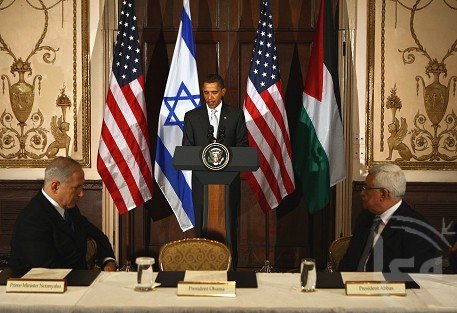
Obama remains fully engaged in ending the Israel/Palestine conflict BUT says US can't impose peace- proximity talks should begin as soon as possible

US President Barack Obama (C) speaks during a trilateral meeting with Israeli
Prime Minister Benjamin Netanyahu (L) and President Mahmoud Abbas (R) at
the Waldorf Astoria in New York on 22 September 2009. [MaanImages/Omar Rashidi/POOL]

Report: Obama says US can't impose peace
Published today (updated) 14/04/2010 10:47

Bethlehem - Ma'an/Agencies - US President Barack Obama said Tuesday that Israelis and Palestinians may not be ready to resolve the conflict, in spite of pressure Washington exerts on the two sides, he told reporters after hosting a nuclear security summit.

Obama said he had little hope for progress toward Middle East Peace during a news conference, according to Reuters.

"The truth is in some of these conflicts the United States can't impose solutions unless the participants in these conflicts are willing to break out of old patterns of antagonism," he said.

US-brokered "proximity talks" were quickly derailed when Israel announced a settlement expansion plan during US Vice President Joe Biden's trip to the region in a bid to renew negotiations. Despite US condemnation, Israeli Prime Minister Benjamin Netanyahu is said to have given little ground over Israeli-only building on land occupied in 1967 during talks with Obama in Washington last month.

However, Obama said that despite frustration with the peace process, the US would press on, "constantly present, constantly engaged," the news agency reported.

"It's going to take time, and progress will be halting," he said. "And there will be frustrations."

"The Israeli people, through their government, and the Palestinian people, through the Palestinian Authority, as well as other Arab states may say to themselves, 'We are not prepared to resolve these issues no matter how much pressure the United States brings to bear,'" Obama said.

On Monday, Obama and Jordan's King Abdullah agreed on the sidelines of a Washington nuclear summit, that Palestinian and Israeli officials should immediately restart proximity talks, Israeli media reported.

"During these discussions, both agreed that Israeli-Palestinian proximity talks should begin as soon as possible, and transition quickly to direct negotiations," the White House said, according to the Israeli daily Haaretz. "They also agreed that both sides should refrain from actions that undermine trust during these talks."

Dispute over naming of occupied Palestinian territories stalls water strategy

Palestinian children queue to fill up containers from a water pump in Khan
Younis refugee camp, southern Gaza, on 4 July 2006. At the time, the Israeli
airforce bombed the sole power plant, leaving only two water pumps
functioning in the southern Strip. [MaanImages/Magnus Johansson]
http://www.maannews.net/eng/ViewDetails.aspx?ID=276343

Dispute over naming of oPts stalls water strategy
Published today (updated) 14/04/2010 11:27

Bethlehem - Ma'an - Failure to agree on how to name the occupied Palestinian territories has prevented representatives of the 43 countries of the Union for the Mediterranean (UFM) from approving a joint strategy for guaranteeing the water resources of the whole Mediterranean basin, a news release from the Spanish Presidency of EU said.

A document intended to promote common initiatives for water management, which was due to be the first major strategy of the recently created UFM had been expected to come out of the 4th Euro-Mediterranean Ministerial Conference, The European Neighbourhood and Partnership Instrument (EPNI) said Wednesday.

However, during a news conference following the meeting, the insurmountable obstacle was a nuance of terminology, since Israel’s representatives would not accept the document referring to "occupied territories," instead proposing the term "territories under occupation," which, EPNI wrote, was not acceptable to the Arab block.

The strategy was meant to establish the political, methodological and financial framework for bringing in regional policies on the matter. It envisaged reducing the consumption of water between now and the year 2025, to levels 25 percent below those of 2005.

The conference, jointly chaired by the Spanish Minister for the Environment and Rural and Marine Affairs Elena Espinosa, brought together ministers from the 43 countries of the UFM, together with representatives of the European Commission and the Arab League, along with representatives of civil society and financial institutions.

In her opening speech, Espinosa described the Mediterranean as an imbalanced hydrological basin, with extreme phenomena of cyclical floods and droughts, requiring UFM nations to adopt a "common strategy for a scarce resource."

The U.N. Partition Plan and Arab ‘Catastrophe’


The U.N. Partition Plan and Arab ‘Catastrophe’

by Jeremy R. Hammond
April 13, 2010

The following is excerpted from The Rejection of Arab Self-Determination: The Struggle for Palestine and the Roots of the Arab-Israeli Crisis.

In 1947, Great Britain, unable to reconcile its conflicting obligations to both Jews and Arabs, requested that the United Nations take up the question of Palestine. In May, the U.N. Special Committee on Palestine (UNSCOP) was created by a General Assembly resolution. UNSCOP’s purpose was to investigate the situation in Palestine and “submit such proposals as it may consider appropriate for the solution of the problem of Palestine”.

At the time, the U.N. consisted of 55 members, including Egypt, Iraq, Lebanon, and Syria. Palestine by then remained the only one of the formerly Mandated Territories not to become an independent state. No representatives from any Arab nations, however, were included in UNSCOP.[1] Egypt, Iraq, Syria, Lebanon, and Saudi Arabia requested that “The termination of the Mandate over Palestine and the declaration of its independence” be placed on the agenda, but this motion was rejected. The Arab Higher Committee thus announced it would not collaborate, although individual Arab states did agree to meet with representatives from UNSCOP.[2]

UNSCOP’s investigation included a 15-day tour of Palestine, splitting time between visits to Arab and Jewish communities. Seven days—nearly half that same amount of time spent touring Palestine itself—were spent touring Displaced Persons (D.P.) camps in Germany and Austria and witnessing the plight of the Jews there.[3] The proposal to visit the D.P. camps passed by a vote of six to four with one abstention, despite the objection from two members that it would be “improper to connect the displaced persons, and the Jewish problem as a whole, with the problem of Palestine”.[4] More time was spent visiting D.P. camps than the total number of days spent visiting the Arab nations neighboring Palestine and meeting with representatives there.

Public hearings were held in which 37 representatives were heard, 31 of whom were Jews representing 17 Jewish organizations, but with only one representative from each of the six Arab states.[5] Two proposals emerged: a federal State plan and a partition plan. The latter passed by a vote of seven to three with one abstention, the dissenting votes being cast by India, Iran, and Yugoslavia, who all favored the federal state plan.

On September 3, UNSCOP submitted its report to the U.N. General Assembly. The report noted that the population of Palestine at the end of 1946 was estimated to be almost 1,846,000, with 1,203,000 Arabs (65 percent) and 608,000 Jews (33 percent). Again, the growth of the Jewish population was mainly the result of immigration, whereas the Arab growth was “almost entirely” natural increase.

Complicating any notion of partition, UNSCOP observed that there was “no clear territorial separation of Jews and Arabs by large contiguous areas.” In the Jaffa district, for example, which included Tel Aviv, “Jews are more than 40 per cent of the total population”, with an Arab majority.[6]

Land ownership statistics from 1945 showed that Arabs owned more land than Jews in every single district in Palestine. In Jaffa, with the highest percentage of Jewish ownership of any district, 47 percent of the land was owned by Arabs versus 39 percent owned by Jews. At the opposite end of the spectrum, in Ramallah district, Arabs owned 99 percent of the land and Jews less than 1 percent.[7] In the whole of Palestine, Arabs were in possession of 85 percent of the land, while Jews owned less than 7 percent.[8] ...READ MORE

Palestine Note News » 'Your conscience, your choice': PA urges the boycott of settler goods to undermine the Occupation

News » 'Your conscience, your choice': PA urges the boycott of settler goods to undermine the Occupation

With unarmed protests ending in injury and rock-throwing at illegal Israeli details ending in detention and death, the West Bank Palestinian Authority is looking for a third way to break through the Israeli Occupation, New York Times Jerusalem bureau chief Ethan Bronner reports.

Palestinians in the West Bank have begun conducting olive tree planting ceremonies as a non-violent way to assert their claim to the land

Neither diplomacy nor armed struggle have effected a positive change in Israeli policy for the West Bank, so now the PA is looking toward ways to "rouse popular passions while avoiding violence.

The idea, as Fatah struggles to revitalize its leadership, is to build a virtual state and body politic through acts of popular resistance.

PA economic minister Hasan Abu-Libdeh says, "it's all about self-empowerment" when it comes to the new campaign to undermine the Israeli occupation. The campaign includes steps to boycott the purchase of settler goods and end the employment of Palestinians by settlers and the settler industrial sector.

"We want ordinary people to feel like stockholders in the process of building a state," Abu-Libdeh says. This new approach has gained plenty of support in the West Bank for the campaign's potential to pressure Israel, but they are none the less unconvinced of its "ultimate effectiveness."

The project to rid the West Bank of "symbols of the occupation" is working in tandem with the "Karama National Empowerment Fund," a $2 million venture funded by the PA Ramallah government and Palestinian businessmen. Billboards stating "Your conscience, your choice" about buying settler goods are springing up as part of the campaign, and the PA Ministry of Communications has banned the sell of Israeli phone cards, as Israeli signals are relayed from settlements.

Abu-Libdeh says a law barring the purchase of settler goods is likely to go into effect soon. Trade with settlements is worth roughly $200 million per year. As for settlement employment, the economic minister said the government could not levy penalties on Palestinians working for settlers or in settlement industries, as the PA does not provide unemployment insurance. An estimated 30,000 Palestinians work within the settlement economy.

The business owners behind Karama are eager to fill the gap left by settler goods with their own. The law would not affect Israeli goods, as Israel and the PA have trade agreements. Settlements in the West Bank are not recognized as part of the Israeli economy.

Even the Prime Minister Salam Fayyad is taking the new campaign rhetoric to heart, getting his hands dirty to plow fields on Land Day and opening civil infrastructure projects related to water works, power, and education in long-neglected West Bank villages.

The Prime Minister, currently in Madrid to work on the Palestinian statehood plan, has called for steadfastness among Palestinians, and he called for it again when he addressed a crowd in Izbet al-Tabib village near Qalqailya last month. The village lies in an area that meets the Israeli separation barrier, which has made farming the land extremely difficult:

“Steadfastness must be translated from a slogan to acts and facts on the ground... This is our real project, to establish our presence on our land and keep our people on it.”

It is too early to tell if this state-sponsored plan of non-violent resistance will be successful, but Palestinian political analysts will say that the new cocktail of popular resistance combined with institution building has gained notice with the public.

Chairman of the Palestinian Academic Society for the Study of International Affairs, Mhadi Abdul Hadi, says:

“Fatah is living through a crisis of vision... How can they combine being a liberation movement with being a governing party? This is one way. The idea is to awaken national pride and fulfill the people’s anxiety and passion. Of course, Hamas and armed resistance still remain a real option for many.”

Palestinian Center for Policy and Survey Research director Khalil Shikaki comments:

“The society is split. The public believes that Israel responds to suffering, not to nonviolent resistance. But there is also not much interest in violence now. Our surveys show support for armed resistance at 47 percent in March. In essence, the public feels trapped between failed diplomacy and failed armed struggle.”

The Israelis have not made clear their response to the new resistance campaign. Israeli politicians have voiced their positive opinion of Fayyad as a true statesmen with whom they can debate, but his new approach may cost him that positive opinion. One Israeli military official commented:

“We respect Salam Fayyad... But we don’t want him to engage in incitement. Burning goods is incitement. Destroying the fence is incitement and is not nonviolent. They are walking a thin line.”

Even if the gains of this campaign are short-lived, Palestinian analysts say another Intifada is unlikely at this time in the West Bank. Fayyad has spent the last two years restoring internal safety and normalcy to the West Bank, and it not the crucible for uprising that it was in 2000. The trappings of civil infrastructure are function again, with police routinely handing out tickets for traffic violations and businesses accepting personal checks, which were long eschewed.

Still, Fayyad can do little about the Israeli presence within and without the West Bank, which has made the his constituency doubt if they will ever live in a sovereign state.

The prime minister is unwavering in his commitment to his statehood plan and all the steps, small and large, to get there:

“It’s about putting facts on the ground... The occupation is not transitional so we need to make sure our people stick around. If we create services, it gives people a sense of possibility. I feel we are on a path that is very appealing both domestically and internationally. The whole world knows this occupation has to end.”

Photo: Hoyasmeg - Flickr

Tuesday, April 13, 2010

My letter to the Washington Post RE Richard Cohen's It takes a village to humanize the Israeli-Palestinian conflict

RE: It takes a village to humanize the Israeli-Palestinian conflict http://www.washingtonpost.com/wp-dyn/content/article/2010/04/12/AR2010041203296.html

Dear Editor,

Regarding humanizing the Israeli-Palestinian conflict, and Richard Cohen's exploration of the documentary "Budrus" ... Well at least he looked- and at least he tried to understand and explain the situation as best as he could. There is only so much one man can do. Will the documentary (and subsequent commentaries and criticisms and spin) help inspire support for a real Palestinian state living in peace alongside Israel- or will it help prolong the Israel-Palestine conflict as every side clamors to make itself heard, with various extremists, petty tyrants, religious wackos, bigots and hate mongers sure that their side alone will win?

A moderate start towards a just and lasting peace has to be Israel ending its invasion projects and its illegal occupation of Palestinian land. Israel, already sovereign and strong, needs to stay within its own borders and it needs to invest in fair and just laws respecting the basic human rights of all people, regardless of supposed race, religion, or nationality.... so too should Palestine.

Sincerely,
Anne Selden Annab

As journalism changes, so must you - USATODAY.com

"Today, citizens need to think like journalists because they increasingly are serving as informational gatekeepers, both by creating and publishing original content online and by passing on (and thereby endorsing) news and information created elsewhere"

Without news literacy, citizenry is often overwhelmed and underinformed.
By Brent Cunningham and Alan C. Miller
http://www.usatoday.com/news/opinion/forum/2010-04-13-column13_ST_N.htm

American Task Force on Palestine- Daily World Press Roundup

Daily News Feed

Stream ATFP's Middle East News: World Press Round up and stay up to date with the latest news concerning the Isareli-Palestinian issue.

April 12, 2010

Human rights groups warn that a new Israeli military order could authorize the deportation of tens of thousands of Palestinians from the West Bank. Zbigniew Brzezinski and Stephen Solarz say Pres. Obama and Arab leaders should travel to Jerusalem and Ramallah with a specific peace plan. Aaron David Miller warns against US efforts at regime change in Israel. Islamic Jihad says Hamas has a secret cease-fire with Israel, and Hamas fighters arrest armed men. Israel threatens to shut off West Bank water. Hamas raises taxes in Gaza. Fatah vows unilateral steps on national reconciliation. Construction in Jerusalem is on hold. Jewish Americans continue to support Pres. Obama. An Israeli court dismisses a lawsuit against the separation barrier. Seth Freedman says the Israeli economy needs a peace deal. Abdullah Iskandar says PM Netanyahu's canceled trip to Washington is another slap in the face. Uri Avnery says all peace hopes now center on Palestinian state building. Stephen Walt replies to Robert Satloff. Hussein Ibish says a US peace plan should be formulated but only publicized at the right time.

Salam Fayyad's big gamble

Salam Fayyad's big gamble
April 12, 2010

If Fayyad fails, every Palestinian will draw the self-evident conclusion: There is no chance whatsoever for a peaceful solution. A bloody intifada will follow, Hamas will take control.

Arab News (Opinion)
April 12, 2010 - 12:00am
http://arabnews.com/opinion/columns/article41971.ece


I met Salam Fayyad, the Palestinian prime minister, two weeks ago, and was again impressed by the calm and modesty he radiates.

Generally, I meet him at demonstrations, such as those at the Bil'in fence. This time, too, there was no opportunity for more than a perfunctory handshake and a few polite words.

We appeared together at the Land Day event in a small village near Qalqilyah, whose name is known only to a few: Izbat al-Tabib. We were surrounded by a large group of respectable personalities - the heads of neighboring villages and officials of the parties that belong to the PLO - as well as the inhabitants of the village. I could speak to him only from the rostrum. I entreated him to strengthen the cooperation between the Palestinian leadership and the Israeli peace camp, a cooperation that has weakened since the assassinations of Yasser Arafat and Faisal Husseini.

It is impossible not to like Fayyad. He radiates decency, seriousness and a sense of responsibility. He invites trust. None of the filth of corruption has stuck to him. He is no party functionary. Only after much hesitation did he join a small party ("the Third Way"). In the confrontation between Fatah and Hamas, he does not belong to either of the two rival blocs. He looks like a bank manager - and that is what he indeed was: A senior official of the World Bank and the International Monetary Fund.

The 58-year-old Fayyad is the very opposite of Yasser Arafat, who first appointed him as finance minister. The ra'is radiated authority, the prime minister radiates diffidence. Arafat was an extrovert, Fayyad is an introvert. Arafat was a man of dramatic gestures, Fayyad does not know what a gesture is.

But the biggest difference between the two lies in their methods. Arafat did not put all his eggs into one basket, he used many baskets. He was ready to use - simultaneously or alternatively - diplomacy and the armed struggle, popular action and secret channels, moderate and radical groups. Fayyad, on the other hand, puts all his - and the Palestinians' - eggs in one basket. He chose a single strategy and sticks to it. That is a personal and national gamble - and bold and dangerous indeed.

Fayyad believes, so it seems, that the Palestinians' only chance to achieve their national goals is by nonviolent means, in close cooperation with the US. His plan is to build the Palestinian national institutions and create a robust economic base, and, by the end of 2011, to declare the State of Palestine. Fayyad's plan is based on the assumption that the US will recognize the Palestinian state and impose on Israel the well-known peace terms: Two states, return to the 1967 borders with small and agreed-upon land swaps, East Jerusalem as the capital of Palestine, evacuation of all settlements which are not included in the land swap, the return of a symbolic number of refugees to Israeli territory and the settlement of the others in Palestine and elsewhere.

That looks like a sensible strategy, but it raises many questions. First question: Can the Palestinians really rely on the US to play their part?

President Obama is demonstrating a new self-confidence in Israeli-Palestinian matters. He may now be ready to impose on both parties an American peace plan that includes those elements. The US has made it clear that this is not a side-show, but a strategy based on a sober assessment of American national interests, supported by the military leadership.

But the decisive battle has not yet been joined. One can expect a Battle of Titans between the two most powerful lobbies in Washington: The military lobby and the pro-Israel lobby. The White House versus the Congress. Fayyad's gamble is based on the hope that Obama, with the help of Gen. David Petraeus, will win this struggle. It's a reasonable gamble, but a risky one.

Second question: Is it possible to build a Palestinian "state-to-be" under Israeli occupation? As of now, Fayyad is succeeding. There is indeed some prosperity in the West Bank. The Netanyahu government supports this effort, under the illusion that "economic peace" can serve as a substitute for real peace. But this entire effort stands on feet of clay. The occupation authorities can wipe everything out at one stroke. If the Israeli government so decides, all the well-ordered government offices of Fayyad, all the new enterprises and economic initiatives, will go up in smoke.

Fayyad relies on the American security net. And indeed, it is questionable whether Netanyahu can do in 2010, in the Obama era, what Ariel Sharon did in 2002 under George W. Bush.

An important component of the new situation is "Dayton's army". The US Gen. Keith Dayton is training the Palestinian security forces. Anyone who has seen them knows that this is for all practical purposes a regular army.

Third question: What will happen if the Palestinians declare their state at the end of 2011?

Many Palestinians are skeptical. After all, the Palestinian National Council already declared an independent Palestinian state in 1988. Dozens of countries recognized this state, and the PLO representatives there enjoy the official status of ambassadors. But did this improve the situation of the Palestinians?

The main question is whether the US will recognize the Palestinian state on the day of its foundation, and whether the UN Security Council will follow suit. If Fayyad's hope comes true and the US recognizes the State of Palestine, the Palestinians' situation will change dramatically. Almost certainly, the Israeli government will have no choice but to sign a peace agreement that will be practically dictated by the Americans. Israel will have to give up almost the entire West Bank.

Fourth question: Will this apply to Gaza? Probably yes. Contrary to the demonic image created by Israeli and American propaganda, Hamas wants a Palestinian state, not an Islamic emirate. Hamas' aims are not restricted to the small enclave they now control. They want to play a major role in the future State of Palestine. The official position of Hamas is that they will accept an agreement signed by the Palestinian Authority if it is ratified by the Palestinian people in a referendum or by an act of Parliament. It should be noted that even now, Hamas treats the Fayyad experiment with relative indulgence.

Fayyad is a man of compromise. He would have reached a modus vivendi with Hamas long ago, if the US had not imposed a total veto.

The Palestinian split is, to a large extent, made in the US and Israel. Israel has contributed to it by disrupting all physical contact between the West Bank and the Gaza Strip - in gross violation of the Oslo agreement, which defines the West Bank and the Gaza Strip as one integral territory. The Americans have a primitive model of the world, inherited from the days of the Wild West: everywhere there are Good Guys and Bad Guys. In Palestine, the Good Guys are the Palestinian Authority people, the Bad Guys are Hamas. Fayyad will have to work hard to convince Washington to adopt a stance a little bit more nuanced.

What will happen if Fayyad's gamble proves to be a historic mistake? If the pro-Israel lobby wins against the statesmen and the generals? Or if some world crisis diverts the attention of the White House into another direction?

If Fayyad fails, every Palestinian will draw the self-evident conclusion: There is no chance whatsoever for a peaceful solution. A bloody intifada will follow, Hamas will take control of the Palestinian people - until they, too, are supplanted by far more radical forces.

Salam Fayyad can indeed say: After me, the deluge.

URI AVNERY | ARAB NEWS

Monday, April 12, 2010

Pomegranate, Cactus, Fig and Olive - by Rana Abdulla


Pomegranate, Cactus, Fig and Olive - by Rana Abdulla, Canada

Land Day is an important date on the Palestinian calendar, for it remembers our people’s sovereignty and independence. It is a day to embrace the land in solidarity, in tribute to those who gave their lives for our homeland and national identity. Land Day is also a day of protest against the theft of Palestine, a land emptied of its people and occupied. The history of Palestine’s indigenous people has been eradicated by its occupiers, such that, not recalling their identity, they would seem never to have existed.

To mark Land Day, I have chosen to honour a woman who dedicated her adult life to protecting and honouring our family property in Palestine. A brave and honourable woman who lived unmarried and without children to preserve our family legacy, she is nearing the end of her life. The family land, farmed and lived on by my ancestors since antiquity, is maintained and thriving in Palestine because of the actions of my dear aunt. By her love of land and family, she has kept a haven to which we may always return.

As I write about my dear Aunt Raya, I recreate Palestine within the folds of deepest memory and imagination. As a Diaspora writer with a profound love for Palestine, I have invariably come to compensate for my loss by recreating Palestine in prose. As a woman writing in 2010, I will never experience what it was like for a woman to do what she chose to do in 1967.

My Aunt Raya was born in Balaa in 1929, the second of five children. Her parents raised her like many other Palestinian daughters, to be ready for marriage and children. Alongwith her brothers and sisters, they educated her in their knowledge of managing the land and preserving the family heritage. Her schooling was brought to an end as a consequence of the war, others of which included displacement from the land, loss of national identity, the violation of her spiritual innocence, exclusion from civic and communal participation, and eventually, exile from the oppressive military occupation of Palestine.

In every Palestinian’s blood, upbringing, and heritage is the connection of “love and passion” to the land. Raya was the same as her family before her. Nothing short of death would separate her from the land. She cultivated the hills with thousands of pomegranate, olive, and fig trees, preserving the inheritance of the family.

During her lifetime, like so many her age, she saw history unfold before her eyes. Her 82 years of existence became a spiritual quest, in which she witnessed and experienced events of world significance. She experienced life’s most wonderful moments and also its worst. In its winding course, her life changed, deepening in meaning, leaving her with a future few would dare embrace and survive.

It seems that some people on this earth are here only on loan. They are the people who light up every room they enter and are able to touch everyone they encounter. These people are not, as we say, “a dime a dozen.” Raya was able to share her light, her energy, with many people. Perhaps this light was her special gift to us.

My memories of Amti "aunt" Raya are of a woman who never complained, taking on as her life’s work the protection of the family holdings, tending the land that had been in our family for centuries.

Raya rooted herself to the land, holding firmly to it. As a child, she planted the trees and watched them grow. She knew every tree and every fruit. They were her children. As a child, she walked the fields alongside her beloved father, helping to tend the vineyards and olive groves, listening to the story of every tree.

Her father told her of the usurpers threatening the land. She saw his tears and promised him to be loyal to the land, to the olive trees and every stone. She worked in the fields, defying the Zionists. When they uprooted one of her beloved trees, she planted new ones. When they came to steal her land, she stood up to them, protecting her land with her body. Raya had fear of neither tear gas nor bullets. She reached for the nearest stone and defended the land of her ancestors.

In choosing this role, her life was not her own. Somehow, though no one else was permitted to reside with her on the family estate, she managed to make it work. She took the necessary risk and gave up her future, freely gave her life to her family, so that we would always have a stake in Palestine.

She was a striking woman, noticed by all. Her hair was dark, straight, and thick. Her heavy eyebrows, joined above her eyes, are those of a woman of confidence, vision, and strength. In her Frieda Kahlo way, she made it the artful expression others would accredit to her living example. She was a woman on a mission. She worked hard and moved fast--fie to the person who could not keep up with her.

Raya always had a biting sense of humour--as she had to have, in order to deal with the not-so-honourable people around her. She had to be tough and strict, so they would know not to try to pull anything over those thick-browed eyes, aware of everything happening around her. When the stories were devastating to the spirit, she held her own. She never showed weakness to anyone.

She told her stories with a sharp sense of humour because what kind of life is this, if one cannot see its bitter ironies? Choosing to see the lighter side of things, if at times this was a defense mechanism, gave her the strength to deal with the senselessness and absurdity amidst difficult circumstances.

To remain unmarried in our culture means living a different life. For Raya, not having the companionship of a husband with whom to share stress and joy, having no children to take care of her in her old age, gives meaning to her sacrifice. Raya stayed unmarried, so that the land would become her companion, of which she knew everything, from one end to the other. She knew the layout of every farm, what fields bore which fruits, not to mention the power of the soil and its meaning. In her life, she did not sit back and watch the world go by.

I saw her several times in my life. Once, when I was a young girl, she took me and my siblings by donkey along the lands of my heritage, containing vine, fig, pomegranate, cactus and olive trees. We picked grapes from the vine trees, roamed the land, and enjoyed the fragrance of the earth and the gentle massage of the wind. All of God’s gifts that we received that day filled our hearts and lungs with love and laughter. We walked on the narrow roads of Balaa and on its hills and slopes. Stone houses that hosted various members of extended and distant relatives greeted us on each side from top to bottom.

Autumn is her festive season. Harvesting of the pomegranate begins in October. Olives are gathered between October and December, and at the same time, the pressing of the olive oil begins. As the only stakeholder in the land, she worked from pre-dawn until post-harvest when she brought her produce to the markets.

Raya happily counted down the days until harvest season. The entire village together harvested the olive trees, the same hardy trees cultivated by Palestinians over the last 5000 years. The olive tree is sacred to Palestinian culture, a symbol of the land and its people’s struggle, holding special status in holy books. It is true that, as Palestinian poet, Mahmoud Darwish, said: “If the olive tree knew the suffering of its owner, its oil would turn into tears.”

As I walked with Raya among the hilly olive groves, verdant in the golden sun, she was singing what to my ears sounded like love songs. When I asked what one especially poignant song was about, she told me it was an improvisation about the olive tree, as it is a powerful symbol of endurance and steadfastness, since they live and produce for centuries.

As we walked a grove or two away, Raya gestured to various trees that marked the death or birth of family members. Every tree held a memory. When she was holding Zatouneh "means olive", her cat, I noticed her arms were wrapped in intertwining gold snake bracelets, each inlaid with ruby eyes, their scales worn out by years of scrubbing and polishing, of embracing and releasing, of dressing and undressing. Her other hand bore a lirat, a heavy bracelet threaded with genuine Osmali and Inglizii coins. Her body swayed as she started to mimic the rhythms of the harvest. To watch her dance and worship the olives was a remarkable experience.

Work in the groves was beautiful in a way difficult to describe. Everywhere along the ancient hillsides of Balaa people were busy amidst the olive trees. Working women held their toddlers with one arm, both reaching into the branches. Using special combs, they culled the olives from the branches, which fell into a round metal pan, fruit separating from leaves.

She took my long hair that simulated an olive tree branch and combed it in her hands, telling me, “This is how we pull the olives. It is not just the invigorating smells of the olive leaves and whiffs of olive oil but the shape and feel of each olive as our hands comb the tree, like I am combing your hair right now, and olives shall fall like a soft rain to the ground.” As we sat on the ground in the sunlight, the sight of family members gathered around, tending the same tree before moving on to the next, greeting their neighbours who would stop by to say hello or comment on the production of the year, gave me a sense of the love and passion that Aunt Raya had for the land.

I observed how she pickled the olives, cracking them and submerging them in water, salt, lemon juice and lemon leaves. Other olives were to be pressed, a process done with love, symbolizing a tender relationship between children and parents, as well as the closeness of the immediate and larger extended family.

As we walked, carrying the olives for pressing in the machine, we could hear the other farmers, overjoyed with the results of their olives, perhaps also thinking about the things they would be able to purchase with the money from their harvest.

As we continued on our way, I saw an elderly man talking to himself. He was staring at a picture of his son, jailed by the Israeli army. I wish I had something consoling to say, but there is little to ease the anguish of knowing you are living by someone else's rules, that at any time someone could impose their power, taking your home and ending life as you know it.

I will never forget the determination and successes I was privileged to learn about, the living tableaux, the hospitality in the Palestinian way, memories of time in the fields, relationships formed between farmers and their children. Yet, my thoughts take me to the Palestinians who lost their olive groves to the colonial settlement, as a result of which over one million of Palestine’s trees have been uprooted. The picture of the old woman hugging her tree being cut out from the land by Israeli occupiers is never far from my mind.

Israelis have targeted farmers’ labour conditions to marginalize their production. Israel has decided to ration severely Palestinian water, reserving over 80% for their own use. This puts Raya and her Palestinian neighbours in a vicious cycle of supply shortage and debt only a miracle could overcome. For the 20% of the water supply remaining to Palestinians, they pay triple the original price.

As these were the circumstances she found herself in, Raya planted trees that could survive just on rainwater. Others gave up and went away, but she dug in, giving even more love to the dry soil, its nutrients shrivelled away from the dryness of the heat.

Raya taught me a history of living memory, what cannot be found in books. She showed me the olive trees, explaining better than a horticulturalist how the olives in the tree family grow under her love and care. I remember learning from her that dense young leaves and flower sprouts promise a season of bountiful harvest. She showed me a Palestine of prosperity, happiness and love. She taught me love for the land that is mine. With her stories, she taught me about my culture, about the folklore the Zionists are stealing. Her steadfastness and bravery in the face of Zionist terror will never cease to inspire me, and her wisdom will never cease to guide me.

She was not literate because her opportunities for a formal education ended in 1948. While this may have been a hindrance to her, it did not stop her from learning. She was a very intelligent and progressive woman, always on par with current issues of the day. She sat in the living room with the men, offering her opinions, and they listened to her. Every family member knew her sacrifice, recognized her strength and thoughtfulness, no matter where they lived or how old they were.

It is for this that family constitutes the fundamental building block of Palestinian society. Family status is based largely in honour, whose foremost measure is the respectability of its daughters. In her 82 years, Raya was held in the highest regard and very well respected. She never chose a short-cut or even thought she could do something against her values.

She lived her full and eventful life quietly, in spite of constant Israeli occupation. The barrage of challenges and harassments that fell upon her only steeled her sense of belonging and place, of life centered in one's neighbours and faith.

I see her as though it were just this morning she stepped up to me, so that we were face to face, and looked me square in the eye. She evoked a hint of mischievousness, of working the magic of the muse, which we now realise is how she inspired the land. It was not about what she said. It was the way confrontation with her spirit required your participation.

With people who are on loan, you seldom get the opportunity to spend as much time as you would like with them. Their gift is much too valuable for you to be allowed to hoard it. They belong to everyone. Raya belonged to everyone. She belonged to the land of Palestine, and God sent her to influence as many as she could.

Through tears of saying goodbye, I will always be able to smile, even laugh, knowing that Amti Raya would not really be very far away from me. Even when she was halfway around the world, in the forgotten land of Palestine, I knew she was the same woman, with the same gift.

I have concluded that to pay tribute to those we love who have struggled, resisted, given, and died, is to hold onto their life, their vision and story, sharing it in our deepest, most lasting memory.

Some time ago, Raya fell into dementia and departed us, taking with her precious secrets and strands in our tragedy, what may have held answers to one thousand and one questions. She gave me little opportunity to narrate her story, and I am unable to prompt her memory and record it in detail.

Raya says nothing, except to greetings. She nods her head with her gaze turned inward on hidden thoughts. Her childlike smile never left her mouth. Yet, we are able to discern the important part of Palestinian history that lay buried within her. In her pocket, she carried a handkerchief wrapped around a handful of soil from her village, Balaa.

As you lay dying and suffering on your death bed, dearest Amti, may your fragrant memory continue to inspire generations of Palestinian women and men and all those who believe in freedom, justice, and dignity for the poor. It would take more than a thousand of us to make one of you, which makes this loss even more important to share. We have comfort in knowing that God will give you an afterlife you deserve, and for that, it gives us peace for all of your sacrifices.

Amti "aunt" Raya
born in
born in Balaa Palestine in 1929
died April 12, 2010

My beautiful Palestine by Samah Sabawi

My beautiful Palestine

by Samah Sabawi

This is to all of the Palestinian parents in exile and the long trail of olive trees they've planted around the globe.

A few days ago, my father e-mailed me a photo of my mum and him standing proudly next to my newest sibling; a young olive tree they've planted in their garden in Queensland, Australia. I was moved beyond belief looking at that photo and thinking of my beautiful Palestine.

To many Palestinians of my generation, raised in the Diaspora, Palestine is more than the landscape, old stones and holy places that so many have written about yet most of us on the outside have never seen. As hard as we try to imagine the magnificence of our ancestors' orange groves, or the enchantment of the scent of jasmine flowers as it lingers at night, we know that we are severed from that world. We know that we can only listen with empathy when our relatives talk of that feeling one gets facing the sea in Gaza, or walking the old streets of Jerusalem, as we'll never come close to truly grasping the depth of those experiences. And while we eagerly read the works of acclaimed poets and masters of the word who confess their undying love for that land, many of us on the outside, born and raised in the suburbs of Canada, Australia, the US, and so many other places may find it difficult to profess our love of a physical piece of land we've never set foot on. Yet there is an undeniable connection we share and there is a beauty we see in a Palestine that is constructed in our minds, in our hearts and in our homes.

When my parents were uprooted from Gaza, they carried my siblings and I on a journey that took them from the refugee camps, through the Arab Gulf all the way to Australia. We grew up in dozens of houses, always on the move from one contradiction to another, one culture to another, one life to another and one language to another. Throughout our life's journey, we knew beyond any doubt who we were and where we came from. We knew we were distinct. Our story was difficult to tell and school projects were particularly challenging. Like many others in the Diaspora we had to explain to teachers and peers where we are from and why the name of our country is not written on their maps. We became experts at reconciling the worlds and identities that inhabit us; feeling the weight of oppression in countries and places that offered us citizenship and freedom and travelling with ease with our Western passports while always remembering our relatives and loved ones under siege, under curfew, behind the checkpoints and under occupation. We appreciated our civil liberties in ways only those who stripped of their human rights can. We, the generation born and raised in exile, began to see the world differently and as a result we now understand our human identity in a way that is truly unique.

My father always told us, "To be a Palestinian means you must speak truth to power and you must never give up." He was always busy teaching us through his poetry and his stories about being good citizens of the world, identifying with the oppressed and standing for the rights of those who have none. He brought home dozens of movies including Gandhi and Cry Freedom and he sat us down to watch the series Roots, always discussing the movies and stories afterwards. It didn't matter if it was about abolishing slavery, apartheid in South Africa or non- violent civil disobedience in India, the message was always the same: Palestine is not one battle, it is an epic human story told again and again of how the oppressed stand up against oppressors. "To understand our story, we must understand the age-old human battle for freedom." My father had a strong conviction that to be of use to Palestine you had to be a part of the world at large. "Palestine is not about a tiny spot on the map," he always said, "it is about the awakening of the human conscience."

As for my mother, she never failed to give us doses of a quiet yet infinite love, filled with all the colours of a culture that could not be crushed, denied or forgotten. If you spend some time with my mother you will know Israel has a losing battle on its hands. She kept Palestinian food on the table, told Palestinian folk tales, sang us Palestinian lullabies, and when we were ready to move away and start our own lives, she orchestrated for us Palestinian weddings that didn't miss any of the details they had back home. Palestine lives uninterrupted through the army of millions of exiled Palestinian mothers who, like my mother, have became a solid bridge to the homeland for their families.

My family has lived in exile now for more than 40 years, and even though I've made many visits back to Palestine, I never really lived there. Yet like all Palestinians in the Diaspora would say, Palestine lives inside me. I have become weaved into the tapestry of Palestinian activism that places me in a larger community of human rights and justice advocates. My global village is filled with inspirational people and their stories of triumphs and tribulations in the face of oppression. Today, I know with certainty that my beautiful Palestine is not just that piece of geography my parents yearn for, and that my people don't all have the same Semitic eyes, skin or hair as I do. My Palestine is wherever there is injustice in this world and my people are the truth seekers and the peace activists. They are my sisters and my brothers.

I look at the photo my parents sent me, how extraordinary their journey has been and what examples they've set for us. Indeed, my beautiful Palestine transcends space and time. It is much larger than any one country on a map. It is a trail of olive trees planted around this globe. My beautiful Palestine is the undefeated and unbreakable human spirit soaring above borders, over walls and beyond oppression.

* The author is a writer, playwright and poet. She was born in Gaza and is currently residing in Melbourne, Australia.