thanks to some local doctors...
http://www.fox5sandiego.com/news/kswb-gaza-girl-surgery,0,4933644.story
Farah Abu Halima, 3, arrived in Escondido from Gaza back in November. She has scars on her face and on her abdomen, but Friday morning she began her long road to recovery.
Her caretakers, a host family in Escondido, said her home in Gaza was bombed in January 2009 during an Israeli air strike, and she is lucky to be alive.
"An F-16 with white phosphorus went over the roof and rained white phosphorus and killed at that spot six people from the family of 17," said Amal Atieh, a nurse who is Farah's host mother.
Friday, January 8, 2010
 Haider Koussan, left, Fatima Kesselouani, center, and Moad Taleb stand outside the Theodore Levin United States Courthouse in Detroit, Friday, Jan. 8, 2010. Umar Farouk Abdulmutallab arrived at federal court Friday for his arraignment on charges he failed to detonate a chemical-laden explosive on a Detroit-bound Northwest Airlines flight. (AP Photo/Paul Sancya)
 Nigerian-Americans including Follisito Ogunfiditimi, right, stand outside the Theordore Levin United States Courthouse in Detroit, Friday, Jan. 8, 2010. Umar Farouk Abdulmutallab, the Nigerian suspect who allegedly tried to set off an explosive device aboard Northwest 253 on Christmas day as it came in for a landing in Detroit from Amsterdam, is scheduled to appear in federal court Friday. (AP Photo/Paul Sancya)
 People carry signs and flags outside the Theodore Levin United States Courthouse in Detroit, Friday, Jan. 8, 2010. Umar Farouk Abdulmutallab, the Nigerian suspect who allegedly tried to set off an explosive device aboard Northwest flight 253, pleaded not guilty to charges of trying to ignite a chemical-laden explosive on the U.S. airliner on Christmas Day. (AP Photo/Paul Sancya)

Friday, January 1, 2010

The Long March.... & the art of Ismail Shammout of Palestine

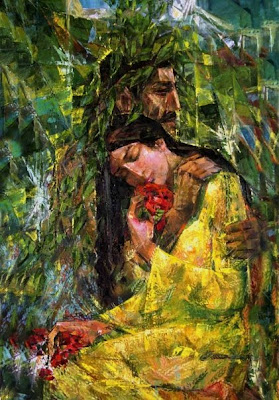
AN OLD STORY
http://web.archive.org/web/20021018062012/http://jerusalemites.org/shammout.html
The Long March East
By Mary Joury
Ismail Shammout, now living in Amman, Jordan, is a pioneer of Palestinian contemporary art, a firmly established and widely recognized artist of power and distinction.
In 1997, Ismail Shammout returned to his home town in Palestine, Lydda, as a “tourist” after an absence of 50 years. The visit was an intensely emotional experience: part happiness at being once again in the town where he was born and spent his childhood and youth, and part wrenching pain at the loss and forced exile of his Palestinian people.
Shammout was filled with joy at finding the mosque and the church of St. George still standing side by side as he remembered them. As a child, he had attended many services in the church with his Christian friends, and celebrated with them the big, joyous “Feast of Lydda” in honor of St. George, who is believed to be buried in the town. The first thing Muslim Ismail and his wife Tamam did, was to enter the church and light two candles. Then they visited the Mosque to pray and give thanks.
Next, Ismail looked for the house where he, his father and grandfather had been born. A Jewish family was now in possession of his family home and Ismail was bitterly disappointed when he was refused entry.
Ismail was just 18 years old in 1948, and clearly recalls the tragic events of that time.
“Contrary to the myth perpetrated by Israel and the US and Western media, the people of Lydda did not leave their homes voluntarily,” says Ismail. In fact, led by their elders they were determined to stay put come what may, and they had made a pact among themselves to that effect.
Lydda was an agricultural town of 25,000 Palestinians in the central “triangle” part of Palestine allocated to the Arabs in the UN partition plan of 1947.
On July 9, 1948, when the Israeli army entered Lydda in force, there was no Arab army there, the townspeople had no arms or weapons, and there was practically no resistance. Yet, in spite of this, the Israeli army acted with deliberate ruthless brutality. All males were rounded up and enclosed in a compound. A curfew was imposed for two days preventing the purchase of food necessities. On the morning of the third day, Ismail and his family watched from their windows as Israeli soldiers gunned down their neighbors’ doors, and screaming, striking and shoving with their guns, drove the people out on the street. Then it was the Shammout family’s turn. Soldiers beat down their door shouting “Out! Out!” As the terrified family hastened to comply, they were body searched and all valuables removed. At the last moment before being evicted Ismail had quickly picked up a small photo album which was lying around and his prized British Palestine passport. An Israeli soldier tried snatching them from him, but Ismail stubbornly refused to let go. These two items were all that the Shammout family-- father, mother, four sons, and three daughters-- came away with from their ancestral home.
The townspeople were first herded into compounds. “There were tens of thousands of us, Ismail recalls. (Actually there were 25.00 people forcibly evacuated from Lydda that day). “There were old men and women, children, babies, pregnant women, sick people.” At noon the Israeli soldiers, gun-prodding, striking, and kicking, with indiscriminate brutality, drove the people out of the compounds and marched them to the east, shouting: “yallah ‘ala Abdallah”, “Go, go to Abdallah” referring to king Abdallah I of Trans-Jordan.
It was Ramadan, the Muslim holy month of fasting, the July sun beat down relentlessly as the townspeople were marched over rough, dusty terrain towards the east, towards ‘Abdallah. Surrounded by terrorizing Israeli soldiers they marched without food, without water; thirst became an agony. They marched in bewilderment and helplessness, parched with thirst, into exile, homelessness, to an unknown destination.
At one point, Ismail managed to slip into an orange grove, found an old rusty tin and filled it with water from an outdoor tap. As he was carrying the water to his family, an Israeli army jeep suddenly blocked his way and an Israeli soldier pointed a gun at his head and commanded “Drop it! Drop it!”
The Shammout family marched all that hot July day, until midnight when they reached the Arab village of Ni’lin, north of Ramallah, where the villagers welcomed them with a couple of loaves of Pita bread and water. “We were the lucky ones,” says Ismail. “We were among the first to arrive. It took the others between two to three days to get to Ni’lin. Many collapsed on the way. Many did not make it.”
For three days the exhausted Shamout family survived on the few loaves of bread the villagers could spare and slept outdoors on the rough ground. Finally, the Jordanian army trucked the homeless refugees to Ramallah, where the Shammout family was billeted to a girls’ school. “Several families had to share one room,” Ismail recalls. For two weeks, Ismail and his family subsisted on bread and water. But then, Ismail’s father who had been a wholesale produce merchant in Lydda, realizing that the Israelis had no intention of allowing the refugees to return to their homes, moved his family to Khan Yunis in the Gaza area, where he had business colleagues, and there, with thousands of other refugees, he and his sons eked out a living.
In Khan Yunis, Ismail and his brothers worked at anything they could get. They sold bread. “We sold anything there was to sell. We learned to make halawah (a sweet confection} at home and sold it to children.” When a school was opened for the refugee children, Ismail and a brother applied as volunteer teachers. They taught school in the morning on voluntary basis, and sold halawah to the children in the afternoon.
Throughout this period Ismail had held tight to his dream. His overriding love was drawing and painting and his dream was to attend art school and become a great painter. He had been drawing and painting since childhood. His talent was soon recognized by the school authorities in Khan Yunis, and he was appointed art instructor in three schools, this time with a tiny salary. It took Ismail a whole year to save 10 Egyptian pounds ($ 30). With this paltry sum in his pocket, and a big chunk of courage, Ismail left for Egypt in search for his dream. He applied and was admitted to the college of Fine Arts in Cairo. After school he worked as a messenger and assistant at a poster advertising agency. He painted in every free minute, and in July 1953, Shammout carried over 60 paintings (oil, watercolor, and drawings) to Gaza for the first ever Palestinian art exhibition.
In Gaza his paintings were received with great interest and pride. Here was a Palestinian artist with Palestinian themes, which aroused intense emotional response among the viewers. The success of the exhibition gave Shammout self-confidence and an appreciation of the power of painting to educate, influence and affect. One of the paintings exhibited was the now well known “whereto”. A distraught father, on the forced march out of Lydda, carries a sleeping child on his left shoulder, while a little girl clutches his right hand and looks up at him in exhaustion and bewilderment, and a third child trails behind: a graphic record of the heart-rending loss and helplessness with which each of the viewers identified.
This exhibition was followed by a second exhibition in Cairo which was inaugurated by president Jamal ‘Abd Al-Nasir of Egypt. Shammout displayed 55 paintings. Two other Palestinian artists were invited by Shammout to participate. Tamam al Akhal (Shammout’s future wife) and Nihad Sibasi. This exhibition met with equal success. It was very well received in Palestinian and Arab art circles, and was given sizeable coverage in the Egyptian press. With the money from the sale of his paintings, Shammout, still following his dream, traveled to Italy to enroll at the Academia De Belle Arti in Rome. Three months after his arrival, he won first prize at an exhibition: the prize was two years study at the academy. Shamout’s dream had been realized!
Palestinian themes and the tragic Palestinian experience continue to be a hallmark of Shammout’s work. He and his wife, Tamam are in the process of recording Palestinian history in oil on canvass. To date, they have produced eight large wall- sized panels (each 2x1.6 meters) of Palestinian life in Lydda and Jaffa (Tamam’s home town) before, during, and after the “Nakbah”, the Palestinian holocaust of loss and expulsion. Shammout’s painting of life in Lydda before 1948 depicts in colors of sun and fruit the tranquil, peaceful joys of a small agricultural community.
These epic pieces of art are witnesses to Palestinian history, to the Palestinian attachment to their land, the wrenching pain of loss and exile, and undying hope for future redemption. They are Ismail and Tamam Shammout’s finest legacy.
Mrs. Joury was born in Nazareth, Palestine, and is now a Jordanian citizen. She began her education at the Beirut College for Women in Beirut, Lebanon, continued at the American University at Cairo, Egypt, and obtained her B.A. degree from Smith College in Northampton, Mass. Mrs. Joury received a M.A. degree from Haverford College at Haverford, Pennsylvania. Following the completion of her studies, she worked as an Information Officer for the Jordanian Tourist Department, as an Instructor and Assistant Dean of Women at the American University of Beirut, and in the Research and Translation Office in Beirut. She was also employed as a Librarian at the Arab States Delegation Office in New York City.
 "....will return" by Ismail Shammout 1930-2006
UN Resolution 194 from the year 1948
- Resolves that the refugees wishing to return to their homes and live at peace with their neighbours should be permitted to do so at the earliest practicable date, and that compensation should be paid for the property of those choosing not to return and for loss of or damage to property which, under principles of international law or in equity, should be made good by the Governments or authorities responsible.
The Arab Peace Initiative
1. Requests Israel to reconsider its policies and declare that a just peace is its strategic option as well.
2. Further calls upon Israel to affirm:
The Golden RuleI- Full Israeli withdrawal from all the territories occupied since 1967, including the Syrian Golan Heights, to the June 4, 1967 lines as well as the remaining occupied Lebanese territories in the south of Lebanon.
II- Achievement of a just solution to the Palestinian refugee problem to be agreed upon in accordance with U.N. General Assembly Resolution 194.
III- The acceptance of the establishment of a sovereign independent Palestinian state on the Palestinian territories occupied since June 4, 1967 in the West Bank and Gaza Strip, with East Jerusalem as its capital.
Thursday, December 31, 2009

My letter to the NYTimes RE: A Mideast Bond, Stitched of Pain and Healing
 A young Palestinian woman paints a mural to commemorate the one-year anniversary of Israel's offensive in Gaza, in Gaza City, Tuesday, Dec. 29, 2009. (AP Photo/Hatem Moussa)
RE: A Mideast Bond, Stitched of Pain and Healing
http://www.nytimes.com/2009/12/31/world/middleeast/31children.html?pagewanted=1&_r=1&ref=middleeast
Dear Editor,
Reading "A Mideast Bond, Stitched of Pain and Healing " on New Year's Eve day, I can not help but hope that 2010 will bring in a new and mutually beneficial trajectory for all the many people who have been harmed in many ways by the rampant religious extremism and violence inspired by the ongoing Middle East conflict. Compassion, empathy, conciliation and a negotiated settlement for Israel and Palestine which firmly respects all basic human rights (and the rule of fair and just laws) certainly would be a good start to the process of making peace for the people's sake.
Sincerely,
Anne Selden Annab


Wednesday, December 30, 2009
PCBS: 10.88 million Palestinians in the world, half in diaspora
http://www.maannews.net/eng/ViewDetails.aspx?ID=250948 Palestinian refugees in Bethlehem protest for the right of return [MaanImges]
Palestinian refugees in Bethlehem protest for the right of return [MaanImges]PCBS: 10.88 million Palestinians in the world, half in diaspora
Published yesterday (updated) 30/12/2009 22:04
The report counted a total of 10.9 million Palestinians worldwide by the end of 2009, with 2.5 million in the West Bank including East Jerusalem, 1.5million in the Gaza Strip and 1.25 million living in Israel. More than half of the world Palestinian population, the report noted, live in the diaspora.
Of those living in the diaspora 3.24 million live in Jordan (29.8%); 1.78 million (16.3%) in the other Arab countries, and 618,000 in orther foreign countries.
Of those living in Palestinian areas, 45.0% are internally displaced refugees. By area, the numbers broke down to 18.8% of the West Bank population and 26.2% of Palestinians in the Gaza Strip.
Population growth
PCBS also analyzed historic data between 1997-2007, measuring family size and fertility rates.
In 2007 the fertility rate was 4.6 births per woman; compared with 6.0 births in 1997. The reported noted that despite a decrease in fartility rates, natural population growth continued. In 2009, growth continued at 2.9%.
Data indicated a fall in average family size from 6.4 in 1997 to 5.8 in 2007, while birthrates also fell from 42.7 births per 1,000 to 32.7 per 1,000 in 2009.
Death rates have also declined in Palestine, from 4.9 deaths per 1,000 in 1997 to 4.3 in 2009.
One Year Later: UNRWA's Response to the Crisis in Gaza (Friends of UNRWA Association)
http://www.z2systems.com/np/clients/unrwa/viewOnlineEmail.jsp?emailId=54568
 Last Sunday marked the one year anniversary of the most destructive military assault in Gaza’s history. Operation Cast Lead resulted in the death of over 1,400 Palestinians and more than 5,000 injuries and widespread destruction of public and private property.
Last Sunday marked the one year anniversary of the most destructive military assault in Gaza’s history. Operation Cast Lead resulted in the death of over 1,400 Palestinians and more than 5,000 injuries and widespread destruction of public and private property.
Today, the bombing has ended, but the devastation endures. The men, women and children of Gaza continue to face the intensely daunting task of rebuilding their lives following the loss of loved ones, homes, personal belongings, dignity, and the routine of daily life that so many of us take for granted.
The current reality for Palestinian refugees is heartbreaking and on-going, but for 60 years, UNRWA has alleviated their pain. UNRWA supplies not just housing, food and healthcare but protection, sustenance, and compassion. Throughout the past year, UNRWA continues to remind the people of Gaza that they are not alone and that in their darkest hours, the international community is there to offer them a helping hand.
As the humanitarian crisis persists, UNRWA continues to be the lifeline for those struggling to survive:
- FOOD - Between January and December 2009, UNRWA distributed emergency food assistance in Gaza, covering an estimated 60 percent of a family’s daily calorific needs. Each beneficiary family, in accordance with its size, receives a single parcel including flour, rice, sugar, sunflower oil, whole milk and luncheon meat. Today, more than 80% of Gazans now rely on this emergency food aid provided by UNRWA’s Emergency Relief program.
- SHELTER - Home repair and rehabilitation activities ensure safe, dignified and minimum standards of housing for Gazan families whose homes were destroyed or damaged during the recent crisis. Over 50,000 Gazans who fled their homes were housed temporarily in 50 temporary shelters opened by UNRWA in schools across the Gaza Strip. Tents were distributed to 895 families; 6,652 families received tarpaulin; 2,366 families received parcels of new clothes and 400 families received kitchen kits. Blankets, mattresses, sleeping mats, family mats and hygiene kits were received by more than 46,000 families.
- EDUCATION - All UNRWA schools reopened on January 24, 2009, within one week of the declaration of ceasefires. Today, the UNRWA school system provides a safe and secure learning environment for more than 200,000 refugee children. A range of approaches have been used to help students and teachers re-engage with the learning process. Recreational activities have been organized, open learning approaches encouraged and evening homework sessions organized for students, to help catch up with teaching time lost during the war.
- HEALTH - UNRWA has expanded the Community Mental Health Program in an effort to mitigate the immediate and longer term effects of the recent conflict on the population in Gaza and contribute to the rehabilitation of affected families and communities. Counselors have identified more than 18,000 students at UNRWA schools as directly involved in the war by being directly exposed to one or more tragedies like loss of home or close family member. While some of these students showed spontaneous recovery most of them underwent counseling and other psychosocial interventions. Training was provided for over 5,000 UNRWA teachers on dealing with students affected by the war and awareness raising activities were held for 25,212 refugees.
Now more than ever, UNRWA needs the support of its friends. For the past sixty years, UNRWA has steadfastly championed the refugees of Palestine by providing health, education, and emergency services. Today, this UN agency needs your assistance to carry on its vital mission.
In 2009, your generous support helped American Friends of UNRWA raise hundreds of thousands of dollars to support the desperately needed work of UNRWA, including special food and medical aid to Gaza. Please consider making an end of the year tax-deductible donation today.
Your donation to American Friends of UNRWA will ensure the continuation of UNRWA’s programs and services for the people of Palestine. This year, more than ever, every gift is critical in helping UNRWA to further its mission.
You can make your tax-deductible contribution online by clicking here, which will lead you to our safe and secure website. Alternatively, you may mail your contribution to the Friends of UNRWA Association, 1666 K Street NW, Suite 440, Washington, DC 20006.

Thank you for your continued support and your personal commitment to UNRWA and the Palestine refugees
IPS NEWS-JORDAN: PALESTINIAN REFUGEES LIVE OUT LIVES IN LIMBO
JORDAN: PALESTINIAN REFUGEES LIVE OUT LIVES IN LIMBO
Mona Alami
AMMAN (IPS) - Music enlivens the yellow taxi as it traverses the Jordanian capital. A small Palestinian flag hangs from the rearview mirror. Jihad, the cab driver, says his father fled here from the Palestinian West Bank in 1948.
"Thank God almighty, life is good for me here and I can offer my family a decent life," he says. "While my father was Palestinian, I feel today Jordanian and I hold the Jordanian nationality. No distinction is made in this country between Jordanian nationals and those of Palestinian descent."
According to the records of the UN Relief and Works Agency for Palestinian Refugees (UNRWA), Jordan is home to 1.9 million displaced Palestinians. "Jordan hosts about 42 percent of the total refugee population," says Mattar Sakr, director of public relations for UNRWA in Jordan.
Sakr adds that most refugees reside in 13 camps, three of them considered unofficial dwellings because they were not assigned by the government.
Not everyone in Jordan is as lucky as Jihad the taxi driver, however. Some 140,000 Palestinian refugees from Gaza do not have the right to permanent citizenship because UNRWA considers Palestinian refugees as people whose normal place of residence was Palestine between June 1946 and May 1948.
Some 4.5 million of the displaced worldwide fit this description while the rest are often left in limbo with regards to obtaining internationally recognised passports.
The disparity between West Bank and Gaza refugees in Jordan began after the creation of the state of Israel in 1948, when Transjordan (which is now the West Bank and parts of Jordan) became part of the Hashemite Kingdom and Gaza became part of Egypt.
Palestinians residing in the kingdom up until 1954 were granted Jordanian citizenship. However, after the Six Day War in 1967, Israel occupied territories in Egypt, Jordan and Syria, forcing a new wave of Palestinians from the Gaza Strip to seek asylum in Jordan.
"Most refugees originated from Gaza, which was at the time under Egyptian authority," explains Sakr. Unlike the Palestinians who came from the West Bank, Gaza residents did not have Jordanian citizenship and many of them moved into temporary residences, mainly in the Jarash camp. They were instead granted temporary passports that were renewable every two years.
Hamed (his name has been changed for the purpose of anonymity) is one of Jordan?s "temporary citizens," whose house is located in the warrens of the al-Wahdat Palestinian refugee camp in Amman. Like many other urban camps, al-Wahdat is a typically impoverished concrete city.
"I came to Amman after the 1967 war with my wife. It was supposed to be a temporary thing, but I have been living here ever since with my four children and 20 grandchildren," recalls Hamed.
Sakr acknowledges that unlike other Jordanians, temporary residents do not have access to the full array of governmental services because of their special status.
"As Gaza Palestinians, we do not benefit from public schooling," explains Hamed, who adds that his grandchildren attend UNRWA schools.
"It is also very difficult for us to send our children to university because they are considered Arab students and, therefore, pay higher fees than Jordanian nationals. We?re very poor as you can see," Hamed says, pointing to the rundown six-room house where his whole family resides.
Asma, his neighbor and a mother of five, explains that holders of temporary passports are not eligible for social security services or government funded healthcare.
"My husband, a holder of the temporary nationality, does not have access to any public programmes and has to seek employment in the private sector. He earns about 150 dinars (210 US dollars) a month, which is the minimum wage. His job is also unstable: sometimes, he?s out of a job for two weeks out of the month."
Sakr explains that although not entitled to government funded medical services, refugees can use UNRWA medical centers, 174 of which are located throughout Jordan.
Other restrictions of temporary passport holders include not having the right to vote or own property, except if they have a local Jordanian partner. "The house where I live, with my children and grandchildren, is owned by the government and we can be evicted at any time," says Hamed.
Hamed and Asma also complain about travel restrictions, saying that it is difficult for them to leave Jordan, especially to visit family members in Palestine. "I was never provided with the proper Israeli authorisation that would allow me to visit my family," says Asma.
Sakr, however, denies that there is any travel ban against holders of temporary nationalities. "Many of them have left Jordan to establish themselves in the Gulf area to work," he replies.
Although travel should not be a problem for Gaza refugees for the most part, Sakr admits that they are confronted with more difficult living conditions than other socioeconomic classes and are more vulnerable to the incumbent economic crisis as well as high unemployment and dropout levels. "All of this has resulted in their marginalisation," he says.
In a speech to army commanders in August 2009, King Abdullah II -ruler of the Hashemite Kingdom - vowed to uphold the right of Palestinian refugees to return to their homes in compliance with UN resolutions, saying, "This attitude will not change and no power can force on Jordan an attitude that runs counter to its interest."
While the pledge is praiseworthy, it may be a long time before the fate of Palestinian refugees is settled considering the apparent indifference of Arab countries and Western powers. Emergency camps have become permanent places of residence, and Gaza refugees remain on the outer fringes of citizenship, stuck in a no man?s land. - Dec 21, 2009 (END)
Hope Springs Eternal By Joharah Baker for MIFTAH

| Date posted: December 30, 2009 By Joharah Baker for MIFTAH | |
| Here comes the New Year. There is something rejuvenating about the start of another year, its true. We all tend to perk up a bit, make promises to ourselves and others and hope – like all the years before – that this one will be great. On the personal level, I still do that. One cannot but hope that this year will be a bit different, better. Stupidly enough, I even hope that things will be better for the Palestinians, even though all the indicators point to the contrary. I mean, there have been some good signs, right? The EU, under Swedish presidency, called for Jerusalem to be the capital of two states (true, in a watered down version of their first statement), the American people elected Barack Obama, who if anything, is the best of the worst, and Justice Richard Goldstone issued a report on the Israeli invasion of Gaza last winter that finally put Israel's crimes into the limelight. Yes, there have been some signs indicating that certain truths about Israel's oppression of the Palestinians are rising to the surface of the years' long smokescreen of fallacies. A British court issued an arrest warrant for Kadima leader Tzipi Livni for her part in the crimes committed in Gaza during Cast Lead and a Swedish journalist accused Israel of illegally harvesting organs from Palestinians it killed during the first Intifada (an allegation admitted by an Israeli forensics expert later). Spanish foreign minister Miguel Mortathinos, whose country is to take over the EU presidency at the beginning of the new year, said one of his goals was to work towards the establishment of a Palestinian state. "My idea, and my dream, and my engagement, is to work for having in 2010, finally, a Palestinian state." It sounds all good, I must admit. If only words could be immediately translated into actions, Livni would be behind bars, settlements would be halted completely and the Palestinians would be ruling themselves in their sovereign state with the Palestinian flag flying over east Jerusalem. Unfortunately, however, intentions go but so far and the fact remains that the situation on the ground is as bleak as ever. I'm wondering what the new year will bring for those who have lost so much? For the people of Gaza, New Years brings the reminder of the horrors of last winter, when Israel pounded the Strip for 22 days on end and killed scores of innocent people. I don't think the Samoudi family, who lost 48 members in the invasion, will have much to celebrate. Neither will the Sukarji and Abu Sharkh families in Nablus, whose sons were executed just last week by invading Israeli troops at point blank range, one of them before his pregnant wife and children. How about the demolished homes and the confiscated land, the prisoners and their families? There are scores of Palestinians, unrecognized soldiers, who pay the price of Israel's occupation every day and for whom empty words from politicians mean absolutely nothing. Realistically, most Palestinian predictions for 2010 are hardly full of hope. With Israeli Prime Minister Benjamin Netanyahu at the top of Israel's government, what can we really expect? Even when one of his own has been hidden away in captivity somewhere in the marshland of Gaza, Netanyahu does not bend. Gilad Shalit is not coming home any time soon from the looks of it, but then again, neither are the 10,000 plus Palestinian prisoners who have languished in Israeli jails for years. But let's not forget our own messy house either. The Palestinians are no closer to reconciliation now than they were six months ago. On the contrary, the longer our leaders remain divided, the more bitter the division becomes. If anything, all Palestinians, from all political spectrums and all walks of life should pool their collective psychic energies into one direction – hope that the Palestinians will reconcile and reunite so they can get back to fighting for their ultimate goal of eliminating the Israeli occupation. This, contrary to our conflict with the Israelis, is actually attainable in the near future, if we set our minds to it. And once that is achieved, we can then move forward with isolating Israel and bringing it to justice. I think perhaps the one thing to be learned is that there is always some glimmer of hope no matter how bleak. As a Palestinian I ache for my country and all that it has endured. I also know that as long as we continue to call ourselves Palestinians and refuse to compromise our love and loyalty to this land, there will always be the possibility of a better year and a better future for us all. Joharah Baker is a Writer for the Media and Information Department at the Palestinian Initiative for the Promotion of Global Dialogue and Democracy (MIFTAH). She can be contacted at mid@miftah.org. | |

Tuesday, December 29, 2009
 Rafah sunset : The minarets of a mosque are silhouetted against the sky at sunset in the southern Gaza Strip town of Rafah on the border with Egypt. (AFP/Said Khatib)
Subscribe to:
Posts (Atom)