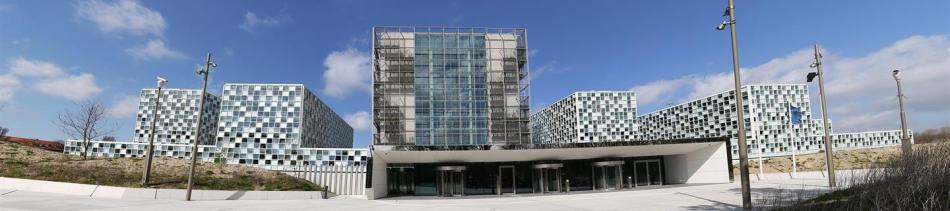
The #ICC thanks the European Parliament @Europarl_ENfor awarding the Court and its officials the 2026 Sakharov Prize for Freedom of Thought, at a time when the Court and its officials face unprecedented challenges.
International Criminal Court (ICC): fighting impunity for war crimes, crimes against humanity, genocide and aggression. Follow/RT≠Endorsement FR: @CourPenaleInt
[AS
ALWAYS PLEASE GO TO THE LINK TO
READ GOOD ARTICLES (or quotes or watch videos) IN FULL: HELP
SHAPE ALGORITHMS (and
conversations) THAT EMPOWER
DECENCY, DIGNITY, JUSTICE &
PEACE... and hopefully
Palestine]
The
International Criminal Court (ICC) investigates and, where warranted,
tries individuals charged with the gravest crimes of concern to the
international community: genocide, war crimes, crimes against humanity
and the crime of aggression. As a court of last resort, it seeks to
complement, not replace, national Courts. Governed by an international
treaty called the Rome Statute...
So according to the WSJ editorial board, the problem isn’t Israel’s actions, it’s the Nobel Prize committee, the UN, the ICC, the ICJ, Amnesty International….
[AS
ALWAYS PLEASE GO TO THE LINK TO
READ GOOD ARTICLES (or quotes or watch videos) IN FULL: HELP
SHAPE ALGORITHMS (and
conversations) THAT EMPOWER
DECENCY, DIGNITY, JUSTICE &
PEACE... and hopefully
Palestine]
[AS
ALWAYS PLEASE GO TO THE LINK TO
READ GOOD ARTICLES (or quotes or watch videos) IN FULL: HELP
SHAPE ALGORITHMS (and
conversations) THAT EMPOWER
DECENCY, DIGNITY, JUSTICE &
PEACE... and hopefully
Palestine]
[AS
ALWAYS PLEASE GO TO THE LINK TO
READ GOOD ARTICLES (or quotes or watch videos) IN FULL: HELP
SHAPE ALGORITHMS (and
conversations) THAT EMPOWER
DECENCY, DIGNITY, JUSTICE &
PEACE... ]
Today, the United States has imposed sanctions on the International
Criminal Court as an institution. This unprecedented step follows a
series of designations against thirteen independent Judges and
prosecutors who serve the cause of justice.
This measure targets an independent judicial institution, created by
treaty and entrusted by 125 States Parties with investigating and
prosecuting genocide, crimes against humanity, war crimes, and the crime
of aggression. It is an attempt to obstruct the course of justice and
to prevent the Court from doing what it was created to do. It is an
assault on the rule of law and on the very foundations of the
international legal order which strikes at the simple principle that no
one stands above the law.
The designation is aimed at disrupting
the Court’s operations and at intimidating those who work for or
cooperate with the Court. The Court, for its part, will not be deterred.
“The Court will continue to fully discharge its mandate, with
independence and impartiality, acting only on the basis of the law and
the evidence, for the sake of the countless victims of grave crimes”
said ICC President Tomoko Akane.
Yet the Court cannot stand
alone. Its fate now rests also in the hands of the States that created
it. The Rome Statute is a collective promise that the most serious
crimes of concern to the international community as a whole must not go
unpunished. That promise is only as strong as the resolve of those who
made it.
There may be challenges. But, together with its States
Parties, the Court has made considerable efforts to ensure the
continuity and resilience of its activities. The Court calls upon States
to continue taking concrete actions, including to ensure that the Court
continues to have the necessary means to continue its work. This is not
just about defending a single institution, but about safeguarding the
international order grounded upon the rule of law.
No one should
be punished for serving the cause of justice. History will judge this
moment. Future generations, and above all the victims of mass
atrocities, will ask how we responded when an institution created to
protect them came under attack. They will ask whether the Court held
firm and whether the international community defended the principles it
proclaimed or allowed them to be abandoned under pressure.
For further information, please contact the ICC Public Affairs Unit. You can also follow the Court’s activities on Twitter/X, Facebook, YouTube, Instagram and Flickr.
[AS
ALWAYS PLEASE GO TO THE LINK TO
READ GOOD ARTICLES (or quotes or watch videos) IN FULL: HELP
SHAPE ALGORITHMS (and
conversations) THAT EMPOWER
DECENCY, DIGNITY, JUSTICE &
PEACE... and hopefully
Palestine]
The Nobel Peace Prize for 2026 goes to a
person who with exceptional courage and integrity has led the way
towards a more comprehensive global legal order. This year’s laureate
has been instrumental in ensuring that war crimes, crimes against
humanity and genocide are prosecuted.
The Norwegian Nobel Committee has
decided to award the Nobel Peace Prize for 2026 to Navanethem “Navi”
Pillay for her efforts to promote peace and international law.
Navi Pillay’s commitment to universal
legal principles and her firm moral compass are constants in a long
career. Born into a family of Indian Tamil origin under apartheid in
Durban, South Africa, Pillay became a lawyer and legal pioneer,
confronting deep structural discrimination, segregation and exclusion. A
common thread runs from her early work defending Nelson Mandela and others who stood up against apartheid to her service as a judge in some of the key international court cases of our time.
This year’s laureate has significantly
enlarged the scope and impact of international law. She has served as a
judge on the High Court in South Africa, the International Criminal
Tribunal for Rwanda and the International Criminal Court. She was the
United Nations High Commissioner for Human Rights and, until recently,
she chaired the UN Independent International Commission of Inquiry on
the Occupied Palestinian Territory. Today Navi Pillay is a judge on the
International Court of Justice in the case where Myanmar stands accused
of genocide.
In historic international court cases,
she has shown that legal measures can help prevent acts of war and
violence. Navi Pillay has also contributed to strengthen the
institutions of international law. Her independence, expertise and
steadfastness have made her one of the most respected international
jurists of our time.
The first Nobel Peace Prize was awarded
125 years ago. Already then, the Norwegian Nobel Committee underscored
the importance of resolving conflicts through international law – a
theme that has remained prominent throughout the history of the peace
prize. The reach of international law expanded after the Second World
War, in particular with the creation of the UN
institutions. The key insight was that lasting peace must be built on
legal principles, not on the will of the strong or a fragile balance of
power. Additional legal mechanisms were introduced in the post-war
decades, and momentum picked up further after the end of the Cold War.
[AS
ALWAYS PLEASE GO TO THE LINK TO
READ GOOD ARTICLES (or quotes or watch videos) IN FULL: HELP
SHAPE ALGORITHMS (and
conversations) THAT EMPOWER
DECENCY, DIGNITY, JUSTICE &
PEACE... and hopefully
Palestine]
The 2026 Nobel Peace Prize has been awarded to South Africa's Navi Pillay for her work on international law and human rights.
| Photo Credit: FABRICE COFFRINI/AFP
The
2026 Nobel Peace Prize was awarded to Navanethem “Navi” Pillay for her
efforts to promote peace and international law. The Prize’s press
statement described Pillay as a person with exceptional courage and
integrity, who has led the way towards a more comprehensive global legal
order.
“The system of
international law is under tremendous pressure, and its institutions are
under attack,” Jørgen Watne Frydnes, chair of the Norwegian Nobel
Committee, said. “We see a shift towards power politics at the expense
of legal frameworks and global respect for law and justice.”
“Navi
Pillay is one of the great defenders of international legal principles
in our time. Her distinguished career reminds us of the need to support,
fortify and expand the global rule of law,” he added.
[AS
ALWAYS PLEASE GO TO THE LINK TO
READ GOOD ARTICLES (or quotes or watch videos) IN FULL: HELP
SHAPE ALGORITHMS (and
conversations) THAT EMPOWER
DECENCY, DIGNITY, JUSTICE &
PEACE... and hopefully
Palestine]
⚖️ Even in the most challenging times, the #ICC remains steadfast in its mission: to bring justice to the victims of the most serious crimes of concern to the international community.
Learn more about the #ICCProcess ➡️https://icc-cpi.pulse.ly/d6u8taynjm
How the Court works
The crimes
The Court's founding treaty, called the Rome Statute, grants the ICC jurisdiction over four main crimes.
First, the crime of genocide is
characterised by the specific intent to destroy in whole or in part a
national, ethnic, racial or religious group by killing its members or by
other means: causing serious bodily or mental harm to members of the
group; deliberately inflicting on the group conditions of life
calculated to bring about its physical destruction in whole or in part;
imposing measures intended to prevent births within the group; or
forcibly transferring children of the group to another group.
Second, the ICC can prosecute crimes against humanity, which are serious
violations committed as part of a large-scale attack against any
civilian population. The 15 forms of crimes against humanity listed in
the Rome Statute include offences such as murder, rape, imprisonment,
enforced disappearances, enslavement – particularly of women and
children, sexual slavery, torture, apartheid and deportation.
Third, war crimes which are grave breaches of the Geneva conventions in
the context of armed conflict and include, for instance, the use of
child soldiers; the killing or torture of persons such as civilians or
prisoners of war; intentionally directing attacks against hospitals,
historic monuments, or buildings dedicated to religion, education, art,
science or charitable purposes.
Finally, the fourth crime falling within the ICC's jurisdiction is the crime of aggression.
It is the use of armed force by a State against the sovereignty,
integrity or independence of another State. The definition of this crime
was adopted through amending the Rome Statute at the first Review
Conference of the Statute in Kampala, Uganda, in 2010.
On
15 December 2017, the Assembly of States Parties adopted by consensus a
resolution on the activation of the jurisdiction of the Court over the
crime of aggression as of 17 July 2018.