Labels

Showing posts with label Nablus. Show all posts

Saturday, July 25, 2026

Rights groups call for help stopping Israeli 'pogrom' against Palestinians in West Bank: B’Tselem and Rabbis for Human Rights among others urge action after four Palestinians are killed by settlers near Nablus

Israeli soldiers outside the Nablus Specialized Hospital on Friday. The army said it had detained two Palestinians in the hospital due to their alleged 'participation in the shooting' in the village of Tel (Jaafar Ashtiyeh/AFP)
Alex MacDonald

Israeli rights groups have called on the international community to intervene in order to prevent a "pogrom" in the occupied West Bank.

Organisations including B’Tselem, Rabbis for Human Rights and the Palestinian-run Adalah said action was needed to prevent further deaths after Israeli settlers killed four Palestinians on Friday.

A group of armed settlers killed the four Palestinians in the village of Tel, near Nablus, while a Palestinian seized a weapon from one of the settlers and opened fire, killing two of them.

Though an Israeli army investigation found that the settlers had entered an off-limits area, the Israeli government ordered the army to demolish the home of the Palestinian accused of killing the two settlers.

The military said it was conducting an operation in Nablus to arrest dozens of Palestinians who "participated in the incident".

Rights groups said that "immediate pressure" must be placed on Israel to stop further attacks, prevent "pogroms" and uphold international law.

"In recent days, violence by settler militias, enabled and supported by the Israeli army, has escalated across the West Bank, including the torching and destruction of Palestinian property, and the forced expulsion of families and communities," they said in a statement.

"These attacks have been met with silence and inaction from much of the international community, allowing the violence to continue and intensify."

Last month, B’Tselem said Israeli forces were killing Palestinian children in the occupied West Bank at the highest rate since 1967, with 54 shot dead in 2025 alone.

The Israeli human rights group said nearly one in four Palestinians killed by Israeli forces in the occupied territory since October 2023 has been a minor, marking the highest proportion since the occupation began.

Despite the high child death toll, no one has been held accountable and there are no known indictments linked to the killings since October 2023.

B’Tselem said the deaths were not "isolated mistakes or violations of military orders".

Instead, it said they were the result of an Israeli policy that permits lax rules of engagement, routinely labels Palestinians as "terrorists", and shields soldiers who use lethal force.

https://www.middleeasteye.net/news/israeli-rights-groups-call-international-community-stop-pogrom-against-palestinians-occupied 

  [AS ALWAYS PLEASE GO TO THE LINK TO READ GOOD ARTICLES (or quotes or watch videos) IN FULL: HELP SHAPE ALGORITHMS (and conversations) THAT EMPOWER DECENCY, DIGNITY, JUSTICE & PEACE... and hopefully Palestine]

Israel approves over $400m to fund 34 settlements in occupied West Bank

Bezalel Smotrich says the settlement expansion is intended to prevent the establishment of a Palestinian state... READ MORE  https://www.middleeasteye.net/news/revolution-israel-approves-funds-34-new-settlements-occupied-west-bank

Friday, May 1, 2026

"The olive tree is not just the modern symbol of the Palestinians and their deep roots in the soil of their land, it was always central to their history and economy..." William Dalrymple

William Dalrymple

The olive tree is not just the modern symbol of the Palestinians and their deep roots in the soil of their land, it was always central to their history and economy. 
 
Along with cotton, which the Palestinians exported to Marseilles, olive oil and olive soap were major export industries in the early Ottoman period, a reflection of the astonishing number amount of olive trees growing between Jerusalem and Nablus. 
 
The trees were divided into rumani- the big, old spreading ones that dated back to Byzantine times and so were most fruiful- and the more youthful islami ones, those planted under Muslim rule, so younger and therefore less productive and taxed at a lower rate. 
 
Camels carried the oil into town, each one carrying a load of four vessels, while soap was carried out.  The Ottomans taxed camels moving in both directions. 
 
There were at least twelve olive oil soap factories operating in Jerusalem under the Mamluks. 
 
Under early Ottoman rule, the Jerusalem economy greatly enlarged, well-organised guilds were set up and yet more soap factories were built. 
 
The Janisseries in the Citadel and the 'ulama of the al-Aqsa were both heavily invested in the trade. 
 
By the 18thC, the making of olive oil soap had partly migrated to Nablus, which along with Acre became the richest city in the region, largely on the proceeds.

 https://x.com/DalrympleWill/status/2049442291086147772/photo/1

 [AS ALWAYS PLEASE GO TO THE LINK TO READ GOOD ARTICLES (or quotes or watch videos) IN FULL: HELP SHAPE ALGORITHMS (and conversations) THAT EMPOWER DECENCY, DIGNITY, JUSTICE & PEACE... and hopefully Palestine]
Sunday, April 21, 2024

CSM In West Bank, wave of settler violence creating feel of a war zone

Nasser Nasser/AP
Mohammad Bader inspects his torched house, in the West Bank village of al-Mughayer, April 13, 2024.

After years of scattered pinpoint attacks, Israeli settler violence this week enveloped the West Bank and struck larger communities.

From Nablus to Jericho to Bethlehem to the edge of Ramallah, deadly attacks by far-right settlers hit towns and villages, killing four Palestinians, wounding dozens, and grinding life in the West Bank to a halt.

The wave of violence, which followed the disappearance and death of a 14-year-old Israeli settler, a shepherd, comes as the Palestinian Authority warns it is struggling to keep the peace.... READ MORE         https://www.csmonitor.com/World/Middle-East/2024/0419/israel-west-bank-settlers-palestinians-violence

[AS ALWAYS PLEASE GO TO THE LINK TO READ GOOD ARTICLES (or quotes or watch videos) IN FULL: HELP SHAPE ALGORITHMS (and conversations) THAT EMPOWER DECENCY, DIGNITY, JUSTICE & PEACE... and hopefully Palestine]

Why We Wrote This

A story focused on

With the world focused on Iran and Gaza, Israeli settlers are stepping up attacks against Palestinian towns and villages in the West Bank. Feeling abandoned, many residents believe they should take matters into their own hands.

Related stories

Thursday, November 16, 2023

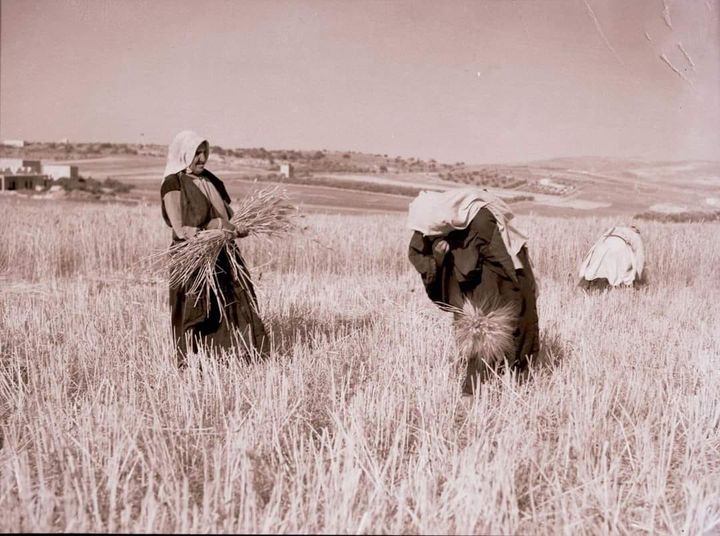
A rare picture of the harvest season from the Bin Amer Meadow located between the Galilee region and the Nablus Mountains in the north circa 1930 PALESTINE

A rare picture of the harvest 🌾 season from the Bin Amer Meadow located between the Galilee region and the Nablus Mountains in the north circa 1930.

Bin Amer's lawn, which was 90 thousand 364 acres, was described as a "bread basket without mud" because of the abundance of wheat and grain cultivation in it

Friday, January 27, 2023

A resident of Jiresh village in Nablus holds up a 117-year-old document demonstrating his title and ownership to his land, as Zionist settlers tried to set up a colonial outpost there over the weekend

A resident of Jiresh village in Nablus holds up a 117-year-old document demonstrating his title and ownership to his land, as Zionist settlers tried to set up a colonial outpost there over the weekend. No amount of historical reinvention by the colonizer will change the truth.
 

Monday, June 23, 2014

UNESCO | Building peace in the minds of men and women... Emergency Nomination- Palestine: Land of Olives and Vines - Cultural Landscape of Southern Jerusalem, Battir, inscribed on World Heritage List and on List of World Heritage in Danger

 [AS ALWAYS PLEASE GO TO THE LINK TO READ GOOD ARTICLES IN FULL: HELP SHAPE ALGORITHMS (and conversations) THAT EMPOWER DECENCY, DIGNITY, JUSTICE & PEACE... and hopefully Palestine]

© Jasmine Salachas/Centre for Cultural Heritage PreservationLand of olives and vines. Cultural Landscape of Southern Jerusalem (Palestine)

Palestine: Land of Olives and Vines - Cultural Landscape of Southern Jerusalem, Battir, inscribed on World Heritage List and on List of World Heritage in Danger


The World Heritage Committee today began the examination of 36 sites nominated for inclusion on the World Heritage List. The first property discussed was Palestine: Land of olives and vines, Cultural Landscape of Southern Jerusalem, Battir, submitted by Palestine as an emergency nomination.


The Committee approved the inscription of the site on the World Heritage List. It also inscribed the property on the List of World Heritage in Danger after finding that the landscape had become vulnerable under the impact of socio-cultural and geo-political transformations that could bring irreversible damage to its authenticity and integrity, citing the start of construction of a separation wall that may isolate farmers from fields they have cultivated for centuries. 

Palestine: Land of Olives and Vines - Cultural Landscape of Southern Jerusalem, Battir, is located a few kilometres south-west of Jerusalem, in the Central Highlands between Nablus and Hebron. The Battir hill landscape comprises a series of farmed valleys, known as widian, with characteristic stone terraces, some of which are irrigated for market garden production, while others are dry and planted with grape vines and olive trees. The development of terrace farming in such a mountainous region is supported by a network of irrigation channels fed by underground sources. A traditional system of distribution is then used to share the water collected through this network between families from the nearby village of Battir. 

The 38th session of the World Heritage Committee began on 15 June and will continue through to 25 June, under the Chair of Sheikha Al Mayassa Bint Hamad Bin Khalifa Al Thani.
                                                           ****
The work of the session can be followed daily via webcast.
UNESCO Media Contact in Doha
Sue Williams, +33(0)6 15 92 93 62 or +974 503 16609
s.williams(at)unesco.org 
  • Follow @UNESCO on Twitter using the hashtag #WorldHeritage for breaking information on important World Heritage Committee decisions during the session. Soon after tweeting, UNESCO will issue press releases about these decisions in Arabic, Chinese, English, French, Russian and Spanish.
  • Daily recaps and discussions will be available on our Facebook page.
  • B-rolls of new World Heritage sites will be available as soon as they are inscribed here.
  • Photo galleries of new World Heritage sites will also be available here.

    Palestine: Land of olives and vines. Cultural Landscape of Southern Jerusalem

    Located a few kilometres south-west of Jerusalem, in the Central Highlands between Nablus and Hebron, the Battir hill landscape comprises a series of farmed valleys, known as widian, with characteristic stone terraces, some of which are irrigated for market garden production, while others are dry and planted with grape vines and olive trees. The development of terrace farming in such a mountainous region is supported by a network of irrigation channels fed by underground sources. A traditional system of distribution is then used to share the water collected through this network between families from the nearby village of Battir. 


    UNESCO | Building peace in the minds of men and women


     [AS ALWAYS PLEASE GO TO THE LINK TO READ GOOD ARTICLES IN FULL: HELP SHAPE ALGORITHMS (and conversations) THAT EMPOWER DECENCY, DIGNITY, JUSTICE & PEACE... and hopefully Palestine]

Wednesday, May 28, 2014

Palestine: Residential buildings with old windows in Nablus. Photos by Ayman Nobani/WAFA.

Residential buildings with old windows in Nablus.  Photos by Ayman Nobani/WAFA.
Nablus - Residential buildings with old windows in Nablus. Photos by Ayman Nobani/WAFA.
http://www.wafaimages.ps/e_album.aspx?id=12411
[AS ALWAYS PLEASE GO TO THE LINK TO READ GOOD ARTICLES IN FULL: HELP SHAPE ALGORITHMS (and conversations) THAT EMPOWER DECENCY, DIGNITY, JUSTICE & PEACE... and hopefully Palestine]

Sunday, February 16, 2014

Israel confiscates Palestinian land near Nablus

[AS ALWAYS PLEASE GO TO THE LINK TO READ GOOD ARTICLES IN FULL: HELP SHAPE ALGORITHMS (and conversations) THAT EMPOWER DECENCY, DIGNITY, JUSTICE & PEACE... and hopefully Palestine]

NABLUS (Ma'an) -- Israeli forces confiscated Palestinian land in the northern West Bank on Sunday, a Palestinian official said.

Ghassan Daghlas, a Palestinian Authority official who monitors settlement activity in the northern West Bank, told Ma'an that the Israeli Civil Administration seized four dunams (one acre) of land in the al-Wafra area between the villages of Burin, Tal, and Madma south of Nablus.

The confiscation will prevent Palestinian residents from reaching 300 dunams (74 acres) of their land, Daghlas said, without elaborating.

The internationally recognized Palestinian territories of which the West Bank and East Jerusalem form a part have been occupied by the Israeli military since 1967.

Wednesday, December 18, 2013

Israel confiscates private Palestinian land near Nablus

[AS ALWAYS PLEASE GO TO THE LINK TO READ GOOD ARTICLES IN FULL: HELP SHAPE ALGORITHMS (and conversations) THAT EMPOWER DECENCY, DIGNITY, JUSTICE & PEACE... and hopefully Palestine]
18/12/2013

NABLUS (Ma'an) -- Israeli authorities confiscated ten dunams and restricted access to 500 dunams of private agricultural Palestinian land in the village of Qusra south of Nablus on Tuesday, an official said.

Ghassan Daghlas, a PA official who monitors settlement activities in the northern West Bank, told Ma'an that the Israeli liaison department in Nablus officially notified its Palestinian counterpart of the confiscation order.

The land, he added, is located between the village and an illegal Israeli settlement outpost called Esh Kodesh.

Daghlas added that the Israelis told their Palestinian counterparts that farmers were not allowed access to an area of more than 500 dunams around the confiscated land.

"This means," he said, "they are confiscating 500 more dunams."

More than 500,000 Israeli settlers live in settlements across the West Bank and East Jerusalem, in contravention of international law.

The internationally recognized Palestinian territories of which the West Bank and East Jerusalem form a part have been occupied by the Israeli military since 1967.

Monday, September 23, 2013

Israeli Settlers Destroy 20 Dunams of Land near Nablus

 [AS ALWAYS PLEASE GO TO THE LINK TO READ GOOD ARTICLES IN FULL: HELP SHAPE ALGORITHMS (and conversations) THAT EMPOWER DECENCY, DIGNITY, JUSTICE & PEACE... and hopefully Palestine]
Published today (updated) 23/09/2013 11:02

NABLUS (Ma'an) -- Settlers destroyed over 20 dunams of Palestinian land near Nablus on Monday, a Palestinian Authority official said.

Ghassan Daghlas, who monitors settlement activity in the northern West Bank, told Ma'an that settlers destroyed land belonging to Yanun village in order to expand Israeli settlements, which surround the Palestinian village on all sides.

Deputy head of nearby Aqraba municipality, Bilal Abdul Hadi, told Ma'an that Israeli bulldozers arrived in an area near the village early Monday and began destroying Palestinian land.

All Israeli settlements in the occupied West Bank are considered illegal under international law.

Sunday, February 3, 2013

Palestine's Burin is squeezed between Israel's Bracha and Yitzhar settlements, and is the target of regular Israeli settler violence.

A Palestinian activist runs from teargas after Israeli forces evacuate a
protest camp in the West Bank village of Burin, south of Nablus,
Feb. 2, 2013. (Reuters/Mohamad Torokman)
 [AS ALWAYS PLEASE GO TO THE LINK TO READ GOOD ARTICLES IN FULL: HELP SHAPE ALGORITHMS (and conversations) THAT EMPOWER DECENCY, DIGNITY, JUSTICE & PEACE... and hopefully Palestine]

NABLUS (Ma'an) -- Israeli forces evacuated a protest tent set up earlier on Saturday by Palestinian activists in Nablus, leading to clashes which injured at least 20 people.

Earlier, around 200 people from across the West Bank set up the "Al-Manatir neighborhood" encampment in an area of Burin village that activists say is slated for confiscation by a neighboring settlement.

Burin is squeezed between the Bracha and Yitzhar settlements, and is the target of regular settler violence.

Israeli forces raided the area and forcibly removed all activists from the site. Soldiers fired multiple tear gas canisters at the protest village, injuring at least 20 Palestinians, witnesses said.

Palestinian Authority official Ghassan Daghlas told Ma'an that during the clashes, settlers attacked Burin with fire-bombs and rocks, damaging homes, cars and setting fire to olive trees.

Earlier on Saturday, 16-year-old Zakariya Al-Najjar was hit in his thigh by a bullet fired by settlers in Burin, a Ma'an reporter said.

Groups of settlers also gathered near Yizhar settlement and threw stones at passing Palestinian cars.
Palestinians Diyaa Bani Audah, Ashraf Abu Rahmah from Bilin, Wahib Qadus, Barakat al-Najjar, Bakir al-Najjar, Ibrahim al-Najjar and Udayy Ahmad from Burin were detained by Israel's military during the clashes.

An Israeli army spokesman confirmed that seven people were arrested.

Fatah official Mahmoud al-Aloul told Ma'an that Palestinians will continue to confront settlers and illegal settlement expansion.

"If they demolish a protest village, we will erect a new one, and we will continue until the Palestinian people retrieve all their rights," he said.

Burin protesters said they had been buoyed by a report issued on Thursday by United Nations human rights investigators who called on Israel to halt settlement expansion and withdraw all settlers, adding that the practice could be subject to prosecution as a possible war crime.

The "Al-Manatir neighborhood" is the fourth such initiative in recent weeks.

The Bab al-Shams village was set up in an area where Israel plans to build the "E1" settlement, severing the West Bank from Jerusalem.

Then, locals established the al-Karamah (Dignity) village in Beit Iksa, northwest of Jerusalem, which is set to be tightly encircled by Israel's separation wall.

Last week, activists set up the Al-Asra, or prisoners, protest village in the village of Anin, northwest of Jenin.

Israeli forces have moved to evacuate the camps and dismantle their structures.

Reuters contributed to this report

Tuesday, October 9, 2012

Israel's Jewish extremists used chain saws to cut down over 120 olive trees on private Palestinian land in Nablus on Tuesday

A farmer pictured on his land in Yatta.(MaanImages/Elenora Vio)

http://www.maannews.net/eng/ViewDetails.aspx?ID=527314
NABLUS (Ma'an) -- Jewish extremists cut down over 120 olive trees on private Palestinian land in Nablus on Tuesday, a Palestinian Authority official said.

The vandals were from the illegal settlement of Eli, Ghassan Daghlas, who monitors settler activity in the northern West Bank, told Ma'an.

Eyewitnesses said the settlers used chainsaws to destroy the trees, which belonged to 12 farmers in the village of Qaryut.

The attack comes on the official start date for the olive harvest in restricted areas of Nablus.

The set date was to enable farmers and local committees to better organize against potential settler attacks, as many restricted access areas lie adjacent to settlements.

Settler attacks often increase around the time of the olive harvest season as settlers target olive trees and agricultural land.

The Nablus district experienced the majority of settler violence in 2011.

On Sunday, a group of settlers attacked Palestinian farmers in the Ramallah town of Beitillu, burning dozens of olive trees, while settlers uprooted around 40 olive trees in the nearby Ramallah village of Ras Karkar.

On Friday, settlers destroyed 100 newly-planted olive saplings and at least 60 vine trees on private Palestinian land in Al-Khader village near Bethlehem.

The UN Office for the Coordination of Humanitarian affairs reported that over 2,500 olive trees were destroyed in September 2011, and 7,500 throughout 2011.

Settler attacks on Palestinian communities and their property are systematic and rarely prosecuted by Israeli authorities.

 [AS ALWAYS PLEASE GO TO THE LINK TO READ GOOD ARTICLES IN FULL: HELP SHAPE ALGORITHMS (and conversations) THAT EMPOWER DECENCY, DIGNITY, JUSTICE & PEACE... and hopefully Palestine]

Sunday, December 18, 2011

Israeli Settlers Attack Palestinian Choir from Bethlehem Returning from a Carol Concert in Nablus

http://www.maannews.net/eng/ViewDetails.aspx?ID=445857
Settlers attack carol singers near Nablus
Bethlehem Bible college choir performs next to Israel's separation wall in
Bethlehem. (MaanImages/Munther Isaac, HO)

18/12/2011
BETHLEHEM (Ma'an) -- Settlers attacked a Palestinian choir bus returning from a carol concert in Nablus on Saturday evening, choristers told Ma'an.

The singers, from Bethlehem Bible college, said five men attacked them on a quiet road outside of the northern West Bank city.

"A rock smashed through the window, and glass shattered everywhere inside," chorister Saleem Anfous told Ma'an, adding that none of the 25 carol singers was injured.

"We kept driving and starting singing to cheer ourselves up and encourage the choir members," he said.

"Tomorrow we will continue our carol tour of the West Bank in Jenin, using the same road, and we are afraid. But we are trying to convince the families that God will protect us."

Hardline settlers have torched mosques near Ramallah, Jerusalem and Salfit since last Wednesday. The latest string of attacks included a rampage on an army base, sparking condemnation in Israel, and Israeli Prime Minister Benjamin Netanhayu to vow stronger enforcement against lawlessness.

But he rejected a recommendation to classify the Jewish extremists as terrorists, and Israeli lawmakers were set to discuss a law to legalize settlement outposts built on land owned by Palestinians on Sunday.

Extremists amongst Israel's 500,000 strong settler population in the West Bank and Jerusalem reference Israel's measures against outposts in their revenge 'price tag' attacks, usually directed at Palestinians in the West Bank, but recently spilling over into Palestinian sites in Israel and army targets.

Israel distinguishes between state-sanctioned settlement building on occupied Palestinian land and the wildcat outposts, but the international community says all settlements in the West Bank and East Jerusalem break international law.

Tuesday, November 15, 2011

NYTimes: From Nablus to Jerusalem by Raja Shehadeh

November 15, 2011, 5:14 am

From Nablus to Jerusalem

NABLUS, West Bank — Last Saturday, I arrived at the Nablus train station, a low, thick-walled stone structure, in time to board the 3:20 pm to Jerusalem. Some 20 passengers were waiting at the entrance, mostly young men and women, with a few people old enough to remember the days of train travel during the British Mandate over Palestine. The excitement was palpable: It was our chance to take a ride to Jerusalem, a city we are barred from visiting, bypassing the Israeli checkpoints along the way. As I entered the station, a porter in a dark blue uniform issued me a ticket on the Green Line. The journey would take 30 minutes, with stops planned at Hawwarah, Zatara, Uyun al Haramiya, Attarah and Kalandia — all existing checkpoints. I made my way to the waiting room. It was barren, except for low tables with brochures entitled “Palestine Connected” showing local train networks and their destinations. Gaza. Jaffa. Haifa. Beersheba.

Soon there was an announcement in Arabic and English: the train would be arriving in three minutes. I could hear it approach, all whistles and honks. The sounds grew louder and louder until they became deafening. Then, they subsided; the train had arrived. The doors of the waiting room opened...READ MORE
[AS ALWAYS PLEASE GO TO THE LINK TO READ GOOD ARTICLES IN FULL: HELP SHAPE ALGORITHMS (and conversations) THAT EMPOWER PALESTINE AND PEACE]

Tuesday, June 28, 2011

We asked the children to each choose a short message to send out to the world from Balata/Nablus/Palestine... Free Palestine - We are all one family

We asked the children of Balata what they wanted to tell the world, and here is what they had to say.Aya & Shada - Free Palestine / We are all one family

Notes from Nablus

Portraits of kids, by kids: presenting the faces and voices of Nabulsi youth to the world

Balata refugee camp, Nablus

Friday, November 12, 2010

Internet Tourism... in Growing Gardens for Palestine

Growing Gardens for Palestine


Al-Diwan - Old Nablus by Afaf Arafat

Afaf Arafat is a Palestinian artist who was attracted to art as a young child, when she would try to draw the jasmine tree which climbed all the way from her father's Diwan to the first floor of the house.... As evident in her pictures the Palestinian countryside figures prominently in her work. So does the old city of Nablus. Other pictures display the splendor of Palestinian heritage whether in costume or architecture. Nablusguide.com

I discovered Afaf Arafat's beautiful artwork while poking around the Internet yesterday- looking for beauty. I have This Week in Palestine bookmarked on my computer, easy to click on and from there I often discover unique and interesting ideas and web sites to explore.

Building a Positive Brand Identity for Palestine in the Media
It is good to see so many different people taking positive media efforts for Palestine seriously. We all have a part to play- each in our own way. Each link we click helps make it more popular- and more likely to be noticed by others.

Different pictures, different tones, different colors- different types of stories and art and adventure appeal to different types of people. There is no one size fits all. There is however a mainstream, a very large middle where more people are more likely to hear and be influenced by what you have to say. It is as simple as that.

The Golden Rule [Do unto others as you would have them do unto you] really is a good rule of thumb for navigating the mainstream if you want more competent and capable people to become interested in Palestine and peace...


"A walk in the wondrous Old City of Jerusalem with all of its fragrances and colourful shops, or a short trip to any Palestinian city can expose a lot of the demographic mix to the discerning eye. I personally see this as strength and an added value to the Palestinian fabric. We are able to offer a diverse and varied culture in such a small country like Palestine." Raed Saadeh


The Dome on the Rock from a 19th century print

An 19th century impression of the land around Hebron

A view of ancient Tyre from a 19th century print

"Imagine cycling from Jenin to Hebron- passing Jerusalem and Bethlehem on the way. Immersed in the breathtaking Biblical landscape, taking the ancient roads of pilgrims and warriors- from the quiet of the Jerusalem Wilderness desert to the majesty of the Dead Sea." BIKE PALESTINE

"Inter-religious and Inter-cultural Explorations of the Holy Land 2011
Participants in this tour will explore the religious diversity and cultural richness of Israel and Palestine. We will investigate holy sites, listen to devotees, observe religious practices, delve into group beliefs and values, and ponder the religious experiences of the peoples of Israel and Palestine. Special attention will be given to the diversity of Jewish life, the vibrancy of Islam, and a selection of the indigenous Christian communities of Israel and Palestine. How have such lusciously flowered religions survived, adapted, and blossomed in the ‘desert’? Siraj Center for Holy Land Studies"

"Reconnect the Human Family - Step by Step Abraham's Path is a cultural itinerary that inspires and engages travelers to journey on the national and local trails of each nation of the region. Some of these national and local trails we have directly helped design and open — others are purely in the domain of national governments. Abraham's Path honors the laws, traveler-related directives, and nomenclature of all government partners."
Or, for the more secular and scientifically inclined arm chair tourist, who is seeking a more global perspective there are fascinating self guided tours through The World At Night (TWAN) where one can star gaze....

Night of an Ancient Library
Stars of Leo, the Lion, and planet Saturn shine above the Library of Celsus in Ephesus, a city of ancient Anatolia. Ephesus hosted one of the seven churches of Asia, addressed in the Book of Revelation of The Bible. It is also the site of a large gladiator graveyard. Pictured here under the moonlight, the Library of Celsus, whose façade has been carefully reconstructed from all original pieces, was built in AD 125 and once held nearly 12,000 scrolls. Today's archaeological site of Ephesus lies 3 kilometers south of the Selçuk district of Izmir Province, Turkey. Tunc Tezel.

The World At Night
(TWAN) is a program to produce and present a collection of stunning photographs and time-lapse videos of the world’s landmarks against the celestial attractions.


Last month my husband and I got all dressed up and went down to a glorious Gala at the Ritiz Carlton in Washington DC. Dr. Ziad Asali of the American Task Force on Palestine emailed me a picture taken there.


ATFP's Dr. Ziad Asali with Annie & Jaffar

The ATFP Gala was very well organized and very well attended. It was VERY impressive!

BUT what has really awed me the most has been the subsequent followup...

ATFP's Fifth Annual Gala 2010: Building Palestine, the Indispensable State for Peace

A beautifully written quick summary is filled with links one can explore in full- watch videos of great speeches or read the riveting transcripts. One can scroll through photos of the Gala, or stroll through the inspiring art work at the silent auction, or read the program and experience the entire program in full from afar- savoring every perfect word. The introductions are as good as the formal speeches. There is also a collection of articles in the media covering the Gala.

Take your time- enjoy the journey. Times are changing- and we citizens of the world, (regardless of supposed race, religion or nationality) are all part of that change.

This past summer, in training for my own empty nest, I was obsessed with a webcam watching an osprey nest on the Chester River (thanks to Chestertown Spy and everyone involved in supporting that project.) The osprey parents were attentive and dedicated. At first the baby birds were pretty darn ugly- but the scenery there was lovely. I'd often watch the sunrise there on the Chester River.... the river where my oldest son rows.


The webcam showed the nest and the river beyond, with a wide enough angle that sometimes you could see one of the osprey swoop down to fish- a small dark silhouette splashing the surface of the water and then winging its way back in a circle- rising up to land, looming large in the nest to feed.

Time passed and as the baby birds grew their elegant parents changed tactics. Early on one parent or the other would position themselves in the nest so as to cast a cooling shadow on the sleeping chicks, to protect them from the full glare of the hot summer sun. Eventually, as the chicks leaned to move the chicks learned to move into protective shade cast by a parent: Each took ownership of their own well-being... and responsibility for themselves.


Relationships change every day- and we adapt. We go from being a dependent child to a teen to an adult. We age- some more gracefully than others. But no matter what our age, or our state of grace, we tend to keep in contact with people we want to hear from, and we avoid people we don't want to hear from- for whatever reason. Our own behavior helps shape the marketplace of ideas.


In growing a garden for Palestine today- on my blog, there are hundreds of potentially worthy projects to point out- and thousands of worthy pictures and photos that I am tempted to post... plus millions of worthy quotes to quote....

Another day perhaps.

The sun sets over Palestinian fishermen in their boat in the Mediterranean sea, near the beach on the outskirts of Gaza City, Wednesday, Nov. 10, 2010. (AP Photo/Adel Hana) Yahoo! news photos


Jasmine

Palestine
Jericho Mosiac- Leaping Gazelle