AN OLD STORYhttp://web.archive.org/web/20021018062012/http://jerusalemites.org/shammout.htmlThe Long March East
By Mary Joury
Ismail Shammout, now living in Amman, Jordan, is a pioneer of Palestinian contemporary art, a firmly established and widely recognized artist of power and distinction.
In 1997, Ismail Shammout returned to his home town in Palestine, Lydda, as a “tourist” after an absence of 50 years. The visit was an intensely emotional experience: part happiness at being once again in the town where he was born and spent his childhood and youth, and part wrenching pain at the loss and forced exile of his Palestinian people.
Shammout was filled with joy at finding the mosque and the church of St. George still standing side by side as he remembered them. As a child, he had attended many services in the church with his Christian friends, and celebrated with them the big, joyous “Feast of Lydda” in honor of St. George, who is believed to be buried in the town. The first thing Muslim Ismail and his wife Tamam did, was to enter the church and light two candles. Then they visited the Mosque to pray and give thanks.
Next, Ismail looked for the house where he, his father and grandfather had been born. A Jewish family was now in possession of his family home and Ismail was bitterly disappointed when he was refused entry.
Ismail was just 18 years old in 1948, and clearly recalls the tragic events of that time.
“Contrary to the myth perpetrated by Israel and the US and Western media, the people of Lydda did not leave their homes voluntarily,” says Ismail. In fact, led by their elders they were determined to stay put come what may, and they had made a pact among themselves to that effect.
Lydda was an agricultural town of 25,000 Palestinians in the central “triangle” part of Palestine allocated to the Arabs in the UN partition plan of 1947.
On July 9, 1948, when the Israeli army entered Lydda in force, there was no Arab army there, the townspeople had no arms or weapons, and there was practically no resistance. Yet, in spite of this, the Israeli army acted with deliberate ruthless brutality. All males were rounded up and enclosed in a compound. A curfew was imposed for two days preventing the purchase of food necessities. On the morning of the third day, Ismail and his family watched from their windows as Israeli soldiers gunned down their neighbors’ doors, and screaming, striking and shoving with their guns, drove the people out on the street. Then it was the Shammout family’s turn. Soldiers beat down their door shouting “Out! Out!” As the terrified family hastened to comply, they were body searched and all valuables removed. At the last moment before being evicted Ismail had quickly picked up a small photo album which was lying around and his prized British Palestine passport. An Israeli soldier tried snatching them from him, but Ismail stubbornly refused to let go. These two items were all that the Shammout family-- father, mother, four sons, and three daughters-- came away with from their ancestral home.
The townspeople were first herded into compounds. “There were tens of thousands of us, Ismail recalls. (Actually there were 25.00 people forcibly evacuated from Lydda that day). “There were old men and women, children, babies, pregnant women, sick people.” At noon the Israeli soldiers, gun-prodding, striking, and kicking, with indiscriminate brutality, drove the people out of the compounds and marched them to the east, shouting: “yallah ‘ala Abdallah”, “Go, go to Abdallah” referring to king Abdallah I of Trans-Jordan.
It was Ramadan, the Muslim holy month of fasting, the July sun beat down relentlessly as the townspeople were marched over rough, dusty terrain towards the east, towards ‘Abdallah. Surrounded by terrorizing Israeli soldiers they marched without food, without water; thirst became an agony. They marched in bewilderment and helplessness, parched with thirst, into exile, homelessness, to an unknown destination.
At one point, Ismail managed to slip into an orange grove, found an old rusty tin and filled it with water from an outdoor tap. As he was carrying the water to his family, an Israeli army jeep suddenly blocked his way and an Israeli soldier pointed a gun at his head and commanded “Drop it! Drop it!”
The Shammout family marched all that hot July day, until midnight when they reached the Arab village of Ni’lin, north of Ramallah, where the villagers welcomed them with a couple of loaves of Pita bread and water. “We were the lucky ones,” says Ismail. “We were among the first to arrive. It took the others between two to three days to get to Ni’lin. Many collapsed on the way. Many did not make it.”
For three days the exhausted Shamout family survived on the few loaves of bread the villagers could spare and slept outdoors on the rough ground. Finally, the Jordanian army trucked the homeless refugees to Ramallah, where the Shammout family was billeted to a girls’ school. “Several families had to share one room,” Ismail recalls. For two weeks, Ismail and his family subsisted on bread and water. But then, Ismail’s father who had been a wholesale produce merchant in Lydda, realizing that the Israelis had no intention of allowing the refugees to return to their homes, moved his family to Khan Yunis in the Gaza area, where he had business colleagues, and there, with thousands of other refugees, he and his sons eked out a living.
In Khan Yunis, Ismail and his brothers worked at anything they could get. They sold bread. “We sold anything there was to sell. We learned to make halawah (a sweet confection} at home and sold it to children.” When a school was opened for the refugee children, Ismail and a brother applied as volunteer teachers. They taught school in the morning on voluntary basis, and sold halawah to the children in the afternoon.
Throughout this period Ismail had held tight to his dream. His overriding love was drawing and painting and his dream was to attend art school and become a great painter. He had been drawing and painting since childhood. His talent was soon recognized by the school authorities in Khan Yunis, and he was appointed art instructor in three schools, this time with a tiny salary. It took Ismail a whole year to save 10 Egyptian pounds ($ 30). With this paltry sum in his pocket, and a big chunk of courage, Ismail left for Egypt in search for his dream. He applied and was admitted to the college of Fine Arts in Cairo. After school he worked as a messenger and assistant at a poster advertising agency. He painted in every free minute, and in July 1953, Shammout carried over 60 paintings (oil, watercolor, and drawings) to Gaza for the first ever Palestinian art exhibition.
In Gaza his paintings were received with great interest and pride. Here was a Palestinian artist with Palestinian themes, which aroused intense emotional response among the viewers. The success of the exhibition gave Shammout self-confidence and an appreciation of the power of painting to educate, influence and affect. One of the paintings exhibited was the now well known “whereto”. A distraught father, on the forced march out of Lydda, carries a sleeping child on his left shoulder, while a little girl clutches his right hand and looks up at him in exhaustion and bewilderment, and a third child trails behind: a graphic record of the heart-rending loss and helplessness with which each of the viewers identified.
This exhibition was followed by a second exhibition in Cairo which was inaugurated by president Jamal ‘Abd Al-Nasir of Egypt. Shammout displayed 55 paintings. Two other Palestinian artists were invited by Shammout to participate. Tamam al Akhal (Shammout’s future wife) and Nihad Sibasi. This exhibition met with equal success. It was very well received in Palestinian and Arab art circles, and was given sizeable coverage in the Egyptian press. With the money from the sale of his paintings, Shammout, still following his dream, traveled to Italy to enroll at the Academia De Belle Arti in Rome. Three months after his arrival, he won first prize at an exhibition: the prize was two years study at the academy. Shamout’s dream had been realized!
Palestinian themes and the tragic Palestinian experience continue to be a hallmark of Shammout’s work. He and his wife, Tamam are in the process of recording Palestinian history in oil on canvass. To date, they have produced eight large wall- sized panels (each 2x1.6 meters) of Palestinian life in Lydda and Jaffa (Tamam’s home town) before, during, and after the “Nakbah”, the Palestinian holocaust of loss and expulsion. Shammout’s painting of life in Lydda before 1948 depicts in colors of sun and fruit the tranquil, peaceful joys of a small agricultural community.
These epic pieces of art are witnesses to Palestinian history, to the Palestinian attachment to their land, the wrenching pain of loss and exile, and undying hope for future redemption. They are Ismail and Tamam Shammout’s finest legacy.
Mrs. Joury was born in Nazareth, Palestine, and is now a Jordanian citizen. She began her education at the Beirut College for Women in Beirut, Lebanon, continued at the American University at Cairo, Egypt, and obtained her B.A. degree from Smith College in Northampton, Mass. Mrs. Joury received a M.A. degree from Haverford College at Haverford, Pennsylvania. Following the completion of her studies, she worked as an Information Officer for the Jordanian Tourist Department, as an Instructor and Assistant Dean of Women at the American University of Beirut, and in the Research and Translation Office in Beirut. She was also employed as a Librarian at the Arab States Delegation Office in New York City.
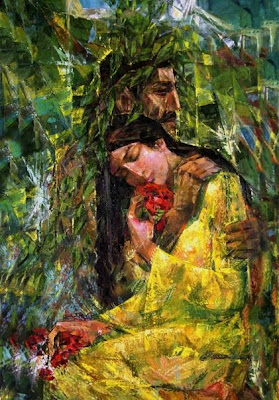
 "....will return" by Ismail Shammout 1930-2006
UN Resolution 194 from the year 1948
Article 11 reads:
- Resolves that the refugees wishing to return to their homes and live at peace with their neighbours should be permitted to do so at the earliest practicable date, and that compensation should be paid for the property of those choosing not to return and for loss of or damage to property which, under principles of international law or in equity, should be made good by the Governments or authorities responsible.
1. Requests Israel to reconsider its policies and declare that a just peace is its strategic option as well.
2. Further calls upon Israel to affirm:
I- Full Israeli withdrawal from all the territories occupied since 1967, including the Syrian Golan Heights, to the June 4, 1967 lines as well as the remaining occupied Lebanese territories in the south of Lebanon.
II- Achievement of a just solution to the Palestinian refugee problem to be agreed upon in accordance with U.N. General Assembly Resolution 194.
III- The acceptance of the establishment of a sovereign independent Palestinian state on the Palestinian territories occupied since June 4, 1967 in the West Bank and Gaza Strip, with East Jerusalem as its capital.
The Golden Rule
 "Whereas recognition of the inherent dignity and of the equal and inalienable rights of all members of the human family is the foundation of freedom, justice and peace..."