if i were mossad
i'd empower
weak men
and bad arguments
to disenfranchise
palestine
i'd elevate
the most incompetent
and celebrate
the insane
if i were mossad
i'd be everywhere
playing all sides away
from peace
poem copyright ©2009 Anne Selden Annab
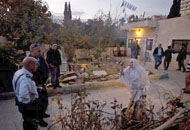
if i were mossad Manger Square lights : Members of a Palestinian Christian family hold candles in front of the Church of the Nativity as they watch the mayor of the biblical West Bank town light the Christmas tree in Manger Square. (AFP/Musa al-Shaer)

Speech by the Commissioner-General of UNRWA, Karen Koning AbuZayd, at the Arab League Special Session marking UNRWA’s 60TH Anniversary 13 December 2009 |  |
Mr. Secretary General, Excellencies, distinguished guests,
I am very grateful to Secretary General Moussa for giving UNRWA this opportunity to stage one of the key events in a year of special events marking the 60TH anniversary of the founding of UNRWA. Similarly I am grateful to Ambassador Khairat of Egypt, the current Chair of UNRWA’s Advisory Commission, and to Ambassador Qattan of Saudi Arabia, the Vice-Chair, for sharing the platform with me. I am also grateful to Ambassador El-Farra of Palestine and Mr. Mahmoud Qabil, UNICEF goodwill Ambassador, for their participation.
A shared history
UNRWA and the Arab League emerged at roughly the same time, six decades ago, from related historical circumstances. Both came into being as part of the fallout from the cataclysm of the Second World War.
Whereas UNRWA was intended to be temporary, the Arab League was created as a permanent organization. Sadly, UNRWA is still needed after 60 years, in the absence of the necessary firm resolve on the part of the international community to create the circumstances in which Palestine refugees could make choices regarding their future, based on the relevant international resolutions, including UNGAR 194.
The two institutions have developed over the years in parallel, always with a strong link. That link has come via the primordial importance of the issue of Palestine, both for Arab states who are members of the Arab League, and for the UN agency, UNRWA, whose mission it has been to give succour and protection to the Palestine refugees who have been among the chief sufferers from the failure to resolve the Palestinian/Israeli conflict.
Tribute to Arab hosts
Some Arab countries and administrations, those hosting large populations of Palestine refugees, have made enormous sacrifices, political as well as economic and social, to share with UNRWA the necessity of providing basic support to the registered refugees who now number 4.7 million in the region. This is often overlooked in assessing who has done most for the refugees. The brochure UNRWA has produced for this occasion draws attention to how much the host countries have done.
...and donors
The booklet also pays tribute to generous Arab donors and institutions that have not stinted in making donations to UNRWA, especially for emergency relief and camp infrastructure. This year has seen the biggest ever single Arab donation, a supremely generous $34 million for Gaza relief from His Highness the Amir of Kuwait. Saudi Arabia has made a timely pledge of $25 million for rebuilding part of Nahr El Bared Camp in Lebanon. Were it not for the Israeli restrictions on access of building materials into Gaza, I am sure we would have seen even larger donations.
Some try to make propaganda out of a supposed contrast between vocal Arab concern for Palestine refugees and oil price windfalls on the one hand, and contributions to UNRWA on the other. UNRWA does what it can to set the record straight in this regard. It is unfair to discount the sacrifices made and those still being made by the host countries, and the generous contributions made by Arab donors.
... but
It is, however, an unfortunate truth that Arab financial contributions have decreased in relative terms. In the early 1980s Arab donations accounted for almost 8% of UNRWA’s budget, whereas the level today is closer to 1% for UNRWA’s core services - the schools for half a million children, the clinics receiving ten million patient visits a year, the social services supporting a quarter of a million of the very poor and the 58 camps housing 1.4 million refugees. Only a few weeks ago, the Arab League Council reiterated its exhortation to member states to restore contributions to their level in the 1980s. UNRWA asks for no more than that.
We deeply appreciate the donations for emergencies and infrastructure and hope they will be sustained. We also urge Arab governments, some of whom have not increased their annual contributions for over a decade, to heed our plea for more support for basic services. This is not money for overheads. This covers salaries for the teachers, doctors, nurses, social workers and sanitation labourers, as well as funds for food for the poorest refugees and the purchase of schoolbooks and medicines.
A warning bell
I do not wish to dwell on UNRWA’s financial difficulties. But I owe it to the refugees to sound a warning bell here, as I have in recent weeks in visits to Europe and the United States. Unless donors significantly increase their donations in the coming year, UNRWA will have major problems with its own staff, nearly all of them Palestinians, whose salaries have been frozen for a year already. And we may be forced to make painful cuts in the services we provide to refugees. The effect, I am afraid, will be dramatic.
The theme of the brochure I mentioned is “So much achieved together. . . . So much still to do”. Indeed, a great deal has been achieved over the past 60 years. Many students educated in UNRWA schools and training centres have gone on to make valuable contributions to the economy and social life in the host countries, and further afield in Arab countries. Even today our schools and training centres are widely admired, notwithstanding the lack of finance to maintain them to their previous standard.
Politics compounds the financial difficulties
Lack of adequate funding, however, is only one of the problems faced by UNRWA and the refugees. The political situation compounds the financial difficulties. Since the outbreak of the Second Intifada and the resulting economic dislocation, UNRWA has been forced to seek ever increasing amounts of money from donors to alleviate the consequent suffering. This year saw two special appeals for Gaza as a result of the ferocious attack on the Strip which left thousands dead, injured and homeless, and the already battered economy torn to shreds.
I must pay tribute to Arab donors for responding in an unprecedentedly generous way to those appeals. Tomorrow, here at the Arab League, I shall be launching the Emergency Appeal for 2010 for the occupied Palestinian territory. I wish I could say that I am hopeful that this, the eleventh such Appeal, will be the last. For that to occur, however, there must be a radical change of policy on the part of the occupying power—and the international community. There must be a relaxation of the closure regime over Gaza, and a serious attempt to deal with the causes rather than the symptoms of deprivation on the West Bank, one of the former being the privileges given to settlers, including in East Jerusalem.
Attention must be paid to the absence of every single one of the rights mentioned in the Universal Declaration of Human Rights, a document whose promulgation we celebrated three days ago. And most important, from an UNRWA point of view, the marginalization of the refugee issue in the peace process must be overcome for there to be a sustainable outcome of negotiations, and for there to be a real opportunity for an independent Palestinian state, living in peace with its neighbours, to emerge.
Conclusion on a personal note
My remarks today represent my next-to-the-last formal speech before I retire at the end of this month. In parting, therefore, I ask you to acknowledge the people whom we are commemorating here this evening, the refugees, who, for 60 years, have counted on UNRWA for protection and assistance. They have withstood six decades of exile, dispossession, conflict, tragedies and sorrow. They have done so with dignity and steadfastness which know no equal.
It has been my privilege to work with and for them—and with all of you.


 Our own academic freedom
December 14, 2009
Greetings----
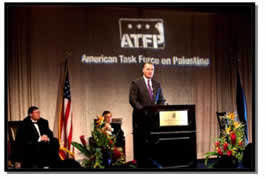
I'm delighted to report to you that our October 15 gala in Washington, DC, demonstrated without any question that the American Task Force on Palestine has become a major player in Middle East policy circles in our nations' capital. The gala was attended by over 650 people, including current and former senior administration officials; numerous ambassadors and several cabinet ministers from various countries; members of Congress and Congressional staff; over 50 journalists from major news organizations around the world; and a veritable who's who of Washington Middle East policy movers and shakers, including for the first time senior leaders of major Jewish pro-Israel organizations. The event confirmed that ATFP is at the forefront of efforts in Washington and around the country to end the occupation and promote peace based on the creation of a Palestinian state alongside Israel. As always, your support is the bedrock of all our activities. I want to update you on the vital work your generosity is underwriting, and encourage you to renew your support for ATFP.
Our Gala keynote speaker, National Security Advisor Gen. James L. Jones, acknowledged that ATFP "has worked to bring the Palestinians closer to fulfilling their legitimate aspirations for statehood, and to unleash the extraordinary potential of the Palestinian people," and assured the audience that, "the President is committed to achieving two states, Israel and Palestine, living side-by-side in peace and security. Make no mistake about that."
We were also delighted to receive a letter of support from Rep. Howard L. Berman (D-CA), the Chairman of the House Committee on Foreign Affairs, who wrote:
 "I want you to know how much I, as Chairman of the House Committee on Foreign Affairs, value my association with you and your colleagues at ATFP. Your integrity, your knowledge of the issues, and your unswervingly principled stand on behalf of peace and fairness -- as well as your deep commitment both to the land of your birth, Palestine, and your adopted homeland, America -- have all had a powerfully positive impact on discourse in Washington about the Middle East. You and your colleagues have also been an important influence on my own thinking about Middle East peacemaking and that of many of my colleagues in the Congress."
We believe that this unprecedented letter to a Palestinian-American organization coming from one of the most powerful members of Congress on the subject of foreign affairs and a stalwart Jewish-American supporter of Israel demonstrates how far the transformation into thinking about peace and the need for a Palestinian state has permeated official circles in Washington, creating heretofore unimaginable alliances and opportunities for cooperation and progress.
In a similar vein, ATFP was represented at the first annual conference of the new pro-peace, pro-Israel lobby group J Street by Senior Fellow Hussein Ibish. Our other Senior Fellow, Ghaith Al-Omari, has been involved with exceptionally influential policy work dealing directly with many of the most prominent individuals and institutions in and around our government. Meanwhile, our engagement with both the domestic and international media has never been stronger, with a continuous flow of commentary and opinion pieces and quotations from our experts in reportage. And our website goes from strength to strength, now ranked in the top 200,000 sites in the United States, with traffic far exceeding almost all other Middle East-related American organizations.
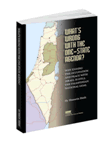 ATFP has also just published two new books to further develop its advocacy and elaborate its analysis. First, "What's Wrong with the One-State Agenda?" by Hussein Ibish is a comprehensive defense of the imperative of ending the occupation and to sustained reputation of the idea that peace with Israel is either impossible or undesirable. It was launched at an impressive event at the prestigious Wilson Center with Aaron David Miller and Rob Malley. Second, ATFP has just released a new collection of its key documents, "Palestine and the Quest for Peace," edited and compiled by Board member Prof. Saliba Sarsar. These publications demonstrate that ATFP is not only a politically effective organization, but and intellectually productive one and a force to be reckoned with in the forum of public opinion.
Meanwhile, ATFP’s sister organization, American Charities for Palestine, continues to pursue its vital humanitarian efforts, thus far investing over $600,000 on health and education projects in the occupied territories. Recently I was proud to join Prime Minister Salam Fayyad, US Consul General Daniel Rubenstein, officials from USAID and other dignitaries proud to announce the inauguration of the $400,000 infrastructure construction project in the West Bank town of Beit Ur al Tahta.
To do all of this crucially important work, we rely, as we always have, on your generous support. Please do whatever you can to support the Task Force, and help us continue to make this kind of serious and effective progress on advocacy in Washington for peace and Palestine.
As always, your support is completely tax-deductible due to ATFP’s designation by the IRS as a 501(c)(3) charitable organization.
Sincerely,

Ziad J. Asali, M.D.
President
Please note that as of December 1, 2009 the American Task Force on Palestine will be located at a new address: 1634 Eye Street N.W., Suite 725, Washington, D.C. 20006.

| Date posted: December 14, 2009 By Joharah Baker for MIFTAH The number is staggering, to say the least. A total of 4,577 Palestinian residents of Jerusalem were stripped of their residency rights in 2008 alone, 35 percent of all east Jerusalemites who lost their residency rights since 1967 and more than any average year since Israel's occupation of the eastern sector of the city almost 42 years ago. For the less versed in the ways of Israel where Palestinian residency rights in Jerusalem are concerned, here is a quick rundown. Upon Israel's occupation in 1967 of east Jerusalem, those Palestinians who had stayed in their homes were included in Israel's census of the city and granted "permanent residency". This, by no means is citizenship, which Israel also duly offered to the war torn residents of the even more war torn neighborhoods of Jerusalem. But taking on Israeli citizenship was, for most Palestinians, tantamount to high treason, given that they would assume the nationality of the country that had usurped most of their homeland and made hundreds of thousands of their fellow Palestinians refugees either outside the borders of Palestine or within it. Not to mention that one condition for citizenship was to swear allegiance to Israel. Since then, the majority of Jerusalem's Palestinians have lived the precarious existence of permanent residents. Falling short of a full-fledged citizen, Israeli authorities impose strict conditions for Jerusalemites to maintain this residency. As the Israeli human rights organization B'Tselem writes, "Israel treats Palestinian residents of East Jerusalem as immigrants who live in their homes at the beneficence of the authorities and not by right." According to Israeli interior ministry sources, the majority of Jerusalem residents whose residency rights have been revoked were living abroad, which according to Israeli "law" is illegal. Palestinians, of course, see it in a different light altogether. Following the 1995 legislation to impose the "center of life" policy on Jerusalem residents, more and more Jerusalemites are finding that their blue ID card was no longer valid. The center of life policy is draconian in nature and is aimed at making it as difficult as possible for Palestinians to remain in their homes in Jerusalem. It demands that Palestinians living in Jerusalem prove that every element of their lives is cemented within the boundaries of the Israeli municipal borders for Jerusalem. That is, rent, land taxes, schools, work, immunization records, phone bills and a slew of other proofs must be ready at any minute to provide as evidence of a person's life in Jerusalem. If something doesn't add up, this could mean bidding farewell to any rights in the city, namely the right to live in your own home. The most obvious Israeli plot behind these measures is to rid Jerusalem of its Palestinian Arab residents, thus claiming the city as Israel's "undivided and eternal capital." Coupled with Israel's other oppressive measures against Palestinians such as house demolitions, land confiscation and discrimination in education and basic services, this seems like a fair assumption, especially if one is to compare east Jerusalem with its western (Israeli) counterpart. Modern roads and buildings characterize west Jerusalem, which gives off any overall air of economic prosperity whereas east Jerusalem's dank and shabby roads and houses mirrors quite a different reflection. Perhaps Israel is upping its policies on Palestinian residency rights with other intentions. If they cannot force all Palestinians out, either by demolishing their homes or revoking their residency cards, perhaps such measures will scare others into applying for Israeli citizenship. This, for Israel, is the best of two evils – if they can't force Palestinians out, they can at least shift the demographic scales in Jerusalem where even the Palestinians there are Israeli citizens, thus undistinguishing them from Israeli Jews in terms of demographic statistics. According to reports from Israel's interior ministry itself, this is a disturbing but growing phenomenon among Palestinian Jerusalemites. According to one Israeli Interior Ministry report, up to 500 Palestinians in Jerusalem applied for Israeli citizenship in 2007. It is not only Israel we can blame however for this trend in particular. Unfortunately, with the constant talk of dividing Jerusalem to make way for a Palestinian capital, there are those Palestinians in Jerusalem who are willing to sacrifice their duty to Palestine for their personal benefit. Taking Israeli citizenship before any final status on the city is reached would guarantee that all the benefits they enjoy such as national and health insurance would continue. Their jobs in Israel would be unthreatened and they would not have to worry about proving residency in their own homes. However, they would then become a permanent part of Israel's establishment and would have helped to hand over Jerusalem to Jewish Israeli sovereignty first handedly. In a roundabout way, this is in Israel's favor, at least in Jerusalem. Inside the 1948 borders, or what is now Israel, it knows the Palestinian residents there are people who managed to remain despite the massacres, fighting and exile that occurred in 1948. Thus, they are a threat in their very existence. However, any Palestinian Jerusalemite who wishes by their own free will to trade in their permanent residency card for Israeli citizenship is hardly a threat to Israel. On the contrary, they have chosen this path rather than the much harder path of proving their Arab and Palestinian roots in the city. Sadly, this is an extremely dangerous and slippery slope. Palestinians have been fighting an uphill battle on Jerusalem for decades, one which most of them are not willing to surrender. The past year's numbers on residency card revocations is evidence that Israel is moving slowly but surely towards the goal of annihilating any strong Palestinian presence in the city. It is a pity when some of us help them along. Joharah Baker is a Writer for the Media and Information Department at the Palestinian Initiative for the Promotion of Global Dialogue and Democracy (MIFTAH). She can be contacted at mid@miftah.org. |
 RE: "Settlements, attacks drive out Palestinians" By Sarah McDonald
Obama’s Nobel feat
Regarding the editorial “Obama in Oslo” (Dec. 12): President Obama was right in stating that his accomplishments were slight compared to other giants of history who deservedly won the Nobel Prize for peace. However, in the midst of political, economic and social injustices, Mr. Obama’s story has symbolized the relentless struggle against enormous odds; the fight against racism, which for so long gripped America. Millions across the globe now believe in their ability to change themselves and their nations for the better. Isn’t this alone a Nobel feat?
Munjed Farid Al Qutob, Amman, Jordan

Documenting Dispossession
UNRWA launches new Refugee Registration Information System to improve refugee services
East Jerusalem, 09 December 2009
UNRWA has launched its new Refugee Registration Information System (RRIS). The digital centralised system has been developed as part of ongoing reform measures and will improve greatly enhance the quality and efficiency of refugee services delivered by the Agency.
UNRWA has digitally scanned and preserved 17.56 million historical documents in its stewardship, offering a comprehensive archive of individual refugee and family experiences. These refugee records, many of which date back to pre-1948 Mandate Palestine, are a crucial historical resource and their preservation within the RRIS is a step in the protection of refugee rights.
The system, the most complex IT system developed by UNRWA in its 60 years of operation, will track 4.7 million refugees registered with UNRWA in its five fields of operations. The RRIS will enhance the data collection and planning capabilities of the Agency. More accurate and detailed data, including addresses and phone numbers, will allow the Agency to identify and respond to beneficiary needs more effectively.
Other concrete benefits of the system include the reduction in the time taken to update registration cards from the current three months to one day. Moreover, registration numbers will be issued to all refugees, allowing to be registered as individuals in addition to their family registration. The individualized capabilities of the system offers potential to better understand changing dynamics within refugee communities.
Another benefit of the RRIS is the inclusion of a special module for all socio-economic and administrative data that will help UNRWA to more effectively target the delivery of its Social Safety Net programme, which supports the poorest of the poor. In future the RRIS will also include data on refugee health, education and microfinance. UNRWA would like to thank its donors the Ruler of Sharjah, the EC and the governments of Saudi Arabia, the UK, Switzerland and Canada for their generous support of this project.
UNRWA provides assistance and protection to Palestine refugees in Jordan, Lebanon, Syria and the occupied Palestinian territory, pending a just and lasting solution to their plight. It does so by offering to a population of some 4.7 million refugees a range of human development and humanitarian services in primary and vocational education, primary health care, social safety-net, community support, infrastructure and camp improvement, microfinance and emergency response, including in situations of armed conflict. UNRWA’s role also encompasses advocacy and actions to address the human rights and protection needs of Palestine refugees.
UNRWA is funded almost entirely by voluntary contributions from UN member states. The Agency’s core budget for the years 2010 and 2011 stands at $1.23 billion. In 2009, emergency appeals for the West Bank and Gaza amounted to $456.7 million, with an additional $370.7 million required for emergency and reconstruction activities in Nahr el Bared, Lebanon.
---END---
For more information please contact:
Matar Saqer
Public Information Officer
UNRWA/Jordan
Tel.: 5809100 Ext. 146
Mobile: 079-5605553