Labels

Showing posts with label 5 Broken Cameras. Show all posts

Wednesday, November 27, 2013

International Emmys Award for Best Documentary to "5 Broken Cameras" in which a Palestinian farmer examines upheaval in a West Bank village.

5 Broken Cameras

5 Broken Cameras

@5brokencameras

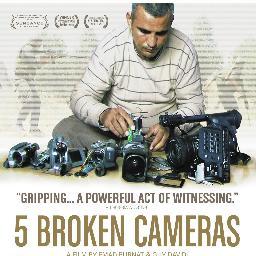
I’m Emad Burnat a Palestinian farmer and Oscar nominated doc filmmaker. My film 5 Broken Cameras took over 7 years to make. It is a story of my life.
Palestine │ World Peace · emadburnat.com

26 Nov
it’s great day & moment for Palestine! I made it, the first Palestinian to win an Emmy Award!


CNN's presents the International Emmys Award for Best Documentary to "5 Broken Cameras"

***

http://emadburnat.com/

Join Hands

Show your support against the  ongoing human-rights violations in Bil'in and Palestine using our resources. Help us inform people about the film.
Contact >

Saturday, August 24, 2013

My letter to the Baltimore Sun RE "PBS airs anti-Israel films"

Nominated for an Oscar®, 5 Broken Cameras is a deeply personal first-hand account of life and nonviolent resistance in Bil’in, a West Bank village where Israel is building a security fence. Palestinian Emad Burnat, who bought his first camera in 2005 to record the birth of his youngest son, shot the film and Israeli filmmaker Guy Davidi co-directed. The filmmakers follow one family’s evolution over five years, witnessing a child’s growth from a newborn baby into a young boy who observes the world unfolding around him. The film is a Palestinian-Israeli-French co-production. PBS Premiere: August 26, 2013
Check local listings
 
RE "PBS airs anti-Israel films"
http://www.baltimoresun.com/news/opinion/readersrespond/bs-ed-pbs-israel-letter-20130821,0,4354129.story

Dear Editor,

For generations now, PBS has been providing Americans with a diverse lineup of fascinating and informative and highly relevant shows... Kudos to PBS POV for airing two revealing films that shed at least a little light on the very real plight of the Palestinians. 

If the acclaimed Israeli filmmaker Ra'anan Alexandrowicz's flim "The Law in These Parts" and "5 Broken Cameras" filmed by Palestinian Emad Burnat and co-directed by Israeli filmmaker Guy Davidi, are anti-Israel then so be it.

An individual watching PBS is always free to change the channel, or turn off the TV- however Palestinian men, women and children are not so free or easily able to escape from Israel's entrenched institutionalized bigotry, occupation and anti-Palestine campaigns.

Sincerely,
Anne Selden Annab


NOTES
**********
The Law in These Parts

Synopsis

In The Law in These Parts, acclaimed Israeli filmmaker Ra'anan Alexandrowicz has pulled off a tour-de-force examination of the system of military administration used by Israel since the Six Day War of 1967 — featuring the system's leading creators. In a series of thoughtful and candid interviews, Israeli judges, prosecutors and legal advisers, who helped devise the occupation's legal framework, paint a complex picture of the Middle East conflict and the balance among political interests, security and human rights that has come with it. Winner, World Cinema Jury Prize: Documentary, 2012 Sundance Film Festival.

5 Broken Cameras

Synopsis

Nominated for an Oscar®, 5 Broken Cameras is a deeply personal first-hand account of life and nonviolent resistance in Bil’in, a West Bank village where Israel is building a security fence. Palestinian Emad Burnat, who bought his first camera in 2005 to record the birth of his youngest son, shot the film and Israeli filmmaker Guy Davidi co-directed. The filmmakers follow one family’s evolution over five years, witnessing a child’s growth from a newborn baby into a young boy who observes the world unfolding around him. The film is a Palestinian-Israeli-French co-production.


******

The Golden Rule... Do unto others as you would have them do unto you


The Office of International Religious Freedom
( http://www.state.gov/j/drl/irf/)   Given the U.S. commitment to religious freedom, and to the international covenants that guarantee it as the inalienable right of every human being, the United States seeks to:

Promote freedom of religion and conscience throughout the world as a fundamental human right and as a source of stability for all countries


"Where, after all, do universal human rights begin? In small places, close to home - so close and so small that they cannot be seen on any maps of the world. Yet they are the world of the individual person; the neighborhood he lives in; the school or college he attends; the factory, farm, or office where he works. Such are the places where every man, woman, and child seeks equal justice, equal opportunity, equal dignity without discrimination. Unless these rights have meaning there, they have little meaning anywhere. Without concerted citizen action to uphold them close to home, we shall look in vain for progress in the larger world." Eleanor Roosevelt
Live by the Golden Rule
Words to Honor: The United Nations Universal Declaration of Human Rights

Article 1.
    All human beings are born free and equal in dignity and rights.They are endowed with reason and conscience and should act towards one another in a spirit of brotherhood.

".... it being clearly understood that nothing
          shall be done which may prejudice the civil and religious
          rights of existing non-Jewish communities in Palestine....
"In 1949, the international community accepted Israel's UN membership upon two conditions: That they respect resolutions 181 (two states) and 194 (refugee rights). Neither has been honored. In fact, 65 years later, Israel has not even acknowledged what it did in 1948." Saeb Erekat


11 December 1948 UN Resolution 194:"Refugees wishing to return to their homes and live at peace with their neighbours should be permitted to do so at the earliest practicable date, and that compensation should be paid for the property of those choosing not to return and for loss of or damage to property which, under principles of international law or in equity, should be made good by the Governments or authorities responsible"

Monday, February 25, 2013

In the West Bank village whose struggle to regain land taken by Israel was portrayed in an Oscar-nominated documentary, activists huddled around a campfire before dawn Monday to watch the ceremony.

Palestinians worm themselves as they watch the Oscar ceremony in the West Bank village of Bilin near Ramallah, Monday, Feb. 25, 2013. Bilin's struggle to regain land taken by Israel was portrayed in an Oscar-nominated documentary "5 Broken Cameras". The village has been the scene of weekly protests against the barrier, which were documented in the film. Palestinians charge that the barrier, which cuts into the West Bank, is a land grab. Israel says it's needed to keep Palestinian attackers out. (AP Photo/Majdi Mohammed)
[AS ALWAYS PLEASE GO TO THE LINK TO READ GOOD ARTICLES IN FULL: HELP SHAPE ALGORITHMS (and conversations) THAT EMPOWER DECENCY, DIGNITY, JUSTICE & PEACE... and hopefully Palestine]

http://hosted.ap.org/dynamic/stories/M/ML_PALESTINIANS_OSCAR?SITE=AP&SECTION=HOME&TEMPLATE=DEFAULT&CTIME=2013-02-25-07-55-10
West Bank villagers view Oscars at night, outdoors

BILIN, West Bank (AP) -- This wasn't your typical Oscar viewing party.

In the West Bank village whose struggle to regain land taken by Israel was portrayed in an Oscar-nominated documentary, activists huddled around a campfire before dawn Monday to watch the ceremony.

For added symbolism, they pinned the screen to a tent just meters (yards) away from Israel's West Bank separation barrier, which cut off the village of Bilin from much of its land....READ MORE

Intifada VS Oscar... a poem by Anne Selden Annab

The director of Palestinian documentary movie 5 BROKEN CAMERAS Emad Burnat and his family at the Oscars 2013.   His wife wearing a traditional carefully embroidered Palestinian dress


                Intifada VS Oscar

 5 Broken Cameras
and the beauty of his wife
in her embroidered dress
and the charm of his child
will win American sympathy

But Arab headlines are all about stoking rage
prisoners tortured... people harassed...
land usurped, lives destroyed, extremists goaded
as the Occupation grinds on and on and on and on...

Negotiations for peace- and justice- are in the hands of headlines
and tweets pushing people into storms of raw emotion
aching for Palestine- or Israel... all depends
on which you want to believe,
who you want to stand with
how you want to be seen
as Palestine disappears
into Israeli news.


Sunday, February 24, 2013

My letter to the CSM RE "Israeli Oscar contenders force citizens to confront uncomfortable questions"

5 BROKEN CAMERAS is a deeply personal, first-hand account of life and non-violent resistance in Bil’in, a West Bank village surrounded by Israeli settlements. Shot by Palestinian farmer Emad Burnat, who bought his first camera in 2005 to record the birth of his youngest son, Gibreel, the film was co-directed by Burnat and Guy Davidi, an Israeli filmmaker. Structured in chapters around the destruction of each one of Burnat’s cameras, the filmmakers’ collaboration follows one family’s evolution over five years of village upheaval. As the years pass in front of the camera, we witness Gibreel grow from a newborn baby into a young boy who observes the world unfolding around him with the astute powers of perception that only children possess.  Burnat watches from behind the lens as olive trees are bulldozed, protests intensify and lives are lost in this cinematic diary and unparalleled record of life in the West Bank. 5 BROKEN CAMERAS is a Palestinian-Israeli-French co-production.  A Kino Lorber Release.
RE: Israeli Oscar contenders force citizens to confront uncomfortable questions
http://www.csmonitor.com/World/Middle-East/2013/0223/Israeli-Oscar-contenders-force-citizens-to-confront-uncomfortable-questions?nav=87-frontpage-entryNineItem

Dear Editor,

A Palestinian puts his life on the line to film his family's perspective in a Palestinian village- and you call that an Israeli film because some of the funds for that movie might have come from "indirect government funding through subsidies to the Israeli film industry".  Using that yardstick 5 Broken Cameras really should be categorized as an American film as taxpayers as well as charities here generously fund the Israeli state- as well as aid for Palestine.

If peace negotiations fail and the two state paradigm is scrapped referring to 5 Broken Cameras as Israeli will be the only option... but we are not there yet. 

A fully secular two state solution to actually end the occupation AND the Israel-Palestine conflict really is the best way forward. It is also the only way to curb the rampant religious extremism, bigotry, chaos and cruelty that is being created by the Israel-Palestine conflict. Religion should be a personal private matter, not a state funded mandate.

Sincerely,
Anne Selden Annab

NOTES
The European Union Renews its Support to Improve Mental Health Services in Gaza

Jordanian Diplomat Marwan Muasher (his country’s first ambassador to Israel, where he made many friends) points out the importance of The Arab Peace Initiative... & the fact that Obama Should Try to Help Solve Conflict

Poll: Large Majority of Palestinians Want Immediate Elections

American Task Force on Palestine Celebrates 10th Anniversary, Announces Oct. 23 Gala

Statement of the General Delegation of the PLO on Qisra Village Attacks & Statement on Commemoration of Dr. Martin Luther King, Jr.

Palestinian negotiator Saeb Erekat to meet with US Secretary of State John Kerry on Thursday

Oscars-bound Palestinian film-maker describes 'unpleasant' LAX detention: Emad Burnat, who made 5 Broken Cameras, said US officials doubted his credentials and threatened to send him home "Although this was an unpleasant experience, this is a daily occurrence for Palestinians, every single day, throughout the West Bank. There are more than 500 Israeli checkpoints, roadblocks, and other barriers to movement across our land..."


Palestinian children and teachers at Qurtuba school in Hebron say getting to class past Israeli soldiers and settlers is like navigating a minefield every day.


In photos: Palestinian children growing up under the shadow of expulsion & the threat of more Israeli firing zones

Israeli Soldiers Order Bethlehem Villagers To Leave Their Lands


"The Israeli occupation has lasted too long. Hollywood gets it; Washington should too." Palestine's Maen Rashid Areikat... The U.S. must push to resolve the Israeli-Palestinian conflict, not just manage it.

Outcry over Israeli soldier's photo of boy in crosshairs: "Every Palestinian mother is concerned for her child ..." How long can this charade continue to function politically?

Israeli settlers pump sewage into ancient Palestinian village

Economist: An Arab village is asked to bow to the wishes of Israel's Jewish settlers

RAJA SHEHADEH: More Than a Land Grab ...Settlers increasingly impinging on Palestinian lives: Jewish settlers aren't just taking empty space, they're destroying Palestinian property and threatening their lives.

The American Task Force on Palestine today warmly welcomed reports that following a year of holds and delays, Congress appears to be preparing to release all outstanding US aid, totaling more than $500 million, to the Palestinian Authority.

"I have no memory of a time without struggle" Emad Burnat is a Palestinian farmer and director of the Oscar-nominated documentary "5 Broken Cameras"...  "
As the world listens, Gibreel, I want to say to you: I am from Palestine. I have lived my whole life under military occupation, and I have no memory of a time without struggle. But you, son, you will know better times. Someday, you will make new, happy memories.... And that will be the true award."


*******
".... it being clearly understood that nothing
          shall be done which may prejudice the civil and religious
          rights of existing non-Jewish communities in Palestine..."
"Legislature should "make no law respecting an establishment of religion, or prohibiting the free exercise thereof..." Thomas Jefferson

The Office of International Religious Freedom ( http://www.state.gov/j/drl/irf/)   Given the U.S. commitment to religious freedom, and to the international covenants that guarantee it as the inalienable right of every human being, the United States seeks to:
Promote freedom of religion and conscience throughout the world as a fundamental human right and as a source of stability for all countries
Palestinian Refugees(1948-NOW) refused their right to return... and their right to live in peace free from religious bigotry and injustice.

The Golden Rule... Do unto others as you would have them do unto you

"Where, after all, do universal human rights begin? In small places, close to home - so close and so small that they cannot be seen on any maps of the world. Yet they are the world of the individual person; the neighborhood he lives in; the school or college he attends; the factory, farm, or office where he works. Such are the places where every man, woman, and child seeks equal justice, equal opportunity, equal dignity without discrimination. Unless these rights have meaning there, they have little meaning anywhere. Without concerted citizen action to uphold them close to home, we shall look in vain for progress in the larger world." Eleanor Roosevelt


Palestinian refugees must be given the option to exercise their right of return (as well as receive compensation for their losses arising from their dispossession and displacement) though refugees may prefer other options such as: (i) resettlement in third countries, (ii) resettlement in a newly independent Palestine (even though they originate from that part of Palestine which became Israel) or (iii) normalization of their legal status in the host country where they currently reside.  What is important is that individual refugees decide for themselves which option they prefer – a decision must not be imposed upon them.

UN Resolution 194 from 1948  : The refugees wishing to return to their homes and live at peace with their neighbours should be permitted to do so at the earliest practicable date, and that compensation should be paid for the property of those choosing not to return and for loss of or damage to property which, under principles of international law or in equity, should be made good by the Governments or authorities responsible.

Wednesday, February 20, 2013

Oscars-bound Palestinian film-maker describes 'unpleasant' LAX detention: Emad Burnat, who made 5 Broken Cameras, said US officials doubted his credentials and threatened to send him home

 "Although this was an unpleasant experience, this is a daily occurrence for Palestinians, every single day, throughout the West Bank. There are more than 500 Israeli checkpoints, roadblocks, and other barriers to movement across our land..."
Emad Burnat, right, with his Israeli co-director Guy Davidi. Five Broken Cameras is nominated in the documentary category. Photograph: Damian Dovarganes/AP

http://www.guardian.co.uk/film/2013/feb/20/oscars-palestinian-filmmaker-lax-detained

An Academy-nominated Palestinian film-maker has spoken of the "unpleasant experience" of being detained by US immigration officials when he arrived for this weekend's Oscars ceremony.

Emad Burnat said that he was held for about an hour at Los Angeles airport on Tuesday, along with his wife and youngest son Gibreel, who plays a central role in Oscar-nominated documentary 5 Broken Cameras.

Burnat said that he thought that US immigration officials – who apparently doubted his credentials – would send him back to Palestine. He compared the incident to daily life for Palestinians under the Israeli occupation.

"Immigration officials asked for proof that I was nominated for an Academy Award for 5 Broken Cameras, and they told me that if I couldn't prove the reason for my visit, my wife Soraya, my son Gibreel and I would be sent back to Turkey on the same day," Burnat said in a statement.

"After 40 minutes of questions and answers, Gibreel asked me why we were still waiting in that small room. I simply told him the truth: 'Maybe we'll have to go back.' I could see his heart sink."

Five Broken Cameras chronicles the events surrounding Israel's creation of a separation wall in Burnat's West Bank village of Bil'in. Burnat, a farmer, initially bought the camera to capture Gibreel's development before using footage for the documentary.

Burnat said his experience was "a very minor example of what my people face every day."...READ MORE

Thursday, February 14, 2013

"I have no memory of a time without struggle" Emad Burnat is a Palestinian farmer and director of the Oscar-nominated documentary "5 Broken Cameras"...

 "As the world listens, Gibreel, I want to say to you: I am from Palestine. I have lived my whole life under military occupation, and I have no memory of a time without struggle. But you, son, you will know better times. Someday, you will make new, happy memories.... And that will be the true award."
Co-director Emad Burnat with his five broken cameras

 http://edition.cnn.com/2013/02/11/opinion/emad-burnat-documentary/

By Emad Burnat, Special to CNN
February 12, 2013 -- Updated 0255 GMT (1055 HKT)
 
Editor's note: Emad Burnat is a Palestinian farmer and director of the Oscar-nominated documentary "5 Broken Cameras", which he co-directed with Israeli Guy Davidi. In this deeply personal piece, he reflects on his family's experiences living in the West Bank and as part of the Palestinian non-violent resistance movement.

(CNN) -- I come from Palestine. I have lived my entire life under military occupation, and I have no memory of a time without struggle.

I have seen my neighbors beaten, blindfolded, and kidnapped. I have seen children snatched from their mothers in the dead of night. I have seen my brother shot and friend murdered.

I can't tell you how this holy land felt before the armored jeeps' rumble. I can't trace a path from here -- from where the Wall surrounds me -- to the sea.

But for as long as I can remember, I could not forget. Forget the checkpoints, the harassment, the detentions. Forget that I am not free.

Like all prisoners, my memories are what sustain me. But what I need now are new memories. Happy memories.

That's why I started filming.

I wanted to make memories of my son, Gibreel. I wanted to capture his smile, to chronicle his life in close-up. I wanted to crop out the occupation, the violence, the hopelessness...READ MORE

Tuesday, February 5, 2013

My letter to CSM RE Need for textbook examples of peace in Israeli-Palestinian conflict

Palestine's 5 Broken Cameras is a deeply personal, first-hand account of non-violent resistance in Bil’in, a West Bank village threatened by encroaching Israeli settlements. Shot almost entirely by Palestinian farmer Emad Burnat, who bought his first camera in 2005 to record the birth of his youngest son, the film was assembled by Burnat and Israeli co-director Guy Davidi... Burnat watches from behind the lens as olive trees are bulldozed, protests intensify, and lives are lost.

RE: Need for textbook examples of peace in Israeli-Palestinian conflict
http://www.csmonitor.com/Commentary/the-monitors-view/2013/0204/Need-for-textbook-examples-of-peace-in-Israeli-Palestinian-conflict?nav=87-frontpage-entryCommentary

Dear Editor,

Good headline on your editorial "Need for textbook examples of peace in Israeli-Palestinian conflict "... really sums up the situation quite well. 

School books are indeed a excellent start, but an even more powerful persuasion would be an end to Israel's ongoing violations of international law and the Palestinians basic human rights:  Israel's anti-Palestine policies, Apartheid walls, Jewish-only settlement projects, checkpoints (...etc...) in the illegally occupied territories are totally sabotaging Palestine's efforts to be a sovereign state. 

Making a bad situation worse religious tyrants and extremists on both sides are teaching kids to hate.  A fully secular two state solution would go a long way towards curbing the injustice and bigotry and crimes created by the Israel-Palestine conflict. 

Sincerely,
Anne Selden Annab

NOTES
*******
".... it being clearly understood that nothing
          shall be done which may prejudice the civil and religious
          rights of existing non-Jewish communities in Palestine..."

The Office of International Religious Freedom ( http://www.state.gov/j/drl/irf/)   Given the U.S. commitment to religious freedom, and to the international covenants that guarantee it as the inalienable right of every human being, the United States seeks to:
Promote freedom of religion and conscience throughout the world as a fundamental human right and as a source of stability for all countries
Palestinian Refugees(1948-NOW) refused their right to return... and their right to live in peace free from religious bigotry and injustice.

The Golden Rule... Do unto others as you would have them do unto you

"Where, after all, do universal human rights begin? In small places, close to home - so close and so small that they cannot be seen on any maps of the world. Yet they are the world of the individual person; the neighborhood he lives in; the school or college he attends; the factory, farm, or office where he works. Such are the places where every man, woman, and child seeks equal justice, equal opportunity, equal dignity without discrimination. Unless these rights have meaning there, they have little meaning anywhere. Without concerted citizen action to uphold them close to home, we shall look in vain for progress in the larger world." Eleanor Roosevelt


Palestinian refugees must be given the option to exercise their right of return (as well as receive compensation for their losses arising from their dispossession and displacement) though refugees may prefer other options such as: (i) resettlement in third countries, (ii) resettlement in a newly independent Palestine (even though they originate from that part of Palestine which became Israel) or (iii) normalization of their legal status in the host country where they currently reside.  What is important is that individual refugees decide for themselves which option they prefer – a decision must not be imposed upon them.

UN Resolution 194 from 1948  : The refugees wishing to return to their homes and live at peace with their neighbours should be permitted to do so at the earliest practicable date, and that compensation should be paid for the property of those choosing not to return and for loss of or damage to property which, under principles of international law or in equity, should be made good by the Governments or authorities responsible.

Monday, February 4, 2013

LATimes: Palestinian farmer, activist, filmmaker — and Oscar nominee

Emad Burnat talks about how he progressed from filming his newborn to teaming with an Israeli to create '5 Broken Cameras,' a documentary about his village's fight against Israeli occupation.

West Bank farmer turned filmmaker Emad Burnat, 41, near the village of Bilin in the West Bank. His movie "5 Broken Cameras" is nominated for an Oscar in the documentaries category. (Edmund Sanders / Los Angeles Times / February 2, 2013)
http://www.latimes.com/news/nationworld/world/middleeast/la-fg-palestinians-filmmaker-qa-20130203,0,6108191.story


February 2, 2013

BILIN, West Bank — Like many Palestinians, West Bank farmer Emad Burnat punctuates his life story with events from the Israeli occupation of his village.

His first son was born amid the optimism that followed the 1993 Oslo peace accords, and another came just as the 2000 Palestinian uprising erupted.

His youngest, Gibreel, was born the same week that Israel began constructing a separation barrier through his hometown of Bilin. That's when Burnat got his first camera, initially to capture his newborn, but later to document his village's fight against the Israeli military and nearby settlers.

It was the first of five cameras he would use, all destroyed during filming by bullets, tear-gas canisters or angry settlers....READ MORE

 [AS ALWAYS PLEASE GO TO THE LINK TO READ GOOD ARTICLES IN FULL: HELP SHAPE ALGORITHMS (and conversations) THAT EMPOWER DECENCY, DIGNITY, JUSTICE & PEACE... and hopefully Palestine]

Thursday, January 31, 2013

Palestinians Hope to Tell Their Story Through the Oscars

[AS ALWAYS PLEASE GO TO THE LINK TO READ GOOD ARTICLES IN FULL: HELP SHAPE ALGORITHMS (and conversations) THAT EMPOWER DECENCY, DIGNITY, JUSTICE & PEACE... and hopefully Palestine]
Watch 5 Broken Cameras
http://www.themedialine.org/news/news_detail.asp?NewsID=37028

Written by Diana Atallah
Published Tuesday, January 29, 2013
 
RAMALLAH – Palestinians hope an Oscar-nominated documentary depicting a non-violent struggle against Israel will succeed in telling their story, even though some recent viewers who saw the film in Ramallah expressed reservations about Israeli involvement in the movie.

5 Broken Cameras is one of five candidates for the Oscar in the Best Documentary Feature category this year. Released in 2011 by Palestinian director Emad Burnat and Israeli director Guy Davidi, it has been screened in 50 countries and translated into several languages.

Mohammed Al-Khatib, of the Popular Struggle Committee, who organized the screening in Ramallah, said the film was a "national" one. It received a mixed reception at its first showing here: the audience clapping, cheering, laughing and crying during the 95-minute film, but also leveling some criticism for Israeli participation in its production.

But Burnat, with his son Jibril -- who is seen in the film -- standing alongside him on the Ramallah Cultural Palace stage, called the film's nomination "a national day for Palestine. One billion people who watch the Oscars will know the story and suffering of the Palestinians."

"There was a misconception about the identity of this movie,” Burnat told the audience after being asked about the Israeli issue. “I invited an Israeli partner, a supporter who came to my village to help me in the final stages, but the Israeli press called the film ‘Israeli.’ The documentaries nominated for the Oscars are not listed under specific countries.”

"I filmed the movie, but just because an Israeli activist came to the village and helped does not mean the film is Israeli. I just think of it as a human issue as opposed to political," he told The Media Line. He added that the directors received funding from European countries including France and the Netherlands, as well as Israel, to underwrite post-production costs, but that the film is a Palestinian-Israeli-French production.

Burnat, a farmer, started filming when Jibril, his fourth and youngest son, was born in 2005 – the same year popular demonstrations began against the security barrier Israel was building on village lands in Bil'in and construction of the Jewish community of Modi'in Illit was under way on lands villagers claimed belongs to them.

The camera barely left Burnat's hands during the five years during which he filmed the movie depicting the life of his family and the villagers, and the constant friction with Israeli soldiers. Included are Jibril's first words, “wall” and “army”; and the killing of his close friend Basem Abu Rahmeh by Israeli soldiers during a demonstration.

The title of the film comes from the five cameras that were smashed or hit by bullets when the demonstrations turned violent. In each case, Burnat kept filming. Back in Bil'in, where he lives with his four sons and Palestinian-Brazilian wife Soraya, the five cameras sit at one corner, and awards fill two tables in the salon. Photos of Jibril meeting in Istanbul with Turkish soap opera stars popular with Arabs and Palestinians adorn the walls.

After the film won awards worldwide, including at the prestigious Sundance Festival, Burnat and his colleague did not rule out the possibility of an Academy Award nomination. If the strong reactions by many at the Ramallah screening are any indication, that optimism may prove to be well-founded.

Nadia Awad, a public relations specialist in the NGO sector, told The Media Line that she cried during the sad parts of the movie. "I think it was moving and heartbreaking. Seeing the violence of the shots and the tear gas was difficult. And to be honest, as a Palestinian I feel guilty that I have never been to Bil'in or Nil'in and attended these demonstrations even when I knew about them. This might make me change my ways."

Ohoud Mraqtan, a freelance journalist, thought the film was one of the strongest she has seen. "The narration, the story, the reality of the scenes kept our attention for two hours. You can't know Palestinian life unless you see the movie," she told The Media Line.

However, Rami Khalil, who attended the screening, was less enthusiastic. "It's a good movie, but I am still not sure why it was nominated for the Oscars. I think maybe because I am a Palestinian living among the heat of events that I don't see what the fuss is all about," he said.

Some in the audience were still fussing about the film's Israeli funding, but others were focusing on the more important contributions its unusual pedigree can make.

"You couldn't find anyone else?" one viewer asked. While Burnat replied that he did not find Palestinian funding during the making of the movie, Awad didn't see any problem. "If the Israeli participation helps this movie be seen by Israelis as well as the world, then why not? I don't think it's a betrayal of any kind," she told The Media Line.

Mraqtan sees the collaboration as a way of bringing peace. "A Palestinian-Israeli film shows that both people want to live in peace,” he sid. “Let the people see that we all want to live in peace but the occupation forces are not allowing us to."

Filmmaker Burnat doesn't think his collaboration is unique, but its message is. "The Palestinians and Israelis have relations, but the Israeli goes back to his house in Tel Aviv and the Palestinian still lives under occupation. My message from the movie is for the world to see the reality of the Palestinian struggle and suffering through a personal and human story," he told The Media Line.

Burnat's Israeli co-director Davidi wasn't at the Ramallah screening because he was busy with screenings in Israel, the farmer-turned-filmmaker said.
Tuesday, January 8, 2013

My letter to the Washington Post RE Wading into the Middle East morass By Jackson Diel

Film Forum Emad Burnat is a Palestinian farmer who lives with his wife and four small children in the village of Bil’in in the central West Bank. Teamed with Israeli filmmaker Guy Davidi, the two men document Burnat’s experiences with his neighbors, the Israeli army, and Israeli activists as his village is increasingly drawn into a multi-year conflict over the construction of a barrier that will confiscate much of the village’s cultivated land. His “five broken cameras” are all shot or smashed in the course of nonviolent demonstrations by the villagers: olive trees are burnt; buildings are bulldozed and lives are lost.

RE: Wading into the Middle East morass By Jackson Diel
http://www.washingtonpost.com/opinions/jackson-diehl-wading-into-the-middle-east-morass/2013/01/06/8879ec84-55c6-11e2-8b9e-dd8773594efc_story.html

Dear Editor,

Times change- awareness is raised: 5 Broken Cameras, a deeply personal, first-hand account of non-violent resistance in Bil’in, a Palestinian village threatened by encroaching Israeli settlements, is up for an Oscar.

Awareness has been raised and continues to rise- that is not a morass, that is a golden opportunity to finally move beyond the extremist rhetoric, militancy, cynicism, religious idiocy, bigotry, ignorance, misinformation and propaganda that has been sabotaging peace in the Middle East for decades.

Sincerely,
Anne Selden Annab

NOTES

The Office of International Religious Freedom ( http://www.state.gov/j/drl/irf/)   Given the U.S. commitment to religious freedom, and to the international covenants that guarantee it as the inalienable right of every human being, the United States seeks to:
Promote freedom of religion and conscience throughout the world as a fundamental human right and as a source of stability for all countries

Palestinian Refugees(1948-NOW) refused their right to return... and their right to live in peace free from religious bigotry and injustice.

".... it being clearly understood that nothing
          shall be done which may prejudice the civil and religious
          rights of existing non-Jewish communities in Palestine..."

The Golden Rule... Do unto others as you would have them do unto you

"Where, after all, do universal human rights begin? In small places, close to home - so close and so small that they cannot be seen on any maps of the world. Yet they are the world of the individual person; the neighborhood he lives in; the school or college he attends; the factory, farm, or office where he works. Such are the places where every man, woman, and child seeks equal justice, equal opportunity, equal dignity without discrimination. Unless these rights have meaning there, they have little meaning anywhere. Without concerted citizen action to uphold them close to home, we shall look in vain for progress in the larger world." Eleanor Roosevelt


The Arab Peace Initiative

Refugees and the Right of Return
Palestinian refugees must be given the option to exercise their right of return (as well as receive compensation for their losses arising from their dispossession and displacement) though refugees may prefer other options such as: (i) resettlement in third countries, (ii) resettlement in a newly independent Palestine (even though they originate from that part of Palestine which became Israel) or (iii) normalization of their legal status in the host country where they currently reside.  What is important is that individual refugees decide for themselves which option they prefer – a decision must not be imposed upon them.

Tuesday, July 10, 2012

ATFP to Co-Sponsor DC Viewing and Discussion of 5 Broken Cameras on July 13, 2012


This Friday, please join the American Task Force on Palestine for a viewing and discussion in Washington, DC of 5 Broken Cameras, a critically acclaimed film about the Israeli-Palestinian conflict.

The event is being co-sponsored with J Street DC Metro. The viewing will be followed by a discussion with ATFP Senior Fellow Hussein Ibish and Howard Sumka.

Click here to purchase tickets for the viewing and discussion, which will be held on Friday, July 13 at 4:45PM at the E Street Cinema, 555 11th Street NW, Washington, DC 20004:

https://tickets.landmarktheatres.com/Ticketing.aspx?ShowDate=7%2F13%2F2012&TheatreID=264
5 Broken Cameras is a deeply personal, firsthand account of non-violent resistance in Bil'in, a West Bank village threatened by encroaching Israeli settlements.

The film was shot by Palestinian farmer Emad Burnat, and edited with the help of Israeli director Guy Davidi.

Following the film at E Street Cinema, Stephen Stern, J Street DC Metro Education and Programs Chair will lead a discussion with ATFP Senior Fellow Hussein Ibish and Howard Sumka (former USAID West Bank and Gaza Chief), representing the Greenhouse Initiative, which gave major development assistance to the filmmakers.


Synopsis

An extraordinary work of both cinematic and political activism, 5 Broken Cameras is a deeply personal, firsthand account of non-violent resistance in Bil'in, a West Bank village threatened by encroaching Israeli settlements. Shot almost entirely by Palestinian farmer Emad Burnat, who bought his first camera in 2005 to record the birth of his youngest son, the footage was later given to Israeli co-director Guy Davidi to edit. Structured around the violent destruction of each one of Burnat's cameras, the filmmakers' collaboration follows one family's evolution over five years of village turmoil. Burnat watches from behind the lens as olive trees are bulldozed, protests intensify, and lives are lost. "I feel like the camera protects me," he says, "but it's an illusion."