Labels

Wednesday, November 16, 2011

Arab Spring a defining moment in Arab history

His Majesty King Abdullah is received by British Queen Elizabeth at Buckingham Palace in London on Tuesday (AP photo by Lewis Whyld/Pool )
Responding to a question on dealing with Israel, the King said there were no indications that the Israeli government is seriously interested in reviving the peace talks with the Palestinians.

“We have been in contact. I haven’t seen or spoken to the Prime Minister [Benjamin Netanyahu] in quite some time because I got to a point where I didn’t see anything to me that justified seriousness on behalf of the Israeli government.”

“Having said that, we are in contact with them. They’re beginning to realise how serious the problem is. Can we collectively put something together from now to the end of the year? We are frankly out of ideas,” he said.

“The continuation of a lack of a peace process limits Israel’s options,” he warned, adding: “The Arab Spring overshadowed the strong discussions that Israel was going to be addressed with by the international community.”

“One Western diplomat said to me recently, if Israel continues with its policy, they will find that the only allies that they have in the world is the US Congress. And that’s quite a fascinating statement. Because their options become less and less as time goes on.”

The Monarch reiterated that the Palestinian-Israeli conflict remains the region’s core issue.

“The train wreck that is waiting to happen is the Israeli-Palestinian problem. As we talk about the Arab Spring and Iran, we keep forgetting the core issue.”

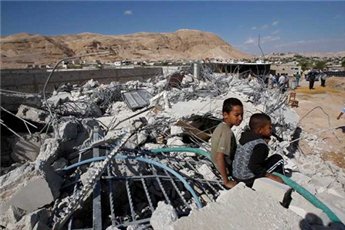
Israeli forces demolish [Palestinian] homes in Jericho

Boys sit on the rubble of demolished structures near Jericho on Nov. 15, 2011. (Reuters/Mohamad Torokman)
[AS ALWAYS PLEASE GO TO THE LINK TO READ GOOD ARTICLES IN FULL: HELP SHAPE ALGORITHMS (and conversations) THAT EMPOWER PALESTINE AND PEACE]

JERICHO (Ma'an) -- Israeli forces on Tuesday demolished four homes west of Jericho in the central West Bank.

Palestinian security officials said over 30 army vehicles and 100 soldiers deployed in the Ein al-Duyuk al-Tahta area early Tuesday morning and declared a closed military zone, before bulldozers started demolishing homes.

Families did not have a chance to remove their furniture and belongings, security officials added.

Majed al-Atawneh said Israeli civil administration officers ordered him to leave his home but he refused and sat on the roof with his family. He told Ma'an he preferred that the army demolished his home "over his head" than to become homeless.

Israeli forces demolished homes belonging to Musbah Ali Mutur, Amar al-Fakhory, Mohammad Ali al-Haaj and Ali al-Dallam.

Two of the families were forced to evacuate their homes and the other two were not at home. One of the homeowners is in Saudi Arabia after performing the Muslim Hajj pilgrimage, a Ma'an reporter said.

A spokesman for Israeli authorities in the West Bank told Reuters the homes were razed because they were built without proper permits.

Palestinian security officials told Ma'an that 30 homes in the area were under threat of demolition because they lacked Israeli permits.

The homes are in Area C, a zone encompassing 62 percent of the West Bank which is under full Israeli military and civil control.

The UN agency for Palestinian refugees UNRWA notes that under Israel's zoning policy, Palestinians can only build in 1 percent of Area C, on land which is already heavily built up. Meanwhile, more than 94 percent of Palestinian permit applications have been rejected in recent years.

"Sadly, the number of people affected by demolition continues to grow. The UN estimates that between 28 and 46 per cent of Palestinian homes could be at risk of demolition, leaving people living under a cloud of anxiety," UNRWA says.

After the demolitions on Tuesday, Israeli soldiers fired stun grenades to stop residents from returning to the rubble, witnesses said.

Tuesday, November 15, 2011

Palestine News & Info Agency - WAFA - Ashrawi: Negotiations’ Success Depends on Quartet’s Commitment to Peace Requirements

RAMALLAH, November 14, 2011 (WAFA) - Hanan Ashrawi, member of the Palestine Liberation Organization’s (PLO) Executive Committee, said Monday “the success or failure of negotiations depends on the Quartet committee’s well to commit to the clear and known peace requirements; make Israel commit to international law and 1967 borders and stop settlement activities as well as determine a binding timeframe,” according to a press release.

Ashrawi added, “If the quartet can commit to these requirements, it means it started dealing with the content not the form, away from dealing with Israeli maneuvers.”

She stressed on the importance of putting pressure on Israel to make it commit to the peace requirements and not to put pressure on the Palestinians.

She affirmed that there are no signs of dealing with Israel seriously in light of America’s acquisition over the peace process, US forthcoming elections and the Israeli arrogance challenging the entire world.

She called on the international community to work on putting pressure on Israel to make it commit to the international law rules and to stop unilateral breaches concerning East Jerusalem, settlement activities as well as to hold Israel accountable.

She said, “If the Israeli right-wing extremist government does not pay for its violations, and is not held accountable for its breaches, it will continue its racist occupational practices.” “If there are no real intentions to hold Israel accountable, then there is no meaning for any steps taken by the quartet in this context.”

ATTENTION...

Ibtisam Barakat- Acclaimed author of Tasting the Sky
Problems, although, we dislike them greatly, come with gifts, making us behave and think in new, brave ways. . . break our fears. . . a problem simply tries to help, to say that things need attention and creative thinking. . . I want to take a minute to thank all the problems of the world for encouraging humanity to think and feel and wonder, not get lazy, dare, discover and change. . A problem is especially exquisite when a person is forced to stop blaming others, any others and all others, and see how they themselves have helped in creating the problem and can certainly help in solving it . . . :D :D
-- Ibtisam Barakat 2011

NYTimes: From Nablus to Jerusalem by Raja Shehadeh

November 15, 2011, 5:14 am

From Nablus to Jerusalem

NABLUS, West Bank — Last Saturday, I arrived at the Nablus train station, a low, thick-walled stone structure, in time to board the 3:20 pm to Jerusalem. Some 20 passengers were waiting at the entrance, mostly young men and women, with a few people old enough to remember the days of train travel during the British Mandate over Palestine. The excitement was palpable: It was our chance to take a ride to Jerusalem, a city we are barred from visiting, bypassing the Israeli checkpoints along the way. As I entered the station, a porter in a dark blue uniform issued me a ticket on the Green Line. The journey would take 30 minutes, with stops planned at Hawwarah, Zatara, Uyun al Haramiya, Attarah and Kalandia — all existing checkpoints. I made my way to the waiting room. It was barren, except for low tables with brochures entitled “Palestine Connected” showing local train networks and their destinations. Gaza. Jaffa. Haifa. Beersheba.

Soon there was an announcement in Arabic and English: the train would be arriving in three minutes. I could hear it approach, all whistles and honks. The sounds grew louder and louder until they became deafening. Then, they subsided; the train had arrived. The doors of the waiting room opened...READ MORE
[AS ALWAYS PLEASE GO TO THE LINK TO READ GOOD ARTICLES IN FULL: HELP SHAPE ALGORITHMS (and conversations) THAT EMPOWER PALESTINE AND PEACE]

Monday, November 14, 2011

Khaldun Bshara has dodged bullets to preserve Palestinians' heritage

"Bshara, born and raised in the village of Tubas near Nablus, says his dedication to Palestinian cultural heritage stems from a sense of social responsibility. "I believe that everyone has to give back to the community that helped him to flourish," he says, citing his mother as the inspiration for this desire to help other people in this way..."
http://www.csmonitor.com/World/Making-a-difference/2011/1114/Khaldun-Bshara-has-dodged-bullets-to-preserve-Palestinians-heritage
Khaldun Bshara, director of the RIWAQ Center for Architectural Conservation, stands atop the 1932 building that RIWAQ renovated and uses as its offices in Al Bireh, just outside the West Bank city of Ramallah. ’ We see our work as a central element,’ he says, ‘to creating a national identity of Palestine.' Tovah Lazaroff

Khaldun Bshara heads RIWAQ, a West Bank architectural firm which renovates and preserves buildings that are part of Palestinians' cultural heritage.

By Ruth Eglash, Contributor / November 14, 2011

Ramallah, West Bank

Most visitors to the Palestinian architectural company RIWAQ would be forgiven for thinking that its building and people are similar to others in the area.

With its Arabesque entryway, high ceilings, and tiled floor, the stone structure that houses the firm is a standard Ottoman design common across the region. And the people, busily working behind desks, appear to be like any other office employees.

But RIWAQ, which means "gallery" in Arabic, is more than just an architectural firm: It's a thriving center for architectural conservation. Today, as the dream of an independent Palestinian state grows more realistic, the organization's work in preserving Palestinian cultural heritage has taken on added significance.

RIWAQ director Khaldun Bshara excitedly points to the intricate details of the long-term renovation that has given this once-run-down 80-year-old former family home a new purpose. Most recently, it served as a strategic frontline base between fighting Palestinians and Israelis.

Standing in the lush garden with its vibrant bougainvillea and mix of indigenous plants, Mr. Bshara recalls how just over a decade ago he would have to keep away from the arched windows as bullets fired by Israeli soldiers and stones from Palestinian protesters flew past.

"We were right on the firing line during the second intifada," recalls the silver-haired architect, who started working for RIWAQ just before that Palestinian uprising began in 2000.

Bshara has gone on to dedicate his life to renovating such buildings and, in the process, has kick-started the efforts at heritage-building that lie at the heart of any viable national identity.

"I don't think that the declaration of [a Palestinian] state will have a huge impact on our work, but as we move in that direction, it will certainly bring more attention to the importance of heritage," says Bshara, referring to the Palestinian leadership's attempt to seek international recognition of a Palestinian state at the United Nations. "Our work will continue on, regardless of whether there is a state or not."

Founded in 1991 by architect Suad Amiry, together with a group of Palestinians concerned that their historical sites were disappearing, RIWAQ has spent the past two decades rebuilding and reviving villages damaged by the constant state of conflict in the area.

Aside from its impressive data-collection operation aimed at identifying all buildings of significance to Palestinian history, RIWAQ has gained financial support from a wide range of local and international sources, which has allowed it to improve people's lives by rejuvenating their surroundings.

"One of our goals is to connect the disconnected villages spread out all over the West Bank," says Bshara, describing one recent project in which a team of architects and experts cleared, renovated, and even added a contemporary structure to a local music conservatory. "We could sense how the renovations had a huge impact on how the kids behaved and even found meaning to their existence in terms of music and openness," he says.

"RIWAQ helped by giving us a place to hold our activities," says Fatimah Issa, director of the nonprofit organization Women for Life. "They let us hold on to our past while helping us for the future."

She adds: "Their work is unique because it makes us feel thankful that we have a country. It makes our country real."

While RIWAQ's projects are largely chosen based on their architectural importance and history, Bshara concedes those are not the only criteria. "We also look at how the project will help the community, and we also consider...READ MORE

One Day, a True Independence Day by Joharah Baker for MIFTAH

[AS ALWAYS PLEASE GO TO THE LINK TO READ GOOD ARTICLES IN FULL: HELP SHAPE ALGORITHMS (and conversations) THAT EMPOWER PALESTINE AND PEACE...]

http://www.miftah.org/Display.cfm?DocId=24109&CategoryId=3

One Day, a True Independence Day
Date posted: November 14, 2011
By Joharah Baker for MIFTAH

Tomorrow is a special day for the Palestinians, at least in the world of symbolism and tenacious hope. Tomorrow is November 15, the day in 1988 when late President Yasser Arafat declared a Palestinian state along the 1967 borders with Jerusalem as its capital.

Yes, we Palestinians – perhaps out of sheer survival – have learned to cling to symbols. We thrive on moral victories, on eloquent speeches and on support from countries that can make no real difference in the unbalanced corridors of power. And we celebrate, each year, on November 15, we take the day off, our children stay home from school and we remind them that one day, we will have a real independence day, but that until then, we cannot lose faith.

There is truth at the heart of this. We cannot lose faith in spite of all that has gone wrong. But there must be a balance between symbolism and reality. Each has its advantages and disadvantages equally and if we find that balance, we will not allow ourselves to get lost in the symbolism that merely lifts our spirits.

This is particularly true today, as the Palestinians face innumerable challenges, both diplomatically and on the ground. Earlier this week, the first blow was delivered to the Palestinians at the UN Security Council admissions committee which said it failed to reach an agreement over Palestine’s bid for full membership. The United States – wanting to spare itself even the slightest bit of awkwardness – seems to have been able to coerce France and Britain among others to either abstain or vote against the Palestinians should the latter decide to take it up in the Council so the US would not be singled out in its veto.

Naturally, the Palestinians are frustrated with the lack of justice and imbalance in powers that govern its diplomatic efforts to gain independence. But, like all these years of various tactics have proven to us, there is always one more way to go, one more idea to get us closer to our goal.

Officially, the leadership is not backing down on its option to turn to the United Nations to achieve statehood – symbolic again, but with a measure of diplomatic clout that could make a difference in their ability to take Israel to court and to get Palestine recognized as an occupied state. That, obviously, goes beyond empty symbolism and is why the leadership insists on pursuing it.

But back to our Independence Day and what it means to us Palestinians living year after year under occupation. At the time when President Arafat proudly took the podium in Algeria during the historical Palestine National Council’s special session, we all believed it would be just a matter of time before the dream came true. Even Arafat told us so – “We are in our last quarter hour,” he would say of the remaining duration of our long and hard struggle. “Jerusalem is just a stone’s throw away.”

That has not yet come to pass. Since then we have ridden the highs of our moral victories such as President Mahmoud Abbas’ speech at the UN General Assembly and the more recent UNESCO vote to include Palestine as full members. But we are no closer to independence than we were back in 1988 and perhaps just that much more disenchanted.

However, all is not lost. Those moral victories and the symbols we desperately cling to are meaningful for a reason. If it were not for the pride we feel when the Palestinian flag is flown on rooftops in Jerusalem or when three-fourths of the General Assembly gave President Abbas a standing ovation after his speech, we may forget what we are fighting for. The symbols are important, but not in and of themselves. It is not enough that Abbas got a standing ovation or that we are members of UNESCO. But it is something. And it is something when countries and individuals speak in our defense or condemn Israel for its crimes on Palestine soil. These are all stepping stones to the higher cause.

So, tomorrow, on our virtual Independence Day, let us be fair. It is not an “illusion” like some fazed cynics might call it. Neither is it the final destination because we are obviously still under occupation. But it is an important day to remember what we are working towards, why we are such a proud people and why, no matter how many more “virtual” independence days we have to celebrate, one day it will be for real.

Joharah Baker is a Writer for the Media and Information Department at the Palestinian Initiative for the Promotion of Global Dialogue and Democracy (MIFTAH). She can be contacted at mid@miftah.org.

My letter to the Washington Post RE Jackson Diehl's For Israel, a tough call on attacking Iran

RE: Jackson Diehl's For Israel, a tough call on attacking Iran
http://www.washingtonpost.com/opinions/for-israel-a-tough-call-on-attacking-iran/2011/11/10/gIQAmHCBJN_story.html

Dear Editor,

If Israel was truly concerned with keeping Jewish people safe from Iran's nuclear bombs it would welcome home the Palestinian refugees, as well as do all it can to help a viable, sovereign and secure Palestinian state emerge for those Palestinians who would rather not be Israeli.

Ending the Israel-Palestine conflict ASAP by fully respecting universal basic human rights and international law would go a long way towards calming down the entire region, and inspiring people here there & everywhere to invest in peace and justice rather than religious bigotry and bombs.

Sincerely,
Anne Selden Annab

NOTES:

The ongoing Palestinian refugee crisis: Don’t demolish my future! UNWRA: Demolitions and the threat of displacement are ruining people’s lives in the West Bank.

"Where, after all, do universal human rights begin?

Fake Progress vs Real Progress in Palestine - The Atlantic

Palestinian Freedom Riders

What's God got to do with it? If you want freedom and security, you need the following...


"Where, after all, do universal human rights begin? In small places, close to home - so close and so small that they cannot be seen on any maps of the world. Yet they are the world of the individual person; the neighborhood he lives in; the school or college he attends; the factory, farm, or office where he works. Such are the places where every man, woman, and child seeks equal justice, equal opportunity, equal dignity without discrimination. Unless these rights have meaning there, they have little meaning anywhere. Without concerted citizen action to uphold them close to home, we shall look in vain for progress in the larger world."Eleanor Roosevelt


Sunday, November 13, 2011

Rafeef Ziadah - 'We teach life, sir', London, 12.11.11

Palestinian Freedom Riders

Palestinian Freedom Riders
Inspired by
the Freedom Rides of the US Civil Rights Movement
Palestinian activists will attempt to board segregated Israeli settler buses to occupied East Jerusalem

A young Arab-American woman’s list of hopes for Arab-American Literature

Author of A MAP OF HOME

Randa Jarrar "I’m lucky enough to teach an Arab-American lit class at Fresno State– it’s officially an Arab-American Women’s Fiction class, but I also teach some poetry, comics, and non-fiction, too– and one of the assignments I gave my class was to think about what direction they think Arab-American literature seems to be going, and what direction they think it ought to go. Lots of students felt that it wasn’t their place, as White, Latino/a, or Asian-Americans, to tell Arab-American writers what to write about. But they wrote wonderful short essays anyway, asking Arab-American writers to write more Sci-Fi, less food porn, more literary fiction, less politically-centered narratives, more literature in general. There were lots of great responses, but I wanted to share this particular response from a young student...READ MORE

As ultra-Orthodox flex muscle, Israel feminists see a backsliding

Women who thought Israel's battle for gender equality was mostly won warn of a new assault from the fast-growing ultra-Orthodox, seeking to expand religious-based segregation into the public realm.