Labels

Wednesday, February 13, 2013

Rising From Ruins: Even as Israel neglects a major archaeological site in the West Bank, it is preventing the Palestinian Authority from tending to it.

"The Oslo Accords list Sebastia among the archeological sites of importance to Israel, yet Israel is not taking care of the place, arguably one of the most important set of ruins in the West Bank. Nor is it allowing the Palestinian Authority to do so. And even though USAID-supported renovation work is taking place in the village, supposedly to improve the ailing Palestinian economy by encouraging tourism in the West Bank, the international community has done nothing to oppose Israeli actions that impede tourism (and are contrary to international law)." RAJA SHEHADEH in the NYTimes
Signs outside a village in the West Bank identical to those at the entrance of Sebastia. Photo credit Bassam Almohor
[AS ALWAYS PLEASE GO TO THE LINK TO READ GOOD ARTICLES IN FULL: HELP SHAPE ALGORITHMS (and conversations) THAT EMPOWER DECENCY, DIGNITY, JUSTICE & PEACE... and hopefully Palestine]

http://latitude.blogs.nytimes.com/2013/02/13/ruins-in-the-west-bank-are-another-victim-of-the-israeli-palestinian-conflict/

'Herod the Great' show causes row over artifacts

A general view of Herodion, near Bethlehem.(MaanImages/file)
13/02/2013

[AS ALWAYS PLEASE GO TO THE LINK TO READ GOOD ARTICLES IN FULL: HELP SHAPE ALGORITHMS (and conversations) THAT EMPOWER DECENCY, DIGNITY, JUSTICE & PEACE... and hopefully Palestine]


JERUSALEM (Reuters) -- The first major museum exhibition on the divisive biblical figure of Herod the Great has provoked a modern-day row between Israel and the Palestinians over who has the right to dig up his artifacts.

The Israel Museum in Jerusalem on Tuesday unveiled a display dedicated to Herod - branded a baby-killer in the Christian tradition but remembered by many in Israel for rebuilding a Jewish Temple two millennia ago.

Palestinian Authority officials have complained many of the exhibits were taken from the West Bank, under Israeli military occupation since 1967.

The show includes busts and statues of figures from the period when the Romans occupied the Holy Land and appointed Herod the monarch of Judea.

The highlight is a reconstruction of part of Herod's mausoleum housing what experts believe is his sarcophagus.

Palestinians said the artifacts were removed without their consent from Herodion, the builder-king's excavated palace on an arid hilltop near Bethlehem.

The Palestinian Authority minister of tourism and antiquities, Rula Maayah, told Reuters all Israeli archaeological activities in the West Bank were illegal.

"Many dig locations (in the Palestinian territories) fall under Israeli control ... and we are unable to reach them. All the work at digs in the occupied territories are against the law, but Israel carries them out and even if they don't dig themselves they don't allow us to do so," she said.

Israel Museum director James Snyder said archaeological digs on occupied Palestinian territories were carried out according to international conventions and protocols laid down in interim Israeli-Palestinian peace accords.

Snyder said he was unaware of any discussions with Palestinian archaeological officials over the exhibit and there had been no way to study the artifacts properly on site at Herodion.

The relics, he said, would eventually be returned to Herodion once proper facilities to house them were in place.

In the Christian story, Herod ordered his men to kill all baby boys in and around Jesus' birthplace Bethlehem, fearing one would grow up to become "King of the Jews" and challenge his rule.

According to The Gospel of Matthew, Jesus and his family escaped the slaughter by fleeing to Egypt.

Historians said Herod ruled Judea from about 37 BC until his death in 4 BC - four years before Jesus' official birth day, though that date is also contested.

Ma'an staff contributed to this report


********* 
Visitor Information Center .... Ancient King Herod’s Palace is visible from Bethlehem: It is located in the Judean desert, 6 km to the south east of Bethlehem
Ruins of Herodium Seen from Above
MAP of Greater Jerusalem, May 2006. United States. Central Intelligence Agency: Shows settlements, refugee camps, fences, walls, etc.

Kerry seeks to unblock $700 million in aid for Palestinians

Kerry seeks to unblock $700 million in aid for Palestinians
News February 12, 2013 

“The secretary feels extremely strongly that it is time now to get this support to the Palestinian Authority.”

Secretary of State John Kerry is working to try to free up almost $700 million in aid for the Palestinians which has been held up in Congress, a top US official said Monday.

“The secretary feels extremely strongly that it is time now to get this support to the Palestinian Authority,” State Department spokeswoman Victoria Nuland said.

The department was working with Congress “to get appropriated money released for the Palestinian Authority because we think it’s very, very important that they remain effective in supporting the needs of the Palestinian people.”

Some $495.7 million was set aside for the Palestinian Authority in the fiscal year 2012 which ended on October 1, while another $200 million for this fiscal year was notified to Congress last week.
The money is earmarked for specific things in the Palestinian budget such as security as well as administrative costs.

However, an additional $100 million has been released, but can only be used on narcotics and law enforcement.

The Palestinian Authority is facing its worst economic crisis in years, in part because of a failure by donors to deliver pledged funds. But its finances were plunged further into chaos after president Mahmud Abbas won upgraded UN observer status at the UN General Assembly.

Israel, which strongly opposed the move along with the United States, said it was suspending monthly transfers of the tax and tariff revenue it collects on behalf of the Palestinian Authority (PA) in the wake of the decision.

It did, however, transfer $100 million in a one-off payment in late January.

Nuland said Kerry had been very active on the issue of the Palestinian aid with Congress since he took over as secretary of state on February 1.

*****
ATFP News Roundup
 
Please help sustain ATFP's work and independent decision-making by donating here.
 
[NOTE: The format of ATFP's news roundup has been revised and streamlined. We hope you will enjoy the new format and earlier delivery. Please click on the links within the text to go to the full article at its original site.]

"Herod the Great" show in Israel angers Palestinians

A man walks near sarcophagi during a media preview of an exhibition titled "Herod the Great: The King's Final Journey" at the Israel Museum in Jerusalem February 12, 2013. REUTERS/Ronen Zvulun
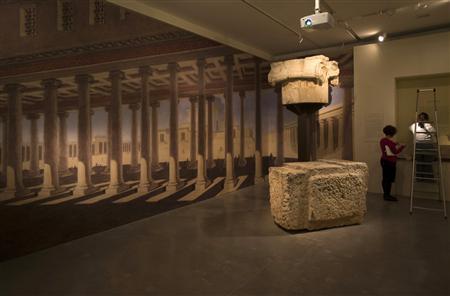
A woman looks at archaeological artifacts during a media preview of an exhibition titled "Herod the Great: The King's Final Journey" at the Israel Museum in Jerusalem February 12, 2013. REUTERS/Ronen Zvulun
Museum employees prepare an exhibition titled "Herod the Great: The King's Final Journey" at the Israel Museum in Jerusalem February 12, 2013.  REUTERS/Ronen Zvulun
People arrive to a media preview of an exhibition titled "Herod the Great: The King's Final Journey" at the Israel Museum in Jerusalem February 12, 2013. REUTERS/Ronen Zvulun
http://www.reuters.com/article/2013/02/12/us-israel-archaeology-herod-idUSBRE91B1G220130212

JERUSALEM | Tue Feb 12, 2013 3:22pm EST
 
(Reuters) - The first major museum exhibition on the divisive biblical figure of Herod the Great has provoked a modern-day row between Israel and the Palestinians over who has the right to dig up his artefacts.

The Israel Museum in Jerusalem on Tuesday unveiled a display dedicated to Herod - branded a baby-killer in the Christian tradition but remembered by many in Israel for rebuilding the Jewish Temple two millennia ago.


Palestinians have complained many of the exhibits were taken from the occupied West Bank, land Israel captured in the 1967 Middle East war and which Palestinians seek as part of a future state.
The show includes busts and statues of figures from the period when the Romans occupied the Holy Land and appointed Herod the monarch of Judea.

The highlight is a reconstruction of part of Herod's mausoleum housing what experts believe is his sarcophagus.

Palestinians said the artefacts were removed without their consent from Herodium, the builder-king's excavated palace on an arid hilltop a short drive from Jerusalem.

The Palestinian minister of tourism and antiquities, Rula Ma'ayah, told Reuters all Israeli archaeological activities in the West Bank were illegal.

"Many dig locations (in the Palestinian territories) fall under Israeli control ... and we are unable to reach them. All the work at digs in the occupied territories are against the law, but Israel carries them out and even if they don't dig themselves they don't allow us to do so," he said....READ MORE

[AS ALWAYS PLEASE GO TO THE LINK TO READ GOOD ARTICLES IN FULL: HELP SHAPE ALGORITHMS (and conversations) THAT EMPOWER DECENCY, DIGNITY, JUSTICE & PEACE... and hopefully Palestine]

Israel unveils Herod's archaeological treasures: Herod's mausoleum headlines Israel's most ambitious archaeological show but Palestinians say treasures should stay where they were found

A stone sculpture of the Roman emperor Augustus, who ruled at the time of Herod the Great – part of the Israel Museum exhibition. Photograph: Jim Hollander/EPA

http://www.guardian.co.uk/world/2013/feb/12/israel-archaeological-exhibition-herod-the-great

"The show has met with opposition from the Palestinian Authority (PA), which says Israel is in breach of international law by exhibiting artefacts excavated and removed from the West Bank.

Hamdan Taha, a PA official responsible for antiquities, said the Israel Museum had not consulted it on the excavation and exhibition. Herodium is located in Area C of the West Bank, which is under full Israeli control, and the site is administered by the Israeli Parks Authority.

The exhibition was an attempt to use "archaeology to justify Israel's political claims on the land", Taha said. The site, along with Jericho, was "an integral part of Palestinian cultural heritage", he added."...READ MORE

Monday, February 11, 2013

Whisper Campaigns ... a poem by Anne Selden Annab


   Whisper Campaigns

Censors everywhere
are erasing Palestine
elevating the insane
eliminating the rational
the compassionate
reasonable
Golden Rule stuff
that might free the [all] people
from the conflict itself.

Censors everywhere
lurking in search engines
and news rooms
and lists

Censors everywhere
pushing peace and justice
and negotiations away

Whisper campaigns
crippling meritocracy
and the market place of ideas

Censors everywhere
deleting dignity
decency

... & civilization itself.


Poem copyright 2013 Anne Selden Annab

Pope Benedict tells Abbas that hope for Mideast solution is "a fair and lasting solution to the Israeli-Palestinian conflict, which may be reached only by resuming negotiations between the parties, in good faith and according due respect to the rights of both"

December 12 2012 Pope tells Abbas of hope for Mideast solution
VATICAN CITY: Pope Benedict told Palestinian President Mahmoud Abbas on Monday the Vatican hoped the recent de facto recognition of Palestinian statehood at the United Nations would spur the international community to find a solution to the Arab-Israeli conflict.

Abbas, who is on a tour of Europe to thank countries that supported the Nov. 29 resolution by the U.N. General Assembly recognising Palestine, held private talks with the pope for about 25 minutes in the Vatican's Apostolic Palace.

"It is hoped that (the resolution) will encourage the commitment of the international community to finding a fair and lasting solution to the Israeli-Palestinian conflict, which may be reached only by resuming negotiations between the parties, in good faith and according due respect to the rights of both," a Vatican statement said...READ MORE

Madame Maha Seca, the head of the Palestinian Heritage Center, and the handmade Palestinian stole for the Pope
*************

POPE BENEDICT XVI TO STEP DOWN


Dear IHT/NYTimes,


Your photo essay POPE BENEDICT XVI TO STEP DOWN has several nice pictures of the Pope pointing out his outreach to Jewish people ( Pope Benedict XVI at the Western Wall, Judaism's holiest prayer site, in May 2009  & The pope visited the Nazi death camps Auschwitz and Birkenau in Poland in 2006) but none about his outreach to Palestinians and his recognition of the importance of Palestinian statehood ... AND his clear message that hope for the Mideast is  "a fair and lasting solution to the Israeli-Palestinian conflict, which may be reached only by resuming negotiations between the parties, in good faith and according due respect to the rights of both"


Sincerely,
Anne Selden Annab

ATFP News [& Commentary] Roundup, February 11, 2013: Pres. Obama's upcoming Middle East trip stirs hopes for peace...

ATFP News Roundup, February 11, 2013
 
Please help sustain ATFP's work and independent decision-making by donating here.
 
[NOTE: The format of ATFP's news roundup has been revised and streamlined. We hope you will enjoy the new format and earlier delivery. Please click on the links within the text to go to the full article at its original site.]
 
 
NEWS:
Pres. Obama's upcoming Middle East trip stirs hopes for peace at little. (New York Times)
 
Israel is rushing to move ahead with settlement construction before Obama's visit. (AP)
 
A Palestinian official rules out a three-way meeting with Israeli leaders during Obama's trip. (Xinhua)
 
Pres. Abbas thanks the Pope for support the recent UN resolution designating Palestine a non-member observer state. (Reuters/AP)
 
Israeli troops detain an AP photographer. (AP)
 
Palestinian refugees continue to flee Syria for Lebanon. (Daily Beast)
 
A Palestinian delegation visits Syria to try to arrange protection for Palestinian refugees there. (UPI)
 
Israeli forces prevent Palestinians from setting up a protest camp to stop settlement expansion in the occupied West Bank. (Reuters)
 
The Oscar-nominated film "5 Broken Cameras" angers many on both sides of the Israeli-Palestinian divide. (AP)
 
Palestinian unity talks collapse again over the issue of a firm date for new elections, which Hamas reportedly does not want. (Jerusalem Post)
 
The Palestinian election commission begins to update voter registers in the West Bank and Gaza Strip. (AP)
 
Hamas complains Egypt is restricting travel in and out of Gaza and destroying smuggling tunnels by flooding them. (Xinhua/Ha'aretz)
 
Israeli products are filling Gaza's supermarket shelves. (Al Monitor)
 
Witnesses say settlers vandalized a Palestinian community center in occupied Hebron. (Ma'an)
 
Cyprus becomes the latest EU state to upgrade Palestine's diplomatic status. (AFP)
 
An Israeli journalist says the Syrian media is mispresenting the views on Israel of a prominent Syrian opposition leader. (New York Times)
 
Yasser Arafat's widow reportedly calls her marriage a "big mistake." (The Guardian)
 
 
COMMENTARY:
Amira Hass says Israeli authorities subject Palestinian prisoners to sleep deprivation. (Ha'aretz)
 
Daniella Peled criticizes Israel's reaction to a new study of Palestinian and Israeli schoolbooks. (Ha'aretz)
 
Chemi Shalev says over-zealous supporters of Israeli overreacted foolishly to a BDS conference at Brooklyn College. (Ha'aretz)
 
Mira Sucharov says the BDS movement isn't compatible with two states. (Daily Beast/Open Zion)
 
Naftali Rothenberg says Arab parties need to be included in Israel's governing coalitions. (YNet)
 
Armin Rosen looks at the first planned Palestinian city in the occupied West Bank, Rawabi. (The Atlantic)
 
Alon Pinkas says Obama's visit will boost US-Israel relations, but not the peace process. (YNet)
 
The Guardian says Obama needs to offer the parties more than solidarity. (The Guardian)
 
Elias Harfoush says Abbas briefly confusing Pres. Morsi with his predecessor Mubarak was "a Freudian slip" revealing much truth. (Al Hayat)
 
Shlomi Eldar asks why former Deputy FM Ayalon suddenly supports a Palestinian state. (Al Monitor)
 
 
If you appreciate this ATFP news roundup service, please help sustain it with a generous donation by clicking here.


ATFP Hosts Washington Briefing on Israeli and Palestinian Schoolbooks: Dr. Asali told the capacity-crowd audience that, "We are very proud to host the distinguished team of scholars. The study shows the need to educate for peace. Narratives in conflict perpetuate the conflict, and are perpetuated by it."

 
ATFP is strictly opposed to all acts of violence against civilians no matter the cause and no matter who the victims or perpetrators may be.  The Task Force advocates the development of a Palestinian state that is democratic, pluralistic, non-militarized and neutral in armed conflicts.

Amidst a brutal war, Syria’s Palestinian community finds itself seeking refuge yet again—this time, in Lebanon’s famous Sabra and Shatila camps.

"He tells me he comes across many cases of discrimination. One refugee needed an asthma inhaler, a common item that costs around $13. “Nobody would give it to him,” Abdullah says, “No hospital or pharmacy, because he was Palestinian Syrian. He died from an asthma attack.” " 

Syria’s Palestinians Seek Refuge in Lebanon

Feb 11, 2013

A Palestinian family who fled their home in the Yarmouk camp for Palestinian refugees in south Damascus, look out through the window, at the Ein el-Hilweh refugee camp, in the southern port city of Sidon, Lebanon, Jan. 15, 2013. The Palestinian exodus from Syria has also revived decades-old debate over the Palestine refugees' 'right of return' to their homes that are now in Israel, adding to the complexity the conflict whose sectarian and ethnic overtones have spilled over into neighboring countries raising fears of a regional war. (Mohammed Zaatari/AP)

This is the second time he has had to leave his home in Yarmouk and come to Lebanon to escape the Syrian conflict.


“Now we have two rights of return,” he says, smiling wryly. “One to Palestine and one to Syria.”

....READ MORE

Sunday, February 10, 2013

Number of Palestinian refugee deaths in Syria increasing, UN agency warns

A Palestinian child. Photo: UNRWA
http://www.un.org/apps/news/story.asp?NewsID=44106&Cr=palestin&Cr1=#.URg1qdY1aS4
10 February 2013 – A United Nations agency today expressed concern over the rising number of deaths and injuries among Palestinian refugees in Syria, following reports of 12 casualties last Thursday in a Damascus suburb.

“These deaths mark the end of a particularly tragic week for Palestine refugees in Syria, with an estimated total of 30 killed,” the UN Relief and Works Agency for Palestine Refugees in the Near East (UNRWA) said in a news release.

More than 60,000 people, mostly civilians, have been killed since the uprising against President Bashar al-Assad began in early 2011. Recent months have witnessed an escalation in the conflict, which has also left more than four million people in need of humanitarian assistance.

According to UNRWA, many of the casualties were caused by the use of heavy weapons and five of the 12 Palestinian refugees killed on 7 February in Yarmouk were members of the same family.

“These Palestine refugees are unable to move safely, are subject to severe movement restrictions and face escalating threats from shelling and armed clashes,” UNRWA said, adding that poverty and deprivation are increasing in the Palestinian community, exacerbating vulnerabilities that existed prior to the Syrian conflict.

“These developments have left the Palestine refugee community, alongside their Syrian neighbours, profoundly traumatized and fearful of the future.”

UNRWA has repeatedly deplored the armed conflict and the extreme suffering it is inflicting on civilians. The agency once again called on all sides to comply with their obligations under international law and ensure the protection of Palestine refugees and other civilians across the country.

UNRWA statement on killing of 12 Palestine refugees in Syria


News Tracker: past stories on this issue

Saturday, February 9, 2013

Palestinian family home demolished by Israeli forces in Jerusalem

A Palestinian child cries after his family's home was demolished in Beit Hanina, Jerusalem. The building was said to have been constructed without proper permits. Members of the 33-member family said that they had been waiting to receive permits. Photograph: Bernat Armangue/AP The Observer photo gallary 2012

The Observer's 20 photographs of the week

Gallery (20 pictures), 9 Feb 2013:

The best photographs in news and culture from around the world over the past seven days


My letter to the Phil Inq RE Trudy Rubin's Worldview: Bold proposals for the Mideast


To be clear: Return
RE: Trudy Rubin's Worldview: Bold proposals for the Mideast
http://www.philly.com/philly/opinion/20130207_Worldview__Bold_proposals_for_the_Mideast.html

There is nothing new, and nothing bold- and nothing wise or noble about refusing to respect the Palestinian refugees' right of return.  Tax payers should not be forced to fund religious "scholars" and schemes and Israel's ongoing Palestinian home demolitions and land confiscation policies.

Furthermore, seriously think about what an Israeli settlement really is... It is a tax payer plus charity investment in highways, housing, freedom, jobs, security, and respect for Jewish Israelis, while the native non-Jewish Palestinians are persecuted, impoverished, pushed into forced exile- and demonized for objecting to such institutionalized bigotry and blatant injustice.

A fully secular two state solution is a step away from the religious tyranny and bigotry and cynicism and cruelty that the Israel-Palestine conflict creates.  You do Israel (and Palestine) no favors by insisting that Palestinian refugee rights be swatted away.  Universal basic human rights should be respected- for everyone's sake.

Sincerely,
Anne Selden Annab

NOTES
What is an Israeli settlement....

"Legislature should "make no law respecting an establishment of religion, or prohibiting the free exercise thereof..." Thomas Jefferson

Palestinians construct new protest village in south Hebron


Letter sent to my elected leaders: Peace and Palestine need to be taken seriously by American leadership now more than ever.

Palestine's Amb. Maen Rashid Areikat: Bias against Palestinians on display at congressional hearing


ATFP Hosts Washington Briefing on Israeli and Palestinian Schoolbooks

Palestine developing school curriculums that teach coexistence, tolerance, justice, and human dignity


Palestinian leadership on Wednesday welcomed US President Barack Obama’s announced plans to visit the region in March.

RAJA SHEHADEH: More Than a Land Grab ...Settlers increasingly impinging on Palestinian lives: Jewish settlers aren't just taking empty space, they're destroying Palestinian property and threatening their lives.

Israel demolishes yet anouther Palestinian home in East Jerusalem

Foriegn Policy: An interview with Palestinian negotiator-in-chief Saeb Erekat 


PBS: Mariam Said on the West-Eastern Divan Orchestra

*******
".... it being clearly understood that nothing
          shall be done which may prejudice the civil and religious
          rights of existing non-Jewish communities in Palestine..."

The Office of International Religious Freedom ( http://www.state.gov/j/drl/irf/)   Given the U.S. commitment to religious freedom, and to the international covenants that guarantee it as the inalienable right of every human being, the United States seeks to:
Promote freedom of religion and conscience throughout the world as a fundamental human right and as a source of stability for all countries
Palestinian Refugees(1948-NOW) refused their right to return... and their right to live in peace free from religious bigotry and injustice.

The Golden Rule... Do unto others as you would have them do unto you

"Where, after all, do universal human rights begin? In small places, close to home - so close and so small that they cannot be seen on any maps of the world. Yet they are the world of the individual person; the neighborhood he lives in; the school or college he attends; the factory, farm, or office where he works. Such are the places where every man, woman, and child seeks equal justice, equal opportunity, equal dignity without discrimination. Unless these rights have meaning there, they have little meaning anywhere. Without concerted citizen action to uphold them close to home, we shall look in vain for progress in the larger world." Eleanor Roosevelt


Palestinian refugees must be given the option to exercise their right of return (as well as receive compensation for their losses arising from their dispossession and displacement) though refugees may prefer other options such as: (i) resettlement in third countries, (ii) resettlement in a newly independent Palestine (even though they originate from that part of Palestine which became Israel) or (iii) normalization of their legal status in the host country where they currently reside.  What is important is that individual refugees decide for themselves which option they prefer – a decision must not be imposed upon them.

UN Resolution 194 from 1948  : The refugees wishing to return to their homes and live at peace with their neighbours should be permitted to do so at the earliest practicable date, and that compensation should be paid for the property of those choosing not to return and for loss of or damage to property which, under principles of international law or in equity, should be made good by the Governments or authorities responsible.