Labels

Showing posts with label Malala Yousafzai. Show all posts

Monday, June 16, 2025

The United Nations 2025 ACT NOW for a peaceful world: Did you know that the world spent $2.4 trillion on its militaries or that the global economic cost of violence was nearly $20 trillion in 2023?

United Nations Geneva
 
Each of us can heal divisions and embrace peace & understanding. 
 
Encourage families & communities to speak up, learn, respect, embrace diversity, and protest injustice. 
 
Be the change you want to see! #ActNow for Peace. buff.ly/4AGOhrR

Building a movement for peace

The future is young. Today, half the world’s population is under 30, and this generation is emerging as a powerful force for peace in a world marred by conflict and injustice.

Across the globe, young people are organizing protests, sparking global movements, and forging bonds of solidarity. In communities ravaged by violence, they serve as peacekeepers and peacebuilders, laying the groundwork for a resilient tomorrow.

Learn more about how young people contribute to peace, and join them in building a movement for a more peaceful and just world.

Know your facts

Empower yourself with knowledge

Get inspired

Read peacebuilder stories

Speak up

Become an advocate for peace

"When the whole world is silent, even one voice becomes powerful.”

Malala Yousafzai, UN Messenger of Peace

ActNow for peace

From ending violence against women and girls to empowering youth and building peace, we can do more to create a better world. Here are ten more actions you can take to contribute to a more peaceful future.

Know your facts

Did you know that the world spent $2.4 trillion on its militaries or that the global economic cost of violence was nearly $20 trillion in 2023? Learn the facts in your campaign against violence.

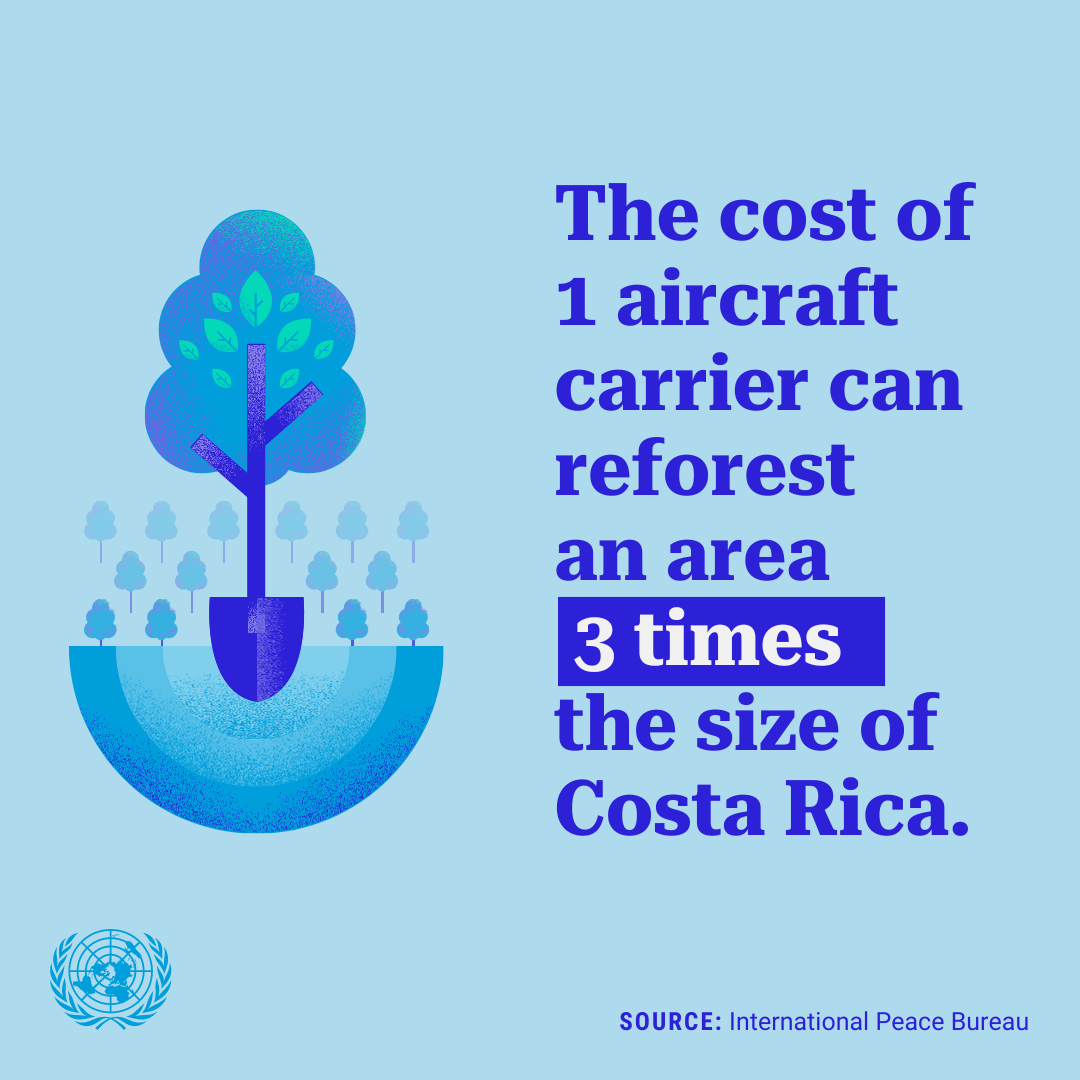
An illustration with the text 'The cost of 1 aircraft carrier can reforest an area 3 times the size of Costa Rica. Source: International Peace Bureau'.
An illustration with the text '200,000 children can attend a year of school for the price of 1 stealth fighter. Source: UN Office for Disarmament Affairs'.
An illustration with the text '26,000 people can be treated for malaria for the price of 1 battle tank. Source: International Peace Bureau'.

Fast facts

Did you know that that wars cost the world $20 trillion in 2023 or that one in three victims of trafficking is a child?

Fortify your campaign against violence with hard facts on issues that matter.

Disarmament

First resolution of the UN General Assembly was on nuclear disarmament in 1946.

#INVEST IN PEACE

 https://www.un.org/en/peace-and-security/page/fast-facts

Saturday, October 11, 2014

In a common struggle for education and against extremism: "“If with my humble efforts the voice of tens of millions of children in the world who are living in servitude is being heard, congratulations to all,” Kailash Satyarthi on winning the Nobel Peace Prize 2014

Malala Yousafzai, with her father, Ziauddin, spoke in Birmingham, England, after learning she had won the Nobel prize. Darren Staples/REUTERS
Reaching across gulfs of age, gender, faith, nationality and even international celebrity, the Norwegian Nobel Committee on Friday awarded the 2014 peace prize to Malala Yousafzai of Pakistan and Kailash Satyarthi of India.

The award joined You-safzai, a Pakistani teen who attained worldwide fame when she was shot by the Taliban in 2012 for promoting girls’ education, with Satyarthi, a veteran of campaigns to fight child labor and trafficking...READ MORE

***
Malala Yousafzai speaks in Britain about winning the Nobel Peace Prize with Indian activist Kailash Satyarthi, who speaks with journalists at this home in New Delhi after the announcement.
“I’m thankful to my father for not clipping my wings and for letting me to fly.” Malala Yousafzai

Friday, October 10, 2014

Malala Yousafzai of Pakistan and Kailash Satyarthi of India jointly won the Nobel Peace Prize on Friday for risking their lives to fight for children's rights... "widening the concept of peace work to include efforts to improve human rights, fight poverty and clean up the environment."

In this Feb. 18, 2014 file photo, Malala Yousafzai, visits Zaatari refugee camp near the Syrian border in Mafraq, Jordan. Children's rights activists Yousafzai, 17, of Pakistan and Kailash Satyarthi of India were awarded the Nobel Peace Prize Friday, Oct. 10, 2014. (AP Photo/Mohammad Hannon, File)

[AS ALWAYS PLEASE GO TO THE LINK TO READ GOOD ARTICLES IN FULL: HELP SHAPE ALGORITHMS (and conversations) THAT EMPOWER DECENCY, DIGNITY, JUSTICE & PEACE... and hopefully Palestine]
http://news.yahoo.com/malala-kailash-satyarthi-win-nobel-peace-prize-090630266.html

Malala, Satyarthi win Nobel Peace Prize

OSLO, Norway (AP) — Malala Yousafzai of Pakistan and Kailash Satyarthi of India jointly won the Nobel Peace Prize on Friday for risking their lives to fight for children's rights.

Malala, a 17-year-old student and education activist, is the youngest ever Nobel winner. She was shot in the head by a Taliban gunman two years ago for insisting that girls also have the right to an education.

Satyarthi, 60, has been at the forefront of a global movement to end child slavery and exploitative child labor since 1980, when he gave up his career as an electrical engineer. The grassroots activist has led the rescue of tens of thousands of child slaves and developed a successful model for their education and rehabilitation. He has also survived several attempts on his life.

"This is an honor for all my fellow Indians, as well as an honor for all those children in the world whose voices were never heard before properly," Satyarthi told India's NDTV network.

The Nobel committee's announcement reflected a delicate diplomatic balance, naming one activist from Pakistan and another from India, two countries that are long-time bitter rivals; one Muslim and one Hindu; both sexes; an elder statesman of child's rights and a youthful advocate who had herself been a victim.

The Nobel Committee said it was an important point to reward both an Indian Hindu and a Pakistani Muslim for joining "in a common struggle for education and against extremism." The two will split the Nobel award of $1.1 million.

By highlighting children's rights, committee widened the scope of the peace prize, which in its early days was given for efforts to end or prevent armed conflicts.

"It is a prerequisite for peaceful global development that the rights of children and young people be respected," the committee said. "In conflict-ridden areas in particular, the violation of children leads to the continuation of violence from generation to generation."

Malala was barely 11 years old when she began championing girls' education in Pakistan, speaking out in TV interviews. The Taliban had overrun her home town of Mingora, terrorizing residents, threatening to blow up girls' schools, ordering teachers and students into the all-encompassing burqas.

She was critically injured on Oct. 9, 2012, when a Taliban gunman boarded her school bus and shot her in the head. She survived through luck — the bullet did not enter her brain — and by the quick intervention of British doctors visiting Pakistan.

Flown to Britain for specialist treatment at the Queen Elizabeth Hospital in Birmingham, she underwent numerous surgeries but made a strong recovery.

Malala currently lives with her father, mother and two brothers in Birmingham, attending a local school. She has been showered with human rights prizes, including the European Parliament's Sakharov Award.

The Nobel committee said Satyarthi was carrying on the tradition of another great Indian, Mahatma Gandhi.

"Showing great personal courage, Kailash Satyarthi, maintaining Gandhi's tradition, has headed various forms of protests and demonstrations, all peaceful, focusing on the grave exploitation of children for financial gain," the committee said.

The founder of the Nobel Prizes, Swedish industrialist Alfred Nobel, said the prize committee should give the prize to "the person who shall have done the most or the best work for fraternity between nations, for the abolition or reduction of standing armies and for the holding and promotion of peace congresses."

The committee has interpreted those instructions differently over time, widening the concept of peace work to include efforts to improve human rights, fight poverty and clean up the environment.

"The struggle against suppression and for the rights of children and adolescents contributes to the realization of the "fraternity between nations" that Alfred Nobel mentions in his will," the committee said.

Former Indian diplomat Lalit Mansingh praised the Nobel committee's choices this year.

"The Nobel committee is always aware of the international situation and is conscious of helping in conflict resolution. The award, especially at a time when India-Pakistan relations are under stress, is a nice gesture," he said.

The Nobel Prizes in medicine, chemistry, physics and literature were announced earlier this week. The economics award will be announced on Monday.

All awards will be handed out on Dec. 10, the anniversary of Nobel's death in 1896.

Sunday, October 21, 2012

How blaming the West hides a war on women

Malala Yousafzai was shot in the head by the Taliban for speaking out in favor of girl’s education.NYTIMES cartoon 10 2012

The Salt Lake Tribune Pat Bagley cartoon: What scares the Taliban


Poet Roya Hakakian in the Washington Post: "Western politicians can apologize for crooked policies and retreat into passivity for fear of committing new errors, which are bound to be deemed as new sins by future generations. Yet none will change the elemental facts. The notion of an Islamic democracy is merely another euphemism for turning women into lesser citizens, and it ought to be deemed as unjust and anti-democratic as America before the end of racial segregation. “Terrorism” is only one manifestation of the evil that the world hopes to root out from the region where part-time terrorists have always been full-time chauvinists.

The real enemy is misogyny. Malala Yousafzai is not just a teenager in Pakistan’s Swat Valley but a victim of the greatest apartheid of our time, and a wounded warrior in feminism’s newest front line."

How blaming the West hides a war on women