Labels

Showing posts with label Metropolitan Museum of Art. Show all posts

Tuesday, March 26, 2024

Pro-Palestine Activists Protest at the Met, Unfurling a Large Quilt Across Museum’s Stairs

The artwork “From Occupation to Liberation” at the Metropolitan Museum of Art. Photo: Alexa B. Wilkinson

 by Tessa Solomon 
 

A vast quilt calling for Palestinian liberation was unfurled across the steps of the Metropolitan Museum of Art on Sunday, making the institution the latest one in New York to be targeted by activists seeking a permanent ceasefire in Gaza.

Each of the quilt’s squares were rendered in the green, black, and red of the Palestinian flag, and bore an artist’s response to a prompt: “From oppression to liberation, free Palestine.”

According to the artist-led advocacy group Hope in the Art World, 64 artists participated in the creation of 30-by-50-foot quilt, titled From Occupation to Liberation. The squares variably invoked tatreez, a traditional form of Palestinian embroidery; poppies, a national symbol and a plant that is indigenous to Palestine; and Thomas Kilpper’s Jenin Horse (2003), a 16-foot sculpture installed removed by the Israeli military during a raid on the occupied West Bank city of Jenin.

The quilt also honored the poet Refaat Alareer, who was killed in an airstrike in Gaza in December. His writings have frequently been invoked by pro-Palestine protestors, most notably the verse, “If I must die/you must live/to tell my story…”

The presentation of the quilt at the museum was realized by a group of autonomous organizers working with the artists. Scattered worldwide, the artists rallied around feelings of solidarity and resistance—which coalesced into Hope in the Art World—and began gathering contributions to the quilt.

One artist who contributed a square and was present at the action told ARTnews: “I worked on putting the quilt together, gathering artists to paint and stitch. It was an act of love, unfurling the quilt felt like alchemy. We must find a way for love to win, artists, dancers, musicians, culture bearers and activists all brought their care and skills together to demand an end to genocide and to show support for Palestinians.”...  READ MORE      https://www.artnews.com/art-news/news/pro-palestine-activists-protest-met-stairs-quilt-1234700782/

 [AS ALWAYS PLEASE GO TO THE LINK TO READ GOOD ARTICLES (or quotes or watch videos) IN FULL: HELP SHAPE ALGORITHMS (and conversations) THAT EMPOWER DECENCY, DIGNITY, JUSTICE & PEACE... and hopefully Palestine

Wednesday, October 5, 2011

New York Times Art & Design Placing Islamic Art on a New Pedestal

A 14th-century prayer niche, or mihrab, from a theological school in Isfahan, Iran. (Photo by Piotr Redlinski for The New York Times)

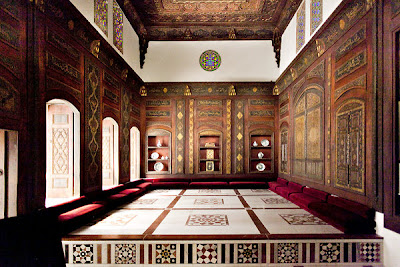
The Damascus room, from the 18th century

Placing Islamic Art on a New Pedestal

By
Published: September 22, 2011
IN one of Washington Irving’s tales from “The Alhambra,” the short-story collection that rooted the great 14th-century Moorish landmark in the American imagination, a poor Spaniard and his daughter discover a hidden chamber deep within the abandoned palace’s crumbling walls and spirit away the treasure inside.

Over the last three years in a suite of galleries concealed from public view on the second floor of the Metropolitan Museum of Art, it is as if Irving’s fable of Islam’s rich past has been unfolding in reverse. Treasures, in this case more than a thousand pieces from the museum’s extensive holdings of Islamic art, have been slowly populating newly constructed rooms, taking their places in gleaming new vitrines with Egyptian marble underfoot and mosque lamps overhead, amid burbling fountains and peaked arches framing views of 13 centuries of art history.

When this 19,000-square-foot hidden chamber is finally opened to the public on Nov. 1 with the unwieldy but academically precise new name of the Galleries for the Art of the Arab Lands, Turkey, Iran, Central Asia and Later South Asia, it will not only represent the culmination of eight years of planning and work. The reinstallation and enlargement of the collection — one of the most important outside the Middle East — also promises to stand as a watershed moment in America’s awareness of the visual culture of the Islamic world, at a time when...READ MORE

Mechthild Baumeister, right, a conservator, with Daniel Olson, a carpenter, in the new galleries.

A Spanish plaque from the late 10th or early 11th century.
READ MORE