Labels

Thursday, March 31, 2011

Twinning and Sister Cities .... PS #98

Sherri Muzher's ESCAPE TO A WORLD OF PALESTINIAN SURPRISESTwinning and Sister Cities

There are a number of world cities and towns that have “twinned” or established friendship links with Palestinian cities, towns, or refugee camps. This allows people around the world to get to know Palestinians and vice versa. For political activists, the information can also be used to lobby their respective governments about Palestine-related matters.

For example, Gaza has twinned or has a sister city relationship with Turin, Italy and Jericho is twinned with Lyon, France.

For an extensive list of “Sister Cities,” please visit: http://en.wikipedia.org/wiki/List_of_twin_towns_and_sister_cities_in_the_Palestinian_territories

"Balady"...Homegrown By Mike Odetalla

"Balady"...Homegrown

By Mike Odetalla

“Are you going to Al Aqsa today for Friday Prayers”? My mother asked. “Of course”, I replied. I wouldn’t consider not taking the opportunity to pray at the Al Aqsa when millions of my Palestinian brethren, dispersed to the four corners of the earth, or living a mere few kilometers away under occupation, can only dream of such a privilege. “After prayers, pick up some fresh fruits and vegetables, especially Faqoos (a type of cucumber that is grown in the Palestinian villages), make sure that everything you buy is “balady” (home grown Palestinian, not from the Israeli farms). “Yes mother”, I replied as I kissed her hand and walked out the door with my wife and children. Since childhood I have always kissed my mother’s hand and thus asked her blessing before leaving the house. No matter how near or far I travel, my mother’s prayers and blessings have always offered me comfort.

“Balady”, is a term that we use to label the products that are grown by the Palestinian Fellaheen (farmers): fruits and vegetables grown on small family farms and orchards; each with their unique flavor, and easily distinguished from the bland mass grown Israeli crops which have been flooding the Occupied Territories, thus endangering the survival of the Palestinian farmers. Unlike the Israeli irrigated produce, balady produce receives its only moisture from the early morning dew that gives life to the Palestinian countryside in the absence of summer rains. One can only get balady produce by using their seeds for planting. These plants, which have been grown in Palestine for centuries, have adapted to its unique soil and atmosphere. They in essence have become indigenous to Palestine. As far as I am concerned, the red soil, dew and loving tender care of working the lands by hand, all combine to produce the best tasting fruits and vegetables on the planet.

Balady fruits and vegetables are not always biggest or best looking: the hallmark of these locally grown produce is the imperfections that they carry. These imperfections have not been genetically modified out of these plants. One can easily tell the difference between what balady is and what is not simply by visual inspection. The uniform, perfect, plastic ones are definitely not balady. Their taste is bland and they tend to spoil much faster than the balady ones. All of these things, I have been taught since a young age. I was after all, a fellah child who grew up on my family’s fields and orchards. We grew every type of fruit, olives, and just about every type of vegetable. My taste buds were spoiled by my ability to pick fresh, vine ripened fruits and vegetables and eating them right there on the spot. There was never any need to scrub chemicals from the fruit that I ate off of the trees, only to rinse the dust and dirt (what harm can the soil of my homeland do to me, it could only help). We never sprayed any chemicals on our orchards or vegetables.

As I walked through the streets of the Old City, I noticed a comforting, familiar sight that the Israelis have been trying to erase for 36 years now. They have been doing everything possible, to discourage and in fact stop the Palestinian women, who come from the outlying Palestinian towns and villages to sell their homegrown fruits and vegetables. These brave women are the bedrock of Palestinian society.

The people cannot leave the villages through normal roads and must often travel back roads, hills, and other venues so that they may be able to get their produce to market in neighboring Jerusalem. The women, who endure a great deal of hardships and risk, are the ones that manage to get there. They risk much and often times have their baskets of produce, vegetables, and other items dumped and destroyed by the soldiers who come across them. Their life is not an easy one, yet they persist, like the majority of Palestinians, because they have to. This is why when I go to Jerusalem to shop; I buy whatever I could from these women. I always ask them where they're from and am often surprised at just how far they travel. Much time and effort is exerted to get their crops to market. Often, it is the family’s only source of income. I have purchased the world’s best tasting figs, apricots, plums, cucumbers, faqoos (a type of cucumber), imlookhia, and other of Palestine’s bounty from these wonderful and courageous ladies. They have a special place in my heart for their bravery, perseverance, and the patience that it takes to keep on going in the face of such oppression.

The women of Palestine are the silent soldiers of our struggle for freedom. They must be the brave face, no matter how much their loss, warm heart, and nurturing spirit from which springs forth our steadfastness. Their life is a life of much hardship, toil, and heartache, which the outside world rarely sees.

I walked to a particular lady with a basket of fresh apricots, and could not help call her, yama (Mother) for she reminded me much of my own Palestinian mother, carrying heavy baskets laden with fruit on her head as she made her way to market. We, all of my brothers and sisters, spent late afternoons in the orchards selecting and harvesting ripe fruits and placing them in the large round, goat skin wrapped baskets. Once full, we'd pick green leaves from the trees and spread them across the face of the baskets to help the fruits retain their freshness and taste until the next morning when they would be taken to market. My mother rose at dawn and prepared for her trip to Jerusalem. When there was no school, as in the summer, I went along: a skinny 7 year old boy, still in pajamas, never far from my mother's side. I carried the scale used to weigh the purchases of our customers. As the morning wore on, my mother would buy me kaaq (a kind of round sesame topped bread), some zatar (dried, powdered thyme), and oven baked eggs (much better tasting than boiled eggs). This and a cup of hot tea made breakfast. I looked forward to this special treat each time I accompanied my mother to the market in Jerusalem and its suburbs.

We usually finished selling our fruits before the hot afternoon sun reached its peak because my mother always did her best and took great steps to ensure that we were already selling as the sun was rising. She was always one of the first to get on the village bus as it made its first run of the morning to Jerusalem. It is difficult to believe how much weight she would carry on her head: her hard work and dedication to her family remains unmatched: she was the epitome of the Palestinian mother.

My mother, along with the many hardworking women of Palestine was ''independent'' before the West knew the meaning of the word. Although now well into her seventies and robbed of her mobility and movement by arthritis, she remains my hero. A Palestinian mother is unlike any other. And the women of Palestine will always have a special place in my heart and in the history of our people.

Mike Odetalla 9-2003

May Palestine and her people know true Freedom, Justice, and a lasting Peace.
Mike..."A seed in the Fruit of Palestine"
http://www.hanini.org/index.html

Growing Gardens for Palestine: Land Day & Liberation... MARCH FORTH!

from Growing Gardens for Palestine

March 31 2011 Google Image search for Growing Gardens for Palestine

I am growing old. We all are. My children are reaching adulthood and coming into their own. Our home is now a place they come back to from various adventures. Eventually they will all have their own homes and families I hope- and my home and garden will be a place they want come to visit when they can. Life moves on. Spring returns with birdsong and blooms and beautiful days where it just feels good to be alive...
Chickadee in our Maple Tree

Last year, on my Annie's New Letters (& Notes) blog I celebrated Women's History month here in America by blogging about some of my favorite Palestinian-American Artists, Writers & Poets: Artists using their talents- and their beauty inside and out- to empower Palestine and America and the Arts... and civilization itself.

Their order listed here is simply a random who ever popped up first line up as I blogged one and then another last March. All, each in their own creative ways are equally important and fascinating and well worth appreciating:

MARCH FORTH [2010]

Palestinian-American POET Ibtisam Barakat

Palestinian-American POET Naomi Shihab Nye

Palestinian-American ARTIST Samia Halaby

Palestinian-American POET Nathalie Handal

Palestinian-American writer Susan Abulhawa

Palestinian-American ARTIST Emily Jacir

Palestinian-American filmmaker Annemarie Jacir

Palestinian-American stand-up comedian Maysoon Zayid

part-Palestinian-ALL-American NOVELIST Randa Jarrar

Palestinian-American POET: Suheir Hammad

This year I widened my MARCH FORTH net to include women world wide- and men.

We are all in this together, for women's liberation is the first real step towards the liberation of all of human kind.

There are many wise and wonderful voices- too many for all to be heard. My feeble efforts to gather together some should be seen as a beginning only- certainly not the end, and not even the middle. Let a multitude of others step up to gently and compassionately and intelligently help build a positive paper trail for Palestine- and for civilization itself. Let the market place of ideas burgeon with good intentions and positive efforts as we the people everywhere help build a better future for all our children.

Sherri Muzher's new online book ESCAPE TO A WORLD OF PALESTINIAN SURPRISES

This year I have been very excited to see some very inspiring efforts for Palestine. I have watched both the American Task Force on Palestine [ATFP] and the General Delegation of the P.L.O. to the United States taking mainstream media work very seriously, listening and learning how to help redirect the conversation here in America in much more positive and helpful directions. Both compile fascinating daily round-ups of important mainstream news and opinion regarding Palestine, and both are important and reliable resources for people who care about mainstream American efforts and Palestine's future as a real nation state. I hope they both continue on with their good work.

There are also many other organizations and individuals working hard to help gather up support for Palestine- far too numerous to name, and we all have our own personal favorites and preferences. Photographs and posters and stories and songs are passed around and savored. Palestine is becoming more and more real to more and more people worldwide as the global information age opens doors and windows everywhere, in ways that could not even be imagined a generation ago. It is up to ALL of us to either help- or hinder- Palestinian efforts to build a real Palestinian state.


Home and family have been very important to me through out all my life. Luckily I live in a country where our property rights are respected- and the rule of fair and just laws helps keep the peace... AND luckily my hardworking husband has a good job which has helped empower us as parents and as citizens.

"Civic Muscle" is a tag that I started to apply to some of my Annie's New Letters (& notes) posts this past year. I saw the phrase in an article in USA Today about American youth and it really caught my attention- what a perfect way to express a very important concept, and a crucial aspect of real democracy.

Glass vase from Hebron- a gift from a friend who likes my letters & poems

MARCH FORTH! 2011

LAND DAY March 30 PALESTINE

Viewpoint: The Grass is Not Always Greener on the Other Side by Harriet Straughen for MIFTAH

Time to Make the Promise of Equality a Reality

My Letter to the Washington Post RE In Obama’s push for Mideast peace, whose side is he on? by Jackson Diehl

Israel’s Bent Neck...by Joharah Baker for MIFTAH

Hanan Ashrawi: "We deserve our freedom, we deserve our state"

German woman devoted to removing Nazi graffiti

Riz Khan - The Arab Street

Women against fundamentalism and for equality | The Elders

Joharah Baker: Palestinian Women Deserve Celebration

Palestinian Women: Narrative Histories and Gendered Memories... & more from This Week in Palestine

Specialized radio station promotes rights of Palestinian women

The Arab Woman You Don't See...

My letter to the Economist RE Israel's Jewish identity. The state we're in

Why Settlements must Go By Joharah Baker for MIFTAH

Sherri Muzher's ESCAPE TO A WORLD OF PALESTINIAN SURPRISES

Michelle Bachelet: “Think of how much more we can do once women are fully empowered as active agents of change and progress within their societies...”

Kim Barker: "Most journalists just don’t report it"

Professor Hala Nassar leaving Yale: “As for me, if I’ve been persecuted or not,” Nassar said. “I’ll keep it to myself.”

Reem Kelani's ululations ... Tahrir Square, Cairo, Friday 11th February

"International human rights law and international humanitarian law are not negotiable. No individual or state can be considered exempt..."

UNWRA's Isabel de la Cruz: "I take aim and shoot all over the place, looking for the human inspiration for our “Peace starts here” campaign."

Planting Eden

Suheir Hammad: Poems of war, peace, women, power | Video on TED.com

Ask a Name... a poem by Anne Selden Annab in Growing Gardens for Palestine

Threads of Identity: Preserving Palestinian Costume and Heritage

[2010] Celebrating Women's History Month by celebrating some GREAT Palestinian-American Artists, Writers & Poets


Yesterday was Land Day for Palestine. I did what I could to help honor and empower Palestine by searching the Internet to find inspiring information and images to blog. And today, in Growing Gardens for Palestine I am celebrating women's liberation as an important part of progress for all people- regardless of race, religion or gender.... or nationality.

Roses- a recent Valentine's Day gift from my husband Jaffar

Long ago, when I was a young and I fell in love with my husband Jaffar I was working full time in a bookstore. I really liked that job. I liked working with books, and I liked helping people find the perfect book. I also liked learning how a business is run- learning many lessons really about life. Lessons I've been able to translate into helping build a good marriage and life for our family. When I married my husband I had no idea what life would bring, both the challenges and the pleasures- nor did I know how much more I would love him as time goes by and we find ourselves growing old together.

Everywhere on earth young people are falling in love, getting married, making a life and a home together. Many (but not all) will soon enough be totally busy with the challenging task of raising children... and growing gardens of their own, each in their own unique way.

Time Magazine: A New Palestinian Movement: Young, Networked, Nonviolent

A New Palestinian Movement: Young, Networked, Nonviolent

Fadi Quran is the face of the new Middle East. He is 23, a graduate of Stanford University, with a double major in physics and international relations. He is a Palestinian who has returned home to start an alternative-energy company and see what he can do to help create a Palestinian state. He identifies with neither of the two preeminent Palestinian political factions, Hamas and Fatah. His allegiance is to the Facebook multitudes who orchestrated the overthrow of Hosni Mubarak in Egypt and who are organizing nonviolent protests throughout the region. In the Palestinian territories, the social-networking rebels call themselves the March 15 movement - and I would call Quran one of the leaders of the group except that it doesn't really have leaders yet. It is best described as a loose association of "bubbles," he says, that hasn't congealed. It launched relatively small, semisuccessful protests in the West Bank and Gaza on the aforementioned March 15; it is staging a small, ongoing vigil in the main square of Ramallah. It has plans for future nonviolent actions; it may or may not have the peaceful throngs to bring these off.

I meet with Quran and several other young Palestinians at the local Coca-Cola Bottling Co. headquarters in Ramallah, which tells you something important about this movement: we are not meeting in a mosque. I've known one of them, Fadi El-Salameen, for five years. He was an early volunteer for the Seeds of Peace program, which intermingled Palestinian and Israeli teenagers at a summer camp in Maine. In recent years, El-Salameen has spent much of his time in the U.S. and has achieved a certain prominence - he is quietly charismatic, a world-class networker, the sort of person who is invited to international conferences - but he is now spending more time at home in Hebron, organizing the March 15 movement in the West Bank's largest city. "I met some of the leaders of the Tahrir Square movement at a conference in Doha," he tells me. "They don't fit the usual profile of a 'youth leader.' They are low-key, well educated but not wealthy. They are figuring it out as they go along, trying to figure out what works." (See "Growing Up Palestinian in the Age of the Wall.") ....READ MORE

Wednesday, March 30, 2011

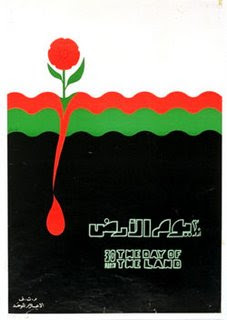
Palestine... Flower of the Land

General Delegation of the P.L.O. to the United States: Land Day for Palestine

March 30th 2011

On March 30th 1976, Palestinians that remained in the newly founded state of Israel after 1948, revolted against Israeli discriminatory policies. Six Palestinians were shot dead and dozens wounded. Today, Palestinians all over the world commemorate “Land Day” to sending a clear message to the Israeli government that our bond to the land of our ancestors is unbreakable. This year, Land Day coincides with the approval by the Israeli Knesset of new discriminatory laws against the Palestinian citizens of Israel. These new laws add are compounded by similar laws that have gone into effect over the years which went unnoticed by “advocates" of democracy and human rights here in Washington. One of these recently approved laws bans Palestinians from celebrating national occasions and threatens to deny Palestinians their government privileges if they do not show allegiance to the state’s religious and cultural character, violating basic human and civil rights.

This year's Land Day should be an occasion for all Palestinians to show unity and to end their divisions. Recognizing new changes in the Middle East, there is an urgent need for the Palestinian people to rise to the challenge of uniting their ranks and confront Israeli government policies. There is no better answer to Israel's attempts to undermine our existence in Palestine but through forging a united front. The quest for Palestinian self-determination and independence must be a guiding light for all Palestinians, in Palestine and the Diaspora. It is time that we bury our differences and focus on the threat posed by shameful Israeli policy.

The General Delegation of the PLO to the United States salutes the struggle of our brethren inside Israel who are fighting for equality and dignity. We also salute the struggle of our people in the Occupied Territories, particularly in East Jerusalem, who are standing up to the Israel occupation. Finally, we salute our steadfast people in the Gaza Strip who are under siege by an inhumane occupation which prevents food and supplies from reaching them. Let this year's Land Day be the beginning of the end of all divisions and the beginning of a united Palestinian campaign to establish our independent state with Jerusalem as its capital and a just and agreed resolution to the fate of Palestinian refugees based on UNGA resolution 194.

BDS Flash Mob in Grand Central Station, NYC

LAND DAY March 30 PALESTINE

LIFE MAGAZINE: DEIR EL-BALAH REFUGEE CAMP, GAZA STRIP - MARCH 31: Palestinian school children plant olive trees in land near the Israeli/jewish settlement of Ghosh Qateef, March 31, 2004 in the refugee camp of Deir al-Balah, Gaza Strip. The olive planting took place during a protest commemorating the 28th anniversary of Land Day. Land Day marks the series of clashes between Israeli Arabs and Israeli police that erupted on March 30, 1976 when Israeli Arabs protested the Israeli government's confiscation of Arab land.

The Day of the Land
Land Day is the day when Israeli Arabs hold demonstrations to mark the loss of their land to Israel in 1948.

It is held on 30 March in commemoration of six Arabs killed by Israeli security forces in 1976 during mass protests against the farm confiscations in the Galilee.

Plans to confiscate land near the Sea of Galilee were announced in 1976
BBC Remembering Land Day


A view of Arraba from the road leading to its northern limit


Fellahat from Battir taking produce to market (1910)

“Compared to the large-scale land expropriations from the 1950′s and 60′s, the amount of land actually seized from Palestinians in 1976 was relatively small.” Rabinowitz & Baker, Coffins on Our Shoulders

Land Day - Palestine


Land Day Remembered
Date posted: March 30, 2011
By MIFTAH

Thirty-five years ago, six Palestinians from the Galilee in what is now northern Israel lost their lives in a bid to protect their land from confiscation. Today, Palestinians everywhere commemorate what has come to be known as Land Day.

Since that day, March 30, 1976, thousands of other Palestinians have lost their lives defending the same cause. At the time, Israeli authorities seized and expropriated 5,500 acres of land from Palestinian villages in the Galilee to expand Jewish settlements in the area. Residents of the villages organized a general strike and peaceful demonstrations in protest of the expropriations and the ongoing confiscation and settlement of Palestinian land.

Israeli authorities, wanting to quell any sign of nationalism and resistance, cracked down hard on the protesters, shooting and killing six men. Nearly 100 others were injured and over 300 people arrested that day.

Land Day has since been marked as a day of remembrance for those who were killed and also a day of protest against Israel’s ongoing policy of Palestinian land expropriation. Land Day also marks the first time Palestinians who remained inside the Green Line after Israel was established rose up in unison against Israel’s expansionist policies.

Today, Palestinians continue to fight for their land despite international calls for a settlement to the conflict and the establishment of a Palestinian state. With the separation wall in the West Bank continuing to grow and taking huge chunks of occupied Palestinian land with it, Palestinians everywhere are acutely aware that the events which set Land Day into motion are still in play today. Still, we remember the fallen and all those before and after them who vowed to defend Palestine and we renew that vow with each anniversary.

Viewpoint: The Grass is Not Always Greener on the Other Side by Harriet Straughen for MIFTAH


The Grass is Not Always Greener on the Other Side

Date posted: 30/03/2011

By: Harriet Straughen for MIFTAH

The other day I was checking through the morning headlines and came across a particular story that both saddened and disturbed me. A young girl of 12 had been walking through the sun, on her way to pray with her friends. As had become routine for the people in her village, she and her friends had to walk past an army patrol set up by the occupying forces. Nearby her father was cutting the grass and tidying up. Moments later, he heard shots ringing out. As he ran round the corner, the soldiers at the checkpoint had shouted abuse, jibing: “What do you think you are doing? You're only the grass-cutter.” At the tragic scene, he found his daughter dying on the ground having been shot twice in the back.

In the trial that followed, the soldier who pulled the trigger was eventually acquitted due to his story that he had been reacting to a sniper attack. There was no independent evidence to support this.

The little girl who died was Majella O’Hare and the year was 1976. The story comes from Northern Ireland and the soldier who shot her was a young British private. It is only now, 35 years later, that the British government has issued an apology to her mother.

An uncomfortable realization occurred after reading this story. Even though I was aware of the history of the Northern Ireland conflict and the unacceptable behavior of the British military during their occupation of the area, it had never really penetrated my consciousness. Such was my ignorance that up until now I had been unaware that the British had established checkpoints in Northern Ireland. It is perhaps significant that I read this story while in the West Bank. The similarities between the two situations and the connection that I made may never have occurred to me had I not been witness to the other side of the conflict. While British, and particularly English, history tells the story from the perspective of the occupier, here I am privy to the life of the occupied.

It is a tough pill to swallow to acknowledge that those in my parents’ generation may have felt similarly towards Northern Ireland and the threat of “terrorism” as many Israelis feel towards Palestinians today. My mother and father lived in London at the time of the IRA bombs and I’m sure it is safe to say that the majority of the British public felt it was justifiable and even necessary to maintain a military presence in Northern Ireland without really knowing what that meant for the civilians.

This has got me to think about how the British people, particularly the older generations, feel towards the Israeli-Palestinian conflict. It is not hard to imagine that those who witnessed armed attacks by the IRA and who, at the time, were concerned for their safety and security, may feel somewhat sympathetic to the Israeli point of view. After all, many in Britain have only been on the occupier side of the fence. As with all people, you are more likely to understand and agree with something to which you can relate.

From what I can tell, the general British public was not, and is not, aware of the full horror of occupation in Northern Ireland and, in the same token, Palestine. It is only through shocking stories such as that of Majella O’Hare that people are awoken to what is really going on ‘on the other side’ of the fence. It is Majella’s story that, for the first time, has brought the reality of the Northern Irish conflict home to me.

Through this uncomfortable realization, the determination to ensure such stories are told is intensified. As more and more people become aware of the terrible and often tragic circumstances that arise from military occupation, the more likely they are to see it from all sides, not just the one they personally relate to. It is not only about Northern Ireland or Palestine but about children and innocent civilians suffering for the ‘security’ of a powerful nation. Whether it is Majella’s story from over 30 years ago, or the equally disturbing stories coming out of Palestine today, it is only through information and understanding that people can start to change perceptions and begin to influence those who make the decisions and put an end to such tragedy.

Harriet Straughen is a Writer for the Media and Information Department at the Palestinian Initiative for the Promotion of Global Dialogue and Democracy (MIFTAH). She can be contacted at mid@miftah.org.

Monday, March 28, 2011

CIVICUS: World Alliance for Citizen Participation

CIVICUS: World Alliance for Citizen Participation is an international alliance of members and partners which constitute an influential network of organisations at the local, national, regional and international levels, and span the spectrum of civil society including: civil society networks and organisations; trade unions; faith-based networks; professional associations; NGO capacity development organisations; philanthropic foundations and other funding bodies; businesses; and social responsibility programmes. CIVICUS has worked for over a decade to strengthen citizen action and civil society throughout the world, especially in areas where participatory democracy and citizens' freedom of association are threatened. CIVICUS has a vision of a global community of active, engaged citizens committed to the creation of a more just and equitable world. This is premised on the belief that the health of societies exists in direct proportion to the degree of balance between the state, the private sector and civil society. CIVICUS provides a focal point for knowledge-sharing, common interest representation, global institution-building and engagement among these disparate sectors. It acts as an advocate for citizen participation as an essential component of governance and democracy worldwide. CIVICUS seeks to amplify the voices and opinions of ordinary people and it gives expression to the enormous creative energy of the burgeoning sector of civil society.

Mission:
CIVICUS is an international alliance dedicated to strengthening citizen action and civil society throughout the world.

Vision:
A worldwide community of informed, inspired, committed citizens engaged in confronting the challenges facing humanity.

CIVICUS seeks to amplify the voices and opinions of ordinary people. It recognizes that for effective and sustainable civic participation to occur, citizens must enjoy rights of free association and be able to engage all sectors of society.

Values:

  • Justice and Equality - CIVICUS believes in the equality and dignity of every person, and that all people should be free to exercise their rights as citizens as defined in the Universal Declaration of Human Rights.
  • Reciprocity - CIVICUS exists to ensure that people treat one another with the respect with which they themselves wish to be treated. Civil society cannot thrive without mutual respect.
  • Knowledge - CIVICUS recognises that to increase its global awareness of civil society and before it can assist or take action, it needs to form alliances with other concerned bodies to increase its influence and knowledge.
  • Vision - CIVICUS is realistic about conflict in today's world, but remains optimistic that most people, organisations, governments and businesses will work together for the benefit of all.
  • Principled Courage - CIVICUS will always promote civil justice and pledges to act in a manner that honours the principles of democratic civil society.

Objectives:
The three main objectives that inform our mission are:

  • Civic Existence - to promote the rights of citizens to organise and act collectively towards defined goals for the public good.
  • Civic Expression - to increase the effectiveness and improve the governance of civil society organisations, as well as their capacity to set and achieve their individual and collective goals.
  • Civic Engagement - Engagement - to foster interaction between civil society and other institutions in order to increase the voice of citizens in public life.

Staff Members

Board of Directors

Time to Make the Promise of Equality a Reality

http://www.everyhumanhasrights.org/human-rights-news/189-international-womens-day-2011-time-to-make-the-promise-of-equality-a-reality
International Women's Day, 2011: Time to Make the Promise of Equality a Reality
Message by Michelle Bachelet, Executive Director, UN Women

A hundred years ago today, women across the world took an historic step on the long road to equality. The first ever International Women’s Day was called to draw attention to the unacceptable and often dangerous working conditions that so many women faced worldwide. Although the occasion was celebrated in only a handful of countries, it brought over one million women out onto the streets, demanding not just better conditions at work but also the right to vote, to hold office and to be equal partners with men.

I suspect those courageous pioneers would look at our world today with a mixture of pride and disappointment. There has been remarkable progress as the last century has seen an unprecedented expansion of women’s legal rights and entitlements. Indeed, the advancement of women’s rights can lay claim to be one of the most profound social revolutions the world has seen.

One hundred years ago, only two countries allowed women to vote. Today, that right is virtually universal and women have now been elected to lead Governments in every continent. Women, too, hold leading positions in professions from which they were once banned. Far more recently than a century ago, the police, courts and neighbors still saw violence in the home as a purely private matter. Today two-thirds of countries have specific laws that penalise domestic violence and the United Nations Security Council now recognises sexual violence as a deliberate tactic of war.

But despite this progress over the last century, the hopes of equality expressed on that first International Women’s Day are a long way from being realised. Almost two out of three illiterate adults are women. Girls are still less likely to be in school than boys. Every 90 seconds of every day, a woman dies in pregnancy or due to childbirth-related complications despite us having the knowledge and resources to make birth safe.

Across the world, women continue to earn less than men for the same work. In many countries, too, they have unequal access to land and inheritance rights. And despite high-profile advances, women still make up only 19 per cent of legislatures, 8% of peace negotiators, and only 28 women are heads of state or government.

It is not just women who pay the price for this discrimination. We all suffer for failing to make the most of half the world’s talent and potential. We undermine the quality of our democracy, the strength of our economies, the health of our societies and the sustainability of peace. This year’s focus of International Women’s Day on women’s equal access to education, training, science and technology underscores the need to tap this potential.

The agenda to secure gender equality and women’s rights is a global agenda, a challenge for every country, rich and poor, north and south. It was in recognition of both its universality and the rewards if we get this right that the United Nations brought together four existing organizations to create UN Women. The goal of this new body, which I have the great privilege to lead, is to galvanize the entire UN system so we can deliver on the promise of the UN Charter of equal rights of men and women. It is something I have fought for my whole life.

As a young mother and a pediatrician, I experienced the struggles of balancing family and career and saw how the absence of child care prevented women from paid employment. The opportunity to help remove these barriers was one of the reasons I went into politics. It is why I supported policies that extended health and childcare services to families and prioritized public spending for social protection.

As President, I worked hard to create equal opportunities for both men and women to contribute their talents and experiences to the challenges facing our country. That is why I proposed a Cabinet that had an equal number of men and women.

As Executive Director of UN Women, I want to use my journey and the collective knowledge and experience all around me to encourage progress towards true gender equality across the world. We will work, in close partnership, with men and women, leaders and citizens, civil society, the private sector and the whole UN system to assist countries to roll out policies, programs and budgets to achieve this worthy goal.

I have seen myself what women, often in the toughest circumstances, can achieve for their families and societies if they are given the opportunity. The strength, industry and wisdom of women remain humanity’s greatest untapped resource. We simply cannot afford to wait another 100 years to unlock this potential.

* About the author: Michelle Bachelet is the first Executive Director of UN Women, a newly formed UN organization dedicated to gender equality and the empowerment of women. She is the former President of Chile.


EVERY HUMAN HAS RIGHTS

My Letter to the Washington Post RE In Obama’s push for Mideast peace, whose side is he on? by Jackson Diehl

RE: In Obama’s push for Mideast peace, whose side is he on? by Jackson Diehl
http://www.washingtonpost.com/opinions/in-obamas-push-for-mideast-peace-whose-side-is-he-on/2011/03/24/AFdkaikB_story.html

Dear Editor,

In glancing at the Mideast and peace- whose side is the Washington Post's
Deputy Editorial Page Editor Jackson Diehl on? Certainly not America's... and certainly not on the side of full disclosure when it comes to his pet project Israel. Reading Diehl's columns it is impossible to see even a glimpse of the well known fact that Israel has been investing in institutionalized bigotry and injustice for decades- and harshly oppressing and punishing the Palestinians because they dare object.

One example out of many: Israel has been persistently expanding an "Israeli-only road network in the West Bank to ease travel for [Jewish] settlers, while continuing to restrict Palestinian movement with checkpoints, roadblocks, earthmounds, earth walls, road gates, road barriers and trenches"
Israel bulldozes Fayyad's Freedom Road, again

How many more Palestinian homes will Israel demolish- how many more Palestinian men, women and children will be pushed into poverty- and forced exile- while pro-Israel pundits spin America away from understanding and believing in Palestine and a secular two state solution.

Sincerely,
Anne Selden Annab

"
Just as a reminder, the Nakba is how Palestinians refer to the period in which Israel was created. While Israeli Jews celebrate the birth of their new homeland, the Palestinians mourn the loss of their loved ones, their homes, their land and their flight into exile. Tens of thousands of Palestinians were killed and over 800,000 Palestinians fled the fighting and massacres perpetrated by Jewish gangs in the months leading up to May 15, 1948, never to return. Over 400 Palestinian villages were razed to the ground to make way for the newly arrived Jewish immigrants from Europe. Palestinians who left their homes, thinking it was a temporary alternative to being slain in their own beds, would end up in squalid refugee camps in neighboring Arab countries and in the West Bank and Gaza, never to return. Sixty-plus years later, refugees, their descendants and Palestinians still living in Israel whose original villages and homes were destroyed or usurped still commemorate that day by remembering the ongoing injustice that history has never rectified.

This seems reasonable within the freedoms provided by a “democratic state”. It also seems reasonable in light of Israel’s rampant attacks against anyone who questions the plight of Jews throughout history, namely those it likes to call “Holocaust deniers”. Surely, Israel would not want to be viewed in a light similar to those it so ardently criticizes?" Israel’s Bent Neck...by Joharah Baker for MIFTAH


The Golden Rule: Do unto others as you would have them do unto you