Labels

Tuesday, February 8, 2011

A Palestinian woman paints the national flag of Palestine on the face of a young boy to mark the Eid al-Adha holiday in the West Bank city of Hebron. Palestinians are pressing the UN Security Council to pass a resolution that they say attacks the "cancer" of Israel's occupied-territory settlements. (AFP/File/Hazem Bader)

The outline of Barack Obama is seen between the Israeli and American flags while speaking at an event to honor the 60th anniversary of Israel's independence in Washington, DC. The deadlocked Israeli-Palestinian peace process was not mentioned in Obama's State of the Union speech this week and the Palestinians and others want to know what the US Middle East strategy is. (AFP/Getty Images/File/Mark Wilson)

** TO GO WITH ARAFAT MUSEO ** In this photo taken Nov. 9, 2010, the keffiyeh, a Toshiba transistor radio and a copy of the Quran that curators say was used by late Palestinian leader Yasser Arafat are displayed in the Yasser Arafat Foundation office in the West Bank city of Ramallah. Six years after his Nov. 11, 2004 death, the keepers of Arafat's memory are still gathering and sifting through his belongings, including pistols and trademark sunglasses from his guerrilla years and the military-style suits he favored until the end (AP Photo/Majdi Mohammed)

FILE - In this Thursday, Sept. 29, 2005 file photo, an elderly Palestinian woman casts her ballot in municipal elections at a polling station in the West Bank village of Beit Fagar near Bethlehem. The Western-backed Palestinian government in the West Bank said Tuesday it will hold local council elections 'as soon as possible.' The move appeared to be a response to unrest in Egypt, where demonstrators have staged days of rallies against the authoritarian regime.(AP Photo/Kevin Frayer, File)

A Palestinian watches news from Egypt on television inside his shop in Jerusalem's Old City, Thursday, Feb. 3, 2011. (AP Photos/Bernat Armangue)

Palestinians smoke water pipes as they watch news from Egypt on television in Jerusalem's Old City, Thursday, Feb. 3, 2011 (AP Photos/Bernat Armangue)

French Foreign Affairs Minister Michele Alliot-Marie (2nd L) attends a working dinner with European Union's High Representative for Foreign Affairs and Security Policy Catherine Ashtonat (4th R) and Palestinian Prime Minister Salam Fayyad (3rd R) during the Paris International Conference of Donors for the Palestinian State at the Quai d'Orsay in Paris February 3, 2011. REUTERS/Gonzalo Fuentes (FRANCE - Tags: POLITICS)
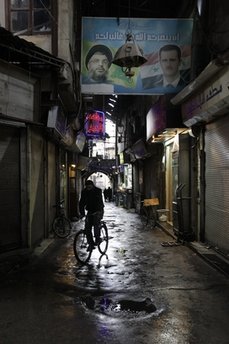
Bashar Assad A Syrian man, rides his bicycle under a poster show a portrait of Syrian President Bashar Assad, rignt, and Hezbollah leader sheik Hassan Nasrallah, left, at a popular market in old Damascus, Syria, Friday Feb. 4, 2011. Campaigns on Facebook and Twitter have called for a 'day of rage' in Damascus on Friday and Saturday. But by early afternoon there were no signs of protesters anywhere in the capital. Worshippers performed Friday prayers in mosques across the city and carried on life as normal. Human Rights Watch quoted witnesses as saying Syrian security forces have been intimidating people in recent days who have tried to assemble to support the protesters in Egypt. The Arabic words in the poster above read: 'With God's help no one can conquer you'. (AP Photo/Hussein Malla)

Palestinians protestors hold Egyptian flags as they run amidst tear gas smoke during a protest against Israel's separation barrier in the West Bank village of Bilin near Ramallah, Friday, Feb 4, 2011. (AP Photo/Nasser Ishtayeh)

A Palestinian protester shouts slogans during a demonstration in support for Egyptian protesters in the West Bank city of Ramallah February 5, 2011 REUTERS/Mohamad Torokman (WEST BANK - Tags: CIVIL UNREST POLITICS)

Former Israeli soldier Anat Kamm File - In this photo taken on Tuesday, Jan. 26, 2010, file photo, former Israeli soldier Anat Kamm, who has been under house arrest since December 2009, attends a court hearing in Tel Aviv, Israel. A former Israeli soldier has signed a plea bargain agreement in which she admits to passing secret documents to a newspaper reporter. Kamm copied more than 2,000 military documents when she served as a clerk in a general's office. Some of them related to the military's policy of targeted killings of Palestinian militants. In 2008 she gave them to a journalist for the daily Haaretz. Kamm was arrested in 2010 and remains under house arrest. Israeli authorities said the documents could have endangered the lives of Israeli soldiers, and initially charged her with espionage and harming state security. Sunday's plea bargain included lesser but still serious charges of collecting and passing on secret information. Kamm's jail sentence has yet to be decided by the court. (AP Photos / David Bachar) ISRAEL OUT

Palestinian children sweep water after rain showers in the West Bank village of Beit Ijza, near Jerusalem February 7, 2011 REUTERS/Mohamad Torokman (WEST BANK - Tags: ENVIRONMENT SOCIETY)

FILE- In this photo dated Wednesday, May, 25, 2010, Queen Rania of Jordan walk pass a Bedouin guard of honor during an official reception to mark the 64th anniversary of Jordan's Independence Day in Amman, Jordan. Members of Jordan's major Bedouin tribes warned Monday feb. 7, 2011 of a Tunisia or Egypt-style revolt in the country if the U.S.-backed ruler does not speed up political reforms.(AP Photo/ Nader Daoud, File)

Tourists take photographs outside the Church of Nativity, traditionally believed by many Christians to be the birthplace of Jesus Christ, in the West Bank town of Bethlehem, Monday, Feb. 7, 2011. The Palestinian Authority said Monday it has asked the U.N.'s cultural agency in January to designate the church built at the traditional birth site of Jesus as the first world heritage site in the Palestinian territories. (AP Photo/Nasser Shiyoukhi)

FILE - In this Friday, Dec. 24, 2010 file photo, Catholic pilgrims pray inside the Grotto of the Church of Nativity, traditionally believed by many Christians to be the birthplace of Jesus Christ, in the West Bank town of Bethlehem. The Palestinian Authority said Monday, Feb. 7, 2011, it has asked the U.N.'s cultural agency in January to designate the church built at the traditional birth site of Jesus as the first world heritage site in the Palestinian territories. (AP Photo/Dimitri Messinis, File)

Israeli bulldozers demolish the Hotel Shepherd complex in east Jerusalem's Sheikh Jarrah neighbourhood to make way for 20 new homes for Jewish settlers. The city council has approved plans for construction of 16 new apartments by a Jewish settlement group in the Sheikh Jarrah district of Israeli-annexed east Jerusalem. (AFP/File/Ahmad Gharabli)

A Palestinian woman stands at the door of a house in the east Jerusalem neighborhood of Sheikh Jarrah, Monday, Feb. 7, 2011. Jerusalem officials on Monday pushed forward plans to build new Jewish housing in the Arab neighborhood of Sheikh Jarrah in east Jerusalem, drawing swift condemnation from Palestinians who see it as encroaching on land they seek for a future state. (AP Photo/Michal Fattal)

A Palestinian woman looks on as a man cuts dry branches outside his house in the east Jerusalem neighborhood of Sheikh Jarrah, Monday, Feb. 7, 2011. Jerusalem officials on Monday pushed forward plans to build new Jewish housing in the Arab neighborhood of Sheikh Jarrah in east Jerusalem, drawing swift condemnation from Palestinians who see it as encroaching on land they seek for a future state. (AP Photo/Michal Fattal)

A Palestinian girl walks in a street in the east Jerusalem neighborhood of Sheikh Jarrah, Monday, Feb. 7, 2011. Jerusalem officials on Monday pushed forward plans to build new Jewish housing in the Arab neighborhood of Sheikh Jarrah in east Jerusalem, drawing swift condemnation from Palestinians who see it as encroaching on land they seek for a future state. (AP Photo/Michal Fattal)

U.N. High Commissioner for Human Rights Navi Pillay, left, speaks with Palestinian President Mahmoud Abbas during their meeting in the West Bank city of Ramallah, Monday, Feb. 7, 2011
(AP Photo/Mohamad Torokman, Pool)

In this photo taken Jan. 27, 2011, Hatem Abudayyeh poses outside the office of the Arab American Action Network on Chicago's South Side. In his first in-depth interview since agents hauled bank statements, computers and even family photos from his Chicago condominium last year, Abudayyeh tells The Associated Press he believes investigators singled him out because he organized trips for Americans to Palestinian areas.(AP Photo/Charles Rex Arbogast)

French fashion designer Christian Lacroix (R) and Widad Kawar, a collector of Jordanian and Palestinian ethnic and cultural arts, visit the exhibition (FRANCE - Tags: SOCIETY FASHION)

Palestinian festive dresses are presented at the exhibition (FRANCE - Tags: SOCIETY FASHION)

Planting Eden

Planting Eden

P
arents
l
et
sunshine
till
into
nostalgia
evermore

Planting Eden
anew
life
evolves
swings
tree to tree
in monkey
nimble
evasiveness

P
a
l
e
s
t
i
n
enitselaP Palestine

P i n e
a n
l i
e t
s o s
t e
i l
n a
e n i t s e l a P


copyright ©2011 Anne Selden Annab

Saturday, February 5, 2011

The Best Investment

The Best Investment
By NANCY GIBBS Monday, Feb. 14, 2011
"The benefits are so obvious, you have to wonder why we haven't paid attention. Less than 2¢ of every development dollar goes to girls--and that is a victory compared with a few years ago, when it was more like half a cent. Roughly 9 of 10 youth programs are aimed at boys. One reason for this is that when it comes to lifting up girls, we don't know as much about how to do it. We have to start by listening to girls, which much of the world is not culturally disposed to do. Development experts say the solutions need to be holistic, providing access to safe spaces, schools and health clinics with programs designed specifically for girls' needs. Success depends on infrastructure, on making fuel and water more available so girls don't have to spend as many as 15 hours a day fetching them. It requires enlisting whole communities--mothers, fathers, teachers, religious leaders--in helping girls realize their potential instead of seeing them as dispensable or, worse, as prey.

A more surprising army is being enlisted as well. A new initiative called Girl Up girlup.org aims to mobilize 100,000 American girls to raise money and awareness to fight poverty, sexual violence and child marriage. "This generation of 12-to-18-year-olds are all givers," says executive director Elizabeth Gore, the force of nature behind the ingeniously simple Nothing but Nets campaign to fight malaria, about her new United Nations Foundation enterprise. "They gave after Katrina. They gave after the tsunami and Haiti. More than any earlier generation, they feel they know girls around the world."

What Influence Does Washington Have in the Arab World?

Photo: AP... Anti-government protesters react in Tahrir Square, Cairo, Egypt, February 4, 2011

"Many analysts, such as Fawaz Gerges with the London School of Economics, said in the long term, irrespective of U.S. influence or lack thereof, people in Arab countries in the Middle East will determine their own fate - as is the case in Egypt.

"The future of Egypt will be determined by Egyptians," said Gerges. "There is a new reality in politics in the Middle East. The new reality is people are becoming empowered, they realize that the oppressive status quo has done a great deal of damage to their society, to their reputation, to their economy. The United States has limited options, even though the United States can be a force for stability by trying to convince and nudge its allies - that is they must respect the new reality of politics in the Middle East."

Gerges said the new reality is all about pluralism. "It's about institution building. It's about bread and butter. It's about freedom. In the long term, I would say that America's strategic interests are served, will be served, by the new reality, in particular if the new awakening is consolidated in institutional building and pluralistic government."

In the final analysis, Aaron David Miller said let's not overstate American influence in the Arab world.

"Look, we have to get a grip and understand one thing - we don't manage history," said Miller. "Reinhold Niebuhr [American theologian] said you can't control and manage history. And we have to get used to that fact."

Describing the Middle East, Miller says "you have a broken, dysfunctional region that is going to take years to repair - and it cannot be repaired from the outside.""

http://www.voanews.com/english/news/middle-east/-What-Influence-Does-Washington-Have-in-the-Arab-World-115324079.html?c=y&pollSubmitted=y#pollAnchor&mr=1&oid=4&pid=114857954&cid=8500664

Wednesday, February 2, 2011

1,500-year-old church found in the Holy Land

A boy walks on a pile of dirt and rubble dug from an archaeological site where an ancient church was found in Hirbet Madras, central Israel, Wednesday, Feb. 2, 2011. (AP Photo/Ariel Schalit)

A view of a mosaic in the archaeological site where an ancient church was found in Hirbet Madras, central Israel, Wednesday, Feb. 2, 2011. (AP Photo/Ariel Schalit)

Amir Ganor of the IAA (Israel Antiquities Authority) stands at the archaeological site where an ancient church was found in Hirbet Madras, central Israel, Wednesday, Feb. 2, 2011. (AP Photo/Ariel Schalit)

A detail of a mosaic in the archaeological site where an ancient church was found in Hirbet Madras, central Israel, Wednesday, Feb. 2, 2011. (AP Photo/Ariel Schalit)

A view of a mosaic in the archaeological site where an ancient church was found in Hirbet Madras, central Israel, Wednesday, Feb. 2, 2011. (AP Photo/Ariel Schalit)

Amir Ganor of the IAA (Israel Antiquities Authority) shows a mosaic in the archaeological site where an ancient church was found in Hirbet Madras, central Israel, Wednesday, Feb. 2, 2011. (AP Photo/Ariel Schalit)

A detail of a mosaic in the archaeological site where an ancient church was found in Hirbet Madras, central Israel, Wednesday, Feb. 2, 2011. Israeli archaeologists say they have uncovered a 1,500-year-old church, including an unusually well-preserved mosaic floor with images of lions, foxes, fish and peacocks. According to Amir Ganor of the IAA (Israel Antiquities Authority) the church in the hills southwest of Jerusalem was active between the fifth and seventh centuries A.D. (AP Photo/Ariel Schalit)

Tuesday, February 1, 2011

This Weeek in Palestine Artist of the Month: Mohammed Amous

Message From the Editor
We are in the midst of a deepening crisis. I am not referring to the political situation - which is, in fact, deepening and which does not show any sign of a breakthrough - nor am I talking about the economic situation - which remains quite precarious, locally and globally. I am referring to the water situation: the lack of rainfall this winter (we are already halfway through it). Precipitation so far has been barely a third of what this country normally gets, which is not much to begin with.

The cost of water to private citizens has increased significantly in the last year, and it is expected to go up by another 18 percent soon. In addition, the tax levied on those who consume water beyond their allotted quota may be re-introduced, in the hope of severely curtailing water consumption. The first to suffer will be private gardens and public parks, whose irrigation will become exorbitantly high. This is all too sad, given the already dry landscape around us. One cannot help but wonder at the paradoxical situation in the world when one sees the floods and torrential rains that other countries are experiencing.

This issue is dedicated to Palestinian children, who make up an important chunk of the population. A solid nation starts with the education and care lavished on its children. It is therefore important that we put in place institutions that care for their education and well-being. Besides good schools, cultural institutions, libraries, museums, sports complexes, and parks (preferably not dry ones!) are a must. We also need to care for the less privileged among us, those who suffer from physical or mental handicaps. Given the proper attention and care, they may get along with the rest of us and even excel. I invite you to read the many articles that focus on education, children’s rights, sexual abuse, and caring for disabled children, among many others.

Children are our future, so it is important that we take good care of them to secure our legacy and make sure it lives on.

Tony A. Khoury
Editor-in-chief
Artist of the Month
Variety has always been the key for Mohammed Amous. Cutting-edge graphic design combined with a love of classical illustration. His subject material has ranged from Sesame Street to mental health campaigns. His client list jumps from youth activism groups to the United Nations. The journey through various projects has informed a career that has developed through experimentation.

From the tender age of six he was sketching regularly, first imitating the works of great Palestinian artists such as Ismail Shamout, before moving on to depict resistance characters as was artistic custom during the mid 1970s.


“The appreciation and support of others encouraged me,” he recalls, and his passion and skill developed through his school years, so much so that after graduating he was offered the opportunity to participate in a prestigious art course at New Jersey College in the United States. It proved a bittersweet moment, as a lack of funding prevented him from obtaining the required visa. Instead he enrolled at Bethlehem University, and instead of art, he found himself studying math and physics.


Amous discovered that the disciplines were complementary, that his new subject matter gave him an “understanding of space” that proved valuable for his artwork. “The teachers would talk about equations and then I would draw them on a board,” he told us.


His first professional works came in the form of illustrations for children’s books, which allowed him to build a reputation for flair and creativity. Following a 1991 diploma in illustration and graphic design, convened by his long-term employers at Turbo Design, he embarked on a career that took in working for some of the region’s most prestigious media institutions and international groups. Amous most enjoys “working for a large audience, which makes me more motivated, professional, and creative.”


His client list includes UNICEF, The World Bank, the Ministry of Health, and the Palestinian National Theatre, and he has learnt from all of their subjects, including health issues and finance. His affinity with children has the deepest roots. He tells us that children were the catalyst for change from his early militaristic art. “When you work for children you realise that you can’t have this subject. You teach yourself to dream again, to learn again. You can build a new style of work.”


Amous credits the influence of children with the development of his personal style. “Working with children, you realise they see more details. They are closer to nature, everything is new to them. I try to look through a child’s eyes. When they look at illustration they see more than an adult does.”


It is partly for this reason that he has come to most enjoy working with watercolour paints. “The transparency and the simplicity make it my favourite, even though it’s harder than using oils or other materials. The value is the details that watercolour allows.”


In 2009, Amous became chief of directors at Al-Mahatta Gallery for Contemporary Art - Ramallah. The gallery had opened just three years before, the brainchild of seven artists volunteering for a labour of love, intended to infect the city’s youth with their passion. Since then it has become Palestine’s largest art space, hosting regular exhibitions and workshops.


Last year Amous hosted a two-week workshop to teach poster design in advance of the “Tolerance” exhibition, partnered by the Ramallah Centre for Human Rights Studies (RCHRS). The workshop elicited a “great reaction from the young artists. We were able to give them experience and exposure, the tools to enter illustration. It helped support the institute and promote the idea of tolerance.” The workshop was a continuation of Amous’s work with youth. He had previously led a series of projects to create murals with children’s groups all over the West Bank.


Yet he sees a worrying trend in the next generation of illustrators. “I advise the youth to keep drawing, to learn the original forms before trying to experiment with graphics and advanced technology. I see the weakness in works coming out today; we are losing artists as illustrators, they need to develop a natural feeling for drawing. They need to study the theory, the history, the various schools and forms before they dive into computers and their talents are lost.”


Amous’s number one ambition today is to create a children’s book entirely of his own making, from conception to bookshelf, including writing, with which he admits having little experience. Yet he is no stranger to the genre, having already produced a series of comics based on characters in a Jerusalem children’s theatre. He describes the theatre as one of his key formative influences and one that allowed him to travel to such far-flung locales as Sweden, Norway, Italy, and Britain.


His other ambitions also include children. Amous would love to see Al-Mahatta Gallery host regular exhibitions of youth work, although he acknowledges the pressures aspiring artists face in this financial climate. Less than 1 percent of the government budget goes toward culture, but he believes that the authorities are “doing their best to support art. We are helped by the Ministry of Culture on many projects. They share our goals to help Palestine modernise, but we want art to be more of a priority; it is very important for development.” He tries to convince young people that it is possible to forge a career in art “if you have the courage and passion. People thought I was crazy to be an artist after studying math.”


Amous’s own children are unsurprisingly touched with the art bug, although their creative talents have led them in a different direction. Jude, 11, is already a whiz on her cello, while Zain, 9, is inseparable from his violin. It doesn’t bother their proud father that his children have taken a fresh path. He has learned to appreciate variety.

You can reach Mohammed Amous at Jawwal: 0598 184 193 or E-mail: m2amous@gmail.com
.


Children of Palestine, UNITE! By Cairo Arafat
As we move forward in our quest to end occupation and establish the State of Palestine, we have begun to ask ourselves what kind of country we want for our people. We hear words like democratic, s


The Situation of Children in the Occupied Palestinian Territory An Overview By Jean Gough
Although there has been some progress towards achieving children’s rights in the occupied Palestinian territory (oPt), 1.9 million children continue to suffer from the impact of occupation, the


The Ritual of Reading By Paola Handal-Michael
It’s about 7 in the evening and things are starting to slow down around the house. Both kids have finished homework and are freshly bathed, and I am buzzing around picking up a few things and cl


Childhood, Parenting, and Poetry The Scars of Love By Dr. Ali Qleibo
There was a time when meadow, grove, and stream, The earth, and every common sight,


Present and Future: The Urgency of Children’s Rights in Palestine By Rifat Odeh Kassis
Our children are our future. This i


Disabled Children Face a Hard Life By Sofie Hviid
Ahmad* was 13 years old before anyone knew that he had autism. Most of his life had been spent in a small room at the top of the house, isolated from the rest of the family. His parents would tie


I’m Palestinian and I’m Going to School Today Madrasati Palestine
Hamza is 16 years old; he is in the final crucial years of his education. He is a Palestinian. To simply get to school each day, he must cross several checkpoints, complete with their intimidating p


TEDx: Celebrating Thought
“Every child is an artist. The problem is how to remain an art


Children’s Space
Palestinian refugee camps challenge our thinking about space as a result of its scarcity and the layered social practices that result from this reality. Since 2003, we have been working with childre


Call of the Wild By Kieron Monks
The happiest day of your life. No, not the one where you got to walk out through the school gates knowing that you would never have to go back. Not the first day of your dream job, your marriage,


Oasis in the Sand
The deserts around Bethlehem make few concessions to human needs. Fierce heat and hostile terrain made life a struggle for Bedouin inhabitants even before the land became “Area C,” subjected to


Moving towards the Sexual and Reproductive Rights of Children and Adolescents By Feletcia Adeeb/Saleh
Palestinian children suffer from a dual burden: they are not only victims of conflict and occupation-related violence, but they are also suffering from non conflict-related violent behaviour, incl


Nablus Circus School By Lisa Masri
When you hear the word “circus” you probably think of clowns, elephants, lions, strange people, and a big tent.


Escape from Gaza By Ahmed Masoud and Justin Butcher
I see her, through a shadowy tunnel, lying on a dirty bed, scarcely breathing, a flicker of light around her. Through the darkness, I hear men crying, weeping - the voi


The Last Word - Beware of Vegetables!
An unemployed university-graduate-turned-street-vendor-of-vegetables who was trying to sustain his family was forcibly evicted from where he had stationed his cart - apparently for not having the


Monday, January 31, 2011

The United Nations on Children and Armed Conflict

Children are the primary victims of armed conflict. They are both its targets and increasingly its instruments. Their suffering bears many faces, in the midst of armed conflict and its aftermath. Children are killed or maimed, made orphans, abducted, deprived of education and health care, and left with deep emotional scars and trauma. They are recruited and used as child soldiers, forced to give expression to the hatred of adults. Uprooted from their homes, displaced children become very vulnerable. Girls face additional risks, particularly sexual violence and exploitation. All of these categories of children are victims of armed conflict. All of them deserve the attention and protection of the international community.

Children are innocent and especially vulnerable. Children are less equipped to adapt or respond to conflict. They are the least responsible for conflict, yet suffer disproportionately from its excesses. Children represent the hopes and future of every society; destroy them and you have destroyed a society.

In stark opposition to the commitments of the international community and the significant progress that has been made on the children and armed conflict agenda, grave violations against children in situations of concern continue to be perpetrated on an alarming scale.

The violations that continue to be perpetrated against children shock the human consciousness and compel us to act. The Secretary-General's words to the Security Council articulate our collective imperative:

"We must send a strong signal to the world that those committing appalling crimes against children in conflict situations will be brought to justice" (Statement at the Security Council Open Debate on Children and Armed Conflict on 29 April 09 - S/PV.6114). "The protection of children in armed conflict is a litmus test for the United Nations and the Organization's Member States. It is a moral call, and deserves to be placed above politics. It requires innovative, fearless engagement by all stakeholders" (Statement at the Security Council Open Debate on Children and Armed Conflict on 17 July 2008 - S/PV.5936).

Developments in the Occupied Palestinian Territory and Israel

Not until signed- By Walid M. Sadi

Not until signed
By Walid M. Sadi

I don’t know exactly what to make of the recent leaks about the Israeli-Palestinian negotiations that go back for almost two decades.

On the one hand, the leaks suggest that the Palestinian negotiators went too far to appease the Israeli counterparts and arrive at some deal with them. The “revelations” also suggest that no matter how far the Palestinians go to accommodate Israeli negotiators, it is never enough.

To start with, there is no way to determine for sure whether the leaks are accurate. “Leaks” can be easily doctored to suit the purpose of the people behind them.

Palestinian negotiators and others were quick to dismiss the leaks as inaccurate and having been quoted out of context. This could be true, but it is not the point.

The question that comes first to the mind of most of us is why the leaks and why now.

While Al Jazeera satellite television station was credited with making public allegedly secret talks between Palestinians and Israeli negotiators, Israeli hands cannot be ruled out altogether, as this whole episode seems meant to embarrass the Palestinians and bring to a complete halt any semblance of peace talks.

It is also possible that when the Palestinian were making generous concessions to Israel on several key issues, including East Jerusalem and the future status of Jewish settlements in Palestinian lands, including East Jerusalem, they were simply bluffing and sounding out Israel’s negotiating stance.

To the credit of the Palestinian side, it must be said that there is no deal with Israel that the Palestinian Authority can be held accountable for until it is signed and ratified by it. Anything short of this remains of academic and rhetorical value.

I doubt very seriously that the Palestinian leader Mahmoud Abbas would commit a historic folly by yielding as much as the leaks seem to suggest.

The shockwaves from the leaks will be soon forgotten and what will remain are the constant basics: Israel does not wish to strike a reasonable and fair deal with the Palestinians, and the Palestinians will continue to have their unfulfilled national dreams for some more time.

30 January 2011

Sunday, January 30, 2011

'Brady Bunch' diplomacy

Muslim Americans: Sitcom diplomacy - latimes.com

People Power

An Egyptian anti-government activist kisses a riot police officer following clashes in Cairo yesterday.

The human wall protecting Cairo museum. So beautiful #egyptEgyptians protect their heritage- and their future

(The Cairo Museum Attracts attracts millions of tourists from overseas every year. Tourism is a vital source of income for many people)