Saturday, May 3, 2025
Thursday, May 1, 2025
Palestinians from Jaffa city enjoy a seaside cafe on the seashore of their city circa 1895 (- 1916) during the Ottoman era.
 |
| Palestinians from Jaffa city on the seashore of their city sometime circa 1895 - 1916 during the Ottoman era. |
Tuesday, April 29, 2025
Some Symbols of Palestine (love not hate): The keffiyeh, Olive Trees, Tatreez Embroidery, Watermelons, Flags, Handala, Mahmoud Darwish, Ismail Shammout, Tamam Al-Akhal, Sliman Mansour, The Holy Family, The Dome of the Rock, Maps, Food, & KEYS
Symbols of Palestine
 |
| This piece by Egyptian artist Dai Abbas evokes symbols of solidarity with Palestine, featuring a watermelon held up by a community of people.Dai Abbas |
The keffiyeh explained: How this scarf became a Palestinian national symbol
 |
Although keffiyehs are worn across the Middle East, in recent decades they have come to be identified in particular as a symbol of Palestinian identity and resistance. At pro-Palestinian protests across the world amid the Israel-Hamas war, demonstrators have sported the scarves around their necks or used them to cover their faces.
Originally worn by shepherds and nomadic farmers, the keffiyeh “has become an iconic piece of clothing globally worn by .. Read More https://www.cnn.com/2023/11/28/style/style-palestinian-keffiyeh-explained/index.html
 |
| Palestinians pick olives during a ceremony marking the start of the olive harvesting season last year in Deir el-Balah in the central Gaza Strip [File: Said Khatib/AFP] |
‘Our hearts burn’: Gaza’s olive farmers say Israel war destroys harvest
Since the start of the Israeli offensive on October 7, farmers have been unable to access their farmland and crops.
She can no longer tend to those trees or tomatoes: The 40-year-old was displaced with her family and is living in a United Nations-run school in the centre of Khan Younis due to near-continuous Israeli bombing since October 7.
“I have no idea what state they are in. I just want to reach my land to see what has become of it,” she says.
It’s a sentiment echoed by farmers across Gaza.
The months of October and November, when olives are harvested, hold special significance for Palestinians, who consider the harvest a national occasion that celebrates their relationship and connection with the land.
Farmers pick olives with their extended families and friends. Folk songs create a festive atmosphere. Meals are cooked and eaten under the trees... READ MORE https://www.aljazeera.com/features/2023/11/6/our-hearts-burn-gazas-olive-farmers-say-israel-war-destroys-harvest [AS
ALWAYS PLEASE GO TO THE LINK TO
READ GOOD ARTICLES (or quotes) IN FULL: HELP
SHAPE ALGORITHMS (and
conversations) THAT EMPOWER
DECENCY, DIGNITY, JUSTICE &
PEACE... and hopefully
Palestine, or at least fair and just laws and policies]
 |
| The olive tree has deep historical and cultural roots in Palestine, and its branches have been associated with peace and prosperity for centuries. |
 |
| The art of Palestinian embroidery, or tatreez, is a decorative needle and thread practice passed down through generations of Palestinian women. |
UNESCO
The art of embroidery in Palestine, practices, skills, knowledge and rituals
Inscribed in 2021 (16.COM) on the Representative List of the Intangible Cultural Heritage of Humanity
The art of traditional embroidery is widespread in Palestine. Originally made and worn in rural areas, the practice is now common in all of Palestine and among members of the diaspora. Women’s village clothing usually consists of a long dress, trousers, a jacket, a headdress and a veil. Each of these garments is embroidered with a variety of symbols including birds, trees and flowers. The choice of colours and designs indicates the woman’s regional identity and marital and economic status. On the main garment, the loose-fitting dress called a thob, the chest, sleeves and cuffs are covered with embroidery. Embroidered, vertical panels run down the dress from the waist. The embroidery is sewn with silk thread on wool, linen or cotton. Embroidery is a social and intergenerational practice, as women gather in each other’s homes to practise embroidery and sewing, often with their daughters. Many women embroider as a hobby, and some produce and sell embroidered pieces to supplement their family’s income, either on their own or in collaboration with other women. These groups gather in each other’s homes or in community centres, where they may also market their work. The practice is transmitted from mother to daughter and through formal training courses.
 |
| © Zahara Hamad, Palestine, 2019 |
https://ich.unesco.org/en/RL/the-art-of-embroidery-in-palestine-practices-skills-knowledge-and-rituals-01722
TATREEZ motif library
Choose Your Tatreez Journey

https://www.tatreeztraditions.com/motif-library?category=Patterns
The Tatreez Institute (TI), also known as Tatreez & Tea, was founded by Wafa Ghnaim in 2016 to preserve, document, and research Palestinian, Syrian, Lebanese, and Jordanian embroidery, dress, and history in the United States.
Committed to safeguarding intangible cultural heritage and preventing cultural erasure, the TI stewards a growing collection of over 180 traditional dresses and headdresses, rescued from dumpsters, estates, households, and vintage shops worldwide.
https://www.tatreezandtea.com/
 |
The flag of Palestine, colored in the Pan-Arab colors of red, green, white and black, had been banned in Israel in certain situations, leading to the locally-grown and similarly-colored watermelon taking its place in Palestinian iconography as an alternative for decades. Following the 1967 Six-Day War, Israel banned the display of the Palestinian flag and its colors in the occupied Gaza Strip and the Wast Bank with the Israeli Army arresting anyone who displayed it.
In 1980, the IDF shut down an art gallery in Ramallah. According to the exhibit organizer the IDF explained that the rules forbade Palestinians from displaying red, green, black and white, and watermelon is an example of art that violated the Israeli army's rules.... READ MORE https://en.wikipedia.org/wiki/Watermelon_as_a_Palestinian_symbol
NPR: How watermelon imagery, a symbol of solidarity with Palestinians, spread around the world
Over the past three months, on banners and T-shirts and balloons and social media posts, one piece of imagery has emerged around the world... READ MORE https://www.pbs.org/newshour/world/how-watermelon-imagery-a-symbol-of-solidarity-with-palestinians-spread-around-the-world
 |
Demonstrators shout slogans and hold up an image of Handala, a symbol of Palestinian struggle, on Jan. 27 during a protest in Madrid in support of Palestinians and to demand a cease-fire in the Israel-Hamas war. Pablo Blazquez Dominguez/Getty Images |
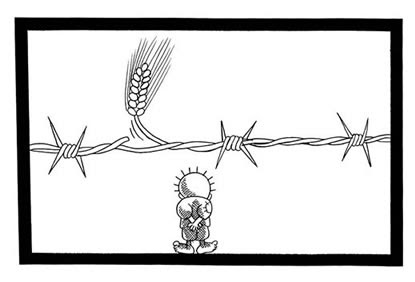
Who is Handala, the barefoot, spiky-haired boy who symbolizes Palestinian resistance?
RAMALLAH, West Bank — His hair is like a hedgehog, his feet are bare, his clothes are rags and his back is to the world always. His name is Handala.
A character created by Palestinian newspaper cartoonist Naji al-Ali in 1969 — two years after the 1967 Arab-Israeli war — the boy known as Handala is a symbol of the Palestinian struggle and resistance to occupation to this day.
Who is Handala?
Handala is forever 10 years old — the age that Ali was when his family was forced to move during the mass displacement of Palestinians in 1948 when the state of Israel was formed. Palestinians and their supporters refer to that displacement as the Nakba, or Arabic for "catastrophe."
Ali's refugee boy character shares his name with a resilient, bitter plant that grows in the Middle East called handal. It has deep roots and will always grow back even if it's weeded out.
"This character represents insurgency, refusal and struggle," says Egyptian columnist Nadi Hafez of al-Qabas newspaper, where Ali worked for a long time. "And it satirizes the politics around the Palestinian cause, or the politics of the Arab world, or indeed international politics when it comes to the Palestinian cause."
Handala didn't turn his back to the reader until 1973, after the Yom
Kippur War, when a coalition of Arab countries led by Egypt and Syria
fought Israel in October of that year. At the time, there was a push by
countries including the U.S. for a settlement of the conflict. By
turning Handala's back to the world, Ali was expressing his rejection of
solutions from foreign nations imposed on Palestinians.... READ MORE https://www.npr.org/2024/02/06/1228097975/handala-naji-al-ali-cartoon-palestinian-symbol
 |
| Key- Universal Declaration of Human Rights & every refugee's inalienable right of return to original homes & lands |
 |


 |
...Universal Echo |
 |
Mahmoud Darwish 1941—2008 |
In the 1960s Darwish was imprisoned for reciting poetry and traveling between villages without a permit. Considered a “resistance poet,” he was placed under house arrest when his poem “Identity Card” was turned into a protest song. After spending a year at a university of Moscow in 1970, Darwish worked at the newspaper Al-Ahram in Cairo. He subsequently lived in Beirut, where he edited the journal Palestinian Affairs from 1973 to 1982. In 1981 he founded and edited the journal Al-Karmel. Darwish served from 1987 to 1993 on the executive committee of the Palestinian Liberation Organization. In 1996 he was permitted to return from exile to visit friends and family in Israel and Palestine.
Mahmoud Darwish’s early work of the 1960s and 1970s reflects his unhappiness with the occupation of his native land... READ MORE https://www.poetryfoundation.org/poets/mahmoud-darwish
Poet Naomi Shihab Nye commented on the poems in Unfortunately It Was Paradise: “[T]he style here is quintessential Darwish—lyrical, imagistic, plaintive, haunting, always passionate, and elegant—and never anything less than free—what he would dream for all his people.”
Mahmoud Darwish died in 2008 in Houston, Texas.
 |
| The Land and Love by Palestinian Ismail Shammout 1931-2006 |
 |
| Spring in Palestine by Ismail Shammout 1931-2006 |
Ismail Shammout was born in 1930 in Lydda – Palestine. During the Nakba of 1948, he and his family were forced out of their home during the assault of Jewish Zionist militant groups on their town. A long march on foot allowed them to settle in the refugee camps of Khan Younis in Gaza where he lived under very harsh conditions. In 1950 he managed to travel to Cairo to study arts from where he later earned a scholarship to study fine arts at the Accademia di Belle Arti in Rome. After he finished his studies, he moved to Beirut in 1959 where he married his fellow arts student from Cairo, the Palestinian artist Tamim El-Akhal (born 1935). Both lived and worked in Beirut until 1983 then moved to Kuwait, then to Germany and finally to Amman in 1994. Shammout died on July 3 rd 2006.
Shammout, who himself experienced expulsion and
refuge and accompanied later the birth of the Palestinian Revolution in
the 1960s, became since the very early days of his professional live
along with his partner Tamam El-Akhal the “artistic face” of the
Palestinian Freedom Struggle. He has been long recognized as Palestine’s
leading modernist painter. His experience of dispossession and the
memories of beloved Palestine, the dreams of return as well as the
dignity and pride of his people formed the soul of his entire art. The
simplicity of the themes and his outstanding artistic skills let his
works enjoy a widely spread popularity which significantly shaped modern
Palestinian Art. https://ismail-shammout.com/
 |
| Palestinian Poppies by Tamam Al-Akhal |

 |
| Holy Family in an Olive Grove by Sliman Mansour |
Sliman Mansour is one of the most distinguished and renowned artists in Palestine. His style embodies steadfastness in the face of a relentless military occupation. His work — which has come to symbolize the Palestinian national identity — has inspired generations of Palestinians and international artists and activists alike.
Born in 1947, Mansour spent his childhood around the verdant hills and fields of Birzeit — where he was born — and later his adolescence in Bethlehem and Jerusalem. These experiences left a significant mark on his work, heightening a sense of gradual loss in Palestine, especially after the occupation of the West Bank and Jerusalem in 1967. His early experiences also presented him with the symbols and images he would later use to preserve and highlight Palestinian identity.
Using symbols derived from Palestinian life, culture, history, and tradition, Mansour uniquely illustrates Palestinians’ resolve and connection with their land. His pieces epitomize art as a form of resistance. With orange trees, he represents land lost in the Nakba of 1948. With olive trees, he represents land occupied in 1967. With women wearing traditional embroidered dresses, he represents Palestinian land and the Palestinian revolution. With the landscape of Palestine and its stone terraces, he represents the mark of Palestinian farmers on the land. With images of Jerusalem and the glistening Dome of the Rock, he represents the Palestinian homeland and the dream of return.
Sliman Mansour’s art
deftly reflects the hopes and realities of a people living under
occupation for the better part of a century. Since the early 1970s, he
has translated his experiences of isolation, displacement, community,
and rootedness using imagery and symbols that have contributed to
developing an iconography of the Palestinian struggle. Paintings such as
“Jamal al-Mahamel” (Camel of Hardships or Camel of Burdens) — with its
iconic porter whose heavy and precious load is the Jerusalem that all
Palestinians yearn for — were made into posters, cards, and stickers.
Such images were popularized in direct defiance of Israeli military
authorities, who frequently confiscated artwork and posters and closed
exhibitions and galleries. https://slimanmansour.com/about-the-artist-sliman-mansour/
 |
| An architectural marvel and a sacred Islamic site, the Dome of the Rock in Jerusalem signifies the religious and historical continuity of the Palestinian identity in the face of shifting global landscapes. |
 |
| Fact based maps |
 |
| Palestinian Cuisine https://www.tasteatlas.com/best-rated-dishes-in-palestine |
Olive oil, herbs, and spices like sumac and za'atar are staples in Palestinian cooking
The Key
The key is a poignant symbol of the right of return for Palestinian refugees. It represents the homes left behind during the Nakba, and the enduring hope of return to their ancestral homes and villages.


 |
| UNIVERSAL HUMAN RIGHTS |
Israeli forces have now dropped more explosives in Gaza than fell on London, Dresden, and Hamburg during the Second World War. The region’s hospitals have not been spared; most are no longer functional. Clayton Dalton writes about the devastation in The New Yorker .
 |
The view from the destroyed emergency department at Al-Shifa Hospital, in northern Gaza.Photographs and videos by the author |
Hospitals in Ruins
Doctors are delivering lifesaving care in a ravaged health-care system—and risking their own lives in the process.
".... Nasser had been the site of a major attack in February, 2024, when the Israeli military—the I.D.F.—shelled the hospital, cut off its power and oxygen, and raided the building. A doctor told CNN that he was strip-searched. “We are completely besieged,” he said. “We have been without electricity, oxygen, heating, barely any food or water.” Gaza’s health ministry reported that a dozen patients died as a result of the attack; the World Health Organization warned that “further disruption to lifesaving care for the sick and injured would lead to more deaths.”
The I.D.F. told a different story. It said that at Nasser it had found
weapons, in addition to medicines meant for Israeli hostages. It also
claimed that it had apprehended hundreds of suspected terrorists,
including some who had allegedly posed or worked as medical staff. “The
operational activity was conducted to ensure minimal disruption to the
hospital’s ongoing activities and without harming patients and medical
staff,” an I.D.F. statement said. “The IDF will continue to operate in
accordance with international law against the Hamas terrorist
organization, which systematically operates from hospitals.” At Gaza’s
thirty-six hospitals, this dynamic has played out again and again. The
I.D.F. has justified the bombing and raiding of hospitals, potential war
crimes, by accusing Hamas of war crimes: turning medical centers into
“terror hubs” and hiding behind civilian infrastructure. But Israeli
officials rarely provide enough evidence for news outlets and
international organizations to verify their claims. Hamas has denied
using health-care facilities for military purposes...." READ MORE https://www.newyorker.com/magazine/2025/04/28/hospitals-in-ruins?utm_brand=tny&utm_social-type=owned
Israeli forces have now dropped more explosives in Gaza than fell on London, Dresden, and Hamburg during the Second World War. The region’s hospitals have not been spared; most are no longer functional. Clayton Dalton writes about the devastation.
[AS ALWAYS PLEASE GO TO THE LINK TO READ GOOD ARTICLES (or quotes) IN FULL: HELP SHAPE ALGORITHMS (and conversations) THAT EMPOWER DECENCY, DIGNITY, JUSTICE & PEACE... and hopefully Palestine, or at least fair and just laws and policies]
"“They were shouting at me, threatening to rape me, chanting ‘death to Arabs’. I thought the police would protect me from the mob, but they did nothing to intervene,” she said."
Mob of Orthodox Jewish men chases woman after protest at Brooklyn synagogue
Woman, who requested anonymity, says ‘a group of 100 men’ followed her, shouting threats and kicking her
A Brooklyn woman said she feared for her life as she was chased, kicked, spit at and pelted with objects by a mob of Orthodox Jewish men who mistook her as a participant in a protest against Israel’s far-right security minister.
The assault, recorded by a bystander, unfolded on Thursday near the global headquarters of the Chabad Lubavitch movement in Crown Heights, where an appearance by Itamar Ben-Gvir set off clashes between pro-Palestinian activists and members of the neighborhood’s large Orthodox Jewish community.
The woman, a neighborhood resident in her 30s, told the Associated Press she learned of the protest after hearing police helicopters over her apartment. She walked over to investigate around 10.30pm but by then the protest had mostly dispersed. Not wanting to be filmed, she covered her face with a scarf.
“As soon as I pulled up my scarf, a group of 100 men came over immediately and encircled me,” said the woman, who spoke to the AP on the condition of anonymity because she feared for her safety.
“They were shouting at me, threatening to rape me, chanting ‘death to Arabs’. I thought the police would protect me from the mob, but they did nothing to intervene,” she said.
As the chants grew in intensity, a lone police officer tried to escort her to safety. They were followed for blocks by hundreds of men and boys jeering in Hebrew and English.
Video shows two of the men kicking her in the back, another hurling a traffic cone at her head and a fourth pushing a trash can into her. “This is America,” one of the men can be heard saying. “We got Israel. We got an army now.”... READ MORE https://www.theguardian.com/us-news/2025/apr/28/mob-orthodox-jewish-men-chases-woman
[AS ALWAYS PLEASE GO TO THE LINK TO READ GOOD ARTICLES (or quotes) IN FULL: HELP SHAPE ALGORITHMS (and conversations) THAT EMPOWER DECENCY, DIGNITY, JUSTICE & PEACE... and hopefully Palestine]
UNWRA Aid is ready to be brought into Gaza, just waiting for the crossings to reopen. Basic supplies meant for people in need are expiring while on the other side starvation deepens. UNRWA has nearly 3,000 trucks of lifesaving aid waiting. The siege imposed by the Israeli authorities must be lifted.

Monday, April 28, 2025
From our cousins in Jordan: With profound sorrow and deep sadness, we bid farewell to His Holiness Pope Francis, who throughout his life was a beacon of giving and love. He embodied humility, championed humanity, and tirelessly advocated for peace, both in word and in deed. He was a defender of the weak, an unwavering voice for truth, and a relentless seeker of justice for the poor and the oppressed... May the gentle soul of beloved Pope Francis Rest in Peace.
Farewell Papa Francis.
It is with great sadness and deepest sorrow that we bid farewell to His Holiness Pope Francis, who in his life embodied the meaning of giving and love, an example of humility, overcoming humanity and calling for peace in word and deed.
With his departure, he left us a lofty spiritual stature, carrying the banner of peace and dignity in a troubled world. Support the weak, adhere to speak the word of truth, and seek justice for every poor and oppressed.
His holiness was a voice for the suffering of children in war and conflict zones, he was their advocate, raising his voice in defense of their innocence and their right to live safely in peace and dignity.
His Holiness Pope Francis, who loved Jordan and his ministry in 2014, left a profound impact on the hearts of Jordanians who loved and respected him. In Jordan, the land of messages, he found a loving shelter and meeting with his lovers from different sides of the society, always carrying the messages of peace, justice and mercy.
With the departure of his holiness, the world loses the voice of a living conscience, and a great humanity, but his message will remain immortal, a beacon of truth, mercy and love.
Rest in peace, Pope Francis
Rest in Peace Pope Francis
With profound sorrow and deep sadness, we bid farewell to His Holiness Pope Francis, who throughout his life was a beacon of giving and love. He embodied humility, championed humanity, and tirelessly advocated for peace, both in word and in deed. He was a defender of the weak, an unwavering voice for truth, and a relentless seeker of justice for the poor and the oppressed.
With his passing, the world bids farewell to a towering spiritual figure who carried the banner of peace and dignity in a conflicted and volatile world.
His Holiness was a steadfast voice for children in conflict zones, a defender of their innocence, and a tireless advocate for their right to live in safety, peace, and dignity.
Pope Francis, who held Jordan dear to his heart and honored it with his visit in 2014, left an indelible mark on the hearts of Jordanians, who reciprocated his love and respect. In Jordan, the land of holiness and prophets, his message was full of affection and love, embracing people from all walks of life, and carrying with him always the messages of peace, justice, and mercy.
With the passing of His Holiness, the world loses a vivid and honest voice of conscience and a monumental humanitarian figure. Yet his message will endure — a lasting beacon of truth, compassion, and love.
May the gentle soul of beloved Pope Francis Rest in Peace.
